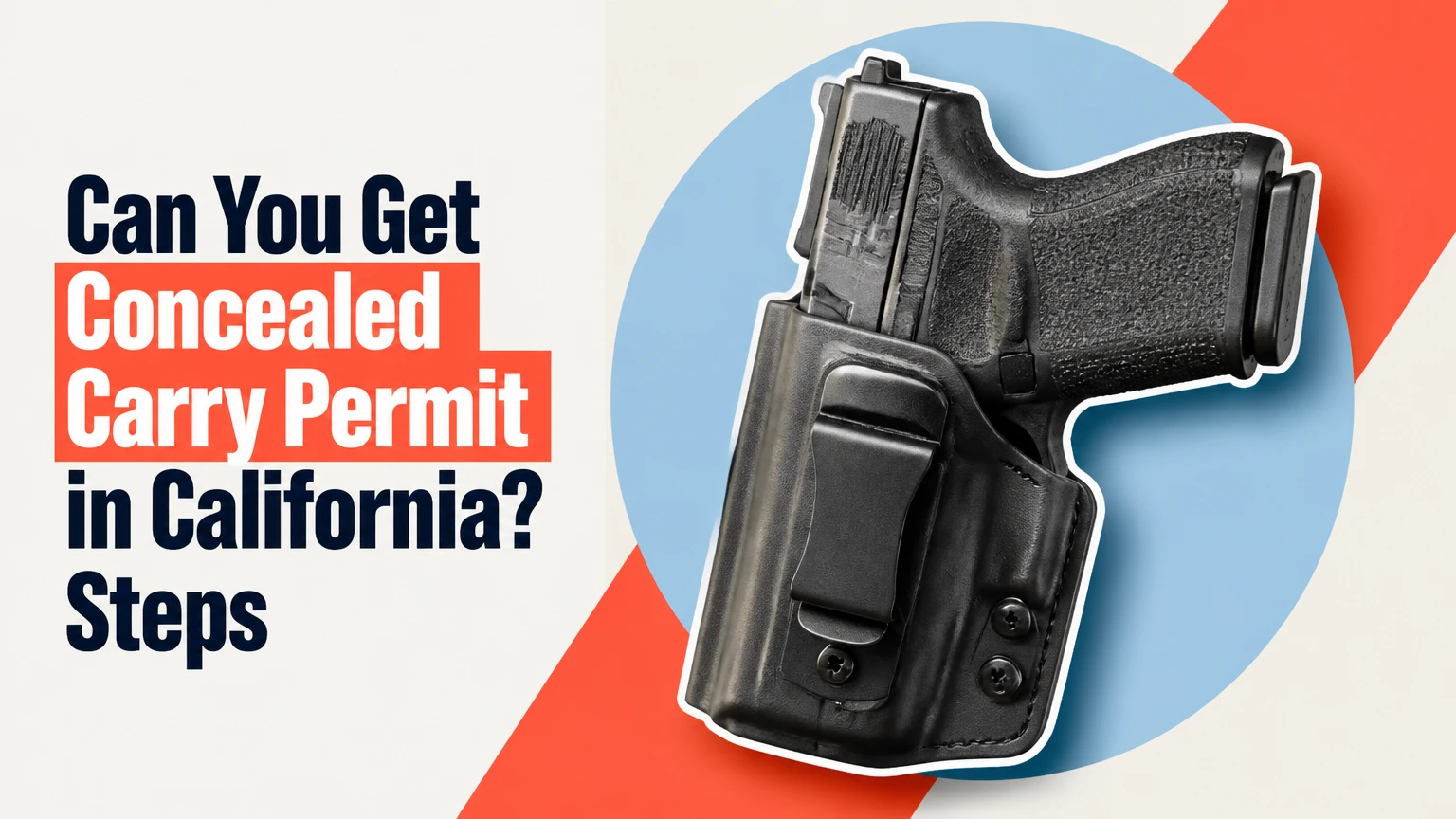
Yes, you can get a concealed carry permit in California if you meet the state and local licensing requirements. A California Concealed Carry Weapon permit generally requires qualifying age, lawful eligibility, good moral character, residency or qualifying employment, background checks, approved training, and live-fire qualification.
Key facts at a glance
California CCW applications usually go to the county sheriff or an eligible city police chief.
California generally requires applicants to be at least 21, legally eligible to possess firearms, and of good moral character.
An initial California CCW course must generally include at least 16 hours of approved instruction, plus firearm qualification.
A permit identifies the handguns authorized for carry by make, model, caliber, and serial number.
Typical first-time costs often total about $500-$900, excluding attorney fees and unusual investigation expenses.
California does not automatically recognize concealed-carry permits issued by other states.
Can You Get Concealed Carry Permit in California?
A California CCW permit is available to a qualifying resident, and certain employment-based or judicial applicants may qualify under separate statutory categories. The permit does not issue merely because an applicant completes a class; the licensing authority must still verify firearm eligibility, character, identity, residency or employment, and compliance with local procedures.
The Supreme Court’s 2022 decision in New York State Rifle & Pistol Association v. Bruen rejected a requirement that ordinary applicants prove a special “good cause” or unusual safety threat. California still may evaluate “good moral character” and statutory disqualifications. Those are different questions: the first concerns whether an applicant must show an exceptional need, while the second concerns whether the applicant is legally and factually suitable.
The practical result is a structured eligibility process, not automatic approval. Local agencies may require an online application, interview, Live Scan, references, psychological screening where authorized or used by the agency, training, and range qualification.
Is California a shall-issue state?
California operates under a statutory framework that generally requires issuance when an eligible applicant satisfies the legal requirements, but “shall issue” does not mean every applicant receives a license. A licensing authority can deny an application for prohibited-person status, insufficient moral character, false statements, failure to meet training standards, or another statutory ground.
Bruen described the Second Amendment as protecting the right to carry a handgun publicly for self-defense, but the decision did not eliminate objective licensing requirements. California’s post-Bruen system therefore removed the special-threat requirement while retaining background, training, and permit-administration rules.
Who Is Eligible for a California CCW?
A typical California CCW applicant must be at least 21, legally permitted to possess firearms, a resident of the licensing jurisdiction or otherwise eligible under an employment category, and able to satisfy the agency’s good-moral-character determination. A local agency also checks records that applicants sometimes assume are irrelevant because a case was dismissed or old.
Common eligibility barriers include:
- A felony conviction or another firearm-prohibiting conviction.
- Certain misdemeanor convictions, including offenses that trigger firearm prohibitions.
- An active domestic-violence restraining order.
- A qualifying mental-health prohibition or disqualifying commitment.
- Unlawful firearm possession or unresolved ownership records.
- False statements, material omissions, or contradictory answers.
- Current probation, parole, or court restrictions.
- Conduct that the licensing agency considers inconsistent with good moral character.
A traffic citation is not automatically a firearm prohibition. It may still matter to an agency’s review if the application asks about citations, arrests, driving conduct, or repeated violations. The safest practice is to obtain the exact wording of every application question and answer completely, rather than guessing which records “count.”
Where do you apply?
A resident generally applies to the county sheriff or to the police chief of the city in which the applicant resides, depending on the agency’s authority and local policy. The California Department of Justice provides statewide forms and regulatory information, but it does not usually process the ordinary resident application for the applicant.
Start with the official website of the county sheriff and city police department. Confirm:
- Whether the city police chief accepts resident applications.
- Whether the agency uses Permitium or another portal.
- Which proof-of-residency documents it accepts.
- Whether references, psychological testing, or an interview are required.
- Which instructors and ranges satisfy local rules.
- The agency’s current fee schedule and payment sequence.
A person who lives in an incorporated city should not assume the sheriff is the only option. A person who works in another county should not assume employment eligibility follows the same process as resident eligibility.
What Does a California CCW Permit Authorize?
A California CCW permit authorizes the permit holder to carry a concealed handgun in public, subject to California law, the permit’s listed firearms, the issuing agency’s conditions, and location-specific restrictions. The license is not a general authorization to carry any weapon or any firearm the holder happens to own.
The handgun must normally be fully concealed from ordinary public view. California’s general rules do not turn a CCW permit into a broad open-carry license, and local conditions may impose additional requirements concerning holsters, ammunition, storage, or conduct.
A listed-firearm requirement is especially important. Agencies typically record each authorized handgun by its make, model, caliber, and serial number. Carrying an unlisted handgun can create a permit violation even when the holder lawfully owns that handgun.
Which firearms can you list?
The exact firearms allowed depend on state law, the applicant’s lawful ownership or registration evidence, and the licensing agency’s written policy. Many agencies limit the number of handguns listed, often to a local maximum such as three, but the number is not uniform statewide.
| Firearm or modification issue | Typical requirement | Practical consequence |
|---|---|---|
| Make and model | Must match the application and permit record | A similar model is not automatically interchangeable |
| Caliber | Must be recorded accurately | Carrying a different caliber may violate permit terms |
| Serial number | Must be legible and correctly entered | Photograph and verify the frame or receiver marking |
| Ownership or registration | Agency may require DOJ-record evidence or lawful-transfer documents | A privately acquired firearm may need additional documentation |
| Optics and accessories | Local policy may restrict lasers, mounted devices, or modifications | Obtain written approval before qualification |
| Number of firearms | Common local caps range from 3-5, but policies vary | Choose carry guns before booking qualification |
California firearm-law details can change, and a local agency may impose a condition that is stricter than a private instructor’s marketing page. Ask the issuing agency, not only the training provider, whether a particular handgun or modification may be listed.
How Do You Apply for a California CCW?
Most applicants complete the process in seven practical stages: select the correct licensing agency, submit the application, complete fingerprinting and investigation, attend the interview, complete approved training, qualify with each listed handgun, and receive final approval. The sequence varies by county, so follow the agency’s instructions when it schedules steps differently.
Step 1: Confirm the licensing agency
Use your physical residence, not a mailing address, business preference, or a nearby county with a shorter queue, to identify the normal licensing authority. Gather a California driver license or identification card, proof of residence, firearm information, and any records needed to explain prior contacts with law enforcement.
Checkpoint: The agency website confirms that it accepts your application category.
Common mistake: Applying to a city or county where you own property but do not actually reside.
Step 2: Submit the application accurately
Complete the California DOJ application and any local supplements. Typical submissions request identity information, addresses, employment, criminal history, firearm details, references, and declarations concerning prohibited-person status.
Read every question literally. If a local form requests arrests, citations, restraining orders, or contacts with law enforcement, do not omit an event because charges were dismissed, sealed, expunged, or resolved years ago. Ask the agency how it wants uncertain records documented, and consult a California firearms attorney when the answer could affect eligibility.
Checkpoint: Save the submitted application, confirmation number, attachments, and payment receipt.
Common mistake: Allowing a spouse, instructor, or application service to provide an answer you have not personally verified.
Step 3: Complete Live Scan fingerprinting
The agency normally directs the applicant to an approved California Live Scan provider. Fingerprints support California Department of Justice and, where applicable, FBI and other records checks.
Bring the correct agency ORI code and completed Live Scan paperwork. A fingerprint appointment cannot correct a wrong application, and a technically successful scan may still be unusable if the agency code or applicant category is incorrect.
Checkpoint: Retain the Live Scan form and transaction number.
Common mistake: Completing fingerprints before the agency supplies the correct form or before confirming whether the agency wants them at that stage.
Step 4: Attend the background interview
An investigator may review application answers, references, employment, residence, firearm ownership, court records, and discrepancies. Publicly available online conduct may also become relevant when it contradicts an application or raises a documented safety concern, but applicants should not assume that ordinary political expression alone is a disqualifier.
Answer directly and correct mistakes promptly in writing. A new disclosure is usually less damaging than a discovered omission that appears intentional.
Checkpoint: You know whether the agency has requested additional records or an amended answer.
Common mistake: Treating the interview as a casual conversation and speculating instead of saying that you need to verify a date or record.
Step 5: Complete approved training
California law generally requires at least 16 hours of training for an initial license. The curriculum typically covers firearm safety, storage, handling, legal restrictions, permissible use of force, and practical exercises; the agency may prescribe approved providers or additional subjects.
Training is not a substitute for legal advice about a specific incident. A class can explain general self-defense principles, but it cannot determine whether a future use of force is legally justified from incomplete facts.
Checkpoint: The instructor gives you a completion certificate accepted by your licensing agency.
Common mistake: Taking a course in another state and assuming California will accept it.
Step 6: Qualify with each listed handgun
The applicant must generally demonstrate safe handling and pass the agency’s live-fire qualification for each handgun to be listed. California does not use one universal range target or score for every issuing authority, so confirm the course of fire, distance, minimum score, ammunition, and firearm limits in advance.
| Application component | Typical figure | What changes locally |
|---|---|---|
| Initial classroom training | At least 16 hours | Curriculum, instructor approval, scheduling |
| Renewal training | Often 8 hours | Statutory updates and agency procedure |
| Handgun qualification | Each listed handgun | Distance, target, rounds, passing score |
| Firearms listed | Often 3-5 maximum | Agency policy and permit capacity |
| Training cost | About $200-$350 | Instructor, range, ammunition, county |
| Range and ammunition cost | About $50-$100 | Firearm count and local prices |
Checkpoint: The instructor or agency records a passing result for every firearm.
Common mistake: Qualifying with a backup handgun and later carrying the primary handgun that was never added to the permit.
Step 7: Pay final fees and collect the license
After the investigation, interview, training, and qualification are complete, the agency may collect remaining issuance fees and produce a physical or electronic permit, depending on its current system. Inspect the card immediately for name, expiration date, firearm entries, and conditions.
Checkpoint: Every carried firearm matches the permit exactly, and the expiration date is entered into a calendar.
Common mistake: Assuming approval by email means the applicant may carry before the license is issued and effective.
How Much Does a California CCW Cost and How Long Does It Take?
A typical first-time California CCW application costs approximately $500-$900 before legal representation, replacement documents, extra range sessions, or travel. A straightforward case may take several months, while agency backlogs, incomplete records, delayed Live Scan results, or limited interview appointments can extend the process substantially.
| Cost category | Typical range | When paid |
|---|---|---|
| Local application and issuance fees | $100-$300 | Initial and final stages, agency dependent |
| Live Scan and records checks | $90-$130 | Fingerprinting appointment |
| Initial training course | $200-$350 | Before or after investigation, locally determined |
| Ammunition and range fees | $50-$100 | Qualification session |
| Psychological evaluation | $150-$250 where required | Agency-specific |
| Possible total | $500-$900+ | First-time application |
California statutes include processing expectations for licensing agencies, but an applicant should not treat a stated statutory period as a guaranteed end-to-end delivery date. The clock may depend on whether the application is complete, whether records are returned, and whether the agency needs additional information.
How long is the permit valid?
A standard license is commonly valid for two years, while employment and judicial licenses use different statutory periods. Verify the expiration date printed on the issued permit because legislative changes, permit category, and agency implementation can affect duration.
Begin renewal several months before expiration. Do not assume that a renewal is merely a shorter new application: renewal training, fingerprinting, fees, firearm qualification, and local forms can differ from initial requirements.
What Locations Restrict a California CCW Holder?
A California CCW holder must check state law, federal law, permit conditions, posted private-property rules, and current court orders before carrying into a location. Sensitive-place restrictions have been heavily litigated after Senate Bill 2, so online summaries can become outdated while an injunction or appellate order changes enforcement.
Potentially restricted locations may include schools, courthouses, government buildings, polling places, airports, secure transportation areas, hospitals, sports venues, bars, and other locations identified by statute or permit condition. Federal facilities and certain federal properties are controlled by federal law, which a California permit cannot override.
Private businesses create a separate issue. A property owner may prohibit firearms through a clearly communicated policy or sign, and a permit holder who ignores that rule may face removal, trespass consequences, or a permit issue even when the underlying carry statute is disputed.
Use a location checklist:
- Identify whether the property is state, local, federal, school, or private.
- Check the current statute and official agency guidance.
- Look for posted restrictions at the entrance.
- Confirm whether the firearm must be secured before entering.
- Never carry into a screening area, courthouse, or airport sterile zone without specific legal confirmation.
Because SB 2 litigation has changed the practical analysis, verify current rules through the California Attorney General, the issuing agency, and a current California firearms lawyer when a location is important.
What Are California’s CCW Permit Types?
California commonly distinguishes resident, employment, judicial, and nonresident categories, but ordinary applicants most often pursue a resident license. The category determines the licensing authority, proof required, validity period, and geographic or employment connection.
| Permit category | Typical applicant | Common validity | Main limitation |
|---|---|---|---|
| Resident license | Resident of the county or issuing city | 2 years | Must maintain qualifying residence |
| Employment license | Person whose qualifying work connection is in the jurisdiction | 90 days under the statutory category | Employment-related eligibility and scope |
| Judicial license | Eligible judge, magistrate, or court commissioner | 3 years under the statutory category | Restricted applicant class |
| Nonresident license | Eligible out-of-state applicant under current law and agency process | Verify with issuing agency | Availability and local implementation vary |
Nonresident applicants should not infer that every California county accepts applications from visitors. Confirm that the relevant statutory pathway is active, that the county accepts the application category, and that California training, Live Scan, residency or travel evidence, and local conditions apply.
Does California Recognize Out-of-State CCW Permits?
California generally does not recognize a concealed-carry permit issued by another state. A visitor who carries a concealed handgun in California must independently satisfy California’s carry law, and an out-of-state license does not replace a California license.
California’s permit may be recognized by other states, but reciprocity is state-specific and can change. Before traveling, check the destination state’s official attorney general or state police guidance for permit recognition, firearm type, magazine, vehicle, notification, and sensitive-place rules.
| Travel question | California answer | Action |
|---|---|---|
| Out-of-state permit valid in California? | Generally no | Follow California carry law |
| California permit valid elsewhere? | Depends on destination state | Check official reciprocity rules |
| Firearm listed on California permit valid everywhere? | No | Destination law controls |
| Carry through an airport? | Secure-area restrictions apply | Follow TSA and airport rules |
| Carry into federal property? | California permit is insufficient | Check federal law |
Is a CCW Better Than Transporting a Firearm or Carrying Pepper Spray?
A California CCW is the only option in this comparison that generally permits concealed public carry of a loaded listed handgun, but it also carries training, cost, storage, legal, and location restrictions. Locked transport is simpler for moving a firearm to a lawful destination, while pepper spray avoids firearm licensing but provides different capabilities and limitations.
| Option | Typical cost | Carry condition | Main advantage | Main limitation |
|---|---|---|---|---|
| California CCW | $500-$900+ first time | Concealed, listed handgun, legal location | Public defensive carry authority | Training, restrictions, renewal |
| Locked unloaded transport | $0 permit cost | Unloaded in locked container or trunk, subject to law | Useful for lawful transportation | Not ready for immediate use |
| Pepper spray | $10-$50 | Lawful possession and use | No CCW application | Range, wind, and deployment limits |
| No-permit handgun carry | Varies | Generally unlawful concealed carry | No administrative process | Significant criminal exposure |
Pepper spray is not a legal substitute for a firearm in every emergency, and a firearm is not a legal substitute for location research or safe storage. Choose according to the actual objective: transportation, deterrence, or lawful public carry.
What Commonly Causes a CCW Denial?
The most preventable denial problem is an incomplete or inconsistent application, especially when the applicant omits an arrest, restraining order, substance-related event, or other record that the agency later finds. A disclosed old incident can be evaluated; an unexplained omission can become evidence of dishonesty or poor judgment.
Frequent failure points
- Using the wrong jurisdiction: Applying based on a mailing address, second home, or workplace without confirming authority.
- Mismatching records: Listing a charge under the wrong date, court, or disposition.
- Ignoring firearm prohibitions: Assuming a dismissed case or expired order has no legal effect.
- Choosing an unapproved class: Completing training before confirming agency acceptance.
- Qualifying with the wrong gun: Carrying a handgun that is absent from the final permit.
- Missing location restrictions: Treating a permit as permission to enter every public building or business.
- Waiting until expiration: Starting renewal after the existing license has lapsed.
If denied, read the written reason and deadline first. Some issues can be corrected through an agency reconsideration process; others may require a statutory administrative hearing, court review, or a new application after a disqualification ends. A denial involving criminal history, mental-health records, domestic violence, or disputed facts warrants advice from a California attorney who handles firearms licensing.
What Should You Do Before Applying?
Before applying for a California CCW, confirm jurisdiction, firearm eligibility, records, training requirements, and the complete fee schedule. A two-hour preparation review can prevent weeks of delay when an agency rejects an attachment, identifies a record discrepancy, or requires a qualification with a firearm that was not originally documented.
Prepare this file:
- California identification and current residence evidence.
- Application confirmation and payment records.
- Complete court dispositions for arrests or convictions.
- Restraining-order and probation documents, if applicable.
- Make, model, caliber, and serial number for each proposed handgun.
- Written confirmation of accepted instructors and ranges.
- Live Scan paperwork with the correct agency code.
- A renewal calendar set at least 120 days before expiration.
A practitioner rule is to photograph each firearm’s markings before submitting the application, then compare the permit card against those photographs at issuance. Serial-number transpositions are easy to make and difficult to discover after a range qualification.
California CCW FAQ
Can a California resident carry a handgun in a vehicle without a CCW?
A California resident may transport a handgun under specific unloaded-and-locked-container rules, but that is different from carrying a loaded concealed handgun for immediate access. Vehicle exceptions depend on the exact facts, firearm, destination, and statutory provision, so use a locked container and verify the current law rather than treating the car as a general carry exemption.
Do you need a registered handgun for a California CCW?
The issuing agency generally requires the handgun to be lawfully owned and identified on the permit by make, model, caliber, and serial number. Registration or ownership documentation can be complicated after private transfers, inherited firearms, or older purchases, so obtain the agency’s document list before attempting qualification.
Can a person under 21 obtain a California CCW?
A standard California CCW applicant generally must be at least 21. Federal firearm restrictions and specific statutory exceptions can affect unusual situations, but an applicant under 21 should not rely on a private instructor’s interpretation. Confirm eligibility with the licensing authority or a qualified attorney before paying application or training fees.
Can a California CCW holder carry into a bar?
A California CCW does not create a blanket right to carry into a bar or other alcohol-serving venue. Alcohol-related restrictions, sensitive-place statutes, permit conditions, and private-property rules may apply simultaneously. Check the current statute and local guidance before entering, especially because California location rules and SB 2 litigation have changed.
What happens when a California CCW expires?
An expired California CCW no longer provides current permit authority. The former holder must follow the lawful transport and possession rules that apply without a valid license, then complete the issuing agency’s renewal process. Begin at least several months early because training, fingerprinting, investigation, and appointment delays can prevent uninterrupted renewal.
Can you add another handgun after receiving the permit?
Many California agencies allow a permit holder to request an amendment or add a handgun, but the process, fee, qualification requirement, and firearm limit are local. Do not carry the additional handgun until the agency has approved and recorded it on the permit. A private range qualification alone does not amend the license.
The Bottom Line
You can get a concealed carry permit in California, but approval requires more than completing a firearm class. Apply through the correct sheriff or police chief, disclose records accurately, complete Live Scan and the required training, qualify with every handgun you intend to carry, and verify sensitive-place and private-property restrictions before carrying.
California law, SB 2 litigation, agency procedures, fees, and reciprocity rules can change. For a pending criminal, domestic-violence, mental-health, or ownership issue, obtain individualized advice from a California firearms attorney and confirm the current rules with the issuing agency.