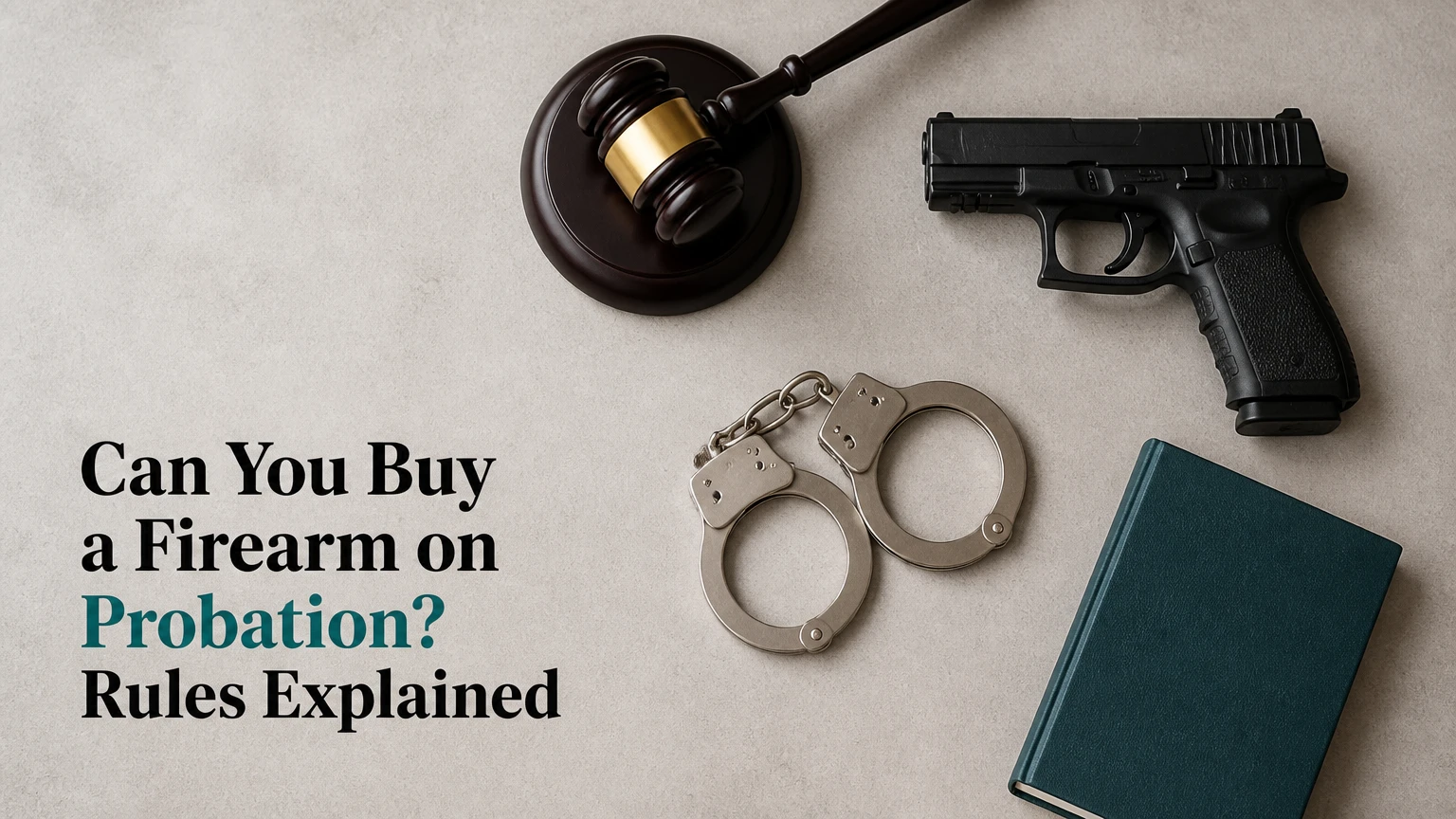
In the United States, probation alone does not create one universal federal ban on buying a firearm, but purchasing or possessing one may still be illegal because of the conviction, a probation condition, state law, or another federal disability. A person on probation should read the sentencing order and obtain jurisdiction-specific advice before attempting a purchase or handling a firearm.
Key facts at a glance
A felony conviction punishable by more than one year generally prohibits firearm possession under 18 U.S.C. § 922(g)(1), subject to statutory definitions and litigation.
A qualifying misdemeanor domestic-violence conviction can prohibit firearm possession under 18 U.S.C. § 922(g)(9), even when the sentence involved probation.
A probation order may ban firearms more broadly than federal law, including firearms, ammunition, weapons, or access to another person’s gun.
An approved NICS check does not override a probation condition or state firearm restriction.
A private transfer does not make it lawful for a prohibited person to receive or possess a firearm.
Completing probation does not automatically restore every firearm right or guarantee an immediate background-check approval.
Does probation automatically ban firearms?
Probation is not itself a single, nationwide federal firearm disability. The legal result comes from four separate sources: the underlying conviction, the precise probation or supervision order, federal restrictions, and the law of the state where the person lives or receives the firearm.
The common advice that “anyone on probation is federally barred” is too broad. Federal law generally focuses on the person’s conviction or status, while courts and probation departments may impose independent conditions that prohibit ownership, possession, access, or ammunition. A state can also impose restrictions that are stricter than federal law.
A written condition might say that the supervised person may not “own, possess, use, purchase, receive, or have access to” a firearm, ammunition, destructive device, or dangerous weapon. Another order may prohibit only firearms. The wording matters, and informal probation does not necessarily mean the person has no enforceable conditions.
Federal courts illustrate the difference. The United States Courts’ standard post-conviction supervision materials describe a firearm condition that bars possession of a “firearm, ammunition, destructive device, or other dangerous weapon.” Federal probation and state probation are not interchangeable, however, so a federal supervision condition cannot be assumed in a state case.
Which federal laws can block a firearm purchase?
Federal law can prevent a firearm transaction when the buyer is prohibited from receiving or possessing firearms, even if the person is not currently incarcerated. The main provisions include 18 U.S.C. § 922(d), § 922(g), and § 922(n), along with the questions on ATF Form 4473.
| Federal rule | Person or conduct covered | Practical consequence |
|---|---|---|
| 18 U.S.C. § 922(g)(1) | Conviction for a crime punishable by imprisonment exceeding one year, subject to statutory exceptions | Firearm receipt and possession are generally prohibited |
| 18 U.S.C. § 922(g)(9) | Qualifying misdemeanor crime of domestic violence | Firearm receipt and possession are generally prohibited |
| 18 U.S.C. § 922(n) | Person under indictment for a crime punishable by imprisonment exceeding one year | Receiving a firearm is prohibited while the indictment is pending |
| 18 U.S.C. § 922(d) | Seller transfers a firearm to a person known or reasonably believed to be prohibited | Seller may commit a federal offense |
| 18 U.S.C. § 922(a)(6) | Material false statement connected with acquiring a firearm from a dealer | False information can create a separate federal prosecution risk |
Section 922(g)(1) is commonly described as the “felon-in-possession” rule, but the statutory language is more precise than the label. It generally covers a person convicted of a crime punishable by more than one year, while excluding certain state misdemeanors punishable by two years or less and addressing other exceptions in the statute.
A probation sentence can therefore accompany a conviction that creates a federal disability. The sentence label, such as “probation,” does not erase the maximum punishment attached to the offense.
Can you buy a firearm on probation for a felony?
A person on probation after a qualifying felony conviction generally cannot lawfully receive or possess a firearm under § 922(g)(1). Probation does not suspend the federal disability; the relevant question is whether the conviction falls within the statute and whether an effective restoration or exception applies.
The prohibition normally applies to possession, not merely retail purchasing. A person can violate federal law by holding a gun, keeping it in a vehicle, storing it in an accessible bedroom, or exercising control over a firearm that another person technically purchased.
Completion of probation also does not automatically remove the federal disability. Federal law can continue to apply after the supervision term ends unless the conviction has been eliminated or the person’s firearm rights have been restored in a legally effective way. The availability and effect of expungement, set-aside relief, pardon, or civil-rights restoration depend on the conviction and jurisdiction.
A state restoration order may not resolve every federal issue. The wording of the order, the state’s restoration process, the type of conviction, and current federal law all matter. A firearms attorney should review the actual judgment rather than rely on the charge’s common name.
Can you buy a firearm on misdemeanor probation?
A misdemeanor on probation requires classification by offense, jurisdiction, and supervision terms. A non-domestic misdemeanor may not trigger the same federal prohibition as a qualifying felony, but a probation order or state law can still forbid firearm possession during supervision.
| Case situation | Federal issue | Probation or state issue | Safer legal conclusion |
|---|---|---|---|
| First-time DUI, no violence | Usually no automatic § 922(g)(1) disability from the misdemeanor alone | Order may prohibit weapons during supervision; state law may add restrictions | Do not buy or possess until the order is reviewed |
| Misdemeanor domestic violence | § 922(g)(9) may prohibit receipt and possession | State protective orders or conditions may add restrictions | Treat firearm possession as prohibited unless counsel confirms otherwise |
| Simple theft misdemeanor | Federal result depends on statutory punishment and conviction details | Court conditions can prohibit firearms or weapons | Read the judgment and supervision conditions |
| Misdemeanor with a pending felony indictment | § 922(n) can prohibit receiving a firearm | Probation, bond, and state restrictions may also apply | Do not receive a firearm while the indictment remains pending |
Section 922(g)(9) applies only when the conviction meets the federal definition of a misdemeanor crime of domestic violence. The relationship, force element, and conviction record can determine whether the federal disability applies. A domestic-violence label in a police report is not identical to a qualifying conviction, but a person should not assume the rule does not apply.
What do probation conditions actually prohibit?
Probation conditions can prohibit conduct that federal law would otherwise allow. A court may restrict firearm possession as a supervision condition, and violating that condition can lead to a violation hearing, stricter conditions, or revocation even if prosecutors cannot prove a separate federal firearm offense.
Check every document, including the judgment, sentencing memorandum, probation contract, deferred-adjudication order, plea agreement, and later modification. Look for terms such as “possess,” “own,” “purchase,” “receive,” “use,” “carry,” “access,” “ammunition,” “dangerous weapon,” or “firearm.”
A probation officer’s informal statement is not a substitute for a written court order. A probation officer may explain how an existing condition is administered, but an officer generally cannot authorize conduct that federal or state law independently prohibits. Only the court or legally authorized restoration process can modify a court condition.
Does ammunition count as possession?
Ammunition can be prohibited separately from a firearm. Many supervision orders expressly list ammunition, and federal law also restricts ammunition possession by people covered by certain firearm disabilities.
The practical mistake is treating an unloaded firearm as harmless. A person who cannot possess a firearm may also face a separate issue with cartridges, magazines, or ammunition stored in the same accessible location. Read the exact order before handling, transporting, or storing any of these items.
What happens when you buy from a licensed dealer?
A purchase from a Federal Firearms Licensee usually involves ATF Form 4473 and a NICS background check, but the paperwork does not decide every probation question. The dealer submits identifying information for the background check, and the FBI or a state point of contact returns a proceed, delay, or denial under the applicable system.
Form 4473 asks about several disqualifying conditions, including certain convictions, indictment status, domestic-violence convictions, restraining orders, unlawful controlled-substance use, and other prohibited categories. The form must be answered truthfully. A person should never interpret an ambiguous question alone when a criminal defense or firearms attorney can review the facts.
| Transaction result | Meaning at the dealer | What it does not mean |
|---|---|---|
| Proceed | Background-check system found no blocking record at that time | It does not cancel probation conditions or guarantee state-law compliance |
| Delay | More research is needed before the transaction can proceed | It is not proof that the buyer is legally eligible |
| Denial | System identified a disqualifying record or unresolved prohibition | It does not always explain which record caused the denial |
| Appeal or challenge | Buyer contests an incorrect denial or record match | It does not authorize possession while the appeal is pending |
The Bureau of Alcohol, Tobacco, Firearms and Explosives Form 4473 instructions warn that a person who answers “yes” to a disqualifying question, or falsely answers “no,” can face criminal consequences. A dealer proceeding with a transaction would not make a false answer lawful.
Do private sales or online transfers avoid the restriction?
A private sale may avoid a dealer-run NICS check in some jurisdictions, but it does not allow a prohibited person to receive or possess a firearm. Federal law also prohibits a seller from transferring a firearm to someone the seller knows, or has reasonable cause to believe, is prohibited.
Online listings generally do not create a special legal category. A firearm ordered online is commonly shipped to an FFL in the buyer’s state, where the transfer requires the dealer’s process. State laws may require background checks for private transfers, impose waiting periods, require permits, or regulate transfers between residents.
Using a spouse, friend, or relative as the buyer can create a straw-purchase problem. The key question is who actually intends to acquire the firearm. The Supreme Court’s decision in Abramski v. United States (2014) confirmed that the actual purchaser’s identity matters on Form 4473, even when the intended recipient could theoretically own a firearm.
Can someone on probation live with a gun owner?
A person on probation may be able to live in a home where another adult lawfully owns firearms, but the arrangement becomes dangerous when the supervised person can access or control the guns. Storage reduces risk; it does not automatically eliminate a probation violation or resolve a state-law issue.
| Household arrangement | Access-control detail | Risk assessment |
|---|---|---|
| Locked safe, owner-only key | Combination, biometric profile, and backup key unavailable to probationer | Lower practical risk, subject to the written order |
| Locked case in shared closet | Probationer knows the key location or combination | High access concern |
| Unloaded firearm with ammunition nearby | Both items remain reachable | High possession and supervision concern |
| Owner’s locked vehicle in shared garage | Probationer can use the vehicle or retrieve the firearm | Fact-specific, potentially serious |
| Firearm carried by the owner | Probationer never handles or controls it | Lower risk, but court conditions may be broader |
Constructive possession is fact-specific. Prosecutors may examine access, knowledge, control, statements, fingerprints, storage arrangements, and the person’s relationship to the premises. A gun safe is not a legal shield if the probationer has the code or routinely controls the safe.
The best practical arrangement uses an owner-only safe, no shared key, no shared combination, no firearm transport by the probationer, and written confirmation from counsel that the arrangement does not conflict with supervision terms. Some probation orders prohibit access regardless of how carefully a gun is stored.
What should you do before attempting a purchase?
Use a document-first process rather than testing the background-check system. The objective is to determine legal eligibility before a firearm enters your possession.
- Collect the complete case file. Obtain the judgment, charging document, plea agreement, probation conditions, discharge order if applicable, and any protective order.
- Identify the conviction category. Confirm whether the offense was a felony, a state misdemeanor, a domestic-violence misdemeanor, or a deferred disposition that has special treatment.
- Check current supervision status. “Informal,” “non-reporting,” or “administrative” probation can still have enforceable conditions.
- Ask counsel to analyze federal and state law. A local criminal defense or firearms attorney should compare the record with § 922(g), § 922(n), state law, and the order’s exact language.
- Get written clarification or modification when needed. Do not rely on a verbal assurance from a store employee, friend, or probation officer.
- After discharge, verify records before a transaction. Obtain certified completion documents and correct inaccurate state or federal records before attempting an FFL transfer.
A typical attorney consultation may cost about $200-$500, while a contested rights-restoration petition often costs roughly $1,500-$5,000 or more, depending on the state, hearing requirements, and record complexity. These are practitioner ranges, not fixed legal fees.
What if probation has ended but NICS denies you?
A completed probation term does not guarantee an immediate “proceed” response. Court clerks, state repositories, and federal databases can update at different times, and an old conviction or incomplete disposition can produce a delay or denial after discharge.
Start by requesting the written denial information from the dealer and obtaining certified court records. The FBI NICS appeal process can address an incorrect denial, while the FBI Voluntary Appeal File may help eligible people reduce repeated misidentification problems. Those procedures do not restore rights that remain legally restricted.
| Post-probation problem | Document to obtain | Appropriate next action |
|---|---|---|
| Court record shows open probation | Certified discharge or termination order | Ask the clerk and reporting agency to correct the disposition |
| Conviction still appears without restoration | Restoration, pardon, expungement, or set-aside order | Have counsel determine whether the order has federal effect |
| Name or date-of-birth mismatch | Certified identity and case records | File the applicable NICS appeal or identity challenge |
| State permit database is outdated | State agency confirmation and court disposition | Request state correction before another transfer attempt |
| Denial reason is unclear | Dealer denial information and NICS instructions | Follow the official appeal process, not repeated purchases |
Do not submit repeated applications merely hoping one will pass. Repeated attempts can create additional records and do not cure an unlawful possession problem.
What legal alternatives exist during supervision?
A person who cannot possess a firearm can improve home safety without acquiring a weapon. Common alternatives include professionally monitored alarms, reinforced strike plates, exterior lighting, cameras, panic buttons, and non-firearm defensive tools that state law permits.
Pepper spray and electronic defense devices are not legal everywhere, and some probation orders prohibit “weapons” broadly enough to cover them. Confirm both state law and supervision conditions before buying or carrying any defensive device. A home-security upgrade can cost less than a rights-restoration petition and creates no firearm-transfer record.
What is the main expert mistake to avoid?
The most dangerous mistake is treating a background-check result as a legal opinion. NICS evaluates accessible records and statutory disqualifiers; it does not read every probation contract, interpret every state restriction, or certify that a household storage arrangement complies with a judge’s order.
A second mistake is focusing only on ownership. Firearm law and probation enforcement often turn on receipt, access, control, transport, ammunition, and statements, not on whose name appears on a sales receipt.
A third mistake is assuming that discharge paperwork equals restoration. Discharge proves that supervision ended; it may not remove a qualifying conviction-based federal disability.
How are firearm rights restored after probation?
Rights restoration is jurisdiction-specific and begins with the underlying conviction, not the probation end date. Some people may qualify for expungement, set-aside relief, pardon, or state civil-rights restoration; others remain prohibited unless a legally effective remedy becomes available.
The process commonly follows this sequence:
- Confirm discharge. Obtain the signed termination or discharge order and verify that no unpaid condition, pending case, or protective order remains.
- Analyze the conviction. Determine the offense level, maximum punishment, domestic-violence elements, plea type, and whether state law treats the disposition as a conviction.
- Identify an available remedy. A state court petition, governor’s pardon, certificate, or federal remedy may have different eligibility rules and effects.
- Obtain a certified order. Keep the filed order, docket entry, and proof of finality.
- Allow reporting agencies to update. State updates may take weeks or longer; there is no universal 30-90-day guarantee.
- Challenge inaccurate records. Use the relevant state correction process and FBI NICS appeal procedures.
- Get a final legal review. Confirm that federal, state, and local law all permit receipt and possession before attempting a transfer.
A pardon or expungement is not automatically effective for every federal firearms question. The legal effect can depend on whether civil rights were restored, whether the order expressly addresses firearms, and whether federal law recognizes the state disposition.
What are the consequences of an unlawful purchase?
An attempted purchase can create several separate problems: a probation violation, a false Form 4473 answer, unlawful receipt or possession, a prohibited transfer by the seller, and a new state offense. The exact penalties depend on the statute, conduct, criminal history, and jurisdiction.
A denial alone is not always proof that a crime occurred. A person should preserve the denial paperwork and obtain counsel rather than argue with the dealer or make new statements. If a firearm was already received or handled, stop handling it and seek immediate legal advice about lawful safekeeping or transfer.
Do not ask another person to buy a firearm for your intended use. Do not conceal a conviction, indictment, domestic-violence order, or controlled-substance issue on Form 4473. Do not transport a household member’s firearm to “prove” that you never owned it.
FAQ
Can a probation officer give permission to buy a gun?
A probation officer generally cannot override a federal or state firearm disability. An officer may clarify or recommend a modification of supervision conditions, but only the court or an applicable rights-restoration process can change a court order. Obtain written legal advice before relying on any permission.
Can you buy a gun after misdemeanor probation ends?
Possibly, but the answer depends on the misdemeanor, domestic-violence status, state law, and any continuing order. A nonqualifying misdemeanor may not create a federal ban, while a qualifying domestic-violence conviction can continue to prohibit receipt and possession after probation ends.
Can you own a gun if probation was deferred adjudication?
Deferred adjudication is highly jurisdiction-specific. Some federal analyses treat the disposition as a conviction, while others depend on whether a formal judgment was entered and how the governing statute defines conviction. Review the plea documents, dismissal terms, and state law before buying or possessing a firearm.
Does a probation violation automatically take away gun rights?
A probation violation can lead to revocation or new conditions, but it does not automatically create every federal firearm disability. The new conduct, resulting conviction, existing order, and applicable state law determine the effect. A firearm-related violation can create especially serious exposure.
How long after probation can you buy a firearm?
There is no universal waiting period after probation. Legal eligibility may exist immediately after discharge for some people, while others remain prohibited for years or permanently unless rights are restored. Record updates can take weeks or longer, so obtain certified documents and legal clearance first.
What should you do if a dealer denies the transfer?
Request the denial information, stop attempting additional purchases, and compare the record with your certified court documents. If the denial is incorrect, use the FBI NICS appeal process and any state correction procedure. An appeal cannot authorize possession when the underlying prohibition is valid.
The Bottom Line
Can you buy a firearm on probation? Sometimes probation itself is not the federal prohibition, but attempting a purchase without reviewing the conviction, written supervision conditions, state law, and other federal disabilities is unsafe and potentially unlawful. A qualifying felony or domestic-violence conviction can prohibit possession beyond probation, while a probation order can impose a broader temporary ban. Read the actual order, consult a lawyer in the relevant jurisdiction, and resolve any record or restoration issue before receiving or handling a firearm.