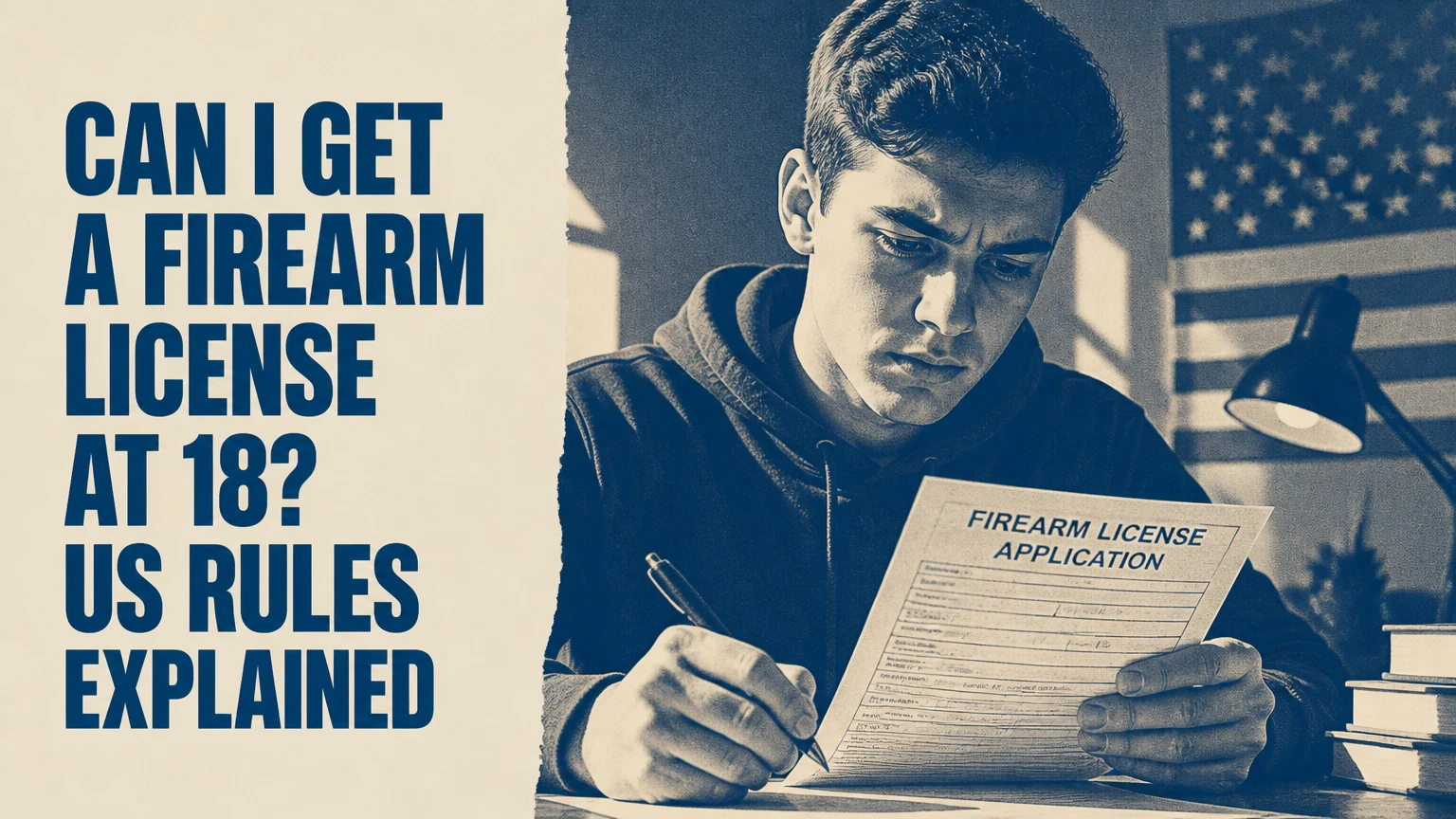
You may be able to get a firearm license at 18, but no single US firearm license has one national age rule. Federal law generally allows a licensed dealer to sell an 18-year-old a rifle or shotgun, while a dealer cannot sell that person a handgun until age 21; state licensing, possession, transfer, and carry laws can be stricter.
Key Facts at a Glance
Federal firearms dealers may generally sell rifles and shotguns to eligible buyers aged 18 or older.
Federal firearms dealers may not sell handguns to buyers younger than 21.
Federal law does not create one general firearm ownership license for every US resident.
States may require a FOID card, FID card, purchase permit, registration, or carry license.
A private transfer, family gift, possession, and dealer sale follow different legal rules.
An 18-year-old must satisfy federal and state disqualifiers regardless of age eligibility.
Can I Get a Firearm License at 18 in the United States?
An 18-year-old can apply for some firearm-owner or firearm-purchaser credentials in the United States, but eligibility depends on the state and the credential’s purpose. A state may allow a person to possess a long gun at 18 while setting a higher age for a handgun purchase, concealed-carry license, or license to purchase.
The phrase “firearm license” creates the first legal problem. Federal law usually regulates dealers, transfers, prohibited persons, and firearms categories, whereas states decide whether residents need an identification card or purchase permit. Illinois uses a Firearm Owner’s Identification card, Massachusetts uses separate firearm credentials, and many states require no general ownership card.
Federal law is the baseline, not the complete answer. The Bureau of Alcohol, Tobacco, Firearms and Explosives, or ATF, states: “A person who is at least 18 years of age may purchase a rifle or shotgun from a Federal firearms licensee.” That statement applies to an eligible transaction under federal law, not every transaction in every state.
What does firearm license mean?
A firearm license can mean an owner-identification card, a permit to purchase, a registration document, a concealed-carry license, or a license required for a particular activity such as hunting. These credentials are legally different and may have different minimum ages, training requirements, and restrictions.
| Credential type | Typical legal function | Common age issue |
|---|---|---|
| FOID card | Possession and acquisition eligibility in Illinois | Applicants aged 18-20 may need parental consent |
| FID card | Limited firearm possession and acquisition in Massachusetts | Long-gun access differs from handgun licensing |
| Purchase permit | Approval for a specific firearm transaction | Some states set separate handgun and long-gun ages |
| Concealed-carry license | Carrying a concealed firearm in public | Many states set the minimum at 21 |
| Hunting license | Participation in regulated hunting | Does not itself authorize unlawful possession or carry |
A license is not a universal permission slip. It does not override prohibited-person rules, location restrictions, safe-storage requirements, waiting periods, or private-transfer laws.
Can an 18-Year-Old Buy a Rifle or Shotgun?
An eligible 18-year-old can generally buy a rifle or shotgun from a federally licensed dealer under federal law. The buyer must complete ATF Form 4473, present acceptable identification, pass the required background-check process, and comply with any state waiting period, permit, training, or minimum-age rule.
The federal dealer rule covers “long guns,” a category that generally includes rifles and shotguns. It does not mean every long gun is lawful. A rifle with prohibited features, a short-barreled rifle regulated under the National Firearms Act, or a firearm restricted by state law can require additional analysis.
At a gun store, the dealer checks the buyer’s age and identity before contacting the FBI’s National Instant Criminal Background Check System, or NICS, where applicable. An 18-year-old can be denied for the same federal disqualifiers that apply to older adults, including certain felony convictions, qualifying domestic-violence convictions, fugitive status, unlawful controlled-substance use, and certain court orders.
Which states add stricter age or permit rules?
Several states impose rules that are stricter than the federal dealer minimum, and those rules change through legislation and litigation. California, Florida, Hawaii, Illinois, New York, Washington, and other jurisdictions may impose additional age, permit, waiting-period, or transfer restrictions, but the exact rule differs by firearm type and transaction.
Do not rely on a generic “states allowing 18-year-olds” list. Check the current statute and the issuing agency’s instructions for the state where the buyer lives and the dealer operates. A state may allow an 18-year-old to possess a hunting rifle yet prohibit a dealer from selling that person a particular semiautomatic rifle or require a purchaser card first.
Can an 18-Year-Old Buy a Handgun?
An 18-year-old cannot buy a handgun directly from a federally licensed dealer because federal law bars FFL dealers from selling handguns to people under 21. That federal dealer rule does not automatically answer whether the person may possess a handgun or receive one through a lawful private transfer, because state law can impose a separate age-21 prohibition.
The distinction between dealer purchase and possession matters. Federal law generally prohibits a licensed dealer from selling or delivering a handgun to someone under 21, while federal law does not impose the same universal age-21 rule on every private transfer between unlicensed residents. However, the transfer must be lawful, the recipient must not be prohibited, and state law may require a dealer, permit, background check, waiting period, or minimum age.
An interstate private transfer generally must go through an FFL in the recipient’s state under federal law. A parent who buys a handgun from a dealer while intending to transfer it to an 18-year-old may also create a straw-purchase problem if the dealer transaction falsely identifies the parent as the actual buyer.
| Transaction scenario | Federal starting point | Main additional question |
|---|---|---|
| 18-year-old buys handgun from FFL | Dealer sale prohibited under 21 | State law may also prohibit possession |
| 18-year-old receives genuine in-state gift | May be possible under federal rules | State age, transfer, and registration rules apply |
| Parent buys handgun at dealer for child | Risk of false-buyer transaction | Was the parent the real buyer and lawful owner? |
| Private interstate handgun transfer | Usually routed through recipient-state FFL | Recipient state’s age and permit rules control |
| 18-year-old possesses handgun at home | Not automatically prohibited by federal age-21 dealer rule | State possession and storage rules still control |
A genuine gift is not the same as a purchase made on someone else’s behalf. The intent, money, statements on Form 4473, transfer route, and state law can determine whether the transaction is lawful.
Can an 18-Year-Old Carry a Concealed Firearm?
An 18-year-old can carry a concealed firearm only where the applicable state law allows that person to do so, either through a permit or under a permitless-carry rule. Many states set concealed-carry license eligibility at 21, while some allow 18-20-year-olds to carry under limited statutes, military provisions, court decisions, or permitless-carry laws.
A concealed-carry license is separate from an ownership card. The application may require residency, fingerprints, a background check, a safety course, a live-fire qualification, and a lawful purpose, although requirements vary sharply. A permit also does not authorize carry in every location.
Court decisions have affected some 18-20 age restrictions, but a court ruling in one state does not automatically change the law nationwide. Before carrying, verify the current statute, attorney-general guidance, licensing-agency rules, prohibited locations, vehicle rules, and recognition of permits from other states.
What is the difference between possession and carry?
Possession means having control of a firearm under circumstances allowed by law. Carry means transporting or having the firearm on or about the person, and concealed carry adds a separate public-visibility and licensing issue.
| Activity | Typical controlling rule | Why age 18 may not settle it |
|---|---|---|
| Keeping a rifle at home | State possession and storage law | Household access and prohibited-person rules apply |
| Hunting with a shotgun | Hunting and firearm law | Hunter education and season rules may apply |
| Transporting a handgun in a vehicle | State transport and storage law | Loaded and concealed definitions differ |
| Carrying concealed in public | Carry permit or permitless-carry statute | Minimum age and prohibited places vary |
| Carrying on school property | Federal and state location restrictions | School zones often have separate offenses |
How Do You Apply for a Firearm License at 18?
An 18-year-old should first identify the exact credential, confirm the state’s age rule, complete required training, submit the application, and wait for the issuing authority’s decision. A typical application takes several weeks to several months, but the actual timeline depends on fingerprints, local workload, background records, and statutory processing rules.
Step 1: Identify the firearm and activity
Write down whether the goal is long-gun ownership, a handgun transfer, hunting, home possession, open carry, or concealed carry. The answer determines which agency, permit, age threshold, and background-check process applies.
Step 2: Check the issuing authority
Use the state police, attorney general, department of public safety, sheriff, or local police agency identified by state law. Confirm the current application form, residency requirement, fee, photograph specification, fingerprint vendor, training certificate, and appeal process.
Step 3: Complete required training
Where training is mandatory, use an instructor or course accepted by the issuing authority. Typical basic courses cost $50-$200 and take 4-16 hours, but a carry license may require classroom instruction, a live-fire qualification, or both.
Step 4: Submit accurate records
Applications commonly require government identification, proof of residence, fingerprints, photographs, and answers about criminal, mental-health, military, and protective-order history. A false answer can create a new criminal problem even when the applicant would otherwise qualify.
Step 5: Track the background check and decision
A dealer transaction normally uses Form 4473 and a NICS inquiry. Under the Bipartisan Safer Communities Act, NICS must conduct an enhanced review for some buyers aged 18-20, including checks involving juvenile records and state databases, which can produce additional delays.
The application succeeds when the agency issues the credential or the dealer receives a lawful approval. A delay is not the same as approval, and a state permit does not cure a federal prohibition.
How Much Do Permits and Licenses Cost?
Typical firearm-owner or purchase-permit costs range from $10-$150, while fingerprinting commonly adds $10-$50 and a required safety course often costs $50-$200. A concealed-carry application can cost more because training, fingerprinting, qualification, photographs, and renewal fees may be charged separately.
| Expense | Typical amount | Typical timing |
|---|---|---|
| Owner or purchase application | $10-$150 | Paid at filing |
| Fingerprints | $10-$50 | 15-30 minutes |
| Basic safety course | $50-$200 | 4-16 hours |
| Carry qualification course | $75-$300 | 1 day to 2 days |
| Processing period | No separate fee in many states | 30-90+ days |
These are typical planning figures, not legal fee schedules. The issuing agency’s current fee page controls, and some states waive fees for military applicants or charge different amounts for residents and nonresidents.
What Can Cause an 18-Year-Old’s Application or Purchase to Be Denied?
An 18-year-old can be denied because of a federal prohibition, a state prohibition, an incomplete application, an age-specific rule, or a records mismatch. Common federal categories include qualifying felony-level convictions, fugitivity, unlawful drug use, certain mental-health adjudications or commitments, qualifying domestic-violence convictions, and restraining orders meeting federal criteria.
The exact legal definition matters. A misdemeanor label does not always resolve whether a conviction qualifies, and a dismissed charge is different from a conviction. Juvenile records can also affect the enhanced 18-20 background review even when the applicant has no adult conviction.
How should you respond to a delay or denial?
Do not buy through another person, submit false information, or assume a delay means the transaction is permanently blocked. Ask the dealer or licensing agency for the transaction or application reference, follow the official appeal or NICS challenge procedure, and obtain legal advice when the record involves juvenile court, expungement, mental-health treatment, or domestic violence.
An incorrect record may be corrected through the FBI’s NICS appeal process or a state procedure. A state license denial and a federal dealer denial are separate events, so the correct appeal route depends on who made the decision.
Can a Parent Give a Firearm to an 18-Year-Old?
A parent may be able to make a lawful firearm gift to an 18-year-old, but the answer depends on residence, state transfer rules, the firearm type, and whether the recipient is legally eligible. A gift must be a genuine gift, not a disguised purchase funded or directed by the recipient.
Federal law generally requires an interstate firearm transfer to pass through an FFL in the recipient’s state. An in-state transfer may follow different federal and state procedures, but states such as Illinois and Massachusetts can require identification cards, permits, background checks, or other documentation.
The safest legal sequence is to confirm the transfer with the state authority or a firearms attorney before moving the firearm. Keep records of the transfer where lawful, follow storage requirements, and never use a false purchaser identity on Form 4473.
Can an 18-Year-Old Travel With a Firearm?
An 18-year-old may transport a firearm across state lines only if the origin, destination, route, vehicle conditions, and firearm type comply with applicable law. A carry permit from the home state may not be recognized elsewhere, and a state can regulate loaded firearms, ammunition placement, magazine capacity, and transport in vehicles.
The federal Firearm Owners Protection Act includes a safe-passage provision for certain interstate transportation when the traveler may lawfully possess the firearm at both endpoints and the firearm is unloaded, inaccessible, and transported in a locked container other than the glove compartment. The provision is not a universal travel license, and states may dispute its application.
| Travel factor | Safer federal transport principle | State-law variable |
|---|---|---|
| Firearm condition | Unloaded | Some states define “loaded” differently |
| Storage | Locked container, inaccessible | Trunk and passenger-compartment rules vary |
| Ammunition | Stored separately or securely | Location and quantity restrictions may apply |
| Endpoints | Lawful possession at origin and destination | Destination may prohibit the firearm |
| Carry permit | Does not guarantee recognition | Reciprocity and age rules differ |
A traveler should check every state on the route, not only the destination. Airports, schools, federal buildings, military installations, and posted private property can create additional restrictions.
How Do Other Countries Handle Firearm Licensing at 18?
Outside the United States, firearm licensing at 18 depends on national law, firearm class, purpose, residency, training, and police approval. The US federal dealer distinction between long guns at 18 and handguns at 21 should not be exported to another country.
Canada, Australia, the United Kingdom, Bangladesh, and New Zealand use different licensing structures and eligibility tests. Some require a firearms license before possession, some separate sporting firearms from restricted firearms, and some impose age thresholds above 18 for particular categories.
| Country | Licensing structure | Age-18 caution |
|---|---|---|
| Canada | Possession and Acquisition Licence, with firearm classifications | PAL rules differ by firearm class and minor exemptions |
| Australia | State or territory firearms license | Genuine reason, registration, storage, and category rules apply |
| United Kingdom | Firearm Certificate or Shotgun Certificate | Police assessment, suitability, storage, and firearm category control |
| Bangladesh | Government firearm licensing system | Current statutory age and policy must be confirmed locally |
| New Zealand | Firearms licence system | Endorsements and fit-and-proper assessment can apply |
Bangladesh-specific age figures circulated in summaries should be checked against the current government rules and licensing office. A social-media post or secondary article is not enough to establish the present legal threshold.
Which Legal Path Fits Your Goal at 18?
The appropriate path depends on the activity, not simply on the desire to own a gun. A hunter may need a hunting license and lawful long-gun access, while a person seeking public defensive carry must separately satisfy carry rules, training requirements, and location restrictions.
| Goal | Likely legal focus | Common barrier at 18 |
|---|---|---|
| Target shooting | Range rules, long-gun purchase, transport | State permit or range age policy |
| Hunting | Hunting license, hunter education, season rules | Youth hunting and firearm category limits |
| Home possession | Ownership, storage, transfer, prohibited-person rules | State handgun or purchase restrictions |
| Concealed carry | Carry license or permitless-carry law | Minimum age often 21 |
| Armed security work | Employer, licensing, firearm, and carry rules | Occupational license may require higher age |
An 18-year-old seeking home protection should not assume a shotgun is automatically legal or appropriate. Storage, household access, training, safe handling, and local discharge rules affect the risk profile. A firearm is also not a substitute for a lawful emergency plan, secure storage, and professional instruction.
Practitioner rules that prevent expensive mistakes
- Treat “license” as an undefined term until the agency names it. An FOID card, purchase permit, and carry license authorize different legal acts.
- Check the transfer method before choosing the firearm. Dealer sale, private transfer, family gift, and interstate shipment have different rules.
- Verify the law on the transaction date. Age restrictions and carry rules change through legislation, agency guidance, and court orders.
- Separate possession from public carry. A person can lawfully possess a firearm at home and still commit an offense by carrying it concealed.
- Use official sources for the final decision. Start with ATF and the state licensing authority, then consult a firearms attorney for a disputed record or unusual transfer.
Frequently Asked Questions
Can I own a handgun at 18 if I cannot buy one from a dealer?
Possibly, but federal dealer-sale restrictions and possession rules are different. A lawful private transfer or genuine gift may be available under federal law, while state law can prohibit possession, require a permit, impose an age-21 rule, or require an FFL. Verify both the transfer method and recipient state before accepting a handgun.
Does an FOID or FID card let me carry concealed?
No. An FOID or FID card generally addresses possession or acquisition eligibility, not concealed carry. Concealed carry may require a separate license, training, fingerprints, qualification, and age threshold, or it may be allowed without a permit under state law. Location restrictions still apply even when carry is authorized.
Can military service lower the minimum firearm age?
Military provisions can change eligibility in some states, but military status does not create a universal federal exception to the under-21 handgun dealer rule. A state may recognize active-duty status, military training, or a service credential for a permit. Read the exact state statute and agency instructions before relying on an exception.
Can an 18-year-old buy firearm ammunition?
Federal ammunition rules do not use exactly the same dealer age structure as firearm sales, but federal law generally prohibits licensed dealers from selling ammunition for firearms other than shotguns or rifles to people under 21, while allowing sales of rifle or shotgun ammunition at 18. State and local rules can be stricter.
What should I do if a dealer says my age is allowed but my state website disagrees?
Pause the transaction and obtain clarification from the state licensing authority. A dealer may be applying federal rules while the state website describes a permit or possession restriction. Ask for the relevant statute or agency guidance, and do not attempt a workaround through a friend, parent, or different state.
The Bottom Line
Yes, you may be able to get a firearm license at 18, but the answer depends on what “license” means, where you live, and whether you want to possess, purchase, receive, transport, or carry a firearm. In the United States, federal law generally permits eligible 18-year-olds to buy rifles and shotguns from licensed dealers, prohibits licensed dealers from selling them handguns until 21, and leaves many additional questions to state law. Check the current state authority before applying or accepting any transfer.