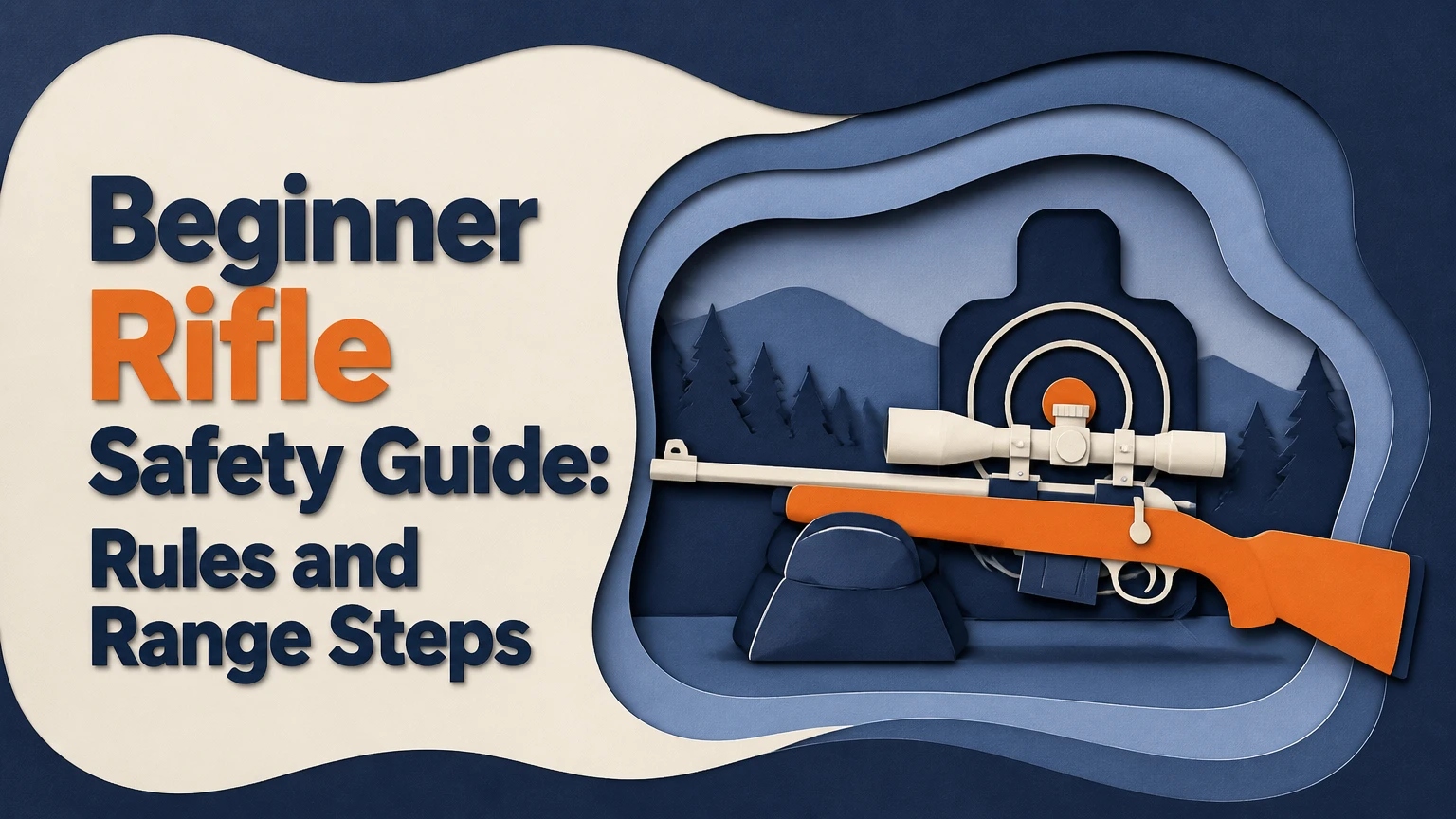
A beginner rifle safety guide teaches safe direction, trigger discipline, ammunition verification, action control, storage, and supervised range behavior before marksmanship. The essential standard is simple: keep the muzzle pointed in a safe direction, keep the trigger finger outside the guard, treat every rifle as loaded, and identify the target and what lies beyond it before any shot.
Key Facts at a Glance
- A rifle is a shoulder-fired firearm with spiral rifling inside the barrel that stabilizes its projectile.
- The four universal rules are loaded-gun treatment, muzzle control, trigger-finger discipline, and target-and-background verification.
- A rifle bullet can travel far beyond a visible target; a safe range requires a purpose-built backstop, not merely open land.
- Hearing protection should combine properly fitted earplugs and earmuffs because gunfire commonly exceeds 140 decibels.
- A beginner should use the exact owner’s manual and direct instruction for that rifle; actions, safeties, magazine systems, and unloading procedures differ.
- Never force a stuck cartridge, place a finger into a chamber, or resume firing after a weak or abnormal report.
What Is a Rifle and How Does It Work?
A rifle is a shoulder-fired firearm whose barrel contains spiral grooves called rifling. Rifling imparts spin to the projectile, which generally improves flight stability, but accuracy still depends on ammunition, barrel condition, sights, shooter technique, and environmental conditions.
Rifles commonly use rimfire or centerfire ammunition. In rimfire ammunition, the priming compound is distributed inside the cartridge rim. In centerfire ammunition, the primer sits in the center of the cartridge base. The distinction affects ammunition identification and mechanical design, but neither type is harmless when mishandled.
A repeating rifle typically cycles through feeding, chambering, locking, firing, unlocking, extraction, ejection, and cocking. A bolt-action rifle requires the shooter to operate the bolt manually. A semi-automatic rifle uses energy from firing to cycle the action, while a lever-action rifle uses a lever and a break-action rifle exposes the chamber by hinging the barrel or barrels.
The cycle does not make a rifle safe automatically. A rifle can contain a live cartridge when the magazine is removed, and some designs can fire if a safety is moved or damaged. Mechanical status must be verified by the operator.
What Are the Four Universal Rifle Safety Rules?
The four universal rifle safety rules are: assume the rifle is loaded, control the muzzle, keep the trigger finger straight and outside the trigger guard, and identify the target, firing line, and background. These rules remain necessary even when a person believes the rifle is unloaded.
- Treat every rifle as loaded. Verify condition rather than relying on someone’s statement, a previous inspection, or an empty magazine.
- Keep the muzzle pointed in a safe direction. At a range, that usually means downrange. During transport or movement, follow the range’s prescribed safe carry.
- Keep the trigger finger outside the trigger guard. The finger belongs high on the receiver or frame until the sights are on the intended target and firing is authorized.
- Know the target and what is beyond it. A target, paper sheet, or animal does not stop every projectile. The background must contain the projectile safely.
The National Shooting Sports Foundation summarizes the same principle in its firearm-safety guidance: “Always keep the muzzle pointed in a safe direction.” That rule is a physical control, not a suggestion about intention.
Which Safety Rule Prevents the Most Serious Error?
Muzzle direction provides the strongest last line of defense because an unintended discharge can only injure someone if the projectile is directed toward a person or an unsafe area. Trigger discipline and loaded-gun treatment prevent the discharge; muzzle control limits its consequences if prevention fails.
How Should a Beginner Prepare Before Handling a Rifle?
A beginner should begin with a certified instructor, the rifle’s current owner’s manual, appropriate eye and hearing protection, and a range with a defined firing line and engineered backstop. Typical preparation takes 30-60 minutes before live fire, excluding any required classroom course.
Before You Start
| Item | Typical requirement | Safety purpose |
|---|---|---|
| Formal instruction | 3-5 hours | Rules, law, handling, and range commands |
| Eye protection | 1 pair, impact-rated | Protects against fragments and ejected cases |
| Hearing protection | 1 plug set plus 1 earmuff set | Reduces impulse-noise exposure |
| Ammunition | Exact cartridge listed by rifle | Prevents chambering an incompatible round |
| Safe range | 1 certified facility | Provides firing-line controls and a backstop |
| Owner’s manual | 1 model-specific copy | Defines loading, unloading, and malfunction procedures |
Do not begin with ammunition on a table unless the instructor or range permits it. Keep the rifle action open when directed, leave the muzzle in the prescribed direction, and do not handle another person’s firearm without explicit permission.
Ammunition packaging must match the barrel or receiver marking exactly. Similar-looking cartridges can have different dimensions, pressures, or case designs. When the marking or cartridge identity is unclear, stop and ask a range officer or qualified gunsmith.
How Do You Safely Unload and Clear a Rifle?
To unload a rifle safely, maintain muzzle control, follow the model-specific manual, remove the ammunition source when appropriate, open the action, and have a qualified person verify the chamber and magazine area. Never insert a finger into the chamber; use visual and tactile inspection only as the manufacturer permits.
- Announce “unloading” or follow the range command.
- Keep the muzzle pointed downrange or in the facility’s verified safe direction.
- Keep the trigger finger outside the trigger guard.
- Engage the mechanical safety if the manual and range procedure require it.
- Remove the detachable magazine or empty the rifle’s ammunition source.
- Open the action using the rifle’s prescribed control.
- Lock the action open if the design permits.
- Visually inspect the chamber, bolt face, magazine well, and feed area.
- Have the instructor or range officer confirm the condition when you are learning.
- Insert a chamber flag if the range uses them and the action is compatible.
A chamber flag communicates an open-action condition to other people; it does not replace inspection. Some rifles cannot accept a generic flag safely, and a flag does not make a closed or loaded action safe.
What Should You Do If the Action Will Not Open?
If an action will not open, keep the muzzle pointed safely, keep everyone away from the muzzle and ejection port, and notify the range officer or instructor. Do not strike the bolt, pry the action, pull repeatedly on the trigger, or use a tool unless the manufacturer’s manual and a qualified professional specifically authorize the procedure.
How Should a Beginner Handle Live Fire?
A beginner should load and fire only under direct supervision, with the rifle pointed at an approved target and the range officer’s instructions understood. The correct sequence is to establish position, verify the target and backstop, load according to the manual, and place the finger on the trigger only when ready and authorized.
A safe live-fire workflow is:
- Confirm the range is open and the firing line is live.
- Point toward the backstop before manipulating the rifle.
- Use the exact ammunition approved for the rifle and range.
- Load only the quantity directed by the instructor or range.
- Keep the action and safety status consistent with the range command.
- Mount the rifle without sweeping people, vehicles, or adjacent firing points.
- Confirm the target, its frame, the backstop, and the area beyond it.
- Disengage the safety only when the sights are on the intended target and firing is permitted.
- Press the trigger deliberately without moving the muzzle.
- After firing, keep the muzzle downrange and wait for the next instruction.
The instructor should explain the specific safety selector, magazine release, bolt catch, lever, or break-action latch before ammunition is present. Generic instructions cannot safely substitute for a model-specific demonstration.
Which Rifle Action Is Best for a Beginner?
For supervised recreational target practice, a manually operated .22 LR rifle is often the simplest starting point because low recoil and inexpensive ammunition make basic handling easier. The best action still depends on the instructor, range rules, user strength, intended activity, and the specific model’s condition.
| Action type | Typical capacity | Beginner advantage | Important limitation |
|---|---|---|---|
| Bolt-action .22 LR | 1-10 rounds | Deliberate cycling and low recoil | Manual operation after each shot |
| Semi-automatic .22 LR | 10-25 rounds | Less manual cycling between shots | More controls and more complex clearing |
| Lever-action .22 LR | 10-15 rounds | Compact manual operation | Lever must be cycled safely and completely |
| Break-action single-shot | 1 round | Chamber is readily visible when open | Requires loading after every shot |
| Break-action double-barrel | 2 rounds | Simple open-and-inspect design | Limited capacity and model-specific controls |
A bolt-action rifle is not automatically safer than a semi-automatic rifle. A negligent muzzle movement or incorrect ammunition remains dangerous regardless of action type. Simplicity helps learning, but supervision and disciplined habits determine safety.
Is a .22 LR Rifle Suitable for Beginners?
A .22 Long Rifle is commonly suitable for supervised beginners because ammunition typically produces less recoil and costs less than centerfire rifle ammunition. It is still capable of causing fatal injury, and a .22 LR projectile can travel approximately 1-1.5 miles under unfavorable conditions, so the same backstop discipline applies.
What Do Rifle Safety Costs and Learning Times Look Like?
Typical beginner safety equipment costs $50-$150, while an entry-level .22 LR rifle commonly costs $250-$450 in the United States before taxes, transfer fees, and accessories. A basic safety course often takes 3-5 hours, followed by several supervised range sessions rather than unsupervised experimentation.
| Category | Typical range or time | Variables |
|---|---|---|
| Eye protection | $10-$40 | Impact rating, prescription needs |
| Plugs and earmuffs | $25-$100 | Fit, electronic features, durability |
| Lockbox or locking device | $15-$200+ | Construction, capacity, jurisdiction |
| .22 LR ammunition | Varies by market | Brand, availability, local regulation |
| Range visit | 1-2 hours | Lane rental, orientation, targets |
| Initial supervised practice | 2-4 sessions | Instructor access and learner confidence |
Gunfire commonly reaches or exceeds the 140-decibel level associated with immediate hearing-risk exposure. Foam plugs plus earmuffs provide redundancy, but no protector eliminates all risk if the devices fit poorly or the shooter stands near other firing points.
How Should a Rifle Be Stored and Transported?
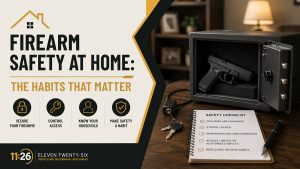
A rifle should be unloaded, secured against unauthorized access, and stored according to local law and the manufacturer’s instructions. Storage must account for children, visitors, roommates, theft risk, and anyone who should not access firearms.
Use a locked safe, lockbox, or approved locking device appropriate to the rifle. Store ammunition in a controlled location, follow jurisdictional requirements for separation or locking, and retain keys or access codes so unauthorized users cannot obtain them. Do not rely on a safety selector, a soft case, or hiding the rifle.
For transport, follow local law and range rules. Common requirements include an unloaded firearm, a closed case, and ammunition packaged separately, but requirements vary by jurisdiction. A transport rule is not a universal safety rule, so verify the destination and route before travel.
What Should You Do After a Click, Weak Report, or Jam?
After a click, weak report, delayed report, or abnormal recoil, keep the muzzle pointed safely, keep the finger outside the trigger guard, and wait for range-officer direction. A weak “pop” can indicate a squib, while a click can involve a misfire or delayed ignition; opening the action immediately may be unsafe on some firearms.
Squib or Abnormally Weak Report
Stop firing immediately. Keep the rifle pointed downrange and alert the instructor. Do not chamber another cartridge, because a projectile may be lodged in the bore and a subsequent shot can rupture the barrel or injure the shooter.
Only a qualified person should inspect and clear a suspected obstruction. Do not attempt to fire a projectile out of the bore.
Click With No Discharge
Keep the muzzle in a safe direction and follow the rifle manual and range procedure for a possible delayed ignition. Waiting periods differ by firearm, ammunition, and training authority, so a universal 30- or 60-second rule should not replace the manufacturer’s instructions or range command.
Do not look down the barrel, move the rifle toward another person, or place hands near the action while treating the cartridge as potentially capable of firing.
Failure to Feed, Extract, or Eject
Keep the muzzle downrange and stop manipulating the rifle if the cause is unclear. Notify the range officer rather than forcing the bolt, prying out brass, or using a screwdriver near a live cartridge.
A range officer may direct a model-specific clearance procedure. Double feeds, stuck cases, damaged extractors, and ammunition defects require different responses, so one generic “tap, rack” method is not appropriate for every rifle.
What Beginner Mistakes Cause Most Preventable Risk?
The most common preventable mistakes are muzzle sweeping, trigger contact during movement, incorrect ammunition, assuming a removed magazine means an empty chamber, and continuing after an abnormal shot. Each mistake combines a faulty assumption with a failure to pause.
- Muzzle sweeping: Keep the rifle pointed downrange during loading, unloading, conversation, and movement.
- Lazy trigger finger: Place the finger high on the receiver, not along the trigger guard.
- Magazine-only clearing: A removed magazine does not prove the chamber is empty.
- Visual complacency: Inspect the chamber and action as the model’s manual directs, then ask for confirmation while learning.
- Ammunition substitution: Never use a cartridge because it appears to fit.
- Distraction or impairment: Do not handle firearms after alcohol, recreational drugs, sedating medication, severe fatigue, or emotional distress.
- Peer pressure: Stop handling immediately if another person rushes, jokes, points a firearm, or ignores a range command.
A practitioner rule worth remembering is “slow hands, fixed muzzle.” Most beginner handling errors occur during transitions, not during the actual trigger press.
How Do Goals Change Beginner Rifle Safety?
Target shooters should prioritize supervised fundamentals and consistent range commands. Hunters need additional training in field carries, changing terrain, identifying game, unloading before climbing or crossing obstacles, and confirming the background beyond an animal.
Home defense introduces a different risk profile and should not be treated as ordinary range practice. Secure storage, access control, legal requirements, identification, communication, and professional instruction matter more than rapid-fire capability. A rifle kept for defense must remain inaccessible to unauthorized people while still being handled only within a lawful, trained plan.
| Goal | First training priority | Common additional risk |
|---|---|---|
| Paper target shooting | Range commands and chamber status | Complacency after repeated shots |
| Hunting | Identification and backstop assessment | Shooting through brush or across terrain |
| Rimfire practice | Ammunition and bore inspection | Underestimating projectile range |
| Home protection | Secure storage and legal instruction | Unauthorized access or mistaken identity |
| Youth supervised shooting | Instructor control and fit | Recoil, reach, and attention span |
A rifle is not a suitable choice merely because a cartridge has low recoil. Fit, control placement, safe storage, and competent supervision must all support the intended use.
When Should a Beginner Stop and Ask for Help?
A beginner should stop immediately when the rifle’s condition, ammunition identity, control operation, or range instruction is unclear. Asking a range officer is safer than guessing, and a qualified gunsmith should inspect damaged, modified, corroded, or malfunctioning firearms.
Stop before live fire if:
- The barrel appears obstructed.
- The cartridge marking does not match the rifle.
- The action, safety, trigger, or magazine behaves unexpectedly.
- The rifle has been dropped or struck.
- Ammunition is wet, corroded, dented, or otherwise damaged.
- The shooter cannot maintain muzzle and trigger control.
- The range officer gives a cease-fire command.
- Hearing or eye protection is missing or displaced.
No beginner should diagnose a mechanical failure by repeated trigger pulls. The safest troubleshooting step is controlled isolation, safe direction, and qualified assistance.
Beginner Rifle Safety Guide FAQ
How far can a rifle bullet travel?
A rifle projectile can travel far beyond a target. A .22 LR may travel approximately 1-1.5 miles, while some centerfire rifle cartridges can travel several miles under favorable conditions. Actual distance varies with cartridge, launch angle, projectile design, terrain, and wind. Every shot requires a reliable backstop.
Should beginners start with a bolt-action or semi-automatic rifle?
A manually operated .22 LR bolt-action rifle often makes a straightforward training platform because each shot requires a deliberate cycle and recoil is low. A semi-automatic rifle can also be appropriate under supervision, but its controls and malfunction procedures may require more instruction.
Do chamber flags make a rifle safe?
A chamber flag indicates an open action and helps range staff see firearm status. It does not replace unloading, chamber inspection, muzzle control, or safe storage. Use only a flag compatible with the rifle and the range’s written procedure.
Can a beginner practice rifle safety at home?
A beginner can study the owner’s manual and rehearse handling only under a strict, verified unloaded condition, with ammunition removed from the area and local law followed. Dry-fire is model-specific and should occur only after qualified instruction confirms that the rifle permits it without damage.
What hearing protection is best for rifle shooting?
Dual protection, consisting of correctly fitted earplugs and earmuffs, is the conservative choice for rifle shooting. Electronic earmuffs can help communication, but they do not remove impulse noise and must fit properly over or alongside the plugs.
What is the first rifle safety habit to build?
The first habit is keeping the muzzle pointed in a safe direction while keeping the trigger finger straight and outside the guard. Practice that pairing during every transition, including receiving, carrying, loading, unloading, clearing, and handing the rifle to another person.
The Bottom Line
A beginner rifle safety guide should produce repeatable behavior, not memorized vocabulary. Treat every rifle as loaded, control the muzzle, keep the trigger finger outside the guard, verify the target and backstop, use exact ammunition, follow the model manual, and ask a qualified instructor whenever the rifle’s condition is uncertain. Beginner rifle safety starts with supervised handling and continues through storage, transport, maintenance, and every future range session.