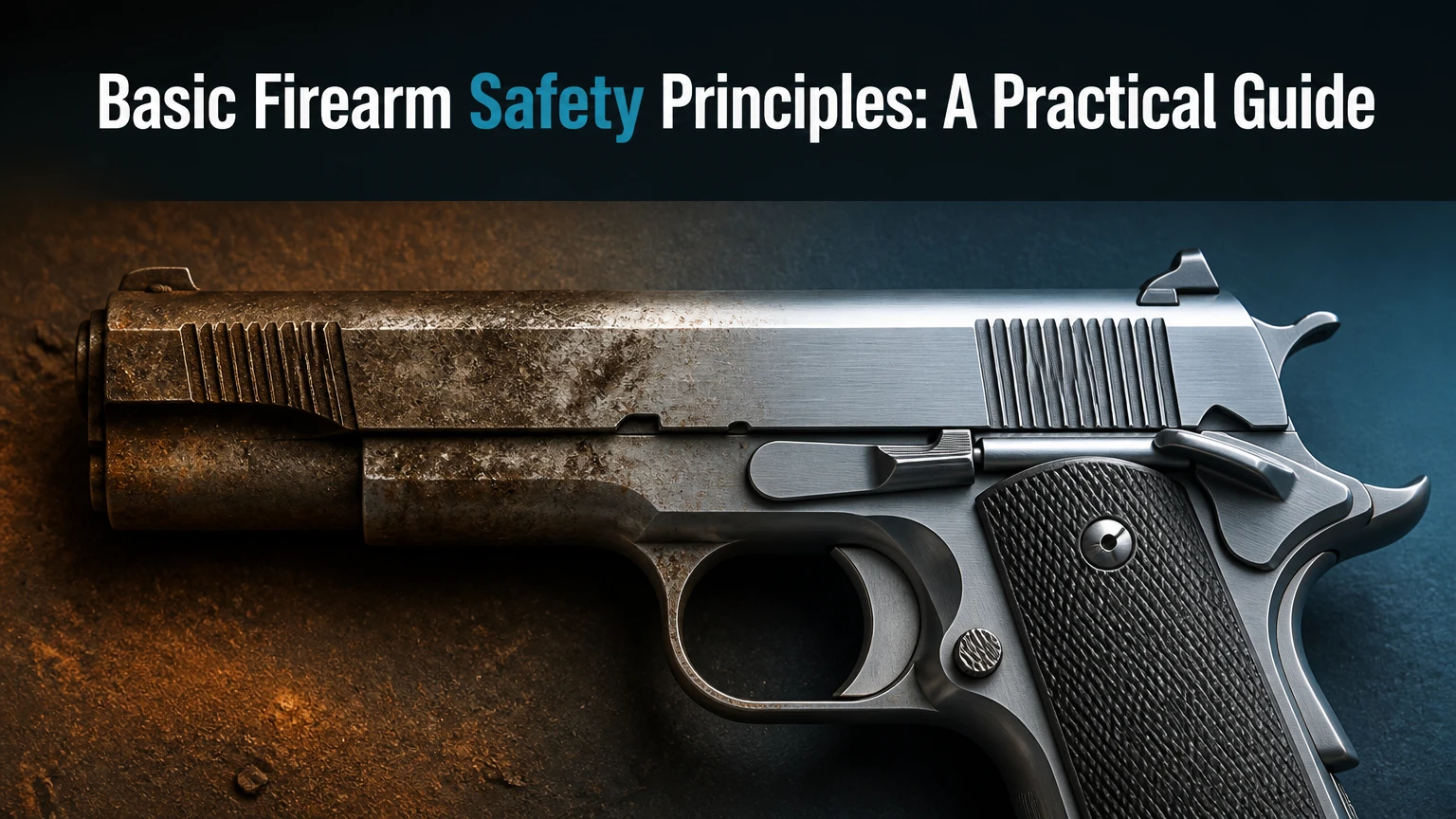
Basic firearm safety principles are the behavioral rules, mechanical safeguards, storage controls, and environmental checks used to prevent unintended discharge, injury, and unauthorized access. The foundation is defense in depth: treat every firearm as loaded, control the muzzle, keep the trigger finger indexed, and identify the target and its complete background before any shot.
Key Facts at a Glance
- Every firearm requires the same four baseline behaviors, regardless of its model or manual safety.
- A manual or internal safety reduces one type of risk but cannot replace muzzle and trigger discipline.
- A chamber check should be visual and physical when conditions make visual inspection unreliable, following the firearm’s manual.
- A safe direction must account for bullet penetration, ricochet, people, animals, and property beyond the immediate area.
- Storage must prevent unauthorized access, and a lock should be tested with the actual firearm and ammunition arrangement.
- A person who is tired, intoxicated, angry, distracted, or unfamiliar with the firearm should not handle it.
What Are Basic Firearm Safety Principles?
Basic firearm safety principles are a layered system that combines four handling rules with secure storage, correct transport, supervision, and training. The four rules are to treat every firearm as loaded, never point it at anything you are unwilling to destroy, keep the trigger finger outside the trigger guard until ready to fire, and know the target and what lies beyond it.
The system is stronger than any single precaution. A firing-pin block can reduce the chance of discharge after a drop, but it does not control where the muzzle points. A locked container can prevent access by a child or burglar, but it cannot make an already unsafe handling action harmless after the container opens.
The National Shooting Sports Foundation, through its Project ChildSafe program, recommends secure firearm storage that prevents unauthorized access. The practical implication is broader than buying a lock: owners must decide who may access the firearm, where ammunition is kept, how the lock is secured, and what happens when visitors arrive.
Why Does Defense in Depth Matter?
Defense in depth works because people and mechanical parts can fail independently. If a person mistakenly touches the trigger, muzzle direction and a suitable backstop can prevent injury; if a mechanical safety fails, trigger discipline and safe storage provide additional barriers.
A useful safety audit therefore asks four separate questions:
- Is the firearm mechanically safe and maintained?
- Is the muzzle pointed where a discharge would cause no injury?
- Is the trigger inaccessible to the handling finger or an object?
- Is the firearm inaccessible to unauthorized people?
No single answer is sufficient.
What Are the Four Fundamental Firearm Safety Rules?
The four fundamental rules are universal behavioral controls, although clubs, instructors, military organizations, and manufacturers may phrase them differently. Jeff Cooper popularized the modern four-rule formulation, while range organizations often add local commands about loading, firing, and ceasefires.
1. Treat Every Firearm as Loaded
Assume a firearm can fire until you personally verify its condition. Do not rely on another person’s statement, a visible magazine gap, a closed case, or a previous inspection.
When taking possession, keep the muzzle in a safe direction, place the trigger finger straight along the frame or receiver, and inspect the firearm according to its design and owner’s manual. A semi-automatic pistol, revolver, shotgun, and bolt-action rifle expose different loading indicators, so a generic glance is not always enough.
Expert insight: “Unloaded” is a condition that must be established, not a label that transfers from one person to another. A handoff resets responsibility.
2. Never Point the Muzzle at Anything You Are Unwilling to Destroy
Muzzle awareness means tracking the barrel’s direction during pickup, transport, loading, unloading, storage, and movement. The safe direction is not automatically the floor. Floors, walls, ceilings, vehicles, and nearby ground may not stop a bullet or may redirect it.
At a range, the safe direction is normally downrange under range-officer control. In a home, the correct direction depends on construction, occupancy, neighboring buildings, and the possible path of a projectile. Feet, hands, pets, and people outside the visible room must be included in the assessment.
3. Keep the Trigger Finger Outside the Trigger Guard
Place the index finger straight along the frame or receiver until the sights are on an identified target and the decision to fire has been made. The trigger guard is not a finger-rest; it is the area that protects the trigger from some external contact.
Clothing, drawstrings, straps, branches, gloves, and holster edges can contact a trigger. A rigid holster should cover the entire trigger guard for a carried handgun, and the firearm should not be forced into a holster containing an obstruction.
4. Know the Target and What Is Beyond It
Positive identification requires adequate light, a clear view, and a defined reason for shooting. A sound, movement, silhouette, or partial view is not reliable identification.
The background matters because bullets can penetrate common building materials, vehicles, doors, vegetation, and thin partitions. A target may move, another person may enter the line of fire, or a missed shot may continue beyond the intended area. Hunters must also identify the species and confirm that no person, road, building, or livestock lies behind the animal.
How Should You Clear and Unload a Firearm?
To clear a firearm, control the muzzle, keep the trigger finger indexed, remove the ammunition source, open the action, and inspect the chamber and feeding area. The exact sequence varies by firearm design, so the manufacturer’s manual and a qualified instructor take precedence over any universal checklist.
Step 1: Control the Direction and Position
Point the muzzle toward a designated safe direction and keep the trigger finger outside the guard. If the firearm is at a range, follow the range officer’s command and keep the action oriented downrange.
Do not begin by manipulating the trigger. Do not place a hand over the muzzle. If the firearm’s condition is uncertain, pause and ask a range officer, instructor, or gunsmith for help.
Step 2: Remove the Ammunition Source
For a detachable-magazine firearm, remove the magazine first. For a revolver, open the cylinder and remove all cartridges. For a tube-fed or fixed-magazine long gun, follow the model-specific unloading procedure in the manual.
Removing a magazine does not necessarily clear the chamber. A cartridge may already be chambered, and cycling the action before removing the magazine can feed another cartridge into that chamber.
Step 3: Open and Lock the Action
Open the slide, bolt, lever, cylinder, or other action as the design requires. If the firearm has a hold-open feature, lock the action open so another person can see its condition.
Do not force an unfamiliar mechanism. A locked action, chamber flag, or open cylinder provides a visible status signal, but it is still necessary to inspect the actual chamber.
Step 4: Inspect the Chamber and Feed Area
Look into the chamber, magazine well, cylinder chambers, and applicable loading port. In poor light, follow the manual’s inspection method and use an appropriate physical check only when the design permits it safely.
Success means no cartridge is present in the chamber, no ammunition remains in the cylinder or feeding path, and the action remains open. If any part of that status is uncertain, treat the firearm as loaded.
How Do You Safely Hand a Firearm to Someone?
The safest handoff is a cleared firearm with the action open, the muzzle directed away from both people, and the transfer confirmed verbally. The person releasing the firearm retains control until the receiving person has a secure grip and acknowledges possession.
Use this sequence:
- Announce that the firearm is clear, without treating the announcement as proof.
- Point the muzzle in a safe direction and keep the finger indexed.
- Remove the magazine or ammunition source.
- Open the action or cylinder and inspect the firearm.
- Leave the action open where the design allows.
- Offer the firearm grip-first, without placing a finger inside the trigger guard.
- Say “clear” or provide the status required by the range.
- Release only after the other person confirms possession.
At a range, place a firearm on the bench with the action open and muzzle pointed downrange when the range rules require a bench transfer. Never pass a loaded firearm casually across a room.
Which Mechanical Safeties Reduce Firearm Risk?
Mechanical safeties reduce specific mechanical risks, but they do not make unsafe handling acceptable. A manual safety may block the trigger or sear, a grip safety may require a particular grip, and an internal firing-pin block may prevent movement unless the trigger mechanism operates correctly.
| Safety mechanism | Typical function | Limitation |
|---|---|---|
| Manual safety | Blocks or limits trigger, sear, or hammer movement | Can be disengaged, misunderstood, or mechanically damaged |
| Trigger safety | Prevents rearward trigger movement unless the trigger face is pressed | Does not control muzzle direction or target identification |
| Grip safety | Requires depression by a properly positioned hand | May not prevent discharge from every drop or malfunction |
| Firing-pin block | Blocks firing-pin travel until a firing sequence moves it | Depends on correct maintenance and design integrity |
| Disconnect safety | Prevents firing when a magazine or action condition is absent on some models | Not universal and not a substitute for clearing procedures |
| Drop safety | Uses internal blocking features to reduce discharge after impact | Does not cover every mechanical failure or unsafe handling act |
The exact feature set differs by model. Read the owner’s manual, identify each control without guessing, and have a qualified gunsmith evaluate a suspected defect.
Should You Rely on a Manual Safety?
No. A manual safety is one layer, not permission to violate the four rules. Owners must know whether the control blocks the trigger, sear, hammer, or another part, and they must understand the firearm’s condition indicators before handling it.
The National Institute of Justice describes firearm safety devices as engineering controls, but engineering controls work best when paired with administrative and behavioral controls. A safety lever cannot identify a target, stop a muzzle from covering a person, or prevent unauthorized access to an unlocked firearm.
What Is the Safest Way to Store a Firearm?
The safest storage method is one that prevents unauthorized access, resists the likely threat, and remains practical enough that the owner uses it every time. A lock, locked container, or vault should be selected for the household, firearm type, local law, and required access speed.
| Storage option | Typical cost | Access characteristic | Main limitation |
|---|---|---|---|
| Cable or trigger lock | $5-$20 | Usually under 30 seconds to apply | Low resistance to determined theft |
| Locking handgun box | $40-$180 | Seconds with key or code | Small models may be portable or pryable |
| Quick-access electronic box | $100-$250 | Typically 1-10 seconds after practice | Battery, keypad, or biometric failure |
| Large steel safe | $600-$3,000 or more | Usually 10-60 seconds | Heavy, expensive, and slower to open |
| Commercial vault or cabinet | $300-$2,000 | Seconds to minutes | Security depends on anchoring and construction |
Prices are typical United States retail ranges, not legal requirements. Firearm owners should verify state and local rules because storage duties, transport requirements, and child-access laws differ by jurisdiction.
How Should a Household With Children Store Firearms?
A household with children should use locked storage that prevents access without an adult-controlled key, code, or credential, and should separately secure ammunition when required by law or household risk. A child’s apparent lack of interest is not an access-control system.
Conduct a physical audit:
- Confirm that every firearm is locked when not under direct adult control.
- Test whether the container can be moved, pried, or opened with an old code.
- Keep keys, backup keys, and codes inaccessible to children and visitors.
- Check that ammunition cannot be reached through the same unlocked drawer.
- Recheck storage after cleaning, range trips, guests, or maintenance.
- Teach children not to touch a firearm and to notify an adult immediately.
Project ChildSafe promotes free firearm safety kits and locking devices through participating law-enforcement agencies. Availability varies by location.
Are Biometric Safes Better Than Cable Locks?
A biometric or electronic quick-access safe generally provides faster controlled access than a cable lock, while a cable lock costs less and is easier to carry. Neither option automatically provides strong theft resistance, and electronic access should be tested under realistic conditions.
| Criterion | Cable or trigger lock | Mechanical push-button box | Biometric box | Heavy steel safe |
|---|---|---|---|---|
| Typical price | $5-$20 | $60-$180 | $100-$250 | $600-$3,000+ |
| Setup time | Under 30 seconds | 10-30 minutes | 10-30 minutes | 1-4 hours including anchoring |
| Unauthorized child access | Good if fitted correctly | Strong when mounted | Strong when maintained | Strong when locked |
| Theft resistance | Low | Moderate | Moderate | High when anchored |
| Power dependence | None | None | Battery dependent | Usually none |
| Best use | Transport or basic lockout | Bedside or home access | Repeated controlled access | Multiple firearms and theft protection |
A quick-access safe is not good for an owner who never replaces batteries or practices the access method. A large vault is not good when emergency access depends on an unknown combination in darkness. The best system is the one that meets the threat model and is used consistently.
What Other Safety Equipment Helps?
Safety equipment supports the rules but cannot replace them. Appropriate equipment includes eye and hearing protection, a chamber flag for range status, a rigid trigger-covering holster, a suitable case, and a correctly fitted lock.
| Equipment | Typical specification | Primary purpose | Replacement or check interval |
|---|---|---|---|
| Eye protection | ANSI Z87.1-rated lenses | Protects against fragments and ejected material | Inspect before every range session |
| Hearing protection | Earplugs rated about 20-30 dB, or earmuffs | Reduces impulse-noise exposure | Replace damaged or compressed parts |
| Chamber flag | Model-compatible visible indicator | Shows open or clear action at a range | Inspect each use |
| Handgun holster | Rigid material covering full trigger guard | Prevents trigger contact during carry | Replace after damage or poor retention |
| Transport case | Closed, padded, model-compatible case | Protects firearm and controls access | Inspect zippers, locks, and seams |
Firearm owners should never use a chamber flag as proof that a chamber is empty. The indicator communicates status after the firearm has been cleared; it does not clear the firearm.
How Do Safety Rules Change at a Range, in a Vehicle, or While Hunting?
The four rules remain constant, but the hazards change with the setting. Range procedures add commands and line controls, vehicle transport adds movement and legal requirements, and hunting adds terrain, companions, game identification, and changing muzzle angles.
At a range, obey the range officer, keep the muzzle downrange, stop immediately during a ceasefire, and do not handle firearms while people are downrange. An open action and visible chamber flag communicate status to others.
During transport, follow applicable local law and the firearm owner’s manual. A common safe practice is an unloaded firearm in a closed case, with ammunition secured separately when required. Do not leave a firearm visible in an unattended vehicle, and do not handle it in a parking area merely to show it to someone.
During hunting, keep the action open and chamber empty while walking, crossing obstacles, entering a boat, climbing, or changing positions unless the lawful activity and local instruction require another condition. Unload before crossing a fence or handing a firearm to another person.
What Should You Do During a Malfunction?
During a malfunction, keep the muzzle pointed in a safe direction, keep the trigger finger outside the guard, and pause rather than improvising. A firearm with a stuck action, unusual sound, failure to fire, or jammed cartridge should remain pointed safely until a qualified instructor, range officer, or gunsmith gives model-specific assistance.
For a failure to fire, maintain muzzle control and wait according to the manufacturer’s instructions because a delayed ignition is possible. Do not immediately look into the muzzle, cycle the action toward people, or strike the firearm.
For a stuck cartridge or action, do not force the mechanism with a screwdriver, punch, or other random tool. Move people away, notify the range officer, and obtain professional help. If the firearm is hot, damaged, or emitting smoke, follow range emergency procedures and do not attempt disassembly.
Expert insight: The most dangerous malfunction response is often a hurried attempt to diagnose the firearm while the muzzle and trigger finger leave their safe positions. The first response is control, not repair.
What Common Mistakes Cause Preventable Risk?
The most common mistakes involve assumptions, rushed transitions, and storage gaps rather than obscure mechanical failures. Correcting the process is more reliable than relying on memory or a safety lever.
| Mistake | Why it creates risk | Corrective practice |
|---|---|---|
| Cycling the action before removing a magazine | Can feed another cartridge into the chamber | Remove the ammunition source first, then open the action |
| Calling a firearm unloaded without inspecting it | Transfers responsibility to an assumption | Personally verify the chamber and feeding area |
| Resting a finger inside the trigger guard | Allows a startle response or object contact to activate the trigger | Index the finger high along the frame |
| Pointing at the floor without checking construction | A projectile may penetrate or ricochet | Evaluate the complete potential path |
| Leaving a firearm unlocked during cleaning | A visitor or child may access it | Lock it whenever direct control ends |
| Trusting a biometric reader without backup planning | Batteries, dirt, moisture, or recognition failures can block access | Maintain the approved backup method and test it |
Alcohol, cannabis, sedating medication, severe fatigue, anger, and distraction impair judgment and coordination. The safe decision is to postpone handling and secure the firearm before impairment begins.
How Should a Beginner Learn Firearm Safety?
A beginner should start with a hands-on course taught by a qualified instructor, followed by supervised practice using the exact firearm type involved. A typical introductory course takes 4-8 hours and may cost $75-$200 in the United States, although prices vary by location and provider.
A useful course should cover:
- Firearm parts and operating differences
- The four rules and safe-direction decisions
- Loading and unloading under supervision
- Storage and transport law
- Range commands and ceasefire behavior
- Misfire and malfunction response
- Hearing and eye protection
- Cleaning according to the manufacturer’s manual
The National Rifle Association, USCCA, state hunter-education agencies, local ranges, and law-enforcement programs offer different training paths. Certification names do not guarantee teaching quality, so verify instructor credentials, class size, live-fire supervision, and whether the course matches the firearm type.
Practice should build correct repetitions slowly. Speed is not a beginner objective. A person who cannot consistently maintain muzzle direction, trigger-finger position, and chamber awareness should stop and obtain more instruction.
FAQ
Is a firearm safe if the safety is on?
A firearm with its manual safety engaged is not automatically safe. Mechanical safeties can be misunderstood, damaged, or disengaged, and some designs allow different operating conditions. Continue treating the firearm as loaded, control the muzzle, keep the finger outside the trigger guard, and verify the target and background.
Should ammunition be stored separately from the firearm?
Separate ammunition storage can reduce unauthorized access and may be required by local law, but the exact arrangement depends on the household and jurisdiction. Ammunition should remain dry, secured from children and unauthorized users, and stored according to the manufacturer’s recommendations.
What is a safe direction for a firearm?
A safe direction is one in which an unintended discharge would not injure a person or cause unacceptable property damage after accounting for penetration and ricochet. Downrange is usually appropriate at a controlled range, but a floor, wall, or ground surface is not automatically safe.
Can a firearm be stored with a round in the chamber?
Storage conditions must follow the owner’s manual, local law, and the owner’s ability to secure the firearm from unauthorized access. A firearm stored loaded presents a different risk profile from one stored unloaded, and neither condition removes the requirement for a locked, access-controlled storage method.
How often should firearm storage be checked?
Check storage whenever the firearm is returned from use, after visitors enter the home, after changing a lock or code, and at regular intervals such as monthly. Test the container, inspect its mounting, verify battery status, and confirm that keys and backup credentials remain controlled.
The Bottom Line
Basic firearm safety principles work as a layered system: treat every firearm as loaded, keep the muzzle in a safe direction, keep the trigger finger indexed until the decision to fire, and identify the target and complete background. Add secure storage, correct transport, protective equipment, qualified training, and calm malfunction procedures. The safest routine is consistent before, during, and after every handling event.