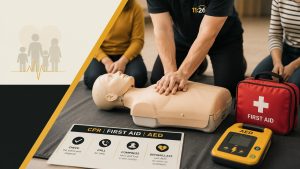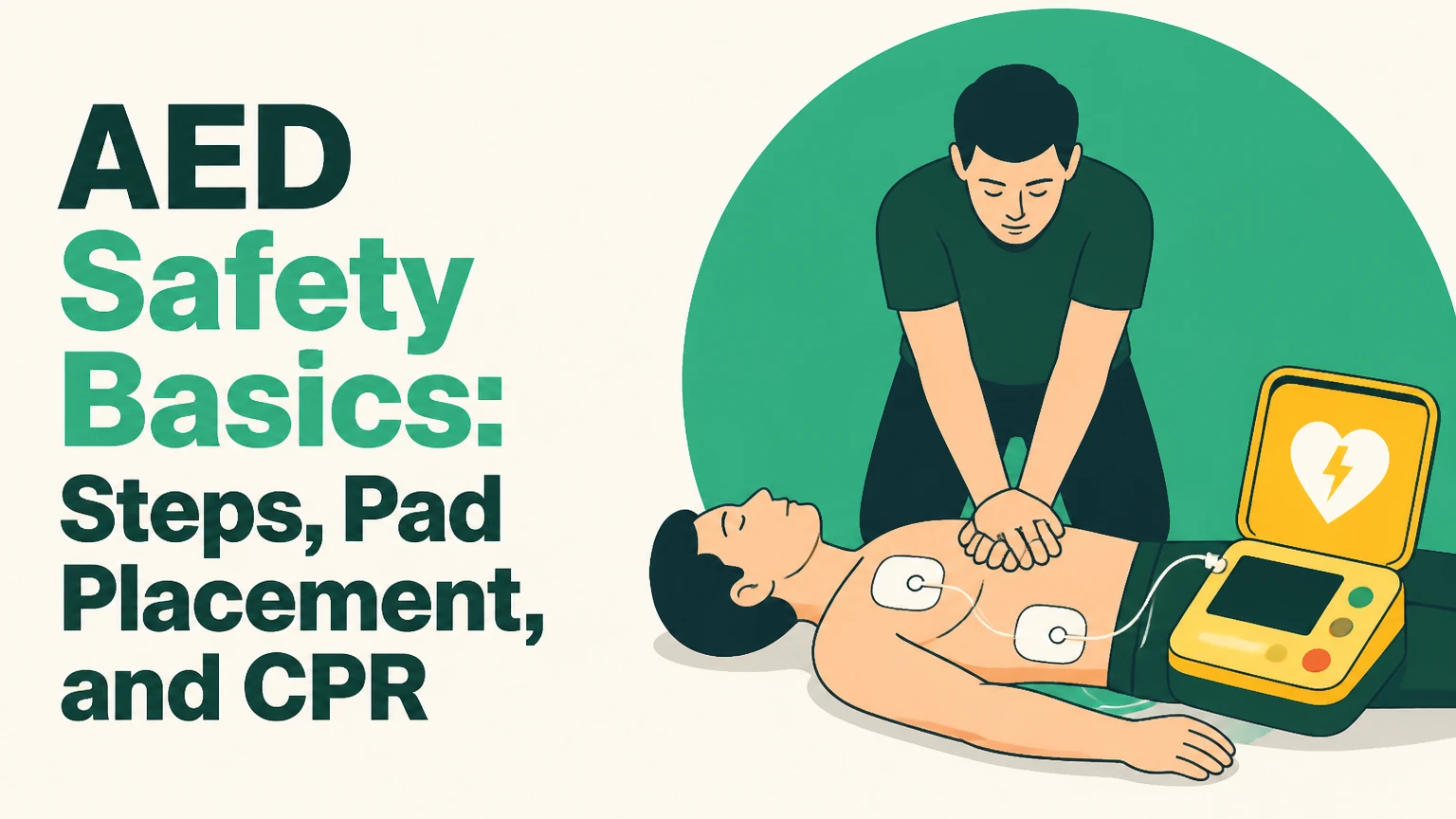
AED safety basics begin with recognizing sudden cardiac arrest, calling emergency services, starting CPR, and following the device prompts without delay. An automated external defibrillator analyzes the heart rhythm and delivers a shock only when appropriate, while rescuers keep everyone clear during analysis and shock delivery.
Key Facts at a Glance
- An automated external defibrillator treats certain shockable cardiac rhythms, especially ventricular fibrillation and pulseless ventricular tachycardia.
- A rescuer should call emergency services, begin chest compressions, and send someone for the AED at the same time.
- AED pads must contact a bare, dry chest, with one pad high on the right chest and the other on the lower left chest for most adults.
- An AED will not shock a rhythm that its software identifies as non-shockable, so pressing the shock button cannot override the analysis.
- CPR must resume immediately after a shock or a no-shock message, usually for about two minutes until the next analysis.
- Expired pads, depleted batteries, inaccessible cabinets, and missing pediatric equipment can make a functional AED unavailable during an emergency.
What Is an AED?
An automated external defibrillator is a portable computerized device that analyzes electrical cardiac activity and provides a controlled defibrillation shock when a shockable rhythm is detected. The device does not restart every stopped heart, and it cannot replace emergency medical care, high-quality CPR, or advanced life support.
Sudden cardiac arrest occurs when the heart abruptly stops producing effective circulation. Ventricular fibrillation is chaotic electrical activity; pulseless ventricular tachycardia is a dangerously fast rhythm without a usable pulse. Defibrillation can interrupt these rhythms, giving the heart an opportunity to resume an organized rhythm.
An AED is designed for trained professionals and untrained bystanders. Voice prompts, diagrams, automatic rhythm analysis, and safety checks guide the sequence, but rescuers still need to expose the chest, apply pads correctly, avoid contact during analysis, and resume CPR quickly.
The European Resuscitation Council states, “The use of an AED should be considered in all cases of cardiac arrest” in its 2021 resuscitation guidance. The practical implication is simple: do not wait to determine the exact rhythm yourself. Use the AED as soon as it arrives.
What an AED cannot do
An AED cannot diagnose every cause of collapse, measure a reliable pulse for the rescuer, administer medication, or guarantee survival. A no-shock decision means the device did not detect a rhythm for which it recommends defibrillation at that moment; it does not mean the person is safe or has recovered.
How Do You Use an AED?
Use an AED through a coordinated sequence: call emergency services, begin CPR, power on the device, expose and dry the chest, attach the pads, clear the patient for analysis, deliver a prompted shock if advised, and immediately resume CPR. The process generally takes only a few minutes, but pad contact and uninterrupted teamwork determine performance.
Step 1: Confirm danger and unresponsiveness
Check that the scene is safe, then tap the person and shout. If the person does not respond and is not breathing normally, or is only gasping, treat the situation as cardiac arrest.
Send one person to call the local emergency number and retrieve the AED. If alone with an adult, call emergency services using speakerphone and follow the dispatcher’s instructions; retrieve an AED only when doing so will not create a substantial delay.
Step 2: Start CPR
Place the person on a firm, flat surface and begin chest compressions in the center of the chest. Adult compressions should be 5-6 centimeters deep at a rate of 100-120 per minute, allowing the chest to recoil fully after each compression.
Trained rescuers should use a 30:2 compression-to-breath ratio. If a rescuer cannot provide breaths, hands-only CPR is preferable to stopping, although ventilation becomes increasingly important during prolonged resuscitation, drowning, and some pediatric arrests.
Step 3: Turn on the AED
Open the lid or press the power button immediately after the AED arrives. Follow the exact audio and visual instructions for that model because pad connectors, pediatric controls, and shock buttons differ between manufacturers.
Continue CPR while another rescuer prepares the unit, unless the device specifically requires a brief pause. Assign one person to operate the AED and another to count down clearance commands.
Step 4: Expose, dry, and prepare the chest
Cut or remove clothing so the adhesive pads contact bare skin. Wipe away sweat, water, medication residue, or heavy lotion, because liquid and debris reduce adhesion and may create an external current path.
Do not delay defibrillation to shave ordinary chest hair. Use the supplied razor only when dense hair prevents the pads from sticking; press a spare pad set onto the area, remove it to pull away hair, and apply the new pads if the manufacturer’s instructions permit that approach.
Step 5: Apply the adult pads
For standard adult placement, put one pad on the upper right chest below the collarbone and beside the breastbone. Put the second pad on the lower left side of the chest, below the armpit and several centimeters below the armpit crease.
Press each pad firmly so the entire adhesive surface contacts skin. Ensure the pads do not touch each other, overlap, sit on clothing, or cross a visible wound.
Step 6: Clear the patient for analysis
Stop compressions when the AED announces analysis. Say, “Everyone clear,” look around the patient, and ensure nobody is touching the person, bed, stretcher, or conductive surface connected to the patient.
Movement, transport vibration, chest compressions, and physical contact can create electrical artifact that interferes with rhythm interpretation. Do not move the patient during analysis unless an immediate scene hazard exists.
Step 7: Deliver the shock only when instructed
If the AED advises a shock, announce “Clear” loudly and visually confirm that no one is touching the patient. On a semi-automatic AED, press the flashing shock button; on a fully automatic AED, remain clear while the device delivers the shock after its audible countdown.
Do not touch the patient while the shock is delivered. The rescuer pressing the button does not receive the shock when pads and skin are correctly applied, but simultaneous contact with the patient can expose a rescuer to current.
Step 8: Resume CPR immediately
Resume chest compressions as soon as the shock ends or the AED says no shock is advised. Continue CPR for approximately two minutes, or follow the device’s countdown, before stopping for another rhythm analysis.
Do not check for a pulse unless you are trained and the AED or advanced medical team directs you to do so. Continue the cycle until the person shows clear signs of life, emergency clinicians take over, the scene becomes unsafe, or you are physically unable to continue.
Which Pads and Placement Are Safe?
Adult AED pads belong on a bare, dry chest in an upper-right and lower-left position unless the device diagram specifies an alternative. Pediatric pads or an energy-attenuating pediatric setting should be used for children when available, but rescuers should not delay a shock because pediatric equipment is absent.
| Patient or situation | Preferred pad option | Typical placement | Key safety point |
|---|---|---|---|
| Adult or adolescent | Adult pads | Upper right chest and lower left lateral chest | Keep pads apart and fully adhered |
| Child under about 8 years | Pediatric pads or attenuator | Front-and-front if pads are separated; front-and-back if they might touch | Follow the AED manufacturer’s age and weight guidance |
| Infant under 1 year | Pediatric system if available | Front-and-back placement is often used | Use an AED if indicated and no better option exists |
| Large chest or breast tissue | Adult pads | Place pads on chest wall, not breast tissue | Move breast tissue aside rather than placing a pad directly over it |
| Implanted pacemaker or defibrillator | Standard compatible pads | Keep a pad several centimeters away from the lump | Never place a pad directly over the implant |
| Medication patch | Standard pad after patch removal | Apply to clean, dry skin | Use gloves when removing a patch and wipe residue away |
Pad diagrams take priority over generic placement rules. Some manufacturers specify anteroposterior placement for small children or particular pad designs, so inspect the printed illustrations rather than relying solely on memory.
What about pacemakers, jewelry, and medication patches?
A pacemaker or implanted cardioverter-defibrillator does not make external defibrillation automatically unsafe. Place the pad beside the device, not directly over the raised implant, while preserving the correct electrical pathway.
Remove a medication patch before applying a pad, using gloves when available. Remove necklaces or metal objects only when they interfere with pad placement; do not waste time searching for hidden metal or attempting to remove ordinary jewelry.
How Does an AED Analyze Rhythm?
An AED analyzes the electrical signal between its two adhesive electrodes and compares the detected pattern with programmed criteria for shockable rhythms. The device does not decide whether a person is “alive” in a broad sense; it determines whether defibrillation is recommended for the rhythm it detects.
AED analysis can be disrupted by chest compressions, movement, poor pad adhesion, radio-frequency interference, or contact with the patient. The rescuer should stop touching the patient only when instructed, keep the torso still, and obey repeated “analyzing” or “do not touch” messages.
An AED may advise no shock for asystole, pulseless electrical activity, or an organized rhythm. These rhythms still require CPR and emergency treatment. A no-shock message is therefore an instruction to resume compressions, not permission to leave the patient.
Which AED Type Fits the Setting?
Semi-automatic AEDs instruct a rescuer to press a button after a shock decision, while fully automatic AEDs deliver the shock after a verbal warning and countdown. Semi-automatic models offer a deliberate final confirmation; fully automatic models can reduce hesitation, but both require complete physical clearance.
| Attribute | Semi-automatic AED | Fully automatic AED | Practical consequence |
|---|---|---|---|
| Shock initiation | Rescuer presses button | Device delivers after countdown | Automatic delivery may reduce hesitation |
| Human confirmation | Required after “shock advised” | Not required | Semi-automatic units create an extra decision point |
| Clearance warning | Voice and visual prompts | Voice, visual prompts, countdown | Both require nobody to touch the patient |
| Best operational fit | Trained responders, clinical settings | Public areas with variable responder experience | Local training and policy matter more than the label |
| Main failure risk | Rescuer delays or forgets to press | Person ignores countdown and touches patient | Drills should rehearse loud clearance commands |
Fully automatic does not mean hands-free. A rescuer must still apply pads, stop CPR during analysis, keep bystanders clear, and resume CPR after the device completes its cycle.
For offices, schools, gyms, and public venues, the better unit is usually the model that local responders can recognize, operate, and maintain reliably. Voice-language options, pediatric capability, clear diagrams, battery availability, and local technical support often matter more than a small difference in waveform specification.
Why Does Time Matter?
Early CPR maintains limited blood flow, while early defibrillation can correct a shockable rhythm. The American Heart Association describes sudden cardiac arrest survival as time-sensitive, but a universal claim that survival falls exactly 7-10% for every minute is an oversimplification because outcomes vary with CPR quality, initial rhythm, response time, location, and underlying disease.
The strongest operational target is rapid access. A device mounted near a sports field may be less useful if staff must cross a locked building, wait for an elevator, or search for a key. AED programs should map the route from likely collapse locations and aim for trained responders to begin defibrillation within minutes.
The commonly cited 3-5 minute defibrillation window is a planning goal, not a guarantee of 50-70% survival. Witnessed collapse, immediate CPR, a shockable initial rhythm, public-location monitoring, and rapid professional care can improve the odds, while unwitnessed arrest or prolonged no-flow time can reduce them sharply.
Where Should an AED Be Installed?
An AED should be visible, unlocked, accessible during operating hours, and reachable within the response time set by the site’s emergency plan. Place the unit near high-occupancy or high-risk areas, such as gymnasiums, pools, production floors, reception areas, and large meeting spaces, rather than inside a restricted office.
| Installation factor | Typical target | Failure to avoid | Verification method |
|---|---|---|---|
| Cabinet access | Unlocked or locally approved alarmed access | Locked cabinet with unavailable key | Test access during a drill |
| Travel distance | Route reachable within 2-3 minutes | Unit located on another floor | Time a responder from each zone |
| Visibility | High-contrast AED sign at eye level | Device hidden in a supply room | Ask an unfamiliar employee to find it |
| Environment | Manufacturer storage range, often 0-50°C operating | Direct sun, freezing vehicle, wet floor | Inspect location and cabinet climate |
| Emergency access | Available whenever people are present | Cabinet closed during evenings | Include security and facilities staff |
| Supplies | Adult pads, pediatric option, razor, gloves, towel | Expired pads or missing accessories | Monthly inventory check |
A pool or industrial site needs additional planning for wet skin, dust, heat, chemicals, and physical impact. Use a cabinet and AED rated for the actual environment, but do not apply pads to a person lying in standing water; move the person to a dry area first.
How Much Does AED Ownership Cost?
A public-access AED commonly costs about $1,200-$2,500 for the device, while replacement adult pads often cost $60-$150 and batteries commonly cost $150-$400. Actual prices vary by manufacturer, pediatric accessories, warranty, connectivity, cabinet, shipping, taxes, and local regulatory requirements.
| Ownership item | Typical price or interval | What changes the figure | Planning action |
|---|---|---|---|
| AED unit | $1,200-$2,500 | Brand, display, connectivity, warranty | Compare total program cost |
| Adult electrode pads | $60-$150, often 18-30 months | Shelf life and model | Record expiration date |
| Pediatric pads or attenuator | $100-$250, model dependent | Age coverage and availability | Keep with the AED when needed |
| Battery | $150-$400, often 3-5 years | Standby design and temperature | Replace before expiry |
| Wall cabinet | $200-$800 | Alarm, heating, connectivity | Match cabinet to environment |
| CPR and AED training | $50-$150 per participant, typical | Provider and course length | Train enough staff for each shift |
The device price is only the purchase cost. A realistic budget also includes a cabinet, signage, replacement consumables, inspections, registration, training, and possible software or cellular fees.
How Do You Maintain an AED?
Maintain an AED through a documented monthly visual check and by replacing pads and batteries before their printed expiration dates. A maintenance program should also follow the manufacturer’s service instructions, local registration rules, recall notices, and any requirements imposed by the workplace or health authority.
| Check | Frequency | Acceptable result | Corrective action |
|---|---|---|---|
| Status indicator | Monthly and after use | Green or manufacturer-ready symbol | Check manual and service provider |
| Pad expiration | Monthly | Expiry date remains in future | Order replacement before expiry |
| Battery date and condition | Monthly | Installed battery within service life | Replace according to manufacturer |
| Case and cables | Monthly | No cracks, cuts, contamination, or loose connector | Remove from service if damaged |
| Accessories | Monthly | Gloves, razor, towel, scissors present | Restock immediately |
| Self-test record | Automatic plus monthly log | No error tone or alert | Contact authorized service support |
| Post-use inspection | Immediately after event | New pads and adequate battery | Restore complete readiness |
Do not place an AED back in service after use without checking the battery, pads, cables, data storage, and self-test status. Some models require authorized data download or inspection, especially when the device recorded a rhythm or delivered a shock.
What Common AED Problems Occur?
Most AED problems involve unavailable equipment, expired consumables, poor pad contact, unsafe clearance, or delayed access rather than a sophisticated electronic failure. A rescuer should follow the device prompt, correct the physical cause quickly, and continue CPR whenever the AED is not actively analyzing or delivering a shock.
| Device message or problem | Likely cause | Immediate response | Do not do |
|---|---|---|---|
| Check pads | Loose, wet, hairy, or contaminated skin | Dry chest, press pads, replace if needed | Do not continue analysis with loose pads |
| No shock advised | Non-shockable rhythm or artifact resolution | Resume CPR immediately | Do not press the button repeatedly |
| Low battery | Battery near depletion | Continue emergency sequence if functioning; replace afterward | Do not remove a working battery mid-event |
| Replace pads | Expired, damaged, or previously used electrodes | Use an unopened compatible set | Do not reuse single-use pads |
| Motion detected | Compressions or patient movement continue | Stop contact and stabilize patient | Do not restrain violently |
| Device will not power on | Battery, damage, or mechanical fault | Send for another AED and continue CPR | Do not spend several minutes troubleshooting |
How do you fix a “check pads” message?
Dry the chest thoroughly, verify that the connector is fully inserted, and press the pad edges and center firmly onto the skin. If dense hair prevents adhesion, shave only the pad locations and use a replacement pad set if the first set cannot be removed and reapplied reliably.
A spare pad set is valuable in public programs because adhesive pads are single-use and can fail after heavy perspiration, water exposure, or chest hair. The rescuer should not interrupt CPR longer than necessary to solve a contact problem.
Children, Infants, and Special Situations
Children, infants, pregnant people, people with implanted devices, and people in wet environments can receive AED treatment when cardiac arrest is suspected, but pad selection and positioning require attention. The AED manufacturer’s pediatric instructions take priority over generic placement advice.
- Children: Use pediatric pads or an energy attenuator when available for children under approximately 8 years. If unavailable, many resuscitation guidelines support using adult pads rather than withholding defibrillation, provided the pads do not touch.
- Infants: Use an infant or pediatric system when available. If no pediatric option exists, follow local protocol and the AED manufacturer’s instructions rather than delaying emergency care.
- Pregnancy: Use standard AED treatment when indicated. Maternal cardiac arrest threatens both patient and fetus, so defibrillation should not be withheld because of pregnancy.
- Pacemakers and ICDs: Avoid placing a pad directly over the implant. A visible lump is usually located below the collarbone; place the pad beside it.
- Water: Move the person out of standing water, remove wet clothing from the pad area, and dry the chest before applying electrodes.
- Trauma: A traumatic collapse still requires emergency assessment. Do not apply a pad directly over an open wound or severe chest injury if an alternative position is possible.
- Medication patches: Remove the patch with gloves, wipe the skin, and apply the electrode to clean skin.
An AED is not appropriate for a responsive person who is breathing normally. Monitor that person, call emergency services for concerning symptoms, and avoid placing pads merely because a heart condition is known.
What Should You Do After an AED Event?
After an AED event, transfer care to emergency clinicians, preserve the device and used accessories, document the event, and restore the unit immediately. A successful shock does not eliminate the risk of recurrent arrest, and the patient needs hospital evaluation even when consciousness returns.
Give emergency responders the AED manufacturer and model, the number of shocks delivered if known, the approximate collapse time, CPR duration, and any observed symptoms. Do not remove the electrode pads unless directed by clinicians.
The organization should replace used pads, inspect the battery, download or preserve event data according to policy, clean the case, and record the equipment fault or use. Conduct a short, factual debrief that identifies access delays, communication failures, and supply gaps without blaming individual rescuers.
Expert Rules That Prevent Avoidable Errors
- Put the AED where the collapse is likely, not where the paperwork is stored. A locked first-aid room can create a longer delay than a visible cabinet near the activity area.
- Train for the handoff, not only the button press. The highest-risk transition occurs when CPR stops, the AED analyzes, and several people crowd the patient.
- Keep a spare pad set when the site is wet, dusty, or heavily occupied. Pad adhesion failures are easier to solve when replacement electrodes are immediately available.
- Use a route timer during drills. A response plan that says “nearby” is not measurable; a 2-minute route from the farthest occupied room is measurable.
- Treat the readiness indicator as a screening signal, not proof of perfection. A green light cannot confirm that a cabinet is accessible, pads fit the patient, or staff know the route.
Frequently Asked Questions
Can an AED shock a person who does not need it?
An AED analyzes the rhythm before recommending a shock and is designed not to deliver a defibrillation shock for rhythms classified as non-shockable. A rescuer cannot safely treat a responsive person as a test subject, however, and should use an AED only for an unresponsive person who is not breathing normally.
Can you use an AED through clothing?
AED pads cannot work correctly through clothing because electrodes need direct contact with bare skin. Cut or remove clothing from the chest, dry the skin, and keep the pads away from wet fabric, medication residue, thick hair that prevents adhesion, and visible wounds.
Should CPR stop while someone searches for an AED?
CPR should continue while another person retrieves the AED whenever enough rescuers are present. If a lone rescuer must choose between CPR and retrieving a nearby device, follow emergency-dispatch instructions and avoid leaving the person when the AED is distant or access creates a substantial delay.
Can an AED be used in a moving ambulance?
AED analysis can be affected by vehicle movement, so emergency crews generally stop the vehicle when feasible before analysis or shock delivery. A bystander should follow the device prompts and emergency dispatcher instructions, keeping everyone clear and avoiding unnecessary patient movement.
Do AEDs work on a flatline?
An AED does not defibrillate asystole, commonly called a flatline, because a shock does not correct that rhythm. The device may announce no shock advised, after which rescuers must resume CPR and continue care until advanced responders arrive.
Are AED users legally protected?
Legal protection depends on the country, state, province, and circumstances, so organizations should check local law and obtain appropriate training. In the United States, Good Samaritan protections commonly support reasonable emergency aid, but they do not excuse reckless conduct or replace compliance with workplace requirements.
The Bottom Line
AED safety basics are practical: recognize cardiac arrest, call emergency services, start CPR, turn on the AED, apply dry pads correctly, clear the patient during analysis and shock, and resume compressions immediately. An AED cannot replace CPR or professional care, but rapid access, maintained equipment, clear roles, and repeated drills make defibrillation more likely to occur when it can help.