Active threat awareness training is an operational safety program that prepares people to recognize warning signals, make rapid protective decisions, communicate with emergency responders, and support survival during a violent incident. Effective training combines mental preparation, site-specific planning, evacuation and shelter options, law-enforcement coordination, trauma care, and post-incident recovery.
Key Facts at a Glance
Active threat awareness training covers prevention awareness, preparedness, response, emergency medical care, and recovery.
Run, Hide, Fight is an options-based model, not a mandatory sequence that every person must follow.
ALICE adds real-time information and multiple response options, while AVERT combines protective action with bleeding-control skills.
A practical program uses online instruction for baseline knowledge and site-specific exercises for decision-making.
Typical delivery ranges from 30-45 minutes online to 2-8 hours for classroom, tabletop, and hands-on programs.
Training should be trauma-informed, announced in advance, accessible, and reviewed at least annually.
What Does Active Threat Awareness Training Cover?
Active threat awareness training teaches people how to identify danger, understand their environment, select a protective action, and interact safely with responders. The program is broader than an active shooter briefing because “active threat” can include a weapon attack, vehicle assault, barricaded person, workplace violence, or another rapidly evolving act of violence.
A complete curriculum normally includes five connected capabilities:
- Recognition: noticing escalating behavior, threats, unusual access attempts, sounds of violence, or other indicators.
- Preparedness: knowing exits, locking mechanisms, communication channels, assembly areas, and accessible shelter options.
- Response: choosing evacuation, sheltering, or last-resort defensive action according to real-time conditions.
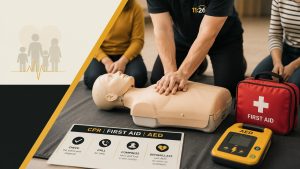
- Medical support: calling emergency services, guiding responders, and applying bleeding-control measures when safe.
- Recovery: accounting for people, preserving information, supporting affected employees, and restoring operations.
The program does not turn civilians into police officers. It cannot guarantee safety, predict who will become violent, or replace professional threat assessment, emergency management, access control, or law-enforcement planning.
What Is the Difference Between Awareness and Response Training?
Awareness training focuses on recognition and decisions before or during an incident; response training adds practiced actions such as evacuation, room security, emergency communication, and bleeding control. Organizations often use “awareness training” for a short employee course, but a resilient program links that course to facility planning and leadership exercises.
A 30-minute online module may establish baseline knowledge. It cannot verify whether a particular door locks, whether a visitor can hear an alarm, or whether a hospital unit can move nonambulatory patients. Those questions require a walkthrough, tabletop exercise, or carefully controlled drill.
How Does the Four-Stage Threat Lifecycle Work?
The four-stage lifecycle is awareness, preparedness, response, and recovery. Federal Protective Service materials use a lifecycle approach because organizations need controls before an event, decisions during the event, and structured support after emergency operations begin.
1. Awareness
Awareness includes behavioral concern reporting, environmental observation, and recognition of immediate danger. Training should avoid profiling based on appearance, disability, race, religion, or ordinary emotional distress; instead, it should focus on specific behaviors, credible threats, weapons-related conduct, targeted grievances, and escalation patterns.
Employees need a clear reporting route. That route might include a supervisor, human resources, security, an anonymous reporting system, or emergency services for imminent danger. A report should identify what was observed, when it occurred, where it occurred, and why it appears urgent.
2. Preparedness
Preparedness converts a policy into usable knowledge. Each site should document primary and secondary exits, rooms that can be secured, accessible routes, alarm limitations, emergency contact methods, visitor procedures, and locations of trauma kits.
Facility managers should test the plan against realistic constraints. Glass walls, electronic locks, noisy production floors, crowded retail aisles, patients who cannot walk, and employees working remotely all change the available options.
3. Response
Response begins with recognizing a credible threat and choosing the safest available action without waiting for perfect information. The FBI’s active-shooter safety guidance summarizes the core civilian choices as “Run. Hide. Fight.” The phrase is memorable, but instruction must explain that people select the option that fits their location and immediate conditions.
People should call emergency services when safe, provide the location and known facts, and avoid delaying protective movement to collect belongings. Employees should follow local instructions when those instructions are more specific than a generic national framework.
4. Recovery
Recovery begins while the incident is still being managed. Leaders may need to account for personnel, arrange family communications, protect confidential information, preserve camera footage, support law-enforcement requests, and activate continuity plans.
Post-incident support should include medical assessment, psychological support, paid time considerations, privacy safeguards, and a structured after-action review. A debrief should examine decisions and system conditions without blaming survivors for actions taken under extreme stress.
Which Response Framework Should an Organization Use?
Run, Hide, Fight, ALICE, and AVERT are complementary training frameworks rather than interchangeable certifications. Run, Hide, Fight offers a simple national message; ALICE emphasizes options and information; AVERT adds emergency medical response and prevention awareness.
| Framework | Core elements | Best fit | Important limitation |
|---|---|---|---|
| Run, Hide, Fight | Evacuate, secure or shelter, resist as last resort | General employee awareness | Can be misunderstood as a rigid sequence |
| ALICE | Alert, Lockdown, Inform, Counter, Evacuate | Schools and organizations needing flexible options | Requires policy alignment and age-appropriate delivery |
| AVERT | Awareness, avoidance, protective action, bleeding control | Workplaces seeking medical integration | Hands-on medical elements require qualified instruction |
| Site-specific policy | Local exits, locks, alerts, roles, reunification | Every facility and industry | Becomes unreliable when layouts or staffing change |
“Fight” is a last-resort survival action when a person faces immediate violence and cannot safely escape or shelter. Training should use legally reviewed, trauma-informed language and avoid presenting physical confrontation as a preferred or heroic response.
How Does ALICE Differ From Run, Hide, Fight?
ALICE differs from Run, Hide, Fight because ALICE presents multiple actions that may occur in different orders, including alerting others, locking down, informing responders, evacuating, and using last-resort countermeasures. Run, Hide, Fight is shorter and easier to communicate across varied workplaces.
Neither framework supplies a complete facility plan. A school must determine classroom access, substitute-teacher procedures, student mobility needs, reunification, and parent communication. A manufacturer must account for machinery noise, hazardous materials, shift changes, and outdoor muster points.
What Should People Do During an Active Threat?
During an active threat, people should recognize the danger, move away if a safe route exists, secure themselves if escape is unsafe, communicate accurate information, and keep hands visible when responders arrive. The correct action depends on the threat’s location, distance, access, barriers, crowd movement, and available exits.
Step 1: Observe and Orient
Recognize possible indicators such as gunfire, screams, impacts, breaking glass, threats, or a sudden crowd surge. Determine the approximate direction and distance without moving toward the sound to investigate.
A practical OODA loop means observe, orient, decide, and act. The loop is useful because it discourages freezing while also discouraging reckless movement based on an unverified assumption.
Step 2: Choose the Safest Available Option
If evacuation is possible, move away from the threat using a known or newly identified route. Leave bags and other objects behind, help others when doing so does not create additional exposure, and keep hands visible.
If sheltering is safer, lock or secure the door, silence notifications and vibration, move away from sightlines, and stay quiet. A locked room is not automatically safe, so occupants should consider whether a more secure interior location is available.
If a person faces immediate violence and cannot escape or secure a room, physical resistance may be a last-resort survival action. Training should focus on commitment, coordination, and creating an opportunity to escape, without teaching civilians to pursue, search for, or confront a threat.
Step 3: Communicate Useful Information
When safe, contact emergency services and provide the facility name, exact location, threat direction, number of injured people, and any information that could help responders. Do not assume someone else has called.
Emergency alerts should be short and verified. Organizations should define who can send mass notifications, which channel is authoritative, how remote workers receive updates, and how corrections are issued when early information changes.
Step 4: Link Up Safely With Responders
When law enforcement arrives, keep hands empty and visible, follow instructions, avoid sudden movements, and do not approach officers. Officers may move past injured people while searching for the threat, so people should remain calm and provide information when asked.
After reaching safety, do not re-enter the facility for property or colleagues. Trained personnel and emergency responders manage rescue, search, evidence, and scene control.
Which Training Delivery Method Works Best?
Blended delivery usually provides the strongest balance: online instruction establishes common vocabulary, while a tabletop exercise and site walkthrough connect the policy to the building. E-learning is scalable, but it cannot validate physical conditions or develop the same behavioral familiarity as a supervised exercise.
| Format | Typical duration | Typical planning cost | Capability developed |
|---|---|---|---|
| E-learning | 30-45 minutes | $20-$60 per seat | Baseline knowledge and completion records |
| Classroom workshop | 2 hours | $750-$1,500 per session | Discussion, policy interpretation, questions |
| Tabletop exercise | 2-4 hours | $1,000-$3,500 per exercise | Leadership decisions and communication |
| Hands-on simulation | 4-8 hours | $1,500-$5,000 or more | Movement, room procedures, medical practice |
| Virtual reality | 20-60 minutes per user | $100-$300 per user | Scenario exposure and decision rehearsal |
Costs are typical planning ranges, not universal market prices. Headcount, travel, instructor credentials, facility complexity, medical equipment, accessibility requirements, and scenario controls can change the final quote.
VR can expose participants to varied decisions without using actors or simulated weapons. It is less useful when the objective is validating a specific building, because a headset cannot confirm that a real door closes, locks, or supports a barricade.
How Should an Organization Build a Program?
An organization can build a defensible program in six stages, beginning with a site risk review and ending with corrective action. The most important success factor is not the course platform; it is whether the training matches the building, workforce, authority structure, and emergency communication system.
Stage 1: Define the Scope
Identify facilities, shifts, contractors, visitors, remote workers, employees with disabilities, and people who may need assistance. Decide whether the program addresses workplace violence generally or only an active attacker scenario.
Stage 2: Assess the Site
Walk every occupied area and document exits, locks, access-control overrides, alarm audibility, interior rooms, glass exposure, elevators, stairwells, medical kits, and emergency vehicle access. Record deficiencies with an owner and target date.
Stage 3: Set Roles and Communications
Assign responsibility for emergency notifications, facility access, employee accounting, family communications, media inquiries, and continuity decisions. A policy that names no decision-maker will fail when normal managers are absent.
Stage 4: Train by Role
All personnel need baseline awareness. Supervisors, reception staff, security, facilities teams, educators, healthcare staff, and executives need additional instruction tied to their responsibilities.
Stage 5: Exercise Without Creating Harm
Use announced, controlled, trauma-informed exercises. Start with discussion, then conduct a walkthrough or tabletop before considering optional physical practice. Do not use surprise attacks, realistic weapons, mock casualties, blank gunfire, or aggressive actors without exceptional justification, informed consent, and professional risk controls.
Stage 6: Correct and Recheck
After every exercise, record what confused participants, which doors or alerts failed, how long notifications took, and whether people with access or mobility needs could participate. Assign corrective actions, then verify completion rather than filing the exercise report and closing the program.
How Often Should Training Repeat?
Baseline awareness should be refreshed at least annually, while site walkthroughs should occur after major layout, staffing, access-control, or communication changes. High-risk or high-turnover environments may need quarterly onboarding and shorter periodic reminders.
| Program activity | Typical cadence | Trigger for an earlier review | Owner |
|---|---|---|---|
| Employee awareness module | Every 12 months | Policy or threat change | Human resources and safety |
| New-hire orientation | First 30 days | Transfer to another site | Supervisor |
| Exit and lock walkthrough | Every 6-12 months | Construction or access change | Facilities |
| Leadership tabletop | Every 12-24 months | Executive or vendor turnover | Emergency manager |
| Medical skills practice | Every 12 months | Kit deployment or expiration | Safety or clinical lead |
| After-action review | Within 30 days of exercise | Incident or near miss | Program owner |
Annual completion alone is a weak metric. Better measures include notification time, percentage of staff who can identify two exits, time required to secure designated rooms, medical-kit accessibility, and the closure rate for corrective actions.
How Do Industries Need to Adapt the Program?
Industry adaptation matters because the same protective action has different consequences in a school, hospital, factory, or open-plan office. A useful plan preserves the core decision model while changing roles, communications, mobility assumptions, and recovery procedures.
| Environment | Primary constraint | Training emphasis | Additional control |
|---|---|---|---|
| Small office, 10-50 people | Limited security staffing | Exits, locks, reporting, accountability | Biannual site walkthrough |
| Retail location | Public access and changing crowds | Staff alerts, customer direction, safe escape | Quiet notification protocol |
| Manufacturing plant | Noise, machinery, shift work | Alarm recognition and zone communication | Radio redundancy |
| K-12 school | Children, visitors, reunification | Age-appropriate options and teacher roles | Parent reunification plan |
| Hospital | Patients cannot evacuate independently | Secure-in-place, unit containment, triage | Clinical continuity plan |
| Remote or hybrid team | Employees outside the facility | Alert receipt and local emergency action | Tested mass-notification channel |
Schools should avoid adult tactical language when teaching young children and should coordinate with families, transportation providers, and local authorities. Hospitals should not assume evacuation is always safer because moving patients can expose them to additional danger.
What Common Training Mistakes Reduce Safety?
The most damaging mistakes are rigid checklists, surprise simulations, unverified facility assumptions, and programs that stop when the immediate threat ends. These failures create false confidence because participants remember a slogan while the organization has not tested its doors, alerts, roles, or recovery process.
Treating Run, Hide, Fight as a Mandatory Sequence
A person may be unable to run because the threat is nearby, unable to hide because the room has glass walls, or forced to make a last-resort decision immediately. Teach the model as options guided by conditions.
Running an Unannounced Attack Simulation
Surprise drills can trigger panic, injury, retraumatization, and emergency calls from people who believe an attack is real. Announce the exercise, explain boundaries, provide opt-out routes, and use discussion or technology before physical scenarios.
Ignoring Bleeding Control
A response plan that omits emergency medical action leaves a gap between injury and professional care. Stop the Bleed instruction may cover direct pressure, wound packing, and tourniquet use, but practical instruction should come from qualified trainers and follow current medical guidance.
Assuming Every Door Is a Safe Door
A locked door may have a glass panel, an automatic release, weak hardware, or a corridor directly exposed to the threat. Facilities teams should test doors under realistic conditions and identify alternatives rather than labeling every room “safe.”
Excluding Remote Workers and Disabled Employees
Remote workers need location-appropriate alerts, while disabled employees need individualized assistance plans developed with them, not assumptions made about them. Evacuation chairs, accessible exits, visual alerts, hearing support, and service-animal procedures belong in planning.
Measuring Completion Instead of Capability
A 100% completion rate proves that accounts opened or modules finished. It does not prove that staff can identify an exit, receive an alert, or explain who contacts emergency services.
How Can an Organization Choose a Training Provider?
Choose a provider that demonstrates instructional quality, site adaptation, qualified instructors, trauma-informed safeguards, and measurable outcomes. A polished video library is insufficient if the provider cannot explain how its material fits local policies and emergency-service expectations.
Ask providers these questions:
- Which agencies, standards, or recognized programs inform the curriculum?
- Does the course distinguish active threat awareness from armed-security training?
- Can the provider adapt examples for schools, healthcare, manufacturing, or retail?
- Are physical drills announced, optional, and governed by a written safety plan?
- What medical content is included, and who is qualified to teach it?
- Can administrators export completion records and exercise findings?
- How are accessibility, language, remote workers, and contractors handled?
- What happens after the course, including plan review and corrective actions?
Certification may document attendance or assessment completion. It does not certify that an entire organization is prepared, that a facility is secure, or that employees will respond identically under stress.
What Does Active Threat Awareness Training Cost?
Typical costs range from $20-$60 per employee for online training, $750-$1,500 for a short instructor session, and $1,500-$5,000 or more for hands-on exercises. A complete organizational budget should also include staff time, travel, translation, accessibility services, medical kits, emergency communications, and corrective facility work.
Online training is usually the lowest-cost entry point for large workforces. Tabletop exercises often produce higher organizational value per dollar because they expose unclear authority, missing contact data, and communication failures before a physical drill is considered.
A low-cost course is a poor investment if employees cannot apply it locally. A smaller program with a site walkthrough, tested alerts, and a documented after-action plan may reduce more risk than a high-realism simulation disconnected from the facility.
What Should the Program Include After an Incident?
Post-incident planning should include emergency medical care, employee and visitor accounting, family communication, law-enforcement coordination, evidence preservation, psychological support, paid leave considerations, and continuity of operations. Recovery also requires a process for updating the plan when an investigation identifies equipment or policy failures.
Organizations should avoid forcing immediate group storytelling or treating every reaction as a performance problem. Offer confidential, qualified support and allow affected people to control how they participate in reviews.
Frequently Asked Questions
Is active threat training required by law?
Requirements vary by country, state, industry, and facility type. Some jurisdictions impose workplace-violence, emergency-action, healthcare, or school safety obligations without prescribing one specific course. Legal counsel, insurers, regulators, and local emergency-management authorities should review the organization’s duties.
Is online active threat awareness training effective?
Online training is effective for shared terminology, reporting procedures, policy knowledge, and completion tracking. It is insufficient for validating exits, locks, alarms, patient movement, or leadership coordination, so organizations should pair it with a site walkthrough or tabletop exercise.
Should employers provide trauma kits?
Employers should assess whether publicly accessible bleeding-control kits are appropriate for their workforce, facility, and emergency-response plan. Kit placement, inspection, signage, replacement supplies, and qualified instruction matter as much as purchasing the equipment.
What should employees do if an alert seems false?
Employees should follow the organization’s verified emergency channel and local instructions rather than dismissing an alert or spreading unconfirmed messages. A false alarm should trigger a documented review of alert authority, wording, delivery speed, and cancellation procedures.
Can training prevent workplace violence?
Training can improve recognition, reporting, preparedness, and response, but it cannot predict every event or replace threat assessment. Prevention also requires fair reporting processes, timely investigation, access control, visitor management, behavioral-health resources, and clear procedures for credible threats.
The Bottom Line
Active threat awareness training is strongest when it connects human decision-making with facility controls, emergency communications, medical readiness, and recovery planning. Use Run, Hide, Fight, ALICE, or AVERT as communication frameworks, then adapt the selected model to the site and population. The best program starts with baseline education, tests real conditions through controlled exercises, measures capability rather than attendance, and corrects weaknesses on a defined schedule. Active threat awareness training should make people more informed and more prepared without creating false certainty about an unpredictable event.
Title tag: active threat awareness training: Run, Hide, Recover
Meta description: Build a site-specific program with 30-minute basics, tabletop testing, bleeding control, and annual reviews. Compare formats and choose wisely.