Active shooter training benefits individuals and organizations by improving threat recognition, clarifying response choices, strengthening emergency communication, and reducing avoidable delays before first responders arrive. Effective programs do not promise safety or require everyone to react identically; they teach people to assess conditions, evacuate when possible, secure a room when necessary, provide emergency information, and understand post-incident procedures.
Key Facts / At a Glance
Active shooter training prepares people for decisions during an ongoing violent threat, not only for a lockdown announcement.
Run, Hide, Fight is a conditional framework, not a mandatory sequence that every person must follow.
Training cannot predict an attacker’s behavior, eliminate fear, or replace police, security, fire, or medical response.
A strong program combines awareness, site-specific planning, communication, accessibility, trauma care, and evaluation.
Typical delivery ranges from 30-60 minutes for awareness modules to 2-4 hours for facilitated exercises.
Unannounced simulations involving actors, weapons, fake blood, or realistic gunfire create preventable safety and psychological risks.
What Are the Active Shooter Training Benefits?
The main active shooter training benefits are faster recognition, better individual decision-making, clearer communication, safer interaction with police, and earlier bleeding control. Training also exposes weaknesses in doors, alerts, evacuation routes, visitor management, staff coverage, and leadership authority that a written emergency plan may never reveal.
A trained employee may recognize that a loud noise requires immediate assessment rather than waiting for a supervisor. A teacher may know two exits and understand that a classroom plan must account for students who cannot move quickly. A hospital team may identify that evacuation is impossible for sedated patients and instead prepare isolation, communication, and sheltering procedures.
The benefit is preparedness under uncertainty. The training does not make an untrained civilian equivalent to a law-enforcement officer, and it does not establish a reliable casualty reduction percentage. Active shooter events differ too widely in location, weapon, attacker behavior, building design, and police response for simple before-and-after comparisons to prove a universal outcome.
How does training change behavior under stress?
Training gives people a limited decision structure before an emergency occurs. Rehearsal can reduce the time needed to identify exits, choose a safer room, communicate location details, and avoid predictable mistakes, although severe stress can still impair memory, hearing, judgment, and physical performance.
The most useful preparation is specific rather than theatrical. Participants inspect their own building, hear the organization’s alert language, discuss blocked exits, practice communicating an exact location, and receive clear instructions for emergency responders. Repetition should reinforce principles, not force a scripted performance.
The FBI’s Active Shooter Attack Prevention and Preparedness guidance describes active shooter preparedness as a shared responsibility involving prevention, response, and recovery. That framing matters because response training is only one part of a workplace violence program.
What Does Active Shooter Training Teach?
Active shooter training typically covers recognition, immediate protective choices, communication, emergency medical response, law-enforcement coordination, and recovery. The content should be adapted to the building, population, legal duties, and threat profile rather than copied from a generic slideshow.
Recognition and early reporting
Participants learn to distinguish a possible violent threat from routine disruption and to report concerning behavior through defined channels. Reporting instruction should identify who receives the report, what information matters, how confidentiality works, and when to call emergency services.
Prevention content must avoid profiling. Clothing, race, religion, disability, political views, or mental-health diagnosis do not identify a violent person. Behavior-based warning signs and credible threats require a defined assessment process involving qualified professionals, human resources, security, and law enforcement where appropriate.
Evacuation, sheltering, and resistance
Federal emergency guidance commonly summarizes civilian options as Run, Hide, Fight. The Department of Homeland Security presents the phrase as a memorable framework for an active shooter situation, while local procedures determine how occupants apply it.
- Run: Leave the danger area when a reasonably safe route exists. Do not stop to collect property.
- Hide: Move out of view, lock or barricade an entry, silence devices, and remain as quiet as conditions require.
- Fight: Resist only when a person faces an imminent threat and cannot safely escape or remain concealed. The objective is survival, not apprehension.
The framework is not a guarantee and should not be taught as a rigid order. A person may move from hiding to evacuation if new information reveals a safer route, or may need to shelter because evacuation would cross the attacker’s path.
Communication and information quality
Emergency communication training teaches people to transmit useful information without exposing themselves unnecessarily. Useful details can include the building, floor, room, direction of travel, number of people affected, clothing description, weapon description, injuries, and known escape routes.
Organizations should test more than one communication channel. A mass-notification application may fail if employees cannot access phones, a public-address system may not reach exterior areas, and a text alert may be delayed by network congestion. Site plans should identify who can authorize an alert and how conflicting reports are handled.
Which Response Framework Should Organizations Use?
Organizations should use a locally validated, options-based plan that is consistent with federal guidance and understandable to their population. Run, Hide, Fight is concise and widely recognized; ALICE adds explicit information-sharing and evacuation choices, but neither framework replaces a site-specific emergency plan.
| Planning model | Core instruction | Main strength | Main limitation |
|---|---|---|---|
| Passive lockdown | Stay in the assigned room | Simple message for rapid notification | Can fail if the room is exposed or breached |
| Run, Hide, Fight | Evacuate, secure, or resist as conditions require | Memorable and broadly recognized | Can be misread as a rigid sequence |
| ALICE | Alert, Lockdown, Inform, Counter, Evacuate | Makes communication and movement explicit | Acronym requires more instruction and local adaptation |
| Site-specific options plan | Apply preapproved choices to building conditions | Connects procedures to exits, doors, staff, and visitors | Requires planning, drills, maintenance, and evaluation |
Is lockdown-only training sufficient?
Lockdown-only training is insufficient when occupants have a safe evacuation route, when doors cannot be secured, or when the threat is already inside the designated room. Lockdown remains a valid option in some conditions, but it should not be the organization’s only response.
A room-by-room assessment should examine door locks, glass panels, interior visibility, furniture, alternate exits, alarm audibility, mobility needs, and the ability to account for visitors. A plan that says “lock the door” without checking whether the door locks from inside is incomplete.
Is ALICE different from Run, Hide, Fight?
ALICE is a branded, options-based training framework whose elements are Alert, Lockdown, Inform, Counter, and Evacuate. Run, Hide, Fight is a shorter federal messaging framework; the practical difference is that ALICE places stronger emphasis on information flow and active movement choices.
No reliable evidence proves that one acronym produces a universal casualty reduction advantage across all buildings. Organizations should select language that local employees can remember, that emergency responders understand, and that fits the physical site.
Which Training Format Fits the Organization?
The best format depends on the learning objective. Online awareness training efficiently reaches every worker, tabletop exercises reveal planning failures, live walkthroughs test physical procedures, and Stop the Bleed instruction develops a separate medical capability.
| Format | Typical duration | Typical cost | Best use | Main limitation |
|---|---|---|---|---|
| Online awareness module | 30-60 minutes | $20-$80 per user | Onboarding and annual baseline | Cannot test doors, routes, or team coordination |
| Facilitated classroom session | 1-3 hours | $50-$150 per user | Questions, discussion, and role clarity | Limited physical realism |
| Tabletop exercise | 2-4 hours | $1,000-$5,000 per session | Leadership and site-plan testing | Participants do not physically move |
| Live site walkthrough | 2-4 hours | $2,000-$7,500 per event | Exits, communications, and reunification | Requires careful safety controls |
| Stop the Bleed class | 1-2 hours | $50-$150 per participant | Tourniquet and bleeding-control skills | Does not teach full threat response |
| Train-the-trainer course | 1-3 days | $500-$5,000 per participant | Internal program ownership | Requires instructor maintenance and governance |
Prices are typical planning ranges, not regulated rates. Travel, customization, translation, accessibility support, substitute staffing, technology, and overtime can increase the total.
Does online training work?
Online training works for common vocabulary, basic recognition, reporting channels, and initial response concepts. Online-only delivery cannot confirm whether an employee can locate an alternate exit, secure a specific door, hear an alert, assist a colleague, or communicate during a live exercise.
A practical blended model assigns a 30-60-minute module during onboarding, conducts a site-specific discussion within the first quarter, and runs a scheduled exercise at an interval justified by risk and local requirements. New hires need access to the same plan as existing staff.
How Should an Organization Build the Program?
An effective program starts with a hazard and capability assessment, then connects training to emergency operations, workplace violence prevention, and recovery procedures. The responsible team should include leadership, facilities, security, human resources, communications, occupational health, disability representatives, and local responders.
1. Map the site and population
Record primary and alternate exits, rooms with lockable doors, areas with poor phone coverage, stairways, elevators, exterior assembly areas, panic alarms, first-aid kits, and access points. Identify people who may need assistance because of mobility, hearing, vision, language, pregnancy, medication, age, or sensory needs.
2. Define alert and reporting procedures
Write the exact emergency message, the authority to issue it, the backup channel, and the process for correcting false information. Employees should know when to call 911 or the local emergency number directly rather than waiting for an internal alert.
3. Teach conditional decisions
Use short scenarios rather than a single script. Examples should include a blocked main exit, a threat in a neighboring building, an unsecured classroom door, a visitor who cannot navigate stairs, and a report that changes during evacuation.
4. Coordinate with responders
Invite law enforcement, fire services, emergency medical services, and building management to review access points, floor plans, utility controls, elevators, reunification locations, and emergency contact procedures. Share only appropriate information and follow local privacy and security rules.
5. Evaluate and revise
After every exercise or real incident, document response time, message delivery, route confusion, door performance, accessibility barriers, accountability problems, and participant feedback. Assign an owner and deadline to every corrective action.
What Are the Benefits for Different Sectors?
Active shooter preparedness has different operational requirements in offices, schools, healthcare facilities, retail sites, and public venues. A single evacuation instruction can be unsafe for patients, young children, customers unfamiliar with the building, or employees working alone.
| Sector | Primary planning issue | Training priority | Useful exercise measure |
|---|---|---|---|
| Office | Distributed staff and visitors | Alerts, exits, manager authority, reunification | Time to receive and understand alert |
| K-12 school | Children, classrooms, guardians | Age-appropriate options, accounting, accessibility | Door and communication coverage by classroom |
| Healthcare | Patients who cannot self-evacuate | Isolation, staff roles, trauma care, protected movement | Patient movement assumptions and handoff points |
| Retail | Public unfamiliar with the site | Plain-language alerts, staff positioning, exits | Employee response without customer instructions |
| Manufacturing | Noise, machinery, shift work | Audible alerts, shutdown authority, alternate routes | Alert audibility across shifts and zones |
| Public venue | Crowds and multiple tenants | Crowd movement, interagency coordination | Egress congestion and information consistency |
Schools should avoid treating children as miniature adults. Teachers need age-appropriate instructions, substitute-teacher access to procedures, arrangements for students with disabilities, and a reunification plan that does not create a second uncontrolled crowd.
Healthcare organizations need special consideration. An intensive-care patient, person receiving anesthesia, or resident in a memory-care unit cannot follow a standard “run” instruction, so the plan must define protected areas, staff assignments, communication, and staged movement.
How Does Medical Training Extend the Benefits?
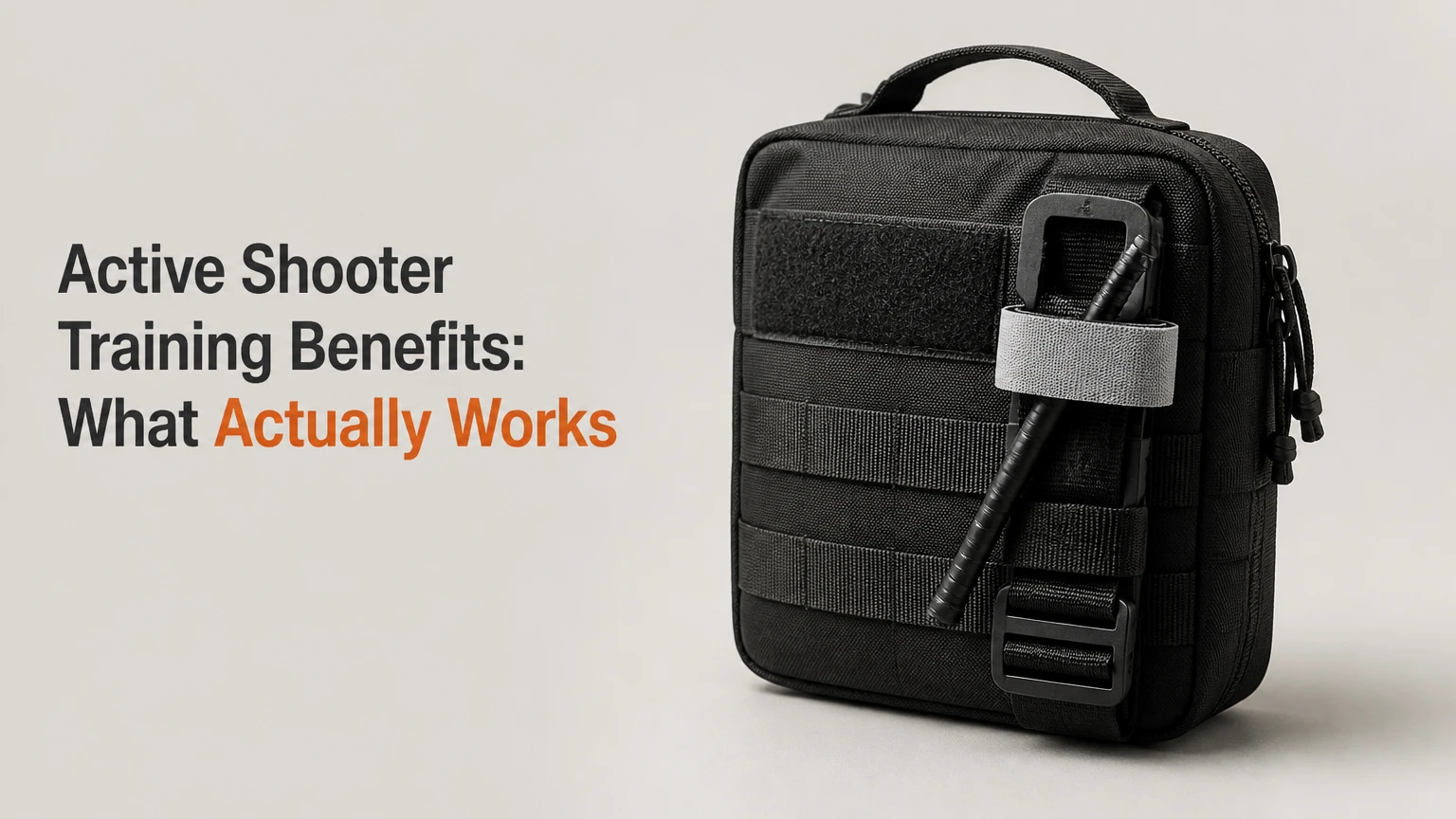
Medical training extends active threat preparedness by teaching people to control life-threatening bleeding before emergency medical teams can safely enter. The American College of Surgeons’ Stop the Bleed program focuses on direct pressure, wound packing, and tourniquet use, but medical training does not make civilians emergency physicians or authorize them to enter a danger area.
Organizations should place bleeding-control kits where people can reach them without entering a suspected threat zone. A kit may include commercial tourniquets, wound packing material, pressure dressings, gloves, trauma shears, and clear instructions, with contents selected and maintained by qualified personnel.
Training must establish boundaries. Do not retrieve equipment from an active danger area, do not delay evacuation to treat a patient, and do not assume a tourniquet eliminates the need for emergency care. After an incident, replace used supplies and provide psychological support for responders and witnesses.
What Makes a Drill Safe and Useful?
A useful drill tests decisions and systems without creating an uncontrolled simulation of violence. Organizations should announce the exercise, identify the date and scope, notify emergency services and building partners, prohibit weapons and realistic props, protect people who opt out, and provide a structured debrief.
The FBI and other public-safety agencies distinguish preparedness exercises from unscheduled shock events. Fake blood, actors posing as attackers, blank ammunition, simulated gunfire, blocked exits, and surprise confrontations can cause panic, injury, trauma, or a real police response.
Common drill failures and fixes
- Unannounced realism: Replace surprise with advance notice, written objectives, and a safety officer.
- Testing speed alone: Measure alert reach, route choice, communication accuracy, accessibility, and accountability.
- Ignoring nonparticipants: Provide an alternative learning activity and confidential support pathway.
- Practicing only during business hours: Include at least one alternate shift, weekend, or low-staff scenario where risk warrants it.
- Ending at evacuation: Add police-arrival behavior, reunification, family communications, records, and recovery.
- Collecting no corrective actions: Record each finding, assign an owner, and set a completion date.
What Should People Do When Police Arrive?
When police arrive, people should follow instructions, keep hands visible and empty, avoid sudden movements, avoid pointing, and continue moving away from danger unless officers direct otherwise. Responding officers may initially pass injured people while locating the threat, so individuals should not interpret that action as abandonment.
Employees should expect loud commands and rapid movement. If safely possible, leave belongings behind, do not stop officers for questions, and tell responders what they know only when directed or when doing so does not expose them to danger.
Organizations should explain that police response, medical triage, witness interviews, identification, and reunification may take time. Leaders should not promise immediate reentry or send staff back for personal property.
What Are the Limits and Ethical Risks?
Active shooter training cannot predict an attack, guarantee survival, reliably identify a future perpetrator, or replace physical security and violence-prevention work. Training may also increase anxiety if instructors use graphic material, imply personal blame, or present resistance as a duty.
The strongest programs use trauma-informed instruction. Participants should receive content warnings, clear objectives, accessible alternatives, confidential support information, and permission to step out without public disclosure. Organizations should consult occupational-health and mental-health professionals when employees report significant distress.
Training also has legal and ethical limits. Employers should review applicable occupational-safety, labor, disability, privacy, education, and emergency-management requirements with qualified local counsel. A generic online certificate does not prove that an organization has completed a risk assessment or maintained a workable emergency plan.
How Can Training Effectiveness Be Measured?
Training effectiveness should be measured through observable capabilities rather than attendance alone. Useful measures include alert delivery time, percentage of rooms with verified locking capability, number of employees who can identify two exits, accuracy of emergency reports, accessibility findings closed, and time to replace medical supplies.
| Measure | Collection method | Practical target example | Review interval |
|---|---|---|---|
| Alert reach | Test all channels and zones | 95% of occupied areas receive message | Quarterly |
| Exit knowledge | Anonymous employee survey | 80% identify primary and alternate exit | Semiannual |
| Door readiness | Facilities inspection | 100% of designated rooms verified | Monthly |
| Report quality | Tabletop scenario scoring | Location, direction, weapon, injuries included | Each exercise |
| Accessibility | Walkthrough with users | All assigned barriers have owners and dates | Each revision |
| Corrective actions | Action register | 90% closed by due date | Monthly |
These targets are planning examples, not universal standards. Compare results over time, publish non-sensitive findings, and change the curriculum when participants repeatedly make the same mistake.
Active Shooter Training Benefits: The Bottom Line
The most durable active shooter training benefits come from turning a vague emergency warning into a site-specific set of choices, communications, medical capabilities, and recovery actions. Use Run, Hide, Fight or ALICE as teaching language, then validate the plan against the actual building, population, responders, accessibility needs, and local law.
A short online module is a starting point, not a complete program. The credible standard is a blended, trauma-informed cycle that trains new staff, tests systems safely, includes Stop the Bleed where appropriate, measures observable performance, and closes identified gaps.
Frequently Asked Questions
Is active shooter training required by law?
Requirements vary by country, state, industry, and facility type. Some jurisdictions require workplace-violence prevention plans or healthcare-specific training, while others do not mandate a particular active-threat curriculum. Employers should check current occupational-safety rules, collective-bargaining obligations, education regulations, and local emergency-management requirements before selecting a course.
How often should employees repeat the training?
Most organizations should provide awareness training during onboarding and refresh core procedures at least annually, with additional sessions after relocation, major staffing changes, a revised emergency plan, or a significant exercise finding. High-risk settings may need more frequent briefings, while repetition should focus on changed procedures rather than replaying identical slides.
Does active shooter training include firearms training?
Civilian active shooter awareness training generally does not include firearms instruction. Firearms training requires separate legal authority, certified instructors, controlled facilities, storage procedures, and a defined job role. Most employees need evacuation, sheltering, communication, emergency medical, and law-enforcement coordination skills instead.
Can training prevent workplace violence?
Training can support prevention by clarifying reporting channels, improving threat-assessment referrals, and helping managers respond to concerning behavior consistently. Training alone cannot prevent every act of violence. Prevention also requires appropriate hiring and access controls, respectful personnel practices, security measures, investigation procedures, and qualified threat-management resources.
What should a small business do with a limited budget?
A small business can begin with a written, site-specific plan, a 30-60-minute awareness course, an exit and door inspection, emergency contact cards, and a facilitated tabletop discussion. The business should then purchase accessible bleeding-control supplies, coordinate with the property manager, and correct physical hazards before paying for a high-fidelity drill.
Should employees be allowed to skip a drill?
Employees should have a safe alternative to a live exercise, especially when they have trauma, disability, sensory, pregnancy-related, or religious concerns. Opting out should not remove access to essential information. A trauma-informed program measures system performance without forcing participation in distressing simulations.