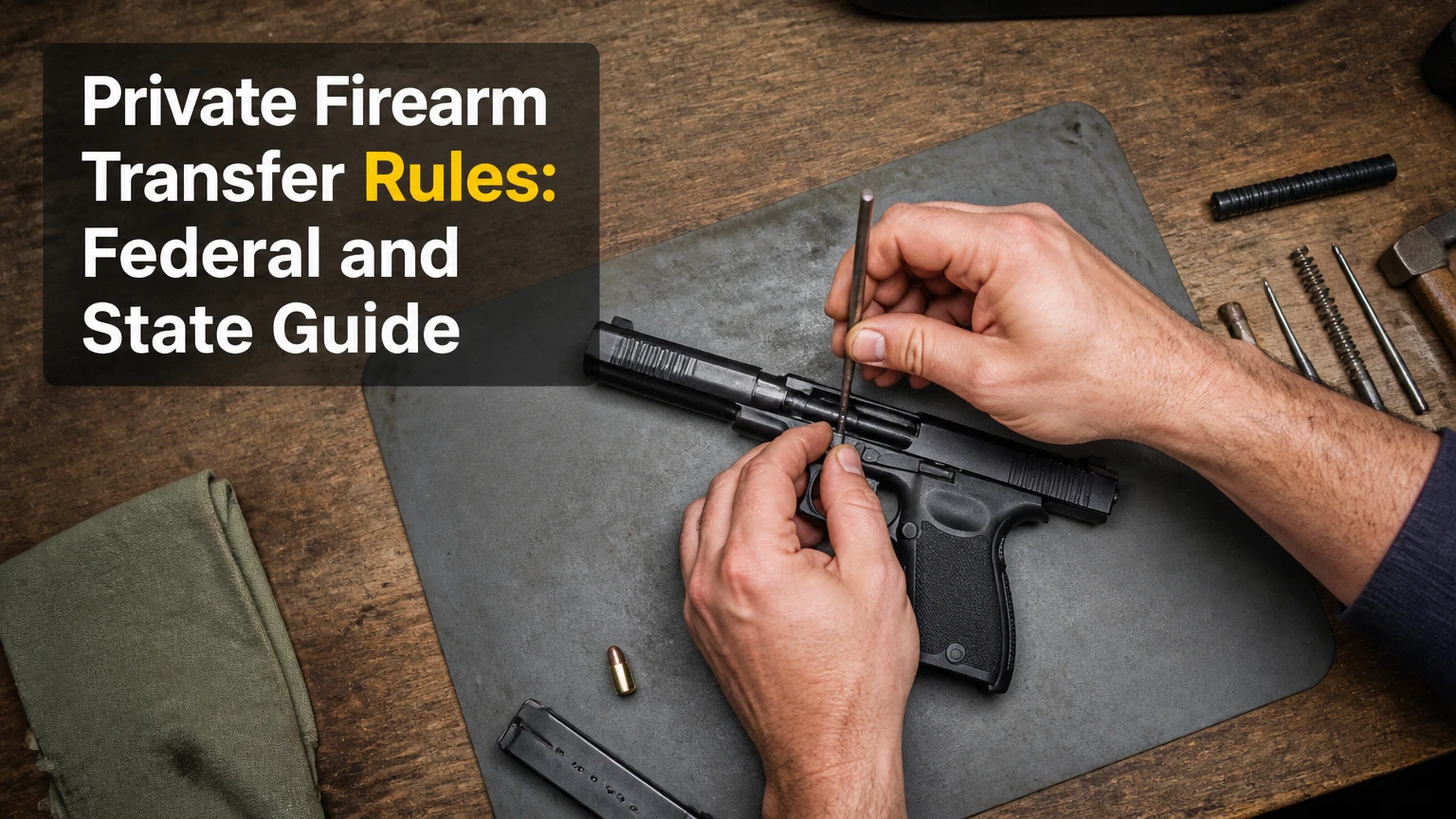
Private firearm transfer rules depend first on the parties’ states of residence, then on the firearm category and the reason for transfer. Federal law generally permits an unlicensed person to transfer a firearm directly to another resident of the same state when no state restriction applies, but interstate transfers usually must go through an FFL in the recipient’s state, and no transfer may knowingly involve a prohibited person.
Key Facts at a Glance
Federal law generally prohibits an unlicensed person from directly transferring a firearm to an unlicensed resident of another state.
A private seller may not transfer a firearm to a person the seller knows, or has reasonable cause to believe, is prohibited from possessing it.
An FFL-facilitated transfer normally requires the buyer to complete ATF Form 4473 and pass a NICS or state background check.
A dealer transfer does not create a national ownership registry and does not automatically eliminate the seller’s legal exposure.
State law may require background checks, permits, reporting, waiting periods, age limits, or FFL involvement even when federal law does not.
Suppressors, short-barreled rifles, machine guns, and other NFA firearms follow separate federal transfer rules.
What Counts as a Private Firearm Transfer?
A private firearm transfer is a change in possession or ownership between people who are not acting as licensed firearms dealers. The transaction can be a sale, gift, exchange, inheritance, or other delivery, although each purpose can trigger different federal and state requirements.
The federal Gun Control Act does not treat every occasional sale by a firearm owner as dealer activity. ATF guidance states that, “A person may make occasional sales, exchanges, or purchases of firearms for the enhancement of a personal collection or for a hobby, without being licensed as a dealer.” The relevant question is whether the person is engaged in the business of dealing firearms for livelihood and profit, rather than merely disposing of personal firearms.
A personal seller should not rely on labels such as “private sale” or “gun-show sale.” A person who repeatedly buys firearms for resale, advertises a business, maintains inventory, or sells with the objective of earning a livelihood may need a Federal Firearms License. The 2024 ATF rule, effective May 20, 2024, provides additional guidance on when a person is engaged in the business.
Which federal rules apply to every private transfer?
The most important federal rule is the prohibition on transferring a firearm to a person known, or reasonably believed, to be prohibited. Federal prohibited categories include people convicted of qualifying crimes punishable by more than one year, fugitives, unlawful users of controlled substances, certain people adjudicated mentally defective or committed to a mental institution, people unlawfully present in the United States, people dishonorably discharged from the Armed Forces, people who renounced U.S. citizenship, and people subject to qualifying domestic-violence restrictions.
Federal law also restricts transfers to certain people under indictment for a crime punishable by more than one year, although the precise prohibition applies to firearms capable of being shipped or transported in interstate commerce. State prohibitions can be broader.
A seller should stop the transaction when the buyer discloses a disqualifying condition, appears intoxicated, offers an unusual premium to avoid paperwork, asks the seller to conceal the buyer’s identity, or refuses reasonable identity and residency verification. A private seller is not required to conduct a NICS check under the federal baseline in many same-state transactions, but the absence of a required check does not excuse an unlawful transfer.
How Do Private Firearm Transfer Rules Work by Residency?
Residency controls the federal transfer pathway. A same-state transfer may be completed directly if state law allows it, while an interstate transfer generally must be delivered to an FFL in the buyer’s state for lawful transfer to that buyer.
Same-state private transfer
A direct same-state transaction involves two residents of the same state. The seller should verify the buyer’s current government-issued identification, confirm that the address establishes state residency, determine that the buyer meets the applicable minimum age, and address any state permit or background-check requirement.
Federal law does not generally require a Form 4473, NICS check, or FFL for a direct transfer between two residents of the same state. State law may change that result. Washington, Colorado, California, New York, Oregon, Illinois, Connecticut, Delaware, Maryland, New Jersey, Nevada, Rhode Island, and Vermont are examples of jurisdictions with significant requirements, but statutes and exemptions differ by firearm type and transaction.
A bill of sale is usually a prudent private record, not a substitute for a required state process. It should identify the parties, date, firearm manufacturer, model, type, caliber or gauge, and serial number, while avoiding unnecessary sensitive information.
Interstate private transfer
An unlicensed seller generally may not directly transfer a firearm to an unlicensed resident of another state. Under 18 U.S.C. § 922(a)(5), the seller must arrange delivery to an FFL in the buyer’s state, subject to federal and state exceptions.
The buyer should select a receiving FFL before money changes hands. The seller or another FFL then ships the firearm according to the receiving dealer’s instructions. The buyer completes Form 4473 at the receiving FFL, undergoes the required background check, satisfies state waiting or permit rules, and receives the firearm only after the dealer may lawfully release it.
| Transaction | Federal baseline | Typical required checkpoint |
|---|---|---|
| Same-state sale between unlicensed residents | Direct transfer generally permitted | State background check, permit, age, and reporting rules |
| California private-party transfer | Dealer processing generally required | California FFL, DROS, eligibility check, waiting period |
| Pennsylvania private handgun sale | FFL or sheriff processing generally required | Background check and applicable Pennsylvania procedure |
| Interstate sale to an unlicensed buyer | Direct handoff generally prohibited | Receiving FFL in buyer’s state, Form 4473, NICS or state check |
| Transfer between two FFLs | Licensee-to-licensee shipment permitted under federal rules | Valid license verification and A&D records |
| Out-of-state inheritance | Federal exceptions may apply in narrow circumstances | Estate documents, recipient eligibility, destination-state law |
The firearm’s physical location is not the only issue. The parties’ legal residences and the intended recipient determine whether the transaction is interstate.
What Is the Lawful Transfer Process?
The safest process begins with classification, not with payment. Identify the parties’ residency, firearm type, transfer purpose, and state requirements before arranging delivery.
Step 1: Classify the transaction
Write down four facts: seller’s state, buyer’s state, firearm type, and transfer reason. A handgun, long gun, frame or receiver, NFA item, gift, estate transfer, and temporary loan may follow different rules.
Check the current official sources for the relevant state. Useful sources include the state police or department of public safety, attorney general, legislature, and the receiving FFL. Retail blogs and old forum posts may omit recent amendments.
Step 2: Confirm buyer eligibility
Ask the buyer whether any federal or state prohibition applies. A private seller should not attempt to conduct a legal analysis of a complicated criminal record, restraining order, substance-use history, immigration status, or mental-health adjudication.
A seller who has credible reason to believe the buyer is prohibited should not transfer the firearm. A background check performed later by an FFL cannot retroactively legalize an earlier unlawful handoff.
Step 3: Choose direct transfer or FFL processing
Use a direct transfer only when the parties are residents of the same state and current state law permits that route. Use an FFL when federal law requires it, state law mandates it, the firearm is being shipped across state lines, or the parties need a dealer to handle the eligibility check and paperwork.
An FFL is also a practical choice when the seller is uncertain about residency, the firearm’s classification, or state reporting rules. Dealer involvement adds cost and may add a waiting period, but it creates a documented compliance process.
Step 4: Prepare the firearm and records
Unload the firearm and separate ammunition before transport. Record the manufacturer, model, type, caliber or gauge, and serial number exactly as marked. A bill of sale should also include the date, price or gift status, names and addresses of the parties, and a statement that the buyer is legally eligible to possess the firearm to the best of the buyer’s knowledge.
A bill of sale does not prove that a transfer complied with state law. It also does not transfer an NFA item without ATF approval.
Step 5: Complete the dealer transaction when required
At the FFL, the buyer completes the current ATF Form 4473 personally and truthfully. The dealer verifies identity and residency, conducts the NICS or state check, records the acquisition and disposition as required, and follows applicable waiting, permit, and delivery rules.
The dealer keeps the completed Form 4473 under federal record-retention rules. A completed Form 4473 is generally retained for 20 years, while records involving a denied transfer are generally retained for five years. These dealer records support firearm tracing; they do not constitute a publicly searchable national registry of every firearm owner.
Step 6: Release the firearm only after approval
A “Proceed” allows the dealer to continue, but state law may impose additional conditions. A NICS “Delay” is not an approval. Under federal law, an FFL may generally transfer after three business days without a final denial, but the dealer is not required to do so, and state law may prohibit release.
The transfer is complete only when the firearm is lawfully delivered. Keep the receipt, state approval, permit information, and shipping documentation for the period recommended by local counsel or the applicable state agency.
Which Transfer Methods Should You Compare?
The appropriate method depends on legality first, then cost, speed, privacy, and the strength of the record created. Direct same-state delivery is usually cheapest, while FFL processing is the standard route for interstate transactions and regulated states.
| Method | Legal setting | Typical cost | Typical timing | Main paperwork |
|---|---|---|---|---|
| Direct same-state sale | Permissive state, eligible buyer | $0-$30 | Same day | Bill of sale recommended |
| Same-state FFL transfer | State mandate or voluntary screening | $25-$100+ | 15 minutes to 10 days | Form 4473, state form, NICS |
| Interstate FFL transfer | Buyer and seller live in different states | $50-$150 before shipping | 2-14 days plus state delay | FFL copies, shipping record, Form 4473 |
| Family gift | Same-state or qualifying exception | $0-$100 | Same day to several weeks | State report or FFL documents |
| Estate or inheritance | Death, bequest, or intestate succession | $0-$200+ | Several days to months | Probate and identity documents |
| NFA transfer | Suppressor, SBR, SBS, machine gun, or other NFA item | $200 federal tax for many Form 4 transfers, plus fee | Months or longer | ATF Form 4 and approval |
Direct sale versus FFL-facilitated transfer
A direct sale avoids dealer fees and may occur immediately, but it provides less formal evidence that eligibility was checked. An FFL transaction costs more and may delay delivery, yet it gives the parties a standardized Form 4473 and dealer record.
The FFL does not “remove the gun from the seller’s name,” because federal law does not maintain a universal title registry. The dealer records the firearm’s receipt and disposition in an A&D record, but that record is not a guarantee against future investigation, civil claims, or state registration obligations.
Winner: Direct transfer for a clearly lawful same-state transaction where cost and speed dominate; FFL processing for interstate, regulated-state, or uncertainty-heavy transactions.
Gifts, family transfers, and inherited firearms
A gift is still a transfer. A parent giving a handgun to an adult child may avoid consideration or payment, but the recipient must be eligible and the state may require a dealer, background check, permit, or report.
Federal law contains limited exceptions involving bequests and intestate succession, but an out-of-state heir should not assume that an estate can bypass every FFL rule. State law may regulate possession, transportation, registration, assault-weapon features, magazine capacity, or inheritance reporting.
Winner: A documented estate or family process using the official state procedure, with an FFL when residency or state law creates uncertainty.
How Much Do Private Transfers Cost and How Long Do They Take?
A direct same-state transfer can cost nothing beyond travel and documentation, while a dealer-facilitated transfer commonly costs $25-$100 or more before shipping, taxes, storage, or state fees. A straightforward NICS response may take minutes, but waiting periods and delayed checks can extend pickup from days to weeks.
| Cost or time item | Typical figure | What changes it |
|---|---|---|
| Private bill of sale | $0-$20 | Attorney-drafted form, notarization, state filing |
| Local FFL transfer fee | $25-$100+ | Region, firearm count, dealer policy |
| Interstate shipping | $30-$100+ | Carrier, insurance, adult signature, distance |
| State transfer or permit fee | $0-$100+ | State agency and firearm category |
| Immediate NICS response | Minutes | Correct data and no database ambiguity |
| Federal delayed-check window | 3 business days | Dealer policy and state restrictions |
| State waiting period | 0-15 days typical | State statute, permit status, firearm type |
| NFA Form 4 processing | Variable, often months | ATF workload, electronic or paper filing |
NICS checks do not have a universal “approval expiration” that permits any later transfer. An FFL may generally rely on a NICS check for the same transaction for up to 30 days under ATF procedures, but a new transaction, changed buyer, changed firearm, or state requirement can require a new check.
What Special Cases Change the Rules?
Special cases can alter the ordinary transfer pathway, but they do not create a universal exemption from eligibility, state law, or safe handling requirements.
NFA firearms
A private transfer of a suppressor, short-barreled rifle, short-barreled shotgun, machine gun, destructive device, or other National Firearms Act firearm generally requires an approved ATF Form 4 before the recipient takes possession. The transferor must not deliver the item merely because the parties have submitted paperwork.
Many Form 4 transfers require a $200 transfer tax, although limited categories and historical rules can differ. A trust may own an NFA firearm, but each responsible person can have separate compliance obligations. Machine guns manufactured after May 19, 1986, generally cannot be transferred to ordinary civilian purchasers under federal law.
Frames, receivers, and unfinished items
A frame or receiver may be treated as a firearm under federal law even when it is not assembled as a complete gun. State definitions can be broader, and unfinished receivers may be regulated differently by federal and state authorities.
The buyer should ask the FFL and state regulator how the item must be identified on Form 4473 and whether state serialization or background-check rules apply. Avoid assuming that “parts” means “unregulated.”
Temporary loans and range transfers
A temporary loan is still a transfer of possession and can create legal problems when the recipient is prohibited, lives in another state, or receives the firearm for an extended period. Federal law contains specific provisions for temporary loans and rentals for lawful sporting purposes, but the details depend on residency, purpose, and duration.
A person should not leave a firearm with an out-of-state friend, lend it to a prohibited household member, or transport it across state lines without checking the applicable rules.
What Mistakes Create the Greatest Risk?
The most serious private-transfer errors involve interstate delivery, prohibited recipients, straw purchases, inaccurate Form 4473 answers, and incorrect assumptions about state exemptions. Each error can create criminal exposure even when the firearm itself was lawfully acquired.
- Directly handing a firearm to an out-of-state buyer: Arrange delivery through an FFL in the buyer’s state instead.
- Ignoring warning signs: Stop when a buyer admits ineligibility, asks for concealment, or offers money to avoid documentation.
- Treating an FFL receipt as immunity: Dealer processing creates records but does not excuse a knowingly unlawful sale.
- Using a family label to bypass the law: A parent-child gift may still require a state report, permit, or dealer.
- Signing an incomplete or false Form 4473: The buyer must answer personally and accurately; a seller should never coach an answer.
- Shipping without dealer confirmation: Obtain the receiving FFL’s acceptance, shipping address, carrier requirements, and fee schedule before shipment.
- Assuming a denied check means the firearm automatically returns: The dealer must follow the transaction and disposition rules, while the buyer may challenge the denial through the FBI NICS process.
- Failing to check prohibited features: State assault-weapon, magazine, barrel-length, and transportation restrictions may apply after the federal transfer analysis.
An important practitioner rule is to treat residency as a documentable legal fact, not a conversational assumption. A driver’s license from one state, a temporary residence in another, and a military or student exception can produce different results.
What Should You Do When NICS Is Delayed or Denied?
A NICS delay pauses the ordinary transfer process, while a denial means the dealer may not deliver the firearm unless the denial is successfully reversed or another lawful pathway applies. The buyer should obtain the transaction number and use the FBI NICS challenge or Voluntary Appeal File procedures when appropriate.
A dealer may choose not to transfer after the federal three-business-day period, even where federal law permits release. State law, dealer policy, an unresolved state permit condition, or a later disqualifying fact can prevent delivery.
The seller should not privately hand the firearm to the delayed or denied buyer. If the transaction ends, the dealer should document the disposition and return the firearm according to the agreed terms. A denied buyer should consult a firearms attorney when the denial involves a criminal-record error, identity confusion, domestic-violence record, immigration issue, or state prohibition.
What Records Should a Private Seller Keep?
A private seller should retain a dated bill of sale and a copy of the buyer’s identification only when lawful, necessary, and securely stored. The seller should not collect more personal data than needed, and a bill of sale should not be treated as a federal registration document.
A useful record contains:
- Seller and buyer names and addresses.
- Transaction date and whether the transfer was a sale, gift, or exchange.
- Manufacturer, model, type, caliber or gauge, and serial number.
- Price or a statement that no money changed hands.
- A signed eligibility representation from the buyer.
- FFL name, license information, receipt, or shipping tracking number when applicable.
- State permit, approval, or reporting confirmation when required.
Keep records encrypted or physically secured. Do not publish serial numbers, addresses, or identity documents online. Retention periods vary; federal law does not impose one universal indefinite retention period on every private seller, so state requirements and legal advice control.
Frequently Asked Questions
Can I sell a firearm without an FFL?
A private seller can generally sell a firearm directly to another resident of the same state when federal and state law permit the transaction and the buyer is eligible. An interstate sale to an unlicensed buyer generally requires delivery to an FFL in the buyer’s state. State universal-background-check laws can also require dealer processing for same-state sales.
Does a bill of sale make a private transfer legal?
A bill of sale documents the transaction but does not make an otherwise unlawful transfer legal. A written record cannot replace a required background check, permit, waiting period, FFL transfer, or ATF approval. Its main value is identifying the parties, firearm, date, and transfer terms if questions arise later.
Can I transfer a firearm to a friend in another state?
An unlicensed person generally cannot directly transfer a firearm to an unlicensed friend who resides in another state. The firearm should be delivered to an FFL in the friend’s state, where the friend completes Form 4473, passes the required check, and satisfies that state’s waiting, permit, and possession requirements.
Can a felon receive a firearm from a family member?
A person prohibited under federal or state law cannot lawfully receive a firearm from a family member. A gift, inheritance, private sale, or transfer through another person does not remove the prohibition. The owner should obtain legal advice about surrender, storage, estate administration, or another lawful disposition.
Is a background check required for every private firearm sale?
Federal law does not require a background check for every same-state private sale, but many states require one for all or many private transfers. Some states distinguish handguns from long guns, use permits instead of NICS checks, or recognize limited family and inheritance exceptions. The current law of the transaction’s state controls.
What is the safest way to handle a private firearm transfer?
The safest method is to use an FFL whenever the transaction is interstate, state-regulated, legally uncertain, or involves a high-risk recipient situation. Verify residency and eligibility, keep the firearm unloaded during transport, document the firearm accurately, and never deliver an NFA item before ATF approval.
Conclusion: Apply the Rules Before the Handoff
Private firearm transfer rules are easiest to apply when the transaction is classified before the parties exchange money or possession. Same-state direct transfers may be lawful under federal law, interstate transfers generally require a buyer-state FFL, and state law can add background checks, permits, reporting, waiting periods, and firearm-specific restrictions.
When the facts involve different states, an NFA item, inheritance, a family exemption, a prior criminal record, or an uncertain dealer-status question, confirm the current rule with the relevant state agency, FFL, or firearms attorney before transferring the firearm.