Firearm safety education for families is a coordinated system of secure storage, adult handling training, age-appropriate child instruction, and repeated household rules. Its purpose is to prevent unauthorized access, negligent discharge, theft, and firearm suicide risk. Education reduces confusion, but physical separation through locked storage remains the primary control.
Key Facts at a Glance
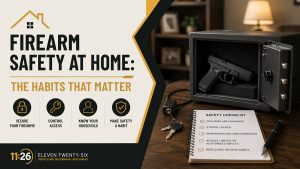
The safest child-access standard is unloaded, locked, and inaccessible to unauthorized users.
A hidden firearm is not securely stored because children, visitors, and burglars can discover concealed locations.
Children should memorize: stop, do not touch, leave the area, and tell a trusted adult.
Cable and trigger locks can prevent firing, but they generally do not prevent theft of the firearm.
Quick-access safes require a tested backup plan for dead batteries, failed biometric scans, lost keys, or forgotten combinations.
Families should review storage, guest access, and emergency contacts at least quarterly and after any household change.
What Does Firearm Safety Education for Families Include?
Firearm safety education for families includes four connected controls: secure storage, competent adult handling, child discovery training, and household access management. The system applies to gun-owning families, non-owner households where children visit homes with guns, caregivers, babysitters, and relatives who bring firearms into the home.
Education is not a substitute for a lock. A child’s promise, a high shelf, a locked bedroom door, or a conversation cannot provide the same protection as a firearm secured against unauthorized access. Project ChildSafe summarizes the storage problem with the phrase, “There is no such thing as a childproof gun.” The practical implication is clear: design the environment so a child cannot reach or operate the firearm.
The prevention model has two layers:
- Behavioral controls: Adults learn safe handling, children learn what to do after discovering a firearm, and every household member follows a no-touch rule.
- Physical controls: Firearms remain unloaded when appropriate, locked in a purpose-built container, and inaccessible to children, visitors, thieves, and anyone experiencing a crisis.
The exact legal storage standard varies by country, state, province, and municipality. Families should verify local requirements through an official government source, law-enforcement agency, or qualified firearms attorney rather than relying on an internet summary.
How Does a Family Firearm Safety Plan Work?
A family firearm safety plan works by assigning responsibility before a risky event occurs. Adults control storage and access; children use a simple response script; guests and caregivers follow the same access rules; and the family periodically checks whether the system still works.
The plan should answer five operational questions:
- Where is every firearm stored?
- Who can access each lock, key, code, or biometric credential?
- Where is ammunition stored?
- What should a child do after seeing a firearm?
- What happens if the owner is injured, intoxicated, emotionally distressed, absent, or unable to open the safe?
A useful plan uses a closed-loop rule: a firearm is either under the direct control of an authorized adult or secured in its locked storage location. “Temporarily unattended” is not a separate safe category. A loaded handgun in a purse, nightstand, vehicle console, or backpack can become accessible within seconds.
Who Has Which Responsibility?
| Household role | Required action | Review interval | Failure response |
|---|---|---|---|
| Firearm owner | Store every firearm and control credentials | Every day | Correct access immediately |
| Other adult caregiver | Know storage location and emergency contact | Monthly | Rebrief before supervising children |
| Child under 8 | Stop, do not touch, leave, tell | Monthly practice | Repeat script calmly |
| Child age 8-12 | Use discovery script and report peer access | Quarterly | Notify an adult immediately |
| Teenager | Follow handling rules and report unsafe access | Monthly | Suspend access and review training |
| Babysitter or guest | Never handle or move a firearm | Before visit | Remove firearm from access area |
How Do You Set Up Firearm Safety Education for Families?
A complete setup usually takes 30-60 minutes initially, plus the time required to install storage hardware and complete adult training. The most important success factor is not the type of lock, but whether every firearm remains inaccessible whenever an authorized adult is not physically controlling it.
Before You Start
| Planning item | Typical requirement | Practical benchmark |
|---|---|---|
| Initial family briefing | 30-60 minutes | Repeat quarterly |
| Storage inspection | 15-30 minutes | Check every firearm |
| Basic adult course | 3-4 hours | Use a qualified instructor |
| Cable or trigger lock | $0-$25 | Often available through local programs |
| Quick-access safe | $100-$450 | Test under normal conditions |
| Large safe or vault | $600-$2,500+ | Anchor according to manufacturer instructions |
| Ammunition container | $30-$250 | Lock separately where practical |
Step 1: Evaluate Home and Household Risk
Inventory every firearm, ammunition container, key, code, and backup credential. Record whether each firearm is stored at home, transported in a vehicle, kept at a second residence, or temporarily loaned to another adult.
Inspect bedrooms, closets, garages, vehicles, bedside areas, bags, and cleaning locations. Include firearms belonging to visitors. A household risk review must account for toddlers, older children, teenagers, visiting relatives, babysitters, contractors, domestic conflict, substance use, cognitive impairment, and suicidal thinking.
You will know this step worked when an authorized adult can account for every firearm without searching. The common mistake is assessing only the gun owner’s bedroom while ignoring a loaded firearm in a purse, vehicle, or guest room.
Step 2: Install Secure Storage
Store firearms in a locked container or with a locking device that prevents unauthorized access. Store firearms unloaded when they are not being carried or used, and secure ammunition separately where feasible and required by local law.
Choose storage based on the threat model. A cable lock can obstruct firing, but a thief may still remove the firearm. A locked handgun safe can restrict child access, while a heavier anchored safe offers stronger theft resistance. No lock is automatically safe because its label says “childproof” or “biometric.”
You will know this step worked when a child cannot reach the firearm, open the container, observe the code, or access a spare key. The common mistake is buying a lock without testing its mounting, credential control, durability, and failure procedure.
Step 3: Teach the Discovery Script
Teach children a short response: stop, do not touch, leave the area, and tell an adult. The child should move away without attempting to identify, unload, hide, or photograph the firearm, then report the location to a trusted adult.
Use direct language. Say that a real firearm can injure or kill someone even when it looks unloaded, appears broken, or resembles a toy. Explain that children should leave immediately if a friend displays a firearm, regardless of the friend’s promise that it is safe.
Practice with verbal scenarios rather than placing a real firearm or realistic replica in a child’s path. The American Academy of Pediatrics recommends asking about firearm storage before a child visits another home. The common mistake is testing children with an actual firearm, which creates unnecessary exposure and may teach curiosity rather than avoidance.
Step 4: Establish Adult Handling Rules
Adults should receive formal instruction from a qualified, safety-focused instructor before handling unfamiliar firearms. Core handling principles include keeping the muzzle pointed in a safe direction, keeping the trigger finger outside the trigger guard until intentionally firing, treating every firearm as loaded, and identifying the target and what lies beyond it.
Only an authorized adult should open a storage container, clear a firearm, clean it, or transport it. Children and untrained guests should not be asked to hold a firearm “for a minute,” even under casual supervision.
You will know this step worked when every adult can state who may access the firearm and what happens after use. The common mistake is allowing a second adult to handle a firearm without confirming training, sobriety, and authorization.
Step 5: Audit, Practice, and Update
Conduct a quarterly review of locks, hinges, mounting hardware, batteries, combinations, keys, and biometric recognition. Confirm that ammunition remains secured, children have not observed access credentials, and visiting children cannot enter the storage area.
Practice the discovery script through discussion and role-play without real firearms. Ask, “What would you do if a friend showed you a gun?” Do not create surprise tests that frighten children or place them near firearms.
You will know this step worked when children can recite the response and adults can open or secure the container under ordinary conditions. The common mistake is testing only the lock while ignoring changing circumstances such as a new babysitter, move, divorce, medication change, or adolescent mental-health concern.
Which Storage Option Fits a Family Home?
The best storage method depends on the access threat, the number of firearms, response time, theft risk, and the owner’s ability to maintain the device. A quick-access safe may reduce delay for an authorized adult, but it must still block children and include a reliable recovery plan.
| Storage option | Typical price | Main protection | Main limitation | Appropriate use |
|---|---|---|---|---|
| Cable lock | $0-$25 | Helps prevent firing | Does not secure the whole firearm from theft | Temporary additional layer |
| Trigger lock | $5-$30 | Blocks trigger access | Fit varies; unsafe if incorrectly installed | Stored unloaded firearms |
| Mechanical push-button safe | $200-$450 | No battery dependency | Code exposure and slower access | Frequently accessed handgun |
| Biometric quick-access safe | $100-$300 | Rapid credential access | Battery or scan failure | Adult-controlled defensive storage |
| Keyed lockbox | $40-$180 | Simple mechanical access | Key can be lost or copied | Travel or backup storage |
| Anchored gun safe | $600-$2,500+ | Theft and child resistance | Weight, cost, installation | Multiple long guns or collection |
Are Biometric Safes Better Than Mechanical Safes?
Biometric safes are not universally better than mechanical safes. Biometric models can provide rapid access without a visible combination, while mechanical push-button safes avoid batteries and fingerprint-reader failures; the better choice is the model an authorized adult can operate reliably and maintain.
| Feature | Biometric safe | Mechanical safe | Family decision question |
|---|---|---|---|
| Power source | Battery, often 6-12 months typical | None | Can the owner check batteries monthly? |
| Access credential | Fingerprint or backup code | Push-button combination | Can children observe or guess it? |
| Failure mode | Dirty sensor, dead battery, wet finger | Forgotten or exposed code | Is a secure backup available? |
| Typical access | Seconds after successful scan | Seconds to tens of seconds | Does the household need rapid access? |
| Maintenance | Battery and sensor testing | Mechanical inspection | Who performs the check? |
| Theft resistance | Varies by steel and mounting | Varies by steel and mounting | Is the safe anchored? |
A biometric reader should be programmed and tested with the owner’s real conditions, including the finger used during ordinary access. Families should not depend on a single electronic safe without a lawful, secure backup plan. Mechanical locks are not maintenance-free either; combinations must remain private and the mechanism must be checked.
Large fireproof safes protect against some fire exposure and opportunistic theft, but “fireproof” is not absolute. Fire ratings describe test conditions, duration, and internal temperature limits, so families should read the manufacturer’s rating rather than treating the label as a guarantee.
What Does Secure Storage Cost?
Typical household secure-storage costs range from $0 for a distributed basic lock to more than $2,500 for a large anchored vault, excluding professional installation and firearms training. The appropriate budget depends on the number of firearms, required access speed, theft exposure, and whether a separate ammunition container is needed.
| Safety component | Typical cost | Replacement or review interval | Cost variable |
|---|---|---|---|
| Basic cable lock | $0-$25 | Replace if damaged | Local distribution program |
| Trigger lock | $5-$30 | Inspect each use | Firearm compatibility |
| Handgun lockbox | $40-$180 | Inspect quarterly | Steel thickness and mounting |
| Biometric safe | $100-$300 | Battery every 6-12 months | Reader and backup lock |
| Mechanical safe | $200-$450 | Inspect quarterly | Capacity and construction |
| Large anchored safe | $600-$2,500+ | Service per manufacturer | Fire rating and installation |
| Adult safety course | $70-$150 per person | Refresher as needed | Instructor and location |
A low-cost lock is better than no lock, but it may not solve theft risk or rapid-access needs. Families should spend first on a storage system that blocks child access, then add a cable or trigger lock as a secondary control when compatible with the firearm and manufacturer instructions.
What Should Children Learn at Different Ages?
Children should learn the same discovery response at every age, but the explanation, supervision, and level of detail should change. Young children need a memorable boundary; school-age children need peer-scenario practice; teenagers need formal education, legal responsibility, and mental-health safeguards.
| Age or stage | Instruction focus | Adult supervision | Avoid |
|---|---|---|---|
| Preschool, roughly 3-5 | Stop, do not touch, leave, tell | Continuous physical storage control | Assuming repetition creates access safety |
| Early school age, 6-8 | Discovery script and trusted adults | Ask about friends’ homes | Using a real firearm for demonstrations |
| Preteen, 9-12 | Peer pressure and reporting | Discuss every playdate | Treating silence as maturity |
| Teenager, 13-17 | Formal training and legal duties | Locked storage remains mandatory | Unsupervised access based only on age |
| Young adult | Ownership, transport, storage, crisis planning | Review independently | Assuming household rules no longer matter |
Educational programs such as the NRA’s Eddie Eagle initiative focus on a simple child response and are designed for younger children. Such programs can support a family plan, but no curriculum verifies storage in another home and no slogan replaces adult-controlled physical security.
How Should Families Handle Playdates and Visiting Children?
Families should ask hosting parents whether firearms are present and securely stored before a playdate. A neutral question such as, “Are there any firearms in the home, and are they locked and inaccessible to children?” treats storage as an ordinary safety issue rather than an accusation.
For visitors to a gun-owning home, secure every firearm before the child arrives. Do not rely on the visiting child’s age, trustworthiness, or prior training. Keep keys, combinations, and backup credentials away from children, and verify that a guest cannot enter the storage room.
Non-gun-owning households also need a plan because children may encounter firearms elsewhere. Parents can teach the discovery script, ask caregivers about storage, and instruct children to report any firearm immediately without touching it. This is one of the highest-value actions available to families without firearms.
What Changes When a Teenager Has Access or a Mental-Health Crisis?
A teenager should receive age-appropriate formal safety instruction, but education does not justify unlocked or unsupervised firearm access. During suicidal thinking, severe depression, psychosis, intoxication, domestic violence, or another acute crisis, remove firearms from the home or place them under verified control outside the person’s access.
The National Suicide Prevention Lifeline’s practical approach is consistent with means-safety principles: increasing time and distance from lethal means can create an opportunity for intervention. Families should contact emergency services or a crisis service when there is immediate danger, and they should ask a healthcare professional about urgent safety planning.
Temporary crisis storage may involve a lawful transfer to a trusted, eligible adult, a licensed dealer, or another option recognized by local law. Families must verify transfer, transport, and possession rules before moving the firearm. Changing a safe code is not enough if another person knows the backup key or can access the safe.
What Are the Most Common Safety Failures?
The most common failures involve access assumptions rather than equipment defects. Families often secure a firearm during normal routines but leave it exposed during cleaning, travel, illness, conflict, or an unexpected visit.
- Hiding instead of locking: Children search successfully, and burglars know common hiding places.
- Leaving a firearm in a purse or vehicle: A portable container can become accessible to children or thieves.
- Using a lock without controlling the key: A locked firearm is not protected if the key is in a nearby drawer.
- Ignoring ammunition access: Separate ammunition storage reduces unauthorized access, but the ammunition container also needs a controlled lock.
- Relying on one battery-powered device: A dead battery can defeat the planned access method.
- Using an overly complex emergency system: Stress, darkness, injury, gloves, and poor fine-motor control can make complicated access unreliable.
- Treating training as permanent: Skills and household conditions change, so adults need refreshers and audits.
- Demonstrating a firearm to satisfy curiosity: Realistic demonstrations can increase exposure and handling interest; supervised classroom or instructor-led education is safer.
A practitioner rule of thumb is to test the entire chain, not just the lock: firearm unloaded status, container closure, mounting, credential privacy, ammunition security, backup access, and adult response. One weak link can defeat the plan.
How Should Families Respond to Special Situations?
If a Safe Battery Dies
Do not leave the safe open or move the firearm to an unsecured location. Follow the manufacturer’s external power or mechanical backup procedure, replace batteries on a scheduled basis, and select a backup method that remains inaccessible to children.
If a Child Finds a Firearm
The child should stop, avoid touching it, leave the area, and tell an adult. The adult should keep others away, avoid handling the firearm unless trained and legally authorized, and contact emergency services if the firearm is unsecured, loaded status is unknown, or anyone may be in immediate danger.
If a Firearm Is Stolen
Report the theft promptly to local law enforcement and preserve information about the firearm, serial number, storage location, and time of discovery. Families should not delay reporting while attempting to investigate independently.
If the Family Rents
Use a safe that can be secured without violating the lease, and ask the landlord before anchoring equipment to walls or floors. A locked portable safe may restrict child access, but it may provide less theft resistance than an anchored container.
If an Adult Has Limited Mobility
Choose storage that the authorized adult can operate without unsafe reaching, transfers, or hurried handling. Accessibility is part of safety, but the solution must preserve child resistance and prevent other household members from learning the credential.
What Should You Verify Before Buying a Lock or Safe?
Verify fit, construction, mounting, credential control, backup access, battery life, warranty, and the manufacturer’s instructions. A safe sized for one handgun may not accommodate a firearm with an attached accessory, while a large vault may be difficult to anchor or open safely.
Ask these questions before purchase:
- Does the device prevent unauthorized access, or only prevent firing?
- Can a child reach the key, code, emergency override, or backup battery?
- Does the safe remain closed if power fails?
- Can the safe be anchored where it is installed?
- Can the owner operate it without unsafe fumbling?
- Does the firearm fit without forcing the action or trigger area against the container?
- Does local law require a particular locking method?
Manufacturer claims do not replace independent judgment. A product marketed for rapid access may be inappropriate if its credential is visible, its mounting is weak, or its owner never checks the battery.
Frequently Asked Questions
Should ammunition always be stored separately from the firearm?
Separate locked ammunition storage is a strong safety practice and may be required by local law, but requirements differ by jurisdiction and storage context. Families should keep ammunition inaccessible to children and unauthorized users, follow firearm and ammunition manufacturer instructions, and verify the applicable legal standard through an official local source.
Is a gun safe enough if children know the combination?
No. A locked safe fails as a child-access control if a child knows or can observe the combination. Change the code, restrict access to the credential, inspect backup keys and overrides, and confirm that other adults have not shared access casually. Credential privacy is part of secure storage.
Should parents tell children that a firearm is in the home?
Parents should use age-appropriate, direct language about firearm danger and the no-touch response. Disclosure alone does not make a firearm safe, and secrecy does not prevent discovery. The strongest plan combines honest instruction with unloaded, locked storage that children cannot access.
Can a child attend a firearm safety course alone?
Age eligibility depends on the provider, curriculum, and local rules. Younger children may benefit from a simple avoidance program, while older children and teenagers may qualify for structured instruction. A course should reinforce, rather than replace, adult supervision and locked storage.
How often should families review their safety plan?
Review the plan at least quarterly and whenever the household changes. Recheck after a move, new firearm purchase, new child caregiver, separation, theft, medication change, mental-health crisis, or change in safe credentials. Families should also inspect electronic safe batteries and mechanical locks on the manufacturer’s schedule.
What is the safest choice for a home-defense firearm?
The safest choice is a storage system that keeps the firearm inaccessible to unauthorized users while allowing the authorized adult to operate it reliably and lawfully. Biometric and mechanical quick-access safes offer different trade-offs, but neither is safe without credential control, maintenance, and a tested backup plan.
The Bottom Line
Firearm safety education for families combines behavior, supervision, and physical access control. Teach children to stop, avoid touching, leave, and tell an adult; train adults in safe handling; secure firearms and ammunition; manage visitors; audit the system quarterly; and remove access during mental-health or domestic-risk emergencies. Education guides behavior, but locked storage creates the essential barrier.