Family firearm safety rules are household procedures that prevent unauthorized access, negligent handling, accidental discharge, theft, and firearm misuse. The reliable standard combines the four universal handling rules with locked storage, ammunition control, age-appropriate education, routine inspections, and a plan for visitors or household crises.
Key facts at a glance
Every firearm should be treated as loaded until the responsible adult verifies its condition using the manufacturer’s procedure.
A firearm is not safely stored when it is merely hidden, placed on a high shelf, or left in a purse, nightstand, vehicle, or backpack.
A locked container provides access control; a trigger or cable lock provides an additional device-level barrier, but neither replaces the other in every situation.
Children should be taught to stop, avoid touching the firearm, leave the area, and tell an adult, while adults maintain locked storage.
Electronic storage devices require battery checks, enrolled-user testing, and a secure backup-access plan.
Storage laws differ by jurisdiction, and some locations impose specific requirements for loaded firearms, locks, transport, and reporting.
What Do Family Firearm Safety Rules Prevent?
Family firearm safety rules prevent unsafe access and unsafe behavior at the same time. A locked safe can stop a curious child from handling a firearm, but it cannot correct an adult who points the muzzle at a person or places a finger on the trigger during loading.
The main household risks are accidental discharge, unauthorized access, theft, mistaken identification, unsafe transport, and intentional misuse during a mental-health or domestic-violence crisis. The safety plan must address each risk because one control rarely covers all of them.
The Centers for Disease Control and Prevention identifies unintentional firearm injuries as preventable injuries, while the American Academy of Pediatrics has consistently supported secure storage that makes firearms inaccessible to children and adolescents. Safe storage also matters when children are visiting, because a child does not need to live in the home to encounter a firearm there.
The four universal firearm-handling rules
The four rules commonly associated with Jeff Cooper provide the behavioral foundation:
- Treat every firearm as if it is loaded. Verify the condition rather than relying on another person’s statement, a previous inspection, or the position of a safety lever.
- Never point the muzzle at anything you are unwilling to destroy. Keep the muzzle directed toward a genuinely safe area, including during loading, unloading, cleaning, and storage.
- Keep your finger outside the trigger guard until the sights are on the intended target and you have decided to fire. A straight trigger finger is a visible safety check.
- Know the target, what is around it, and what is beyond it. Drywall, doors, furniture, and many vehicle panels do not reliably stop bullets.
These rules apply at home, at a range, during hunting, inside a vehicle, and when handing a firearm to another adult. A mechanical safety lever can supplement them, but it cannot replace them.
How Does a Layered Household Safety System Work?
A family firearm safety system uses overlapping controls so one mistake does not become an injury. The practical layers are education, handling discipline, access control, storage security, and ongoing review.
Layer 1: Education and household expectations
Every adult who may handle a firearm needs hands-on instruction from a qualified instructor or a recognized safety course. Reading a manual can explain controls, but it cannot reliably teach muzzle awareness, loading procedures, malfunction response, or safe range behavior.
Children need a simple response rather than technical firearm instruction unless a qualified instructor and parent decide that formal training is appropriate. The NRA Eddie Eagle program uses the wording, “Stop! Don’t touch. Leave the area. Tell an adult.” Adults should rehearse that response without presenting an accessible firearm as a teaching prop.
Write the household rules down. A useful family agreement states who may handle firearms, where handling is permitted, how storage is checked, and what children must do if they see a firearm.
Layer 2: Handling and administrative discipline
Handling discipline covers every transition: removing a firearm from storage, loading, unloading, cleaning, transporting, handing it to another person, and returning it to storage. The person handling the firearm remains responsible for its direction and condition throughout the transition.
Use a designated handling area that is free of distractions, pointed toward a safe backstop, and separated from children, pets, visitors, and unrelated tasks. Do not handle a firearm while impaired by alcohol, cannabis, sedating medication, fatigue, anger, or emotional distress.
Layer 3: Device-level locking
A chamber lock, cable lock, or other compatible device can prevent the action from closing or the firearm from firing. Device compatibility matters: a lock must not interfere with safe unloading, damage the firearm, or create a condition that leaves ammunition in an unsafe position.
A device-level lock is an additional barrier, not a substitute for a locked container when children, visitors, or unauthorized adults could reach the firearm. Follow the lock manufacturer’s directions and the firearm manufacturer’s manual.
Layer 4: Container security
A locked safe or lockbox controls physical access and reduces theft risk. The container should be anchored when practical, resistant to prying, inaccessible to children, and located where authorized adults can use it without leaving the firearm exposed.
A safe that is technically strong but routinely left open is a failed safety system. Convenience affects compliance.
Layer 5: Inspection and change management
Families should review storage after a move, new child, visiting child, divorce or separation, new roommate, firearm purchase, safe replacement, or change in mental-health risk. Test locks at least monthly and after battery replacement, firmware updates, or relocation.
An annual review should confirm that codes remain private, backup keys are controlled, mounting hardware is tight, ammunition is accounted for, and every household adult can explain the emergency plan.
Which Storage Method Fits a Family Home?
The best storage method depends on the firearm type, household access, theft exposure, response time, and local law. A small quick-access safe may fit a bedside firearm, while a bolted full-size safe may better protect several long guns from theft and unauthorized access.
No storage category is automatically safe. A fingerprint reader can reject a dirty finger, a keypad can lose power, and a large safe can remain open if daily access is inconvenient.
| Storage method | Typical cost | Typical access time | Main barrier | Important limitation |
|---|---|---|---|---|
| Cable or trigger lock | $5-$20 | 15-60 seconds | Blocks trigger or action | Does not secure the whole firearm from theft |
| Keyed lockbox | $30-$150 | 10-30 seconds | Steel container with key lock | Key control becomes the weak point |
| Biometric quick-access safe | $100-$350 | 1-5 seconds after practice | Fingerprint or electronic release | Batteries and recognition can fail |
| Mechanical push-button safe | $200-$500 | 2-8 seconds after practice | Battery-free mechanical code | Code can be observed or forgotten |
| Full-size steel safe | $600-$3,000 or more | 10-60 seconds | Heavy enclosure and bolt system | Requires anchoring and may slow emergency access |
Typical prices vary by steel thickness, lock certification, capacity, delivery, and anchoring. Advertised opening times are product-dependent and should not be treated as guaranteed emergency performance.
Are biometric safes reliable enough for families?
Biometric safes can provide rapid access, but a fingerprint reader should never be the household’s only access method. Test each enrolled adult’s finger in darkness and under realistic conditions, keep fresh batteries available, and confirm that the backup method remains secure.
Wet, dirty, injured, or cold fingers can reduce recognition reliability. Some models also depend on an emergency key, external battery contacts, or a digital keypad. Store the backup key where children and unauthorized adults cannot find it, and never leave it inside the same unlocked furniture that holds the safe.
A biometric safe is a poor choice when the owner does not test it regularly, cannot maintain battery power, or cannot secure the override key. Mechanical push-button safes avoid battery dependence, but they still require private codes, firm mounting, and repeated access practice.
How should a full-size gun safe be evaluated?
A full-size safe should be evaluated by construction, lock quality, anchoring, capacity, fire rating, and resistance to unauthorized access. A stated fire rating, such as 30-120 minutes at a specified temperature, does not guarantee that paper, optics, ammunition, or internal contents will survive every house fire.
Check door construction, bolt diameter, hinge protection, lock type, interior layout, and installation requirements. A 200-pound safe can still be stolen if it is not anchored, while a larger 1,000-pound safe may require professional delivery and floor assessment.
Fire protection is secondary to access control in a home with children. A safe that protects firearms from heat but leaves them accessible during normal use does not solve the primary household risk.
How Do You Unload and Store a Firearm Safely?
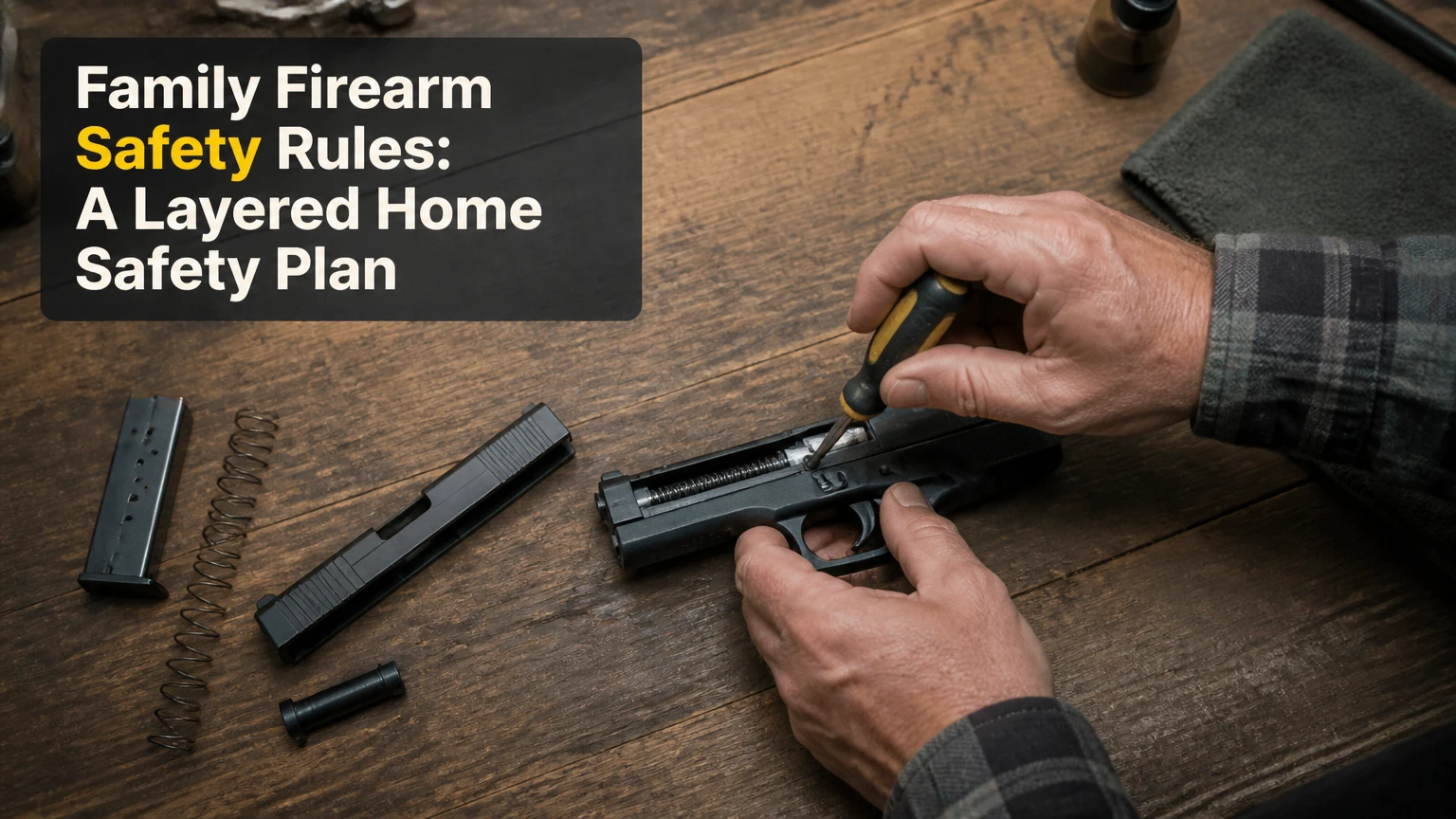
Unload and store a firearm by controlling the muzzle, removing the ammunition source, opening the action according to the manual, verifying the chamber and feeding path visually, and locking the firearm immediately. The exact sequence varies by firearm design, so the owner’s manual or qualified instructor takes precedence over a generic checklist.
- Choose a safe handling location. Keep the muzzle pointed in a direction that will limit injury and property damage if a discharge occurs. Do not select a concrete floor automatically, because hard surfaces can cause bullets or fragments to ricochet.
- Keep the trigger finger straight. Place the finger high on the frame or receiver, outside the trigger guard.
- Remove the ammunition source. Remove the magazine, open the cylinder, empty the tube, or follow the design-specific procedure. Removing a magazine does not necessarily clear the chamber.
- Open the action. Lock the slide, bolt, breech, or action open when the firearm design permits it. Do not rely on a visible safety lever.
- Inspect without inserting a finger. Look into the chamber, magazine well, cylinder, and loading path using adequate light. Never place a finger into a chamber or trigger area to confirm that it is empty.
- Use a second check when practical. Have another trained adult verify the open and unloaded condition, or repeat the visual inspection after a short pause.
- Secure ammunition separately when required. Store ammunition in a locked container inaccessible to unauthorized people, protected from moisture and excessive heat. Whether ammunition must be separate from the firearm depends on local law and the household risk assessment.
- Apply the compatible lock and secure the firearm. Lock the firearm in its safe or container immediately. Do not set it down “temporarily” before locking it.
The success checkpoint is simple: the firearm is unloaded according to its manual, the action is in the appropriate safe position, ammunition is controlled, and the firearm is behind a locked barrier. If any step is uncertain, stop handling and contact a qualified instructor or the manufacturer.
What Should Families Store Separately?
Ammunition, keys, codes, and firearms need deliberate access controls. Separate storage can reduce impulsive access and prevent a child who finds one item from immediately obtaining the others, although applicable law may specify different requirements.
| Item | Recommended control | Typical review interval | Common failure |
|---|---|---|---|
| Firearm | Locked safe or lockbox | Every month | Left in a purse or drawer |
| Ammunition | Locked container, dry location | Every 6-12 months | Mixed with accessible household items |
| Safe key | Separate restricted location | Every 3 months | Hidden in an obvious drawer |
| Electronic safe battery | Fresh manufacturer-approved battery | Monthly test, annual replacement | Low battery discovered during need |
| Access code | Private, non-obvious code | After any access change | Birthday or shared family PIN |
Do not label keys or codes in a way that identifies the firearm safe. Do not share a code with a teenager merely because the teenager has completed a class; access should reflect maturity, judgment, legal permission, and the adult’s continuing assessment.
How Should Rules Change for Different Ages?
Children’s education should become more sophisticated with age, but locked storage should remain constant. A child’s verbal promise, firearm familiarity, or previous good behavior does not make an unlocked firearm safe.
| Household situation | Storage standard | Education approach | Adult action |
|---|---|---|---|
| Toddler, age 0-3 | Locked container every time | Stop, leave, tell | Maintain direct supervision |
| Child, age 4-8 | Locked firearm and controlled ammunition | Rehearse the four-step response | Inspect bedrooms, bags, and visitors’ items |
| Preteen, age 9-12 | Locked storage, private adult access | Formal safety class if ready | Ask scenario questions without testing access |
| Teenager, age 13-19 | Locked storage, no predictable codes | Qualified instructor and supervised practice | Reassess after conflict, substance use, or mood change |
| Adult guest or roommate | Restricted access unless authorized | Explain house rules directly | Secure firearms before the visit |
Teenagers can understand mechanical operation but may also face peer pressure, impulsivity, conflict, or depression. The National Suicide Prevention Lifeline, now 988 in the United States, advises calling or texting 988 for immediate crisis support; in an acute danger situation, call emergency services and reduce firearm access immediately.
What Should You Do When a Child Finds a Firearm?
When a child finds a firearm, the child should stop, avoid touching it, leave the area, and tell an adult. The adult should move other children away, avoid handling the firearm unless necessary to prevent immediate harm, and contact emergency services or a qualified professional if the firearm’s condition is uncertain.
Do not punish the child for reporting the discovery. Punishment can teach children to hide future encounters. After the immediate risk ends, identify how access occurred, repair the storage failure, change codes or keys, and repeat the household response.
If an adult finds a firearm in an unknown condition, keep the muzzle pointed away from people, keep the finger outside the trigger guard, prevent others from approaching, and seek qualified assistance. A person who is not trained to unload a particular firearm should not improvise.
Which Mistakes Defeat Family Firearm Safety?
The most common failures are predictable access, temporary placement, false confidence in a safety lever, poor code management, and failure to account for changing household conditions. Each failure needs a specific correction rather than a general reminder to “be careful.”
| Mistake | Why it fails | Corrective action | Verification |
|---|---|---|---|
| Hiding a loaded firearm | Children search high shelves and bedrooms | Use locked storage every time | Child cannot reach or open the container |
| Relying on the safety switch | A safety lever is not an access barrier | Keep the firearm locked and follow handling rules | Adult can state both controls separately |
| Leaving it in a purse or vehicle | Temporary locations are easily accessed or stolen | Lock before leaving the room or vehicle | Physical check before departure |
| Using a simple birthday code | Family and friends can guess it | Use a random private code | Test authorized access only |
| Ignoring low batteries | Electronic access may fail | Test monthly and replace proactively | Safe opens through the tested method |
| Leaving the safe unanchored | A thief may remove the entire container | Anchor according to manufacturer instructions | Bolts remain tight and structure is sound |
One practitioner rule is especially useful: the highest-risk moment is often the transition, not the normal storage state. Loading after a range trip, answering a door while carrying a firearm, or placing a handgun down during cleaning creates opportunities for distraction.
A second rule is to build for the least reliable day. Storage should still work when the owner is tired, rushed, injured, emotionally upset, or responding to a household emergency.
How Can Families Prepare for Visitors and Travel?
Families should complete a firearm-access sweep before children or unfamiliar guests arrive. Check bedrooms, nightstands, bags, vehicles, coat pockets, cleaning areas, and temporary storage locations, then confirm that every firearm is locked and every key or code is controlled.
During travel, use a locked container that prevents access and protects the firearm from movement or damage. Follow transport laws for the departure location, destination, and route, because requirements can differ for loaded status, ammunition, container placement, and vehicle storage.
When staying in another home, ask directly whether firearms are present and securely stored. Johns Hopkins Center for Gun Violence Solutions recommends that parents ask about firearm storage before a child visits another home, because a parent cannot assess an unseen firearm by assuming another family follows the same rules.
What If a Safe Fails or a Household Risk Changes?
A failed safe should be treated as a safety defect, not an inconvenience. Remove the firearm from service, use a verified secondary storage method, replace batteries if appropriate, and contact the manufacturer when the lock, keypad, fingerprint reader, or override mechanism behaves unpredictably.
Do not leave a backup key taped under furniture or stored in an adjacent unlocked drawer. The key must be reachable by the authorized adult while remaining inaccessible to children and unauthorized people.
Secure firearms immediately when a household member expresses suicidal thoughts, makes credible threats, experiences severe intoxication, or becomes violent. Options include transferring firearms temporarily to a lawful, trusted storage provider where permitted, contacting emergency services, and using 988 in the United States for a mental-health crisis. Legal transfer and storage rules vary, so local law enforcement, a licensed dealer, or a qualified attorney can clarify the lawful option.
A 10-Minute Family Firearm Safety Audit
A short audit can expose failures that a one-time storage decision misses. Perform it monthly and after any major household change.
- Confirm every firearm is inside a locked container.
- Check that no firearm is in a purse, vehicle, nightstand, backpack, or cleaning area.
- Test the safe without exposing the firearm to unauthorized people.
- Check electronic battery status and mechanical lock operation.
- Verify that backup keys and codes remain private.
- Confirm ammunition is controlled according to local law and household needs.
- Ask each child what to do if they see a firearm.
- Inspect visiting children’s access to bedrooms, bags, and vehicles.
- Confirm each authorized adult knows the firearm’s manufacturer and manual location.
- Record and correct every failure before resuming normal routines.
The audit is complete only when the correction is verified. A note saying “buy a lock” is not a completed control; a compatible lock installed on a firearm inside a secured container is.
Frequently Asked Questions
Is hiding a firearm from children enough?
No. Hiding a firearm is not secure storage because children may search bedrooms, closets, drawers, bags, and high shelves, while visitors may discover the location accidentally. Store firearms in a locked container, control the key or code, and teach children to leave the area and tell an adult if they encounter one.
Should a firearm be stored loaded at home?
The answer depends on the firearm’s purpose, the owner’s training, household risks, and local law. A firearm intended for immediate defensive use may be stored in a locked quick-access container according to the manufacturer’s guidance, while a hunting or sporting firearm is commonly unloaded before locked storage. Never let convenience override access control.
Should ammunition be kept in the same safe?
Ammunition may be stored in the same locked safe when local law permits and the arrangement prevents unauthorized access. Separate locked ammunition storage can add a barrier for children and reduce impulsive access. Keep cartridges dry, protected from excessive heat, and away from damaged or unknown ammunition.
Are trigger locks safe on every firearm?
No. A trigger lock is not universal, and an incorrectly fitted lock can damage a firearm or create an unsafe handling condition. Use only a compatible device installed according to its instructions. A trigger or cable lock also does not prevent theft of the entire firearm, so a secured container may be necessary.
How often should a gun safe be checked?
Test the safe at least monthly and after battery replacement, relocation, code changes, or a failed opening attempt. Inspect anchors and locking hardware every three to six months. Replace electronic batteries on a planned schedule rather than waiting for a low-battery warning.
Where can a family find authoritative local requirements?
Check the official government website for the relevant state, province, territory, or municipality, then confirm transport and storage requirements with a qualified local authority. In the United States, state police, the state attorney general, a licensed firearms dealer, and a firearms-law attorney can help identify current rules.
The Bottom Line
Family firearm safety rules work when behavior, education, locks, containers, and regular audits overlap. Treat every firearm as loaded, control the muzzle and trigger finger, know what lies beyond the target, and lock every firearm whenever an authorized adult is not actively handling it.
A layered plan also accounts for children, teenagers, visitors, travel, electronic failures, ammunition, and mental-health emergencies. The strongest family firearm safety rules are the ones that remain effective during ordinary distractions and the household’s most difficult day.