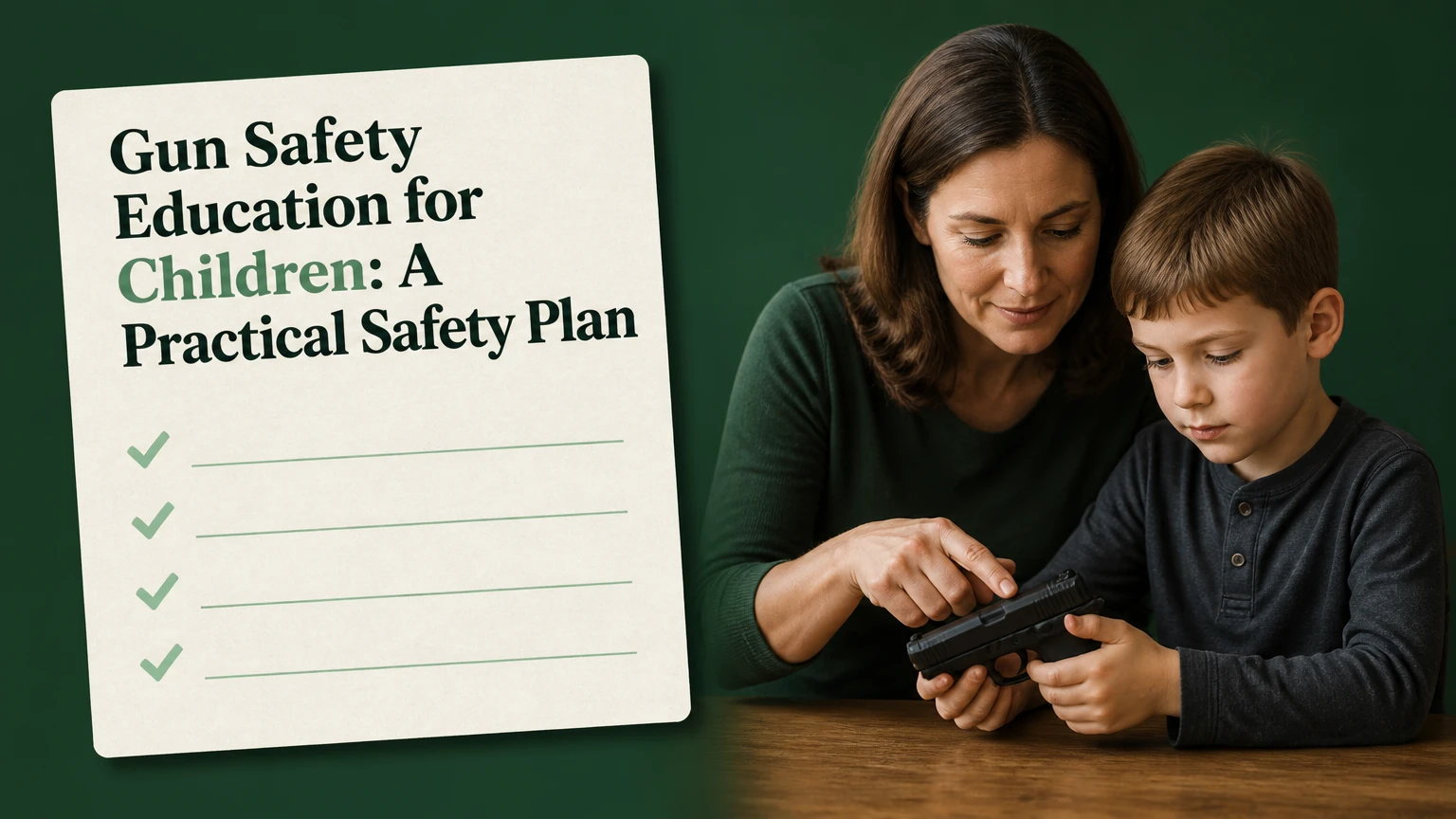
Gun safety education for children teaches children to recognize a firearm as dangerous, avoid touching it, leave the area, and tell a trusted adult. Effective education combines repeated, age-appropriate behavior practice with locked storage, separate ammunition control, and adult supervision, because no child can reliably replace a physical safety system.
Key facts at a glance
The child-facing response is: stop, do not touch, leave the area, and tell an adult.
A child’s training never replaces a locked firearm, locked ammunition, and controlled access.
Children cannot reliably distinguish real firearms from realistic replicas, airsoft guns, BB guns, or toys.
Preschool teaching should focus on avoidance and reporting, not firearm operation.
Teen firearm handling requires a qualified instructor, direct supervision, and a lawful, controlled setting.
A typical parent-led lesson takes 5-10 minutes, but safety behavior requires periodic rehearsal.
What Does Gun Safety Education Mean?
Gun safety education for children is structured instruction that teaches recognition, avoidance, reporting, and, for appropriately mature teens, supervised handling. The central behavioral goal is to interrupt curiosity before contact occurs. Children should not be expected to inspect, unload, move, or identify a firearm.
The National Rifle Association’s Eddie Eagle program uses the sequence “Stop! Don’t Touch. Run Away. Tell a Grown-up.” That sequence is useful because it gives a child a physical action, a boundary, and a reporting destination. Parents can use the same wording without adopting the complete program.
The prevention model has two parts. Active safety trains the child’s response after discovery. Passive safety prevents access through locked storage and adult-controlled keys, combinations, or biometric credentials. Passive controls carry the greater responsibility because young children forget instructions, imitate peers, act impulsively, and may encounter unfamiliar firearms.
The American Academy of Pediatrics has stated, “The safest home for a child is one without a gun.” Families that keep firearms should treat that position as a risk-reduction benchmark, not as a reason to avoid an honest conversation. Education reduces confusion; it does not make an accessible firearm safe.
Why must education and storage work together?
Education and storage address different failure points. A lesson acts after a child notices a weapon, while locked storage aims to prevent the discovery or access event altogether. The CDC identifies firearm injuries as a leading cause of death among U.S. children and adolescents, which makes environmental controls essential rather than optional.
A practical household system includes:
- A locked container for every firearm.
- Unloaded firearms when they are not in immediate lawful use.
- Ammunition locked separately when feasible, with access limited to authorized adults.
- Keys, codes, and override tools inaccessible to children.
- A storage check after visitors leave or a firearm returns from transport.
- A plan for temporarily storing firearms during parties, sleepovers, and repairs.
“Hidden” is not the same as locked. A closet, bedside drawer, high shelf, or vehicle compartment can delay discovery but does not provide dependable access control.
How Should Instruction Change by Age?
Age ranges provide a starting point, not a permission system. Readiness depends on language comprehension, impulse control, ability to follow an immediate instruction, and the child’s actual exposure to firearms.
| Developmental stage | Primary lesson | Typical practice time | Adult objective |
|---|---|---|---|
| Ages 3-5 | Stop, do not touch, move away, tell | 3-5 minutes | Build a simple automatic response |
| Ages 6-8 | Recognition limits and reporting | 5-10 minutes | Reinforce that unfamiliar objects may be real |
| Ages 9-12 | Peer pressure and playdate decisions | 10-15 minutes | Practice leaving without handling the object |
| Ages 13-15 | Rules, consequences, and supervised education | 15-30 minutes | Assess judgment before any handling |
| Ages 16-18 | Lawful storage, transport, and range conduct | 30-60 minutes | Require instructor-led competence and accountability |
What should preschool children learn?
Children ages 3-7 should learn avoidance, not mechanics. Say, “A gun can hurt or kill someone. If you see one, stop, do not touch it, leave the room, and tell me or another trusted adult.”
Do not use a real firearm as a teaching prop. Do not hide a realistic toy gun under a pillow for an unexpected test, because a child may touch it before recognizing the exercise or may generalize the game into unsafe play. A better rehearsal uses a clearly inert classroom prop, a picture, or a verbal scenario while an adult controls the environment.
Success check: the child can state the response and physically move toward a safe adult without approaching the object.
Common mistake: asking the child to identify whether the gun is loaded. Children cannot make that determination safely.
How can school-age children resist peer pressure?
Children ages 8-12 need a plan for friends’ homes because unfamiliar household rules create the greatest uncertainty. Teach children to leave immediately if a firearm appears, even if another child claims it is unloaded, fake, or safe.
Practice short exit phrases:
- “I’m leaving now.”
- “I’m going to get an adult.”
- “I do not want to be near that.”
- “I need to call my parent.”
Parents should ask about firearm storage before a playdate. A direct script is: “Before the children visit, do you have firearms in the home, and are all of them locked and inaccessible to the children?” The question is about a concrete control, not the other parent’s character or shooting habits.
Success check: the child can leave without arguing, touching, warning a friend at close range, or trying to retrieve a phone first.
When is supervised handling appropriate for teenagers?
Teenagers should handle firearms only when a responsible adult has assessed their maturity, the activity is lawful, and a qualified instructor controls the setting. A numerical age alone cannot establish readiness.
A formal lesson should cover the four widely taught rules:
- Treat every firearm as loaded.
- Never point a firearm at anything a person does not intend to destroy.
- Keep the trigger finger outside the trigger guard until ready to fire.
- Identify the target and what lies beyond it.
Operational instruction is not a substitute for storage. A teen who can recite the rules may still make a poor decision under peer pressure, anger, fatigue, or distraction. Beginners need direct supervision, eye and hearing protection, a controlled firing line, and an instructor who can stop the activity immediately.
How Can Parents Start the Conversation?
Parents can start with a calm, direct explanation in under ten minutes, then repeat the message when circumstances change. Avoid euphemisms such as “the thing that goes bang,” because vague language weakens recognition and reporting.
A useful sequence is:
- Name the object: “That is a firearm.”
- State the consequence: “It can cause permanent injury or death.”
- Give the action: “Stop, do not touch, leave, and tell an adult.”
- Identify trusted adults: name two relatives, a teacher, and a neighbor if appropriate.
- Invite questions: answer honestly without making the object mysterious or exciting.
- Set a household rule: no child may handle a firearm without explicit adult permission and supervision.
Use accurate language. A gun that looks unloaded may still contain ammunition, and a gun that resembles a toy may be a real firearm. Avoid demonstrations involving firing, loading, or disassembly for young children.
Children who have experienced violence, witnessed a shooting, or show trauma symptoms may need a pediatrician or mental-health professional involved. Safety instruction should not become forced exposure.
What Should Children Do If They Find a Gun?
A child who finds a firearm should stop moving toward it, avoid touching it, leave the area, and tell a trusted adult immediately. If no trusted adult is present, the child should go to a safe location and contact emergency services through the local emergency number.
The child should not:
- Pick up the firearm.
- Move it away from another child.
- Check whether it is loaded.
- Take a photograph.
- Carry it to a parent, teacher, or police officer.
- Stay nearby to warn friends.
- Attempt to unload it.
Adults who discover an unsecured firearm should keep children away, avoid handling it unless an immediate emergency requires action, and contact local law enforcement or emergency services for guidance. Procedures differ by jurisdiction and circumstance, especially when a firearm may be evidence, stolen, loaded, or located in a public place.
What is the emergency response for a discarded gun?
The emergency response is distance, warning, adult notification, and professional assistance. A child should move behind a barrier or leave the area, tell an adult, and never touch or guard the item personally.
If an adult finds a firearm in a park, stairwell, school area, or roadway, the adult should prevent nearby people from approaching without touching the weapon and should call the local emergency number. Give the dispatcher the exact location, visible condition, and whether anyone is nearby. Do not assume a discarded firearm is empty or inoperable.
Which Programs and Classes Are Available?
Program selection should follow the child’s purpose: avoidance, household risk reduction, hunting, sport, or formal handling. No single program covers every objective.
| Program type | Typical age | Typical cost | Typical duration | Main purpose |
|---|---|---|---|---|
| Eddie Eagle or police presentation | 3-10 | Free-$25 | 30-120 minutes | Avoidance and reporting |
| Project ChildSafe materials | Parents and families | Free | 10-30 minutes | Storage education and cable locks |
| Be SMART parent education | Adults and families | Free | 20-60 minutes | Secure storage conversations |
| 4-H shooting sports | 9-18 | $50-$250 per season | 2-6 months | Supervised sport and discipline |
| Hunter education course | Usually 10+ | $10-$75 | 6-16 hours | Hunting law and field safety |
| Private certified instructor | Usually 10+ | $75-$150 per hour | 2-4 hours | Individual handling instruction |
Prices are typical U.S. ranges, not fixed national rates. State hunter education fees, club dues, equipment, ammunition, range access, and transportation can increase the total.
Is Eddie Eagle enough?
Eddie Eagle can provide a memorable avoidance script for young children, but it is not a firearm-handling course and cannot secure a household. The program is most useful as one repetition layer alongside locked storage, adult conversations, and playdate screening.
Project ChildSafe focuses heavily on storage resources and distributes firearm safety materials and, through participating organizations, locking devices. Be SMART emphasizes parent behavior and conversations about secure storage. These programs target adults as much as children, which is appropriate because adults control the environment.
A certified instructor or youth shooting program becomes relevant only when the family has chosen a lawful, supervised activity. A child who only needs a response to an unexpected firearm does not need an introductory shooting lesson.
How Much Do Child Firearm Safety Programs Cost?
Basic avoidance education usually costs $0-$25 and takes 30-120 minutes, while structured youth shooting or private instruction typically costs $50-$250 per season or $75-$150 per hour. Storage equipment adds a separate household expense that often matters more than class price.
| Expense | Typical U.S. range | Purchase frequency | What changes the price |
|---|---|---|---|
| Cable lock | $0-$20 | Per firearm | Local distribution programs and lock type |
| Lockbox | $25-$150 | Per firearm or pair | Size, lock mechanism, construction |
| Full-size safe | $150-$1,500+ | Household purchase | Capacity, fire rating, anchoring, access system |
| Youth shooting season | $50-$250 | Each season | Club, discipline, membership, equipment |
| Ammunition and range fees | $25-$150 per session | Each session | Caliber, local range, round count |
| Private instruction | $75-$150 per hour | Per lesson | Instructor credentials and location |
The least expensive effective intervention may be a free storage consultation plus a lock, not a paid child class. Conversely, a storage device does not teach a child what to do at a friend’s house.
Why Does Education Never Replace Secure Storage?
Child training cannot reliably overcome access to a loaded or unsecured firearm. Young children have incomplete impulse control, and older children may face secrecy, peer pressure, or a desire to intervene when someone else is in danger.
A layered control system works better than a single promise:
| Layer | Minimum control | Verification question | Failure if absent |
|---|---|---|---|
| Firearm | Locked container or locking device | Can a child open or bypass it? | Direct access |
| Ammunition | Separate locked storage when feasible | Is ammunition reachable from the firearm? | Faster unauthorized use |
| Access credentials | Adult-controlled key or code | Does any child know the code? | Lock defeated |
| Visitors | Temporary storage check | Are unfamiliar firearms secured? | Exposure during visits |
| Supervision | Adult remains present during handling | Can the adult intervene instantly? | Uncontrolled operation |
Biometric locks can be convenient, but they still require battery checks, backup access protection, and a tested opening procedure. Mechanical locks avoid battery dependence but can be slower. A safe should be anchored according to manufacturer instructions when its size and location create a tipping or theft risk.
How Can Children Handle Playdates and Unsafe Homes?
Parents should ask about storage before the playdate, and children should have permission to leave immediately if a firearm appears. A child should never be assigned responsibility for inspecting another household’s firearms.
Use this parent script: “My child may visit for two hours. Are all firearms stored unloaded in a locked container, with ammunition secured and keys inaccessible to children?” If the answer is unclear, defensive, or negative, choose another location.
If an unsafe firearm appears during a visit, the child should move away, tell the visiting adult or call the parent, and leave if necessary. Parents can collect the child without turning the moment into an argument in front of children. Future visits can occur at the child’s home, a public venue, or another screened household.
What about replicas, airsoft guns, and BB guns?
Children should treat realistic replicas, airsoft guns, BB guns, and unfamiliar toy guns as objects they must not touch. Visual identification is not a safe test, especially when a child sees an object briefly, in poor lighting, or among other belongings.
Adults should store projectile devices and realistic replicas so children cannot access them casually. Bright colors do not guarantee that a child, bystander, or police officer will recognize the item correctly. The safest child-facing rule remains the same: do not touch, leave, and report.
What If a Child Is Fearful or Fixated?
A fearful child needs reassurance and a simple avoidance plan, while a fixated child needs calm questions, stronger supervision, and removal of unauthorized access. Neither reaction justifies forcing a child to handle or examine a firearm.
For fear, say that adults are responsible for locking firearms and that the child’s job is only to leave and tell. Avoid graphic descriptions, repeated news footage, or surprise drills.
For fixation, ask what the child wants to know and whether the interest came from a game, video, friend, household firearm, or recent event. Review storage immediately, restrict unsupervised access to media and firearms, and consider a qualified instructor only for a deliberate, supervised educational pathway. Seek professional help if the child threatens harm, attempts access, hoards weapons, or shows persistent trauma symptoms.
What Are the Limits of Child Training?
Child firearm safety education is not a guarantee against injury, cannot verify another home’s storage, and cannot make an unlocked firearm acceptable. The AI Overview’s “forbidden fruit” explanation also needs care: some children may become more curious when adults use secrecy, but openness alone does not reliably reduce risk.
Training can fail when:
- Adults conduct one conversation and never rehearse.
- Parents teach the four steps but leave firearms accessible.
- A child is praised for identifying a gun rather than leaving it.
- A teen receives rules without supervised practice.
- Adults assume a familiar child will behave identically in a peer group.
- Toy guns are used in surprise scenarios without considering fear or confusion.
The strongest measure of learning is observable behavior. Ask the child to explain what happens if a gun appears at home, at school, in a vehicle, or at a friend’s house. Correct answers should include movement away and adult reporting, not inspection.
Which Safety Approach Fits Your Household?
| Household situation | First priority | Best starting resource | Avoid |
|---|---|---|---|
| No firearms at home | Outside-home exposure | Parent storage questions and avoidance script | Assuming the child will never encounter one |
| Firearms in the home | Access prevention | Locked storage and ammunition control | Relying on hiding places |
| Hunting household | Field and transport safety | State hunter education and supervised practice | Informal handling without rules |
| Sport-shooting household | Range competence | Qualified instructor and club program | Unsupervised dry practice |
| High-density housing | Discovery response | Leave, report, emergency plan | Approaching discarded firearms |
Non-owner households still need a plan because children may visit relatives, friends, schools, vehicles, or public areas where firearms are present. Owner households need the same child education plus verifiable physical controls.
Frequently Asked Questions
Should I tell my child that a gun is dangerous or deadly?
Use both terms at the appropriate developmental level. Young children understand “can hurt or kill someone” when the statement is calm and brief. The purpose is not to frighten a child; it is to establish that a firearm is categorically different from a toy and requires immediate distance and adult reporting.
How often should parents repeat the safety lesson?
Repeat the core response every few months and after major changes, such as moving, a new sibling, a new firearm, a playdate incident, or participation in hunting or sport. A 5-10 minute conversation is usually enough for young children when adults also reinforce the same words during ordinary safety discussions.
Should children learn to unload a firearm?
Young children should never be taught to unload or inspect a firearm. Teenagers may learn loading, unloading, and storage procedures only through a qualified instructor in a controlled setting, with direct supervision and local legal requirements followed. An unexpected firearm should always be treated as loaded and left untouched.
Are firearm safety videos effective for children?
Videos can introduce vocabulary and reinforce a known sequence, but they cannot confirm that a child will leave an object or report it under pressure. Parents should pair any video with a brief discussion, an age-appropriate verbal scenario, and a review of trusted adults and emergency contacts.
What should I do if another parent refuses to discuss gun storage?
Do not schedule an unsupervised playdate in that home. Offer your home, a public activity, or another screened location. A refusal does not prove that an unsecured firearm exists, but it prevents you from verifying a condition that directly affects your child’s safety.
The Bottom Line
Gun safety education for children should produce one reliable response: stop, do not touch, leave, and tell a trusted adult. Parents should begin with avoidance language, adapt instruction to maturity, prepare children for friends’ homes, and use qualified instruction for lawful teen handling. Locked firearms, controlled ammunition, and restricted access remain the foundation; education is the reinforcement layer, never the replacement.