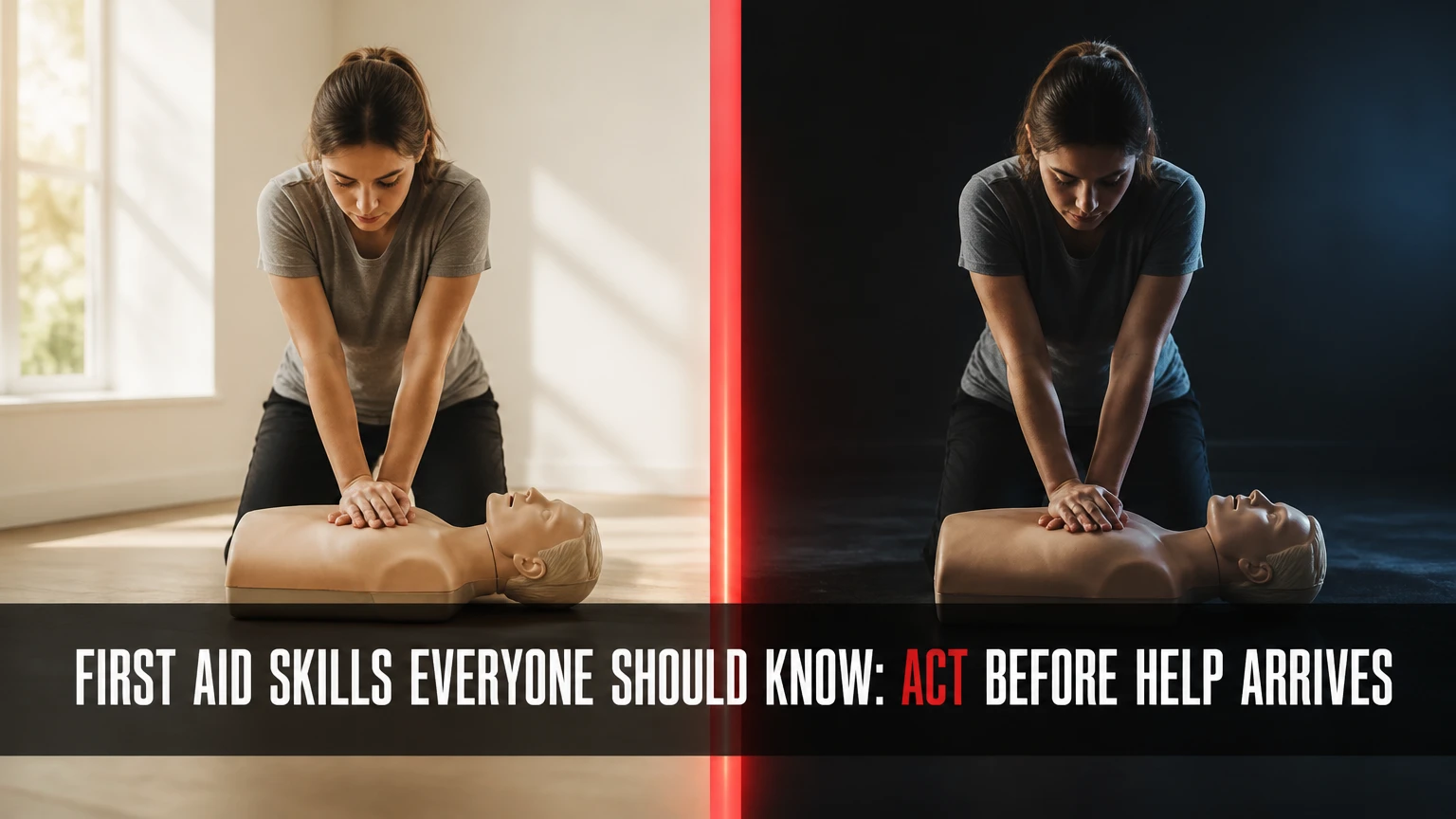
First aid skills everyone should know include scene safety, emergency assessment, CPR, AED use, choking relief, severe bleeding control, burn care, fracture support, and recognition of stroke, heart attack, anaphylaxis, and shock. The correct priority is to protect yourself, activate emergency services early, and provide immediate care until trained help takes over.
Key Facts at a Glance
Adult CPR uses chest compressions at 100-120 per minute, with a depth of about 5-6 cm for most adults.
A commercial tourniquet belongs 5-7 cm above life-threatening limb bleeding, never directly over a joint.
A burn should be cooled under cool running water for 20 minutes, when practical and safe.
Stroke requires immediate emergency activation because treatment options depend heavily on time and symptom onset.
An AED analyzes the heart rhythm and gives a shock only when its prompts determine that a shock is appropriate.
First aid is temporary care. It does not replace emergency medical assessment, diagnosis, or definitive treatment.
First aid succeeds through priorities rather than improvisation. A person who calls for help, controls catastrophic bleeding, begins effective CPR, or supplies an epinephrine auto-injector promptly can change the outcome before an ambulance arrives.
What Does First Aid Do?
First aid is immediate, temporary care for illness or injury before professional medical assistance arrives. The three operational goals are to preserve life, prevent deterioration, and support recovery while avoiding actions that create additional harm.
Begin with DRABC:
- Danger: Check traffic, fire, electricity, unstable structures, violence, chemicals, and blood exposure.
- Response: Speak loudly and tap the shoulders of an apparently unresponsive adult.
- Airway: Look for an obstruction without blindly sweeping the mouth.
- Breathing: Check for normal breathing for no more than 10 seconds.
- Circulation or care: Treat immediately life-threatening bleeding, then follow the emergency procedure.
Use gloves or another barrier when available. Ask a conscious person for permission before helping, identify yourself, and explain what you intend to do. If a person cannot consent because of unconsciousness, emergency first aid generally proceeds under implied consent, subject to local law.
Call the local emergency number as soon as a life threat is recognized. Put the phone on speaker, follow the dispatcher’s instructions, and send another person to retrieve an AED or first aid kit.
Which First Aid Skills Have the Highest Priority?
CPR, AED operation, severe bleeding control, choking relief, emergency recognition, and safe casualty assessment have the highest public value because minutes and correct sequencing affect survival. A first aid course should teach these skills with physical practice, not only online reading.
| Emergency | First action | Escalation threshold | Main tool |
|---|---|---|---|
| Cardiac arrest | Call emergency services and start CPR | Unresponsive and not breathing normally | AED, firm surface |
| Severe bleeding | Apply hard, continuous pressure | Spurting, pooling, amputation, or uncontrolled blood loss | Dressing, gauze, tourniquet |
| Choking | Ask the person to cough if able | Silent, ineffective cough or inability to breathe | Back blows, thrusts |
| Stroke | Note last known well time and call emergency services | Face, arm, speech, vision, or balance changes | Phone, symptom record |
| Anaphylaxis | Assist with prescribed epinephrine | Breathing difficulty, throat swelling, collapse | Auto-injector |
| Major burn | Stop the burning process and cool the area | Deep, extensive, electrical, chemical, or airway burn | Running water, clean covering |
The American Heart Association recommends immediate CPR and AED use for sudden cardiac arrest. Its public instruction is direct: “Push hard and fast in the center of the chest.” The statement captures the main practical failure: bystanders often delay compressions while searching for perfect technique.
How Do You Perform CPR and Use an AED?
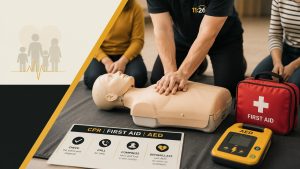
For an unresponsive adult who is not breathing normally or is only gasping, call emergency services, obtain an AED, and begin CPR. Place both hands in the center of the chest, compress at 100-120 per minute to approximately 5-6 cm, allow full recoil, and continue until the person moves, professional rescuers take over, or the scene becomes unsafe.
Adult CPR steps
- Check responsiveness and normal breathing.
- Call the local emergency number and ask for an AED.
- Place the adult face-up on a firm, flat surface.
- Put the heel of one hand on the lower half of the breastbone and the other hand on top.
- Give 30 compressions, then 2 breaths if trained and willing to provide them.
- Continue cycles of 30:2, minimizing pauses to under 10 seconds.
- If unwilling or unable to give breaths, provide continuous hands-only compressions.
Use a barrier device for rescue breaths when available. Each breath should last about one second and produce visible chest rise. Excessively forceful ventilation can inflate the stomach and cause vomiting.
AED procedure
Turn on the AED, expose and dry the chest, attach the pads as illustrated, and follow the voice prompts. Everyone must be clear while the device analyzes or delivers a shock. Resume compressions immediately after a shock or when the AED advises no shock.
| CPR situation | Compression rate | Compression depth | Breaths |
|---|---|---|---|
| Adult | 100-120/minute | 5-6 cm | 30:2 if trained |
| Child, approximately age 1 to puberty | 100-120/minute | About 5 cm | 30:2 solo rescuer |
| Infant, under approximately 1 year | 100-120/minute | About 4 cm | 30:2 solo rescuer |
| Any casualty, unwilling rescuer | 100-120/minute | Appropriate age depth | Hands-only |
For children and infants, use pediatric AED pads or an attenuator when available, but do not delay defibrillation while searching for special equipment. The American Heart Association and American Red Cross both emphasize that an AED is designed for layperson use and provides instructions.
How Do You Help Someone Who Is Choking?
A choking person who can cough forcefully should be encouraged to cough and observed closely. If the person cannot speak, breathe, or produce an effective cough, alternate five firm back blows with five abdominal thrusts until the object clears or the person becomes unresponsive.
Ask, “Are you choking?” Do not strike a person who is coughing effectively. For severe airway obstruction:
- Stand to the side and slightly behind.
- Support the chest and deliver five back blows between the shoulder blades.
- If ineffective, stand behind the person and give five inward-and-upward abdominal thrusts.
- Continue alternating five back blows and five thrusts.
- Call emergency services early, especially if the obstruction persists.
Use chest thrusts instead of abdominal thrusts for a pregnant person or a person whose abdomen cannot be encircled. For an infant, support the head and neck, deliver five back slaps followed by five chest thrusts, and never perform abdominal thrusts.
If a choking person becomes unresponsive, lower them carefully, call emergency services, and begin CPR. Each time the airway opens during compressions, look for a visible object and remove it only if clearly seen. Never perform blind finger sweeps.
| Person | Effective cough | Severe obstruction response | Special rule |
|---|---|---|---|
| Adult | Encourage coughing | 5 back blows, 5 abdominal thrusts | Use chest thrusts if pregnant |
| Child over 1 year | Encourage coughing | 5 back blows, 5 abdominal thrusts | Match force to body size |
| Infant under 1 year | Observe breathing | 5 back slaps, 5 chest thrusts | No abdominal thrusts |
| Unresponsive casualty | No oral food or drink | CPR and emergency activation | Remove only visible objects |
How Do You Stop Life-Threatening Bleeding?
Severe bleeding requires immediate, direct, continuous pressure with a dressing or gloved hand. If bleeding from an arm or leg remains life-threatening, apply a commercial tourniquet 5-7 cm above the wound, tighten until bleeding stops, record the application time, and leave it in place for medical professionals.
Use wound packing for a deep wound in the groin, armpit, shoulder, or neck when a tourniquet cannot be used. Pack gauze firmly into the cavity and maintain pressure. A hemostatic dressing can help when included in trained first aid or bleeding-control instruction.
Do not repeatedly lift the dressing to inspect the wound. Add material on top if blood soaks through, and keep pressure uninterrupted. Do not remove an embedded knife, glass fragment, or other object because the object may be limiting blood loss.
Call emergency services for spurting or rapidly flowing blood, partial or complete amputation, shock symptoms, uncontrolled bleeding, or wounds involving the chest, abdomen, neck, or eye. Lay the person down if safe, keep them warm, and do not give food or drink.
Practitioner rule: A tourniquet that is loose and painless can be worse than no tourniquet because it may reduce venous return while allowing arterial bleeding to continue. Tighten until catastrophic bleeding stops, even when the casualty reports significant discomfort.
What Should You Do for Burns?
Cool a thermal burn under cool running water for 20 minutes as soon as possible, remove jewelry and loose clothing before swelling develops, and cover the area with a sterile non-stick dressing or clean plastic film. Do not use ice, butter, toothpaste, adhesive dressings, or greasy creams on a fresh burn.
Stop the burning source first. Brush off dry chemicals before flushing, and flush chemical burns with copious running water while removing contaminated clothing. Electrical burns require emergency medical assessment because internal injury or cardiac rhythm disturbance may exist despite limited skin damage.
Seek urgent medical care for burns that are deep, larger than the casualty’s palm, circumferential, located on the face, hands, feet, genitals, or major joints, or caused by electricity or chemicals. Any burn with smoke inhalation, facial soot, hoarseness, or breathing difficulty is an airway emergency.
Never break blisters. Keep the person warm overall while cooling the burn, because prolonged whole-body exposure to cold water can cause hypothermia, particularly in children.
How Should You Handle Fractures, Sprains, and Strains?
Treat a suspected fracture by keeping the injured area still, supporting it in the position found, checking circulation beyond the injury, and arranging medical evaluation. For a sprain or strain, protect the area and use comfortable movement; routine prolonged icing and tight compression are not substitutes for diagnosis.
Look for deformity, severe pain, swelling, inability to bear weight, abnormal movement, numbness, pale or blue skin, or bone through the skin. Do not straighten a deformed limb or push exposed bone back under the skin.
A padded splint can stabilize an injury when evacuation is delayed. Immobilize the joint above and below a suspected long-bone fracture, then recheck color, warmth, sensation, and movement beyond the splint. Loosen the splint if circulation worsens.
The traditional RICE method means rest, ice, compression, and elevation, but modern sports injury guidance increasingly favors protection, optimal loading, ice for short-term comfort, compression, and elevation rather than prolonged immobilization. Ice wrapped in cloth for 10-20 minutes can reduce pain; it does not repair a torn ligament or rule out a fracture.
How Do You Recognize Stroke and Heart Attack?
Stroke symptoms require an immediate emergency call and the exact time the person was last known well. Use FAST, meaning Face drooping, Arm weakness, Speech difficulty, and Time to call, while also treating sudden vision loss, severe imbalance, or an unexplained severe headache as possible stroke signs.
Do not drive a suspected stroke patient yourself unless emergency services are unavailable and the situation demands it. Record symptom onset, medications if known, and changes in consciousness. Do not give food, drink, or aspirin because swallowing impairment and bleeding-type stroke are possible.
Heart attack symptoms can include pressure or squeezing in the chest, pain spreading to the arm, back, neck, jaw, or upper abdomen, shortness of breath, sweating, nausea, or unusual fatigue. Women, older adults, and people with diabetes may have less typical symptoms.
Call emergency services, keep the person seated and calm, loosen restrictive clothing, and monitor breathing. Help the person take their own prescribed nitroglycerin. Aspirin may be appropriate for some adults with suspected heart attack, but only follow dispatcher or clinician guidance after checking allergy, bleeding risk, and contraindications.
Which Other Emergencies Need Immediate First Aid?
Anaphylaxis, seizures, poisoning, heat illness, and hypothermia each require a different first action. The shared rule is to activate emergency help early, protect breathing, prevent secondary injury, and avoid giving substances by mouth to a confused or unconscious person.
| Emergency | Immediate action | Avoid | Emergency trigger |
|---|---|---|---|
| Anaphylaxis | Assist prescribed epinephrine into outer thigh | Waiting for antihistamine to work | Breathing trouble, throat swelling, collapse |
| Seizure | Clear hazards and cushion the head | Restraining or placing objects in mouth | Seizure over 5 minutes or repeated seizures |
| Poisoning | Call poison control or emergency services | Inducing vomiting | Breathing change, collapse, unknown substance |
| Heat stroke | Call emergency services and cool rapidly | Giving fluids to confusion or unconsciousness | Altered mental state with high body temperature |
| Hypothermia | Remove wet clothing and warm gradually | Rubbing cold skin or alcohol | Confusion, drowsiness, abnormal breathing |
For a seizure, time the event. After jerking stops, place the person on their side if breathing normally and stay with them. Call emergency services for a first seizure, pregnancy, injury, water-related seizure, breathing difficulty, or duration beyond five minutes.
For suspected poisoning, retain the container or product label and provide the substance, amount, route, and time to poison specialists. Do not rely on milk, salt water, activated charcoal, or induced vomiting unless specifically directed.
What Are the Most Common First Aid Mistakes?
The most dangerous first aid mistakes are delaying emergency activation, failing to control severe bleeding, stopping CPR to check repeatedly, applying ice to burns, and moving a person unnecessarily after major trauma. Correct first aid is often simpler and more restrained than popular home remedies.
- Do not remove an embedded object.
- Do not give food or drink to an unconscious, confused, or possibly surgical patient.
- Do not move a casualty with suspected spinal injury unless danger, CPR, or airway protection requires movement.
- Do not place a spoon, wallet, or fingers in a person’s mouth during a seizure.
- Do not apply a tourniquet over a joint or loosen it periodically.
- Do not use a household belt as a preferred tourniquet when a commercial device is available.
- Do not leave a casualty alone to search for supplies when another person can call or retrieve them.
Counterintuitive insight: A person with life-threatening bleeding can lose fatal blood volume before appearing pale or collapsing. Visible blood on clothing is less informative than the flow pattern, pooling, wound depth, and response to pressure.
What Should Be in a First Aid Kit?
A practical first aid kit should match the environment, number of people, travel time to care, and rescuer training. A household kit needs dressings and gloves, while a vehicle or outdoor kit benefits from a commercial tourniquet, pressure bandage, emergency blanket, and communication backup.
| Item | Household quantity | Vehicle or outdoor quantity | Use |
|---|---|---|---|
| Nitrile gloves | 4 pairs | 6-10 pairs | Blood and body-fluid barrier |
| Sterile gauze pads | 10 | 20 | Wound coverage and pressure |
| Adhesive bandages | 20 | 30 | Minor cuts and abrasions |
| Roller or elastic bandage | 2 | 4 | Dressing retention and support |
| Commercial tourniquet | 0-1 | 1-2 | Life-threatening limb bleeding |
| CPR face shield | 1 | 1 | Rescue-breath barrier |
| Emergency blanket | 1 | 2 | Heat loss and shock support |
| Splint material | 0-1 | 1 | Remote fracture stabilization |
Check expiration dates, replace used supplies, store medication according to its label, and keep the kit accessible rather than locked in an obscure cabinet. A tourniquet is valuable only when the user recognizes catastrophic bleeding and has practiced application.
Which First Aid Training Is Worth Taking?
Hands-on CPR, AED, and first aid training is the best preparation for most adults because psychomotor skills decay without practice. Typical United States course prices are about $50-$150, with completion commonly taking 3-8 hours, although local providers and blended formats vary.
| Training type | Typical duration | Typical U.S. price | Best fit |
|---|---|---|---|
| CPR and AED class | 2-4 hours | $45-$100 | Every household adult |
| Basic first aid plus CPR | 4-8 hours | $75-$150 | Parents, caregivers, workers |
| Wilderness first aid | 16-24 hours | $150-$350 | Hikers and remote travelers |
| Bleeding-control workshop | 1-2 hours | Free-$75 | Public spaces and workplaces |
Choose an instructor using current American Heart Association, American Red Cross, or equivalent national curriculum, and verify whether the certificate meets workplace or childcare requirements. Parents should add infant and child CPR. Outdoor users should practice splinting, wound packing, hypothermia prevention, and evacuation decisions.
Online videos can refresh sequence and recognition. They cannot reproduce the feedback of compressing a manikin, sealing a mask, tightening a tourniquet, or operating an AED under stress.
How Should First Aid Change by Situation?
First aid priorities change with age, environment, and access to emergency care, but life threats always outrank minor injuries. A remote hiker needs evacuation planning, while a parent needs pediatric airway and medication awareness; neither should delay a local emergency call when cellular service works.
For a child, use pediatric CPR training, secure hazardous medicines and chemicals, and treat breathing difficulty as urgent because children can deteriorate rapidly. For an older adult, ask about anticoagulants after falls because internal bleeding risk may be higher even without dramatic bruising.
At a roadside collision, park safely, activate hazard lights, beware fuel and traffic, and avoid entering an unstable vehicle. At a water incident, use a reach or throw rescue rather than entering water without training. In wilderness settings, protect the casualty from wind, rain, heat loss, and further terrain exposure while arranging evacuation.
First aid is not a substitute for airway surgery, fracture reduction, burn assessment, stroke treatment, or infection management. The correct endpoint is a clear handoff, not confidence that the emergency has been solved.
FAQ
Can I perform CPR if I have no certification?
Yes. A bystander can begin CPR without certification when an adult is unresponsive and not breathing normally. Call emergency services first or have someone call, follow dispatcher instructions, and provide chest compressions at 100-120 per minute. Hands-only CPR is preferable to waiting for a trained rescuer when rescue breaths are not possible.
How long should I check for breathing?
Check for normal breathing for no more than 10 seconds. Occasional gasps, known as agonal respirations, are not normal breathing and should prompt CPR for an unresponsive person. Do not spend additional time searching for a pulse if you are an untrained lay rescuer.
Should I drive someone to the hospital after an emergency?
Do not drive a person with suspected stroke, heart attack, severe bleeding, major breathing difficulty, serious allergic reaction, or reduced consciousness when emergency services are available. An ambulance crew can begin care during transport, and private vehicles cannot safely manage sudden deterioration.
What is the difference between a first aid kit and a trauma kit?
A first aid kit usually covers minor wounds, dressings, gloves, and basic support. A trauma kit adds equipment for life-threatening bleeding, such as a commercial tourniquet, wound-packing gauze, pressure dressing, and shears. Trauma equipment requires training because incorrect use can delay effective treatment.
How often should first aid skills be refreshed?
Refresh CPR and AED skills at least every two years when a certification provider requires recertification, and practice key procedures more often if emergencies are likely in your work or home. Review kit contents every six months, replace expired supplies, and rehearse local emergency contacts and access instructions.
The Bottom Line
The first aid skills everyone should know are scene safety, emergency activation, CPR, AED use, choking relief, catastrophic bleeding control, burn care, fracture support, and recognition of stroke, heart attack, anaphylaxis, seizures, and shock. Learn them through hands-on training, keep a fitting kit available, and act early when a life threat appears. First aid buys time, it does not replace professional care.