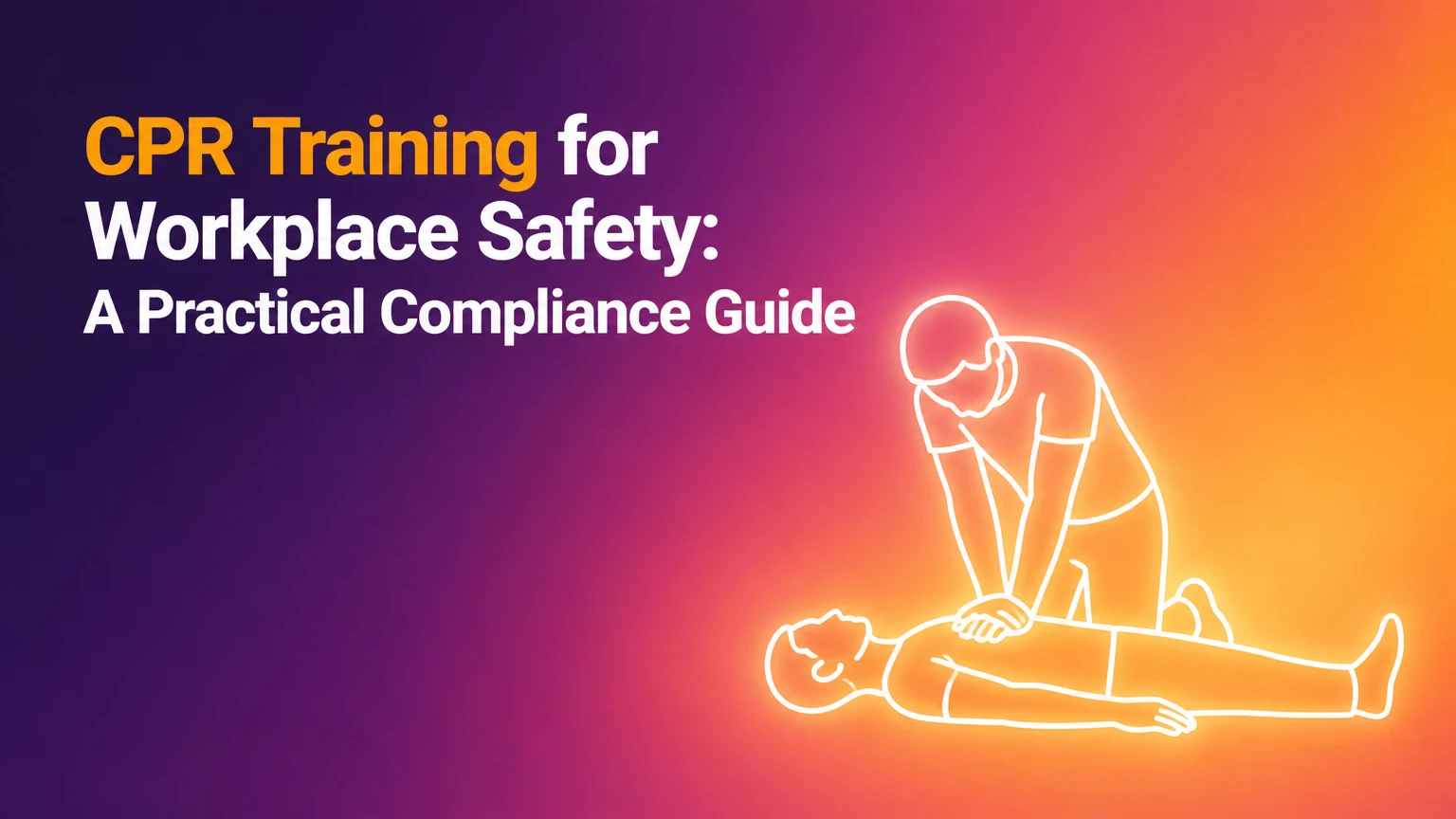
CPR training for workplace safety teaches employees to recognize cardiac arrest, choking, and breathing emergencies, activate emergency medical services, perform high-quality cardiopulmonary resuscitation, and use an automated external defibrillator. Effective programs combine instructor-led or blended education with hands-on skills assessment, workplace risk planning, and certification records.
Key Facts at a Glance
Adult CPR uses a compression rate of 100-120 compressions per minute and a depth of 5-6 cm, or about 2-2.4 inches.
A trained single rescuer generally uses 30 compressions followed by 2 breaths when providing conventional CPR.
A lay rescuer should begin CPR for an unresponsive person with absent or abnormal breathing, including gasping, without delaying for a pulse check.
OSHA 29 CFR 1910.151 requires suitable first-aid supplies and trained personnel when medical care is not in near proximity, but it does not create one universal CPR certification rule for every workplace.
American Heart Association and American Red Cross certifications commonly expire after two years, although employer and jurisdictional requirements can differ.
Typical workplace First Aid/CPR/AED training costs $80-$130 per learner in a public class and approximately $600-$1,200 for on-site group instruction.
What Is CPR Training for Workplace Safety?
CPR training for workplace safety is a structured program that prepares employees to respond during the minutes between a medical emergency and EMS arrival. The course normally covers emergency recognition, calling 911 or the local emergency number, chest compressions, rescue breathing options, AED operation, choking response, and infection-control precautions.
The training has two distinct components. The knowledge component explains cardiac arrest, the chain of survival, legal and organizational procedures, and hazard assessment. The performance component requires learners to practice compressions, ventilation, AED pad placement, and coordinated response on manikins.
Workplace CPR is therefore more than an online certificate. A credible program verifies that the learner can perform physical skills under instructor observation or through an accepted practical assessment. The course should also fit the workplace, because an office, a warehouse, a school, and a remote workforce face different response distances and hazards.
Why Does Immediate CPR Matter?
Cardiac arrest stops effective circulation, so oxygen no longer reaches the brain and other organs normally. CPR creates limited blood flow through chest compressions, while an AED can analyze a shockable rhythm and recommend defibrillation when appropriate.
The American Heart Association reports that more than 350,000 people experience an adult out-of-hospital cardiac arrest in the United States each year, and survival depends heavily on rapid recognition, CPR, and defibrillation. The often-repeated “four to six minutes” statement is a useful urgency reminder, not a precise deadline: brain injury varies with cause, temperature, oxygen levels, and the speed of resuscitation.
The practical rule is simple: do not wait for perfect certainty. AHA public guidance states, “Any attempt at CPR is better than no attempt.” Employees should follow their training, protect themselves from hazards, and continue until EMS takes over, the person shows signs of life, the scene becomes unsafe, or the rescuer cannot continue.
Does OSHA Require Workplace CPR Training?
OSHA does not require every employee in every American workplace to hold CPR certification. OSHA 29 CFR 1910.151(b) requires adequate first-aid supplies and trained personnel when a clinic, hospital, or infirmary is not in near proximity, while other OSHA standards address specific industries, hazards, or job functions.
The compliance question is therefore risk-based. An employer should review the applicable OSHA standard, state-plan rules, local occupational requirements, industry contracts, and workplace emergency action plan before selecting a course. Construction, logging, maritime operations, healthcare, childcare, and remote or isolated work may trigger more specific expectations.
A certificate alone does not prove compliance. Employers should document the hazard assessment, trained-personnel coverage, emergency contacts, AED access, first-aid supplies, course provider, completion date, and renewal date. The Occupational Safety and Health Administration also expects employers to address bloodborne pathogens when employees may reasonably anticipate contact with blood or other potentially infectious materials.
What Should an Employer Verify Legally?
An employer should verify five items before purchase:
- Applicable jurisdiction: Confirm federal OSHA, an OSHA-approved state plan, provincial rules, or another national regulator.
- Industry requirements: Check whether construction, healthcare, education, transportation, or maritime rules specify training content.
- Response distance: Document how long EMS typically takes and whether professional medical care is nearby.
- Employee exposure: Identify shift workers, lone workers, drivers, security staff, and employees exposed to electrical, chemical, mechanical, or drowning hazards.
- Course acceptance: Ask the regulator, contract holder, insurer, or licensing body whether the provider and credential are accepted.
How Should an Employee Respond to a Workplace Cardiac Emergency?
A trained employee should use a rapid sequence: confirm scene safety, check responsiveness, activate emergency services, obtain an AED, assess breathing, and begin CPR when the person is unresponsive and not breathing normally. A lay rescuer should not delay compressions because a pulse is difficult to locate or uncertain.
Step 1: Check the Scene and the Person
Look for live electricity, fire, traffic, chemical vapors, weapons, unstable equipment, or bodily-fluid exposure before approaching. Tap the person’s shoulders and speak loudly, asking whether they are okay.
If the person responds, leave them in position unless a hazard requires movement, and obtain medical help. If the person does not respond and is not breathing normally, treat gasping as abnormal breathing rather than reassurance.
Step 2: Activate the Emergency Response
Point to specific coworkers instead of giving a general instruction. Say, “You call 911 and return with the AED,” then identify another person to meet EMS and guide responders inside.
A lone rescuer with a mobile phone should use speakerphone while beginning care. The exact sequence can change for children, infants, drowning, trauma, or a suspected opioid overdose, so employees should follow the protocol taught by their certifying organization.
Step 3: Start Chest Compressions
Place the heel of one hand in the center of the adult chest on the lower half of the breastbone, place the other hand on top, and keep the shoulders above the hands. Compress at 100-120 per minute, to 5-6 cm, allowing complete recoil after every compression.
Minimize pauses. A practical quality target is to keep interruptions under 10 seconds, including the time needed to analyze or deliver an AED shock.
Step 4: Add Breaths When Trained and Equipped
A trained rescuer using a barrier device can provide 30 compressions followed by two breaths, with each breath delivered over approximately one second and enough volume to produce visible chest rise. Do not force large or rapid breaths, because excessive ventilation raises chest pressure and reduces venous return.
Hands-only CPR is an appropriate option for an untrained or unwilling adult rescuer. A pocket mask or bag-valve mask does not remove the need for training, cleaning procedures, or correct technique.
Step 5: Apply the AED
Turn on the AED as soon as it arrives, expose and dry the chest, apply pads according to the diagrams, and follow the device prompts. Everyone must stop touching the person during rhythm analysis and shock delivery, then resume compressions immediately when instructed.
Remove the person from standing water and avoid placing pads over medication patches, implanted devices, or excessive chest hair when the device instructions require another placement. AED models differ, so workplace responders should practice with the model installed at their facility.
What Skills Should Employees Practice?
A complete workplace course should assess recognition, compressions, ventilation choices, AED operation, choking response, and team communication. A lecture without manikin practice cannot reliably verify the physical skill required during a high-pressure emergency.
| Skill | Standard adult target | Assessment checkpoint |
|---|---|---|
| Compression rate | 100-120 per minute | Consistent rhythm for 2 minutes |
| Compression depth | 5-6 cm, approximately 2-2.4 inches | Adequate depth without excessive force |
| Compression cycle | 30:2 with breaths | Correct sequence when breaths are included |
| Ventilation | 2 breaths, about 1 second each | Visible chest rise without overventilation |
| Pause duration | Less than 10 seconds | Rapid AED analysis and restart |
| AED response | Pads on bare, dry chest | Follows voice and visual prompts |
These figures apply primarily to adult CPR. Child and infant compression depth, hand placement, and equipment selection differ. Employers serving children should choose a course that explicitly includes pediatric content rather than assuming adult certification covers every scenario.
Which Course Level Fits the Workplace?
For most general workplaces, a First Aid/CPR/AED course or a Heartsaver CPR AED course provides the appropriate foundation. Basic Life Support is better for healthcare personnel, professional rescuers, and roles that require team-based resuscitation or more advanced airway skills.
| Course | Typical learner | Main content | Typical time |
|---|---|---|---|
| Heartsaver CPR AED | Office, retail, hospitality employee | Adult CPR, AED, choking, optional pediatric modules | 2-4 hours |
| First Aid/CPR/AED | Safety officer, supervisor, general workforce | CPR, AED, bleeding, burns, shock, injuries | 4.5-6 hours |
| BLS | Nurse, EMT, clinician, professional rescuer | Adult, child, infant CPR, team dynamics, airway skills | 3-5 hours |
| Pediatric CPR/AED | School, childcare, recreation employee | Infant and child CPR, choking, AED adaptations | 3-6 hours |
Course names vary by provider and country. American Heart Association Heartsaver courses, American Red Cross courses, and Health & Safety Institute programs may differ in module names, testing, and renewal processes, so employers should compare the actual curriculum rather than the label alone.
Who Needs CPR Certification?
Employers should prioritize people who can reach an emergency quickly, work on every shift, supervise others, operate in high-risk areas, or have duties involving children or vulnerable adults. A single daytime certificate holder is inadequate coverage for a 24-hour facility.
A typical starting allocation is one trained responder per shift and per major work area, followed by expansion based on floor size, travel time, employee count, turnover, and EMS response. The frequently cited target of training 15-20% of staff can be a useful planning baseline, but it is not a universal legal threshold.
Which Delivery Method Works Best?
In-person training provides the strongest immediate feedback, blended learning reduces classroom time, and on-site instruction simplifies group logistics. The right choice depends on learner count, shift coverage, travel distance, practical assessment requirements, and the complexity of the workplace response plan.
| Format | Learner time | Typical price | Best operational fit |
|---|---|---|---|
| Public classroom | 4.5-6 hours | $80-$130 per person | Small teams and first-time learners |
| Blended course | 2-3 hours online plus 45-60 minutes skills practice | $60-$100 per person | Distributed or time-constrained staff |
| Private on-site class | 4-5 hours | $600-$1,200 per group | 6-20 or more local employees |
| Skills renewal | 2-3 hours | $50-$80 per person | Learners with current or recently expired credentials |
Online-only CPR courses may teach useful concepts, but they generally cannot demonstrate hands-on competence. If an employer, regulator, insurer, or licensing body requires a practical assessment, select classroom or blended training with an in-person skills check.
How Should a Business Choose a Format?
Small offices usually benefit from a public First Aid/CPR/AED class because per-person pricing avoids a private minimum. A manufacturing site with multiple shifts often saves money with on-site delivery, provided the provider can train each shift and use realistic facility scenarios.
Blended learning works well for remote teams only when each employee completes an approved local skills session. It is a poor fit when staff have limited internet access, low self-direction, or job duties that require extended pediatric, trauma, or team-resuscitation practice.
Winner by situation: classroom training wins for feedback, blended training wins for scheduling flexibility, and on-site training wins for coordinated group coverage.
How Much Does Workplace CPR Training Cost?
Typical workplace CPR training costs $60-$130 per person for blended or public classroom delivery and $600-$1,200 for a private on-site session. The final price depends on group minimums, travel, manikin fees, replacement cards, pediatric modules, first-aid scope, and the number of shifts.
| Cost item | Typical range | Common pricing unit | Budgeting note |
|---|---|---|---|
| CPR/AED public class | $60-$100 | Per learner | Often excludes travel |
| First Aid/CPR/AED class | $80-$130 | Per learner | Broader injury content |
| On-site instructor | $600-$1,200 | Per group | Minimum often 6-8 learners |
| Replacement card | $10-$30 | Per learner | Provider-dependent |
| AED refresher supplies | $50-$200 | Per session | Pads and batteries may be separate |
To estimate annual cost, multiply the number of learners by the course price, add travel and replacement supplies, then divide by the certification interval. A 20-person team paying $100 each for a two-year credential has a baseline training cost of $1,000 per year before payroll time and equipment costs.
Training cost is only one part of readiness. An employer may also need AED purchase, cabinet installation, signage, first-aid supplies, bloodborne-pathogen controls, paid training time, and periodic drills.
How Long Does Certification Last?
Most mainstream CPR and First Aid credentials remain valid for two years, but the expiration date printed on the card controls the individual credential. Some employers require earlier renewal or short refresher practice because psychomotor performance declines between courses.
Track each employee’s course date, expiration date, provider, credential level, and work location. Start reminders 90 days before expiration, then confirm completion before the old card lapses. Employees who miss renewal may need a full course rather than a shorter renewal class, depending on provider policy.
Certification is evidence of course completion, not permanent competence. A worker who completed training 22 months ago may need immediate practice before a high-risk assignment, especially after a long period without compressions or AED use.
What Commonly Goes Wrong During Workplace CPR?
The most common performance failures are shallow compressions, leaning between compressions, excessive ventilation, long AED pauses, and hesitation caused by unclear role assignment. Employers can reduce these failures through short practice sessions that measure actions rather than attendance.
| Failure mode | Likely cause | Corrective action | Verification measure |
|---|---|---|---|
| Shallow compressions | Fear of causing injury | Practice on a feedback manikin | Depth indicator reaches target |
| Leaning on chest | Fatigue or poor posture | Reset shoulders and hand position | Full recoil after each compression |
| Excessive breaths | Inexperience with ventilation | Use one-second breaths and a barrier | Visible chest rise only |
| AED delay | Device location unknown | Conduct a timed retrieval drill | AED reaches scene within target |
| Role confusion | No assigned response plan | Use direct names and defined roles | Call, retrieval, and crowd control occur |
| Lapsed credential | Manual tracking failure | Use 90-day automated reminders | Current roster at every audit |
A counterintuitive operational fact is that an AED located 100 feet away may be functionally inaccessible if a locked door, elevator, or security desk adds two minutes. Measure retrieval time during a drill, then relocate or duplicate equipment when the response path is slow.
Another practitioner rule is to train for coverage, not headcount. Twenty certified employees on one weekday shift do not protect a night shift, a satellite warehouse, or a traveling sales team.
What Special Situations Should Employers Plan For?
Workplace emergency plans should address children, lone workers, remote employees, hazardous areas, language needs, mobility limitations, and contamination risks. A generic adult office scenario does not prepare employees for a school, construction site, laboratory, or isolated field assignment.
Remote and Lone Workers
Remote employees should receive approved local training or vouchers for a nearby classroom and should know how to contact emergency services at their actual work location. Lone workers need location-sharing procedures, check-in controls, and instructions for accessing nearby AEDs, because a coworker may not be present to retrieve equipment.
Children and Infants
Schools, childcare facilities, camps, gyms, and family-facing businesses should select pediatric CPR and choking content. Adult hand placement and depth are not interchangeable with infant technique, and pediatric AED pads or energy-reduction settings may be required.
Hazardous and Contaminated Areas
Electrical, chemical, confined-space, and traffic hazards must be controlled before rescue. Employees should never enter an unsafe atmosphere to perform CPR; confined-space incidents require a specialized rescue plan, not an improvised response by a CPR-certified coworker.
How Do You Vet a Training Provider?
Choose a provider that supplies an accepted credential, qualified instructors, current equipment, hands-on assessment, and usable completion records. Employers should request the course syllabus, instructor credentials, learner-to-manikin ratio, practical testing method, renewal policy, and total price before booking.
Use this procurement checklist:
- Confirm acceptance by the relevant regulator, licensing body, insurer, or client contract.
- Verify that every learner practices on a manikin, rather than watching one demonstration.
- Ask whether the instructor uses feedback manikins that measure rate, depth, recoil, and ventilation.
- Confirm that AED trainers match the equipment installed at the workplace.
- Check whether adult, child, infant, choking, first aid, and bloodborne-pathogen modules are included.
- Require attendance records, completion dates, expiration dates, and downloadable certificates.
- Ask about maximum class size and whether every learner receives individual skills time.
- Obtain travel, card, cancellation, and equipment fees in writing.
A low price is a warning sign when it comes from removing the skills assessment. A short course can be legitimate, but the provider should explain which content is self-paced, which skills are tested, and which credential the learner receives.
How Can Employers Keep CPR Skills Current?
Employers should combine two-year certification with brief quarterly or semiannual practice, AED location drills, and annual review of the emergency action plan. Short repetitions improve recall of the first actions, especially calling for help, retrieving the AED, and starting compressions.
A practical retention schedule is:
- At onboarding: assign emergency roles and show AED and first-aid locations.
- Every three months: run a 10-minute response walkthrough or timed AED retrieval.
- Every six months: practice compressions, communication, and handoff procedures.
- Annually: review staffing coverage, contact numbers, access routes, equipment status, and incident lessons.
- Before expiration: renew credentials at least 30-90 days in advance.
Do not use unannounced drills that create unnecessary distress or interfere with real emergencies. Notify managers, define the stop signal, protect employee privacy, and conduct realistic but controlled exercises.
Frequently Asked Questions
Is workplace CPR training worth it for a small office?
Yes, especially when EMS travel time exceeds several minutes, the office has visitors, or employees work outside normal hours. A small office can train one or two people per shift through a public First Aid/CPR/AED class, then place the AED and emergency instructions where every employee can find them.
Can an employer accept an online CPR certificate?
An employer can accept online-only training only when the applicable regulator, insurer, contract, and internal policy permit it. Many recognized programs require an in-person skills demonstration, so blended learning with a documented hands-on check is usually easier to defend than an unverified online certificate.
Should every employee take BLS instead of CPR?
No. BLS is appropriate for healthcare providers, professional rescuers, and designated roles requiring advanced team skills. Most office, retail, hospitality, and general industrial employees need First Aid/CPR/AED or an equivalent Heartsaver course unless a specific regulation or employer policy requires BLS.
What equipment should a workplace keep with CPR training?
A workplace should maintain an accessible AED, adult pads, pediatric capability when children are present, disposable gloves, a breathing barrier, first-aid supplies, signage, and a documented inspection schedule. AED batteries and pads have expiration dates, so facilities should record those dates alongside CPR certificates.
How many employees should be CPR certified?
There is no universal percentage that protects every workplace. Train enough people to cover every shift, building zone, and foreseeable absence, then use a timed drill to test coverage. A 15-20% staffing baseline can begin planning, but response distance and shift structure determine the actual requirement.
What should an employee do if rescue breaths are not possible?
The employee should call emergency services, obtain an AED, and provide continuous hands-only chest compressions for an unresponsive adult who is not breathing normally. A trained rescuer may use a barrier device, but fear of mouth-to-mouth contact should not prevent immediate compressions.
The Bottom Line
CPR training for workplace safety is most effective when certification, hands-on assessment, AED access, shift coverage, and emergency procedures operate as one system. Select First Aid/CPR/AED for most general employees, BLS for professional rescuers, and pediatric training where children are present. Verify local requirements, track two-year renewals, and test the response plan with timed practice rather than relying on certificates alone.