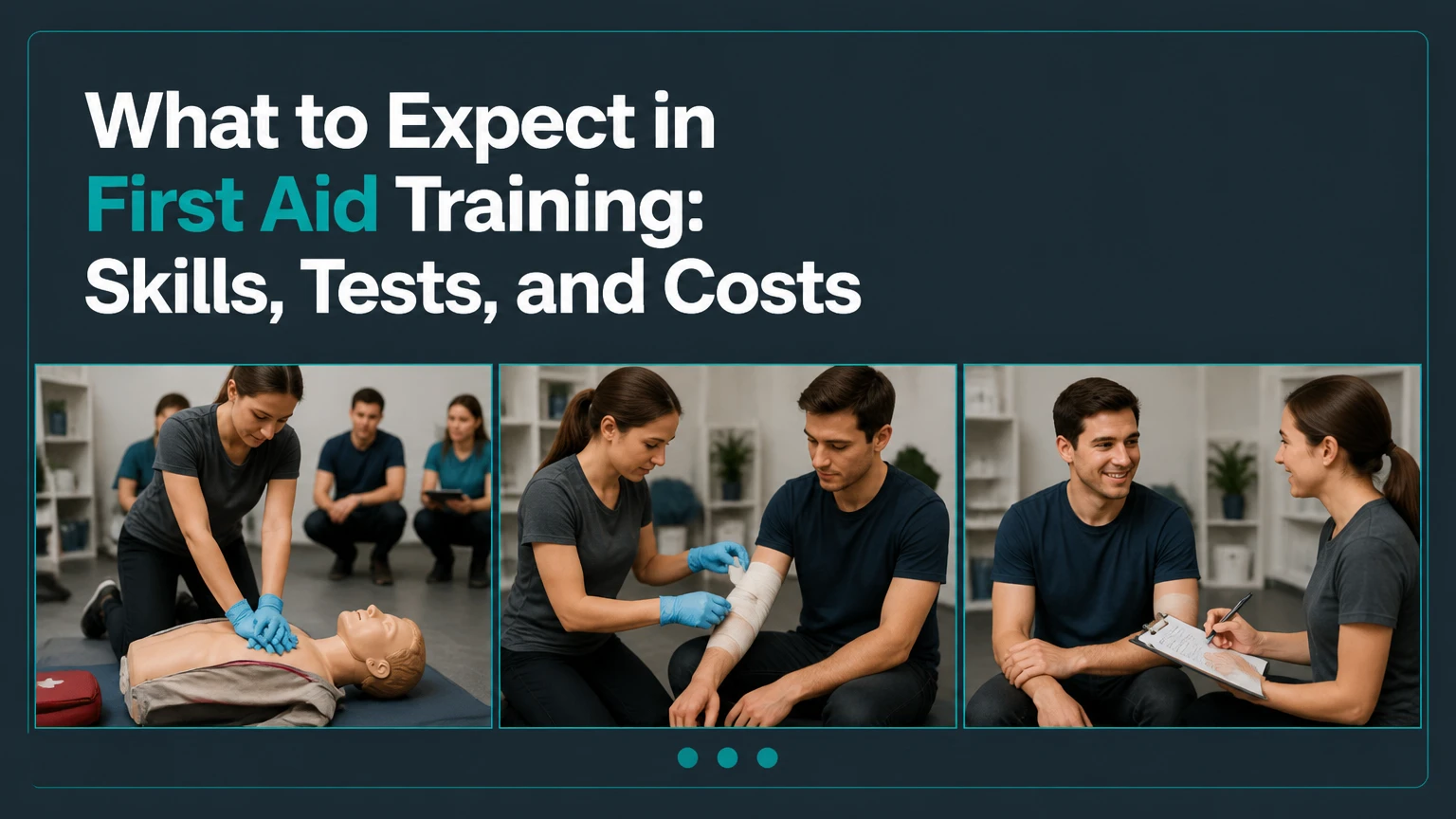
First aid training combines classroom instruction, scenario practice, and hands-on assessment so learners can preserve life, prevent deterioration, and support recovery until professional help arrives. Most general courses cover scene safety, emergency calls, CPR, AED operation, choking, severe bleeding, common medical emergencies, and a practical skills check.
Key Facts at a Glance
A general first aid course typically takes 6-16 hours, depending on the certification level and local requirements.
Students usually practice CPR and AED use repeatedly on adult manikins, with infant and child skills added in pediatric courses.
A valid workplace certificate normally requires an instructor-observed practical assessment, not online theory alone.
Adult CPR uses a compression rate of 100-120 per minute and a depth of about 5-6 centimetres, or 2-2.4 inches.
Typical United States course prices range from $40-$75 for CPR and AED training and $70-$200 for broader first aid programs.
Certification commonly lasts 2 years, although renewal periods depend on the issuing organization, employer, and jurisdiction.
What Is First Aid Training?
First aid training is structured instruction in the immediate care of an injured or ill person before emergency medical services take over. The training does not turn participants into paramedics; it teaches recognition, prioritization, basic intervention, communication, and safe handover.
A course develops two abilities at once. The first is cognitive judgment, such as deciding whether a scene is safe, identifying life-threatening bleeding, or recognizing abnormal breathing. The second is physical execution, such as positioning hands for compressions, operating an AED, applying a pressure dressing, or placing a breathing casualty in the recovery position.
The course also teaches a repeatable response sequence. Many programs use DRSABCD, DRABC, or another local equivalent. These acronyms are not universal laws, so students should follow the protocol taught by their certifying organization and local emergency services.
The American Heart Association states that “Hands-Only CPR can be just as effective as conventional CPR” for some adult sudden cardiac arrest situations, particularly when a rescuer is unwilling or unable to provide rescue breaths. A certified course explains when conventional CPR, hands-only CPR, or pediatric procedures apply.
What Happens During a Typical Course?
A typical first aid course moves from explanation to demonstration, guided practice, realistic scenarios, and assessment. A one-day class commonly alternates short theory segments with manikin work, because CPR, airway positioning, bleeding control, and AED operation cannot be learned reliably from slides alone.
The instructor normally begins with introductions, course objectives, safety rules, and an explanation of the assessment requirements. Learners then work through a primary survey, emergency communication, cardiopulmonary resuscitation, defibrillation, choking, trauma, and medical emergencies.
A practical session may involve pairs or small groups. One learner acts as the first aider, another provides bystander information, and a third observes the sequence. The instructor corrects hand placement, compression depth, body position, communication, and unnecessary delays while the scenario is still fresh.
How should you prepare before class?
Wear clothing that permits kneeling, bending, and reaching, because CPR practice often takes place on a floor manikin. Bring water, identification if required, glasses or hearing aids, and any accessibility information the provider requests.
Tell the instructor before practice if you have a back, knee, wrist, or breathing condition. Many providers can raise a manikin onto a table, provide a practice stool, change partner arrangements, or offer alternative methods without removing the required skill assessment.
Expect a realistic but controlled environment. Training may include simulated blood, injury photographs, choking sounds, or timed scenarios, but learners can request a short break if anxiety, dizziness, or sensory discomfort interferes with safe participation.
Which Practical Skills Are Taught?
Most general first aid programs teach a core set of life-support and injury-management skills, then add medical, environmental, or workplace modules according to course level. The instructor assesses the sequence and safety of each action, not merely whether a learner can recite a definition.
| Skill area | What you normally practice | Typical performance detail |
|---|---|---|
| Scene assessment | Hazard check, gloves, emergency call | Identify traffic, fire, electricity, gas, or structural risks before contact |
| CPR | Chest compressions, rescue breaths, switching rescuers | 100-120 compressions per minute; adult depth about 5-6 cm |
| AED operation | Pad placement, analysis, shock safety | Clear the casualty during analysis and shock; follow voice prompts |
| Choking care | Cough encouragement, back blows, abdominal thrusts | Use age-appropriate technique and call emergency services for severe obstruction |
| Severe bleeding | Direct pressure, wound packing, pressure dressing | Maintain firm pressure and escalate to a tourniquet when indicated by training |
| Recovery position | Roll a breathing, unresponsive casualty safely | Recheck breathing continuously and avoid leaving the person alone |
| Injury care | Splints, slings, burns, sprains, suspected spinal injury | Control movement and monitor circulation, sensation, and worsening symptoms |
Will you practice CPR and AED skills?
Yes. CPR and AED practice is the physical center of most first aid courses, and learners usually repeat compressions on an adult manikin until they can maintain the correct pace, depth, recoil, and body alignment.
A standard adult CPR sequence commonly uses 30 compressions followed by 2 breaths when rescue breaths are included. Compressions occur in the centre of the chest at 100-120 per minute, with complete chest recoil after every compression. The exact depth and breathing approach vary by age, rescuer ability, and certifying protocol.
Modern manikins may provide audible clicks, lights, or digital feedback. These tools reveal shallow compressions, excessive depth, incorrect rate, leaning, and incomplete recoil. A useful practitioner rule is to correct one variable at a time, because trying to fix speed, depth, hand placement, and ventilation simultaneously often causes a new error.
AED practice includes opening the device, exposing and drying the chest when needed, attaching pads, standing clear during analysis, delivering a shock only when prompted, and restarting CPR immediately afterward. AEDs analyse the rhythm themselves; rescuers do not diagnose cardiac rhythms manually.
Which medical emergencies are covered?
General courses commonly cover heart attack symptoms, stroke recognition, asthma, anaphylaxis, seizures, diabetic emergencies, shock, fainting, and altered consciousness. The goal is early recognition, appropriate first aid, and rapid communication with emergency dispatchers rather than independent diagnosis.
Students may learn to help a person use a prescribed inhaler or epinephrine auto-injector according to local law and course policy. They also practice gathering medication information, recording the timeline of symptoms, and monitoring breathing while waiting for EMS.
Course depth varies significantly. A basic workplace course may give each emergency 10-15 minutes of recognition and response instruction, while a pediatric or advanced program uses longer scenarios involving age-specific symptoms and communication with caregivers.
Are injuries and environmental hazards included?
Broader first aid training usually includes burns, cuts, bruises, sprains, fractures, head injuries, spinal concerns, heat illness, hypothermia, poisoning, and bites or stings. Electrical injuries and chemical burns receive additional safety instruction because the hazard may remain active after the initial injury.
The most important distinction is between treating a minor injury and identifying a life threat. A small burn may require cooling and a sterile covering, while a major burn involving the airway, face, hands, genitals, or a large body area requires emergency escalation.
Wilderness courses add prolonged-care skills because evacuation may take hours rather than minutes. Participants may practice improvised splints, hypothermia prevention, patient monitoring, navigation, and evacuation decisions that are outside the scope of ordinary workplace first aid.
What Is the Difference Between Course Types?
CPR-only training focuses on cardiac arrest, choking, and AED use, while general first aid adds trauma, illness recognition, and ongoing casualty care. The appropriate course depends on the learner’s role, workplace risk, local regulation, and whether infants or children are part of the environment.
| Course type | Typical duration | Typical price | Main audience |
|---|---|---|---|
| CPR and AED only | 2-4 hours | $40-$75 | Fitness staff, lifeguards, household members |
| Emergency or basic first aid | 6-8 hours | $70-$120 | Office employees, volunteers, low-risk workplaces |
| Standard first aid with CPR | 14-16 hours | $120-$200 | Construction, manufacturing, schools, supervisors |
| Pediatric first aid and CPR | 6-10 hours | $75-$150 | Parents, teachers, childcare workers, nannies |
| Wilderness first aid | 16-24 hours | $200-$400 | Hikers, guides, camp staff, outdoor leaders |
| Wilderness first responder | 40-80 hours | $600-$1,000 | Search teams, expedition staff, remote professionals |
Course names are not globally standardized. For example, Emergency First Aid at Work and First Aid at Work are United Kingdom terms, while Heartsaver First Aid CPR AED is associated with American Heart Association training. Australian providers may use units such as HLTAID011, and Canadian providers commonly distinguish emergency first aid from standard first aid.
CPR-only versus full first aid
Choose CPR-only training when the requirement specifically names CPR and AED certification or when the learner needs a short life-support refresher. Choose full first aid when the role involves injury assessment, workplace hazards, children, public contact, or responsibility for a first aid kit.
CPR-only training does not usually teach enough about fractures, burns, allergic reactions, bleeding control, or illness recognition. Conversely, a full first aid course may take an extra day but provides broader coverage for the incidents people commonly encounter outside cardiac arrest.
How Long Does First Aid Training Take?
First aid training takes about 2-4 hours for CPR and AED only, 6-8 hours for emergency first aid, and 14-16 hours for a standard course with broader practical assessment. Blended learning can reduce classroom time, but it does not remove the time needed to demonstrate physical skills.
| Training format | Theory time | Practical time | Common completion pattern |
|---|---|---|---|
| Classroom CPR and AED | 30-90 minutes | 1-3 hours | Same-day certificate |
| Classroom basic first aid | 2-3 hours | 4-5 hours | One 6-8 hour session |
| Blended standard first aid | 4-8 online hours | 6-8 classroom hours | Online study plus one practical day |
| Pediatric course | 2-4 hours | 4-6 hours | One day or two shorter sessions |
| Wilderness first responder | 20-40 hours | 20-40 hours | Five to eight training days |
Actual duration depends on class size, language support, prior knowledge, breaks, and whether every learner completes individual rather than paired practice. A provider advertising a 45-minute “certification” should be checked carefully if an employer requires instructor-observed skills.
How Much Does First Aid Training Cost?
Typical first aid training costs $40-$75 for CPR and AED instruction, $70-$120 for basic first aid, and $120-$200 for standard first aid with CPR in the United States and similar high-income markets. Prices rise for pediatric specialization, travel-to-site instruction, small private groups, and wilderness qualifications.
The quoted fee may include a digital certificate, learner manual, disposable manikin face shield, CPR barrier, assessment, and instructor time. Some providers charge separately for the certificate, replacement card, online module, or same-day booking.
Workplace buyers should compare the total delivered cost rather than the advertised seat price. A $65 public class may become more expensive than a $90 onsite session after travel, employee downtime, and multiple booking fees are counted.
Which Training Format Should You Choose?
In-person training is the strongest choice when the certificate must prove physical competence, while blended learning is efficient for learners who can complete theory independently. A fully online course may teach useful concepts, but it generally cannot verify compression quality, airway positioning, AED safety, or bleeding-control technique.
| Format | Typical learner time | Practical verification | Typical price | Main limitation |
|---|---|---|---|---|
| Fully in-person | 6-16 hours | Instructor observes all skills | $70-$200 | Fixed schedule and location |
| Blended | 10-20 total hours | In-person skills session | $90-$220 | Requires reliable internet and self-study |
| Fully online | 2-8 hours | Usually quiz-only or video review | $20-$80 | Often unsuitable for regulated workplaces |
| Private onsite | 6-16 hours per group | Instructor observes employees | $600-$1,500 per session | Higher minimum group cost |
A provider’s logo alone does not establish workplace acceptance. Confirm the issuing organization, practical assessment method, certificate expiry, instructor qualifications, and employer or regulator requirements before paying.
How Are Students Assessed?
First aid students are usually assessed through observed practical demonstrations, scenario-based decisions, and a short theory quiz. The instructor may require a learner to complete CPR, use an AED, manage choking, control severe bleeding, or respond to an unconscious casualty in the correct order.
The practical assessment normally checks five dimensions:
- Safety: The learner identifies danger, uses available PPE, and avoids becoming a second casualty.
- Recognition: The learner identifies unresponsiveness, abnormal breathing, severe bleeding, or another immediate threat.
- Sequence: The learner calls for help, requests an AED, begins appropriate care, and follows the local protocol.
- Technique: The learner uses correct hand placement, depth, rate, recoil, pad placement, pressure, or positioning.
- Communication: The learner gives clear instructions, updates EMS, reassures the casualty, and records relevant observations.
Some providers use an 80% theory pass mark, but no universal percentage applies to every organization. Practical criteria can be more important than a quiz score because a learner who knows the correct answer but cannot safely perform the action has not demonstrated operational competence.
What Mistakes Do Learners Commonly Make?
The most common training mistakes are shallow compressions, incomplete recoil, poor hand placement, unsafe scene entry, and delayed escalation. Instructors correct these errors through immediate feedback, slower rehearsal, and repeated scenarios rather than by expecting learners to memorize more text.
Bending the elbows during CPR
Bent elbows cause the rescuer to push with the arms, which increases fatigue and reduces consistency. Stack the shoulders over the hands, keep the elbows mostly straight, and use the upper body to deliver compressions.
Failing to let the chest recoil
Leaning on the manikin between compressions prevents full recoil and reduces the effectiveness of chest compressions. Listen for the manikin’s feedback click, relax pressure without lifting the hands, and maintain the 100-120-per-minute rhythm.
Hesitating because injury seems possible
Fear of broken ribs can delay CPR when a person is unresponsive and not breathing normally. Follow the trained emergency sequence, because delaying compressions in cardiac arrest is more dangerous than causing an injury during an attempt to resuscitate.
Entering an unsafe scene
A rescuer who approaches live electricity, traffic, smoke, unstable structures, or chemical contamination can create a second casualty. Scene safety comes before treatment, and emergency dispatchers can often provide hazard-specific instructions.
Over-treating minor injuries
Learners sometimes spend several minutes cleaning a small wound while ignoring pale skin, confusion, breathing difficulty, or uncontrolled bleeding. Treat the most immediate threat first, then return to minor care after emergency help is activated.
What If You Feel Anxious or Cannot Kneel?
Training providers can often accommodate limited mobility, chronic pain, hearing needs, vision needs, pregnancy, or blood-related anxiety, but the learner must disclose the limitation before practical assessment. A raised manikin, alternate kneeling position, clear verbal descriptions, or additional breaks may make practice possible.
An accommodation cannot remove a required competency. If an employer requires floor-based CPR at a specified standard, the provider must still determine whether the learner can demonstrate the necessary performance safely.
Blood or injury anxiety usually becomes easier when scenarios are broken into procedural stages. First rehearse the emergency call, then the primary survey, then the physical intervention. Instructors can also explain which symptoms require urgent escalation without asking a learner to diagnose the condition.
An important limitation is often overlooked: training improves readiness, but it does not guarantee calm performance in every emergency. Skills decay without rehearsal, and a certificate is evidence of training at a point in time, not proof that a person will remember every step years later.
What Happens After Certification?
Most first aid certificates remain valid for 2 years, although some CPR credentials renew annually and some jurisdictions or employers set different intervals. The certificate should state the expiry date, issuing body, covered units, and any renewal conditions.
The best retention plan combines a formal refresher with brief practice. A workplace can run a 10-minute monthly drill covering AED location, emergency access, bleeding supplies, and the local emergency number. Individuals can review the course handbook, practise compressions with an approved training manikin, and inspect their first aid kit every few months.
Employers should also verify operational readiness. A trained employee is not enough if the AED battery is expired, the emergency address is unclear, the first aid kit lacks gloves, or no one knows who will meet EMS at the entrance.
Which Course Fits Your Situation?
Parents and childcare workers should select pediatric first aid with infant and child CPR, choking response, allergic reactions, fever-related seizures, and age-specific communication. Adult-only CPR training leaves important gaps when the primary casualties are infants or young children.
Office employees generally need emergency or basic first aid with CPR and AED operation. Construction, manufacturing, electrical, warehouse, and laboratory workers usually need broader training that addresses severe bleeding, crush injuries, chemical exposure, burns, falls, and workplace-specific evacuation procedures.
Outdoor participants should choose wilderness first aid when professional help may be delayed beyond the normal urban response window. Wilderness first responder training is more appropriate for guides, expedition staff, and remote professionals responsible for prolonged patient care.
| User situation | Recommended course | Verify before enrollment |
|---|---|---|
| New parent | Pediatric CPR and first aid | Infant CPR, choking, epinephrine support |
| Office employee | Emergency first aid with CPR and AED | Employer acceptance and AED practice |
| Childcare worker | Pediatric first aid certification | Local childcare regulator requirements |
| Construction worker | Standard workplace first aid | Bleeding, crush, electrical, and fall scenarios |
| Remote outdoor leader | Wilderness first aid or WFR | Evacuation planning and prolonged care |
| Community volunteer | Basic first aid and CPR | Practical assessment and certificate validity |
The best course is the shortest program that fully matches the risk and credential requirement. A longer certificate is not automatically better if it omits pediatric skills, wilderness care, or industry hazards that define the learner’s actual environment.
Frequently Asked Questions
Is first aid training difficult for beginners?
First aid training is manageable for beginners because instructors teach each skill in small stages before combining skills in a scenario. The physical work can be tiring, especially during CPR, but learners are normally allowed to rotate with partners. Passing depends more on safe sequence and repeated practice than on medical background.
Do I need medical knowledge before taking a course?
No. General first aid courses are designed for people without clinical training. Learners need enough language comprehension to follow instructions, participate in demonstrations, and complete the assessment. Medical professionals may take advanced courses, but prior clinical knowledge is not a prerequisite for basic community or workplace certification.
Can I fail the practical assessment?
Yes, a learner can fail a practical assessment by omitting emergency activation, performing unsafe CPR, using an AED incorrectly, or failing to control a life-threatening problem. Most providers allow remediation or a second attempt. Ask about reassessment fees and timing before the class begins.
Is an online first aid certificate accepted by employers?
An online certificate is accepted only when the employer, regulator, or certifying organization explicitly permits online-only completion. Many workplaces require an instructor-observed practical demonstration because video lessons cannot verify compression depth, chest recoil, airway positioning, or safe AED handling.
Should I take CPR or full first aid?
Take CPR and AED training when your only requirement is cardiac arrest response. Choose full first aid when you may manage bleeding, burns, fractures, allergic reactions, asthma, seizures, workplace injuries, or illness while waiting for EMS. Parents and childcare workers should add pediatric coverage.
How often should first aid skills be refreshed?
Refresh skills before the certificate expires and practise key actions more often than the formal renewal cycle. A 2-year certificate does not prevent skill decay, so quarterly review and short workplace drills are sensible. Follow the shorter renewal period when an employer or local regulator requires it.
The Bottom Line
Knowing what to expect in first aid training makes enrollment and preparation easier: expect structured safety instruction, CPR and AED practice, emergency scenarios, injury and illness modules, and an observed assessment. Choose the course by matching the certificate requirement and real risk, then refresh the physical skills before confidence fades.