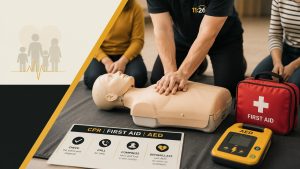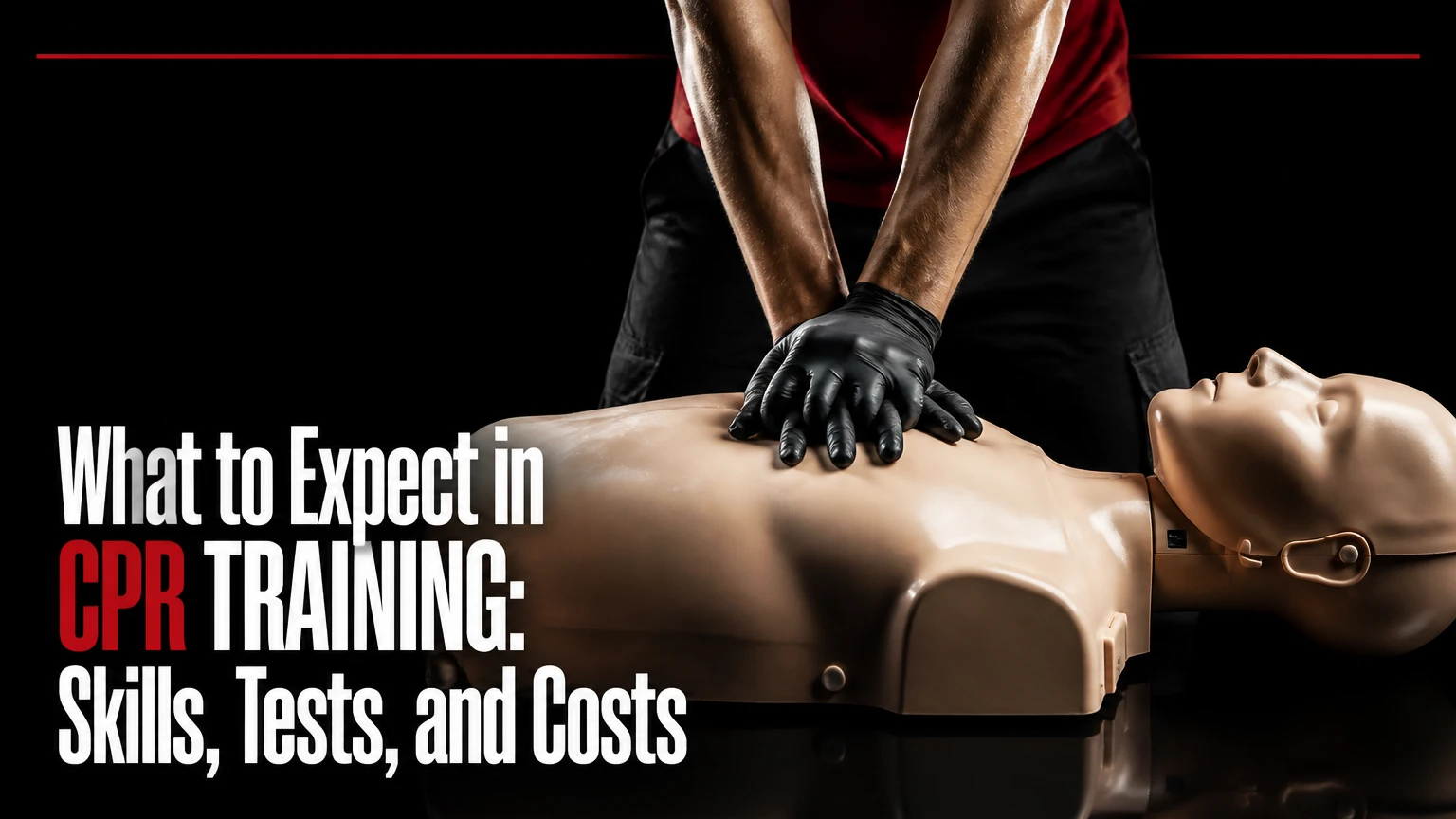
CPR training teaches you how to recognize cardiac arrest, activate emergency help, perform high-quality chest compressions, provide rescue breaths when appropriate, and use an automated external defibrillator. Most beginner courses combine instructor demonstration, repeated manikin practice, feedback, and a short written or practical evaluation.
Key Facts at a Glance
A basic CPR/AED class typically takes 3-5 hours in person, although course length varies by provider and curriculum.
Adult CPR uses compressions at 100-120 per minute and a depth of about 5-6 centimeters, or 2-2.4 inches.
A layperson course generally teaches adult CPR, child CPR, infant CPR, AED use, and choking response.
Healthcare workers usually need a BLS Provider course rather than a community CPR class.
A fully online course may teach useful theory but cannot replace hands-on evaluation when an employer requires physical skills verification.
Many major providers issue cards valid for two years, but renewal rules and employer acceptance depend on the issuing organization.
What Is CPR Training?
CPR training is a practical emergency-response course that prepares a learner to support a person in cardiac arrest until emergency medical services take over. The course focuses on rapid recognition, chest compressions, ventilation decisions, AED use, and coordinated action rather than on diagnosing the underlying heart problem.
Cardiopulmonary resuscitation does not usually restart a stopped heart by itself. Chest compressions create limited blood flow to the brain and heart, while an AED may deliver a shock when a shockable rhythm is present. The American Heart Association describes the immediate public response in direct terms: “Call 911 and push hard and fast in the center of the chest.”
A competent course also teaches what not to do. Students learn to avoid delaying compressions while searching for a pulse, continuing to touch a victim during AED analysis, ventilating too forcefully, or stopping every few seconds to recheck conditions unnecessarily.
Why Does CPR Training Include More Than Compressions?
CPR training includes the full chain of early response because compressions alone do not address every immediate problem. A learner must identify danger, obtain emergency assistance, expose the chest for AED pads, maintain an open airway when giving breaths, and resume compressions quickly after analysis or ventilation.
The course uses a manikin because CPR is a physical skill. Classroom slides can explain rate and depth, but a learner needs repeated practice to discover whether the shoulders are over the hands, the elbows are locked, and the chest is fully recoiling.
How Does the CPR Sequence Work?
The CPR sequence begins with scene safety and a responsiveness check, followed by emergency activation, assessment of normal breathing, chest compressions, ventilation when included, and AED use. In training, students repeat the sequence until the actions become fast, deliberate, and safe.
Step 1: Check Safety and Responsiveness
You first scan for traffic, fire, electrical hazards, bodily fluids, unstable structures, or other threats. After confirming that the scene is reasonably safe, you tap the person and ask loudly, “Are you okay?”
A responsive person may need a different first-aid response. An unresponsive person requires immediate escalation.
Step 2: Activate Emergency Help
A lone rescuer uses a mobile phone to call emergency services, normally placing the phone on speaker while beginning CPR. With other bystanders present, the student practices assigning tasks directly: one person calls emergency services, another retrieves an AED, and another starts compressions.
Training emphasizes specific instructions instead of vague requests such as “Someone call for help.” Clear task ownership reduces the chance that every bystander assumes someone else has called.
Step 3: Assess Breathing Correctly
A lay rescuer should look for normal breathing and recognize that occasional gasping is not normal breathing. Current public CPR guidance generally does not require an untrained rescuer to check a pulse, because an uncertain pulse assessment can delay compressions.
Healthcare-provider courses teach pulse assessment because clinicians must integrate it into formal BLS algorithms. The assessment is normally limited to 10 seconds. This distinction matters because the broad instruction to check a carotid pulse applies to trained healthcare providers, not every beginner.
Step 4: Perform High-Quality Compressions
Students kneel beside the manikin, place the heel of one hand in the center of the adult chest, place the other hand on top, straighten the elbows, and compress at 100-120 times per minute. Adult depth is at least 5 centimeters, while avoiding excessive depth beyond approximately 6 centimeters.
The instructor watches four linked variables: correct hand position, adequate depth, complete recoil, and minimal interruption. Many classes use a manikin feedback system that displays compression rate, depth, release, and ventilation volume.
Step 5: Open the Airway and Give Breaths
A trained rescuer uses a head-tilt/chin-lift maneuver and gives two breaths after 30 compressions, with each breath lasting about one second and producing visible chest rise. A pocket mask or bag-mask device may be introduced depending on the course level.
Students are not expected to force air into the lungs. Excessive ventilation can inflate the stomach, increase the chance of regurgitation, and interrupt compressions longer than necessary.
Step 6: Use the AED
The AED lesson covers powering on the device, exposing and drying the chest, attaching pads to bare skin, following voice prompts, and standing clear during rhythm analysis and shock delivery. Training includes the instruction to remove everyone from contact with the victim before a shock.
After a shock, or when the AED advises no shock, the rescuer resumes CPR immediately according to the device prompts. The AED does not replace compressions. It guides rhythm analysis and may provide defibrillation.
Which CPR Skills Will You Practice?
CPR training normally combines recognition, compressions, ventilation, AED operation, choking response, and teamwork. The exact skill list depends on whether the course is a community class, healthcare BLS course, or advanced resuscitation program.
| Skill area | Typical learner action | Performance target |
|---|---|---|
| Adult compressions | Two hands on the sternum | 100-120/min, 5-6 cm depth |
| Child compressions | One or two hands based on body size | About one-third chest depth |
| Infant compressions | Two fingers for one rescuer or two-thumb technique for two rescuers | About one-third chest depth |
| Rescue breaths | Pocket mask or barrier device | 1 second, visible chest rise |
| AED operation | Pads on bare, dry chest | Clear during analysis and shock |
| Choking response | Back blows, abdominal or chest thrusts as taught | Alternate technique by age and condition |
Will You Practice Adult, Child, and Infant CPR?
You will practice the age groups included in your enrollment, but not every CPR course covers all three. Community courses often include adult, child, and infant modules, while some workplace classes focus primarily on adults and add child or infant content only when requested.
Children and infants require different compression depth, hand placement, airway considerations, and choking responses. The common depth rule is approximately one-third of the chest: about 5 centimeters for a child and 4 centimeters for an infant, subject to the course guideline and manikin design.
Parents, childcare workers, nannies, swim instructors, and pediatric staff should verify that infant and child practice is included. An adult-only card may not satisfy a childcare employer or licensing requirement.
What Does an AED Lesson Actually Involve?
An AED lesson is hands-on and usually takes place during a simulated cardiac-arrest scenario. You remove clothing from the manikin’s chest, attach the pads according to the diagrams, keep hands away during analysis, deliver a shock only when prompted, and restart compressions without waiting for further direction.
Students also encounter realistic complications. AED pads may need repositioning on a small child, a wet chest must be dried, medication patches should be removed from the pad area, and excessive chest hair can interfere with adhesion.
Which CPR Course Should You Take?
The correct CPR course depends on your job, patient population, employer policy, and whether you must use healthcare equipment. Heartsaver or community CPR suits most lay rescuers, BLS suits healthcare providers and clinical students, ACLS suits advanced adult cardiac-care teams, and PALS suits professionals treating critically ill children.
| Course type | Intended audience | Main skills | Typical duration |
|---|---|---|---|
| Heartsaver CPR/AED | Teachers, parents, office staff, fitness workers | CPR, AED, choking | 3-5 hours |
| BLS Provider | Nurses, EMTs, physicians, dental staff, students | One- and two-rescuer CPR, team response, BVM | 3-5 hours |
| ACLS | Emergency, critical-care, and acute-care clinicians | ECG rhythms, medications, advanced airway, post-arrest care | 1-2 days |
| PALS | Pediatric and emergency clinicians | Pediatric assessment, respiratory failure, shock, arrest | 1-2 days |
| Infant and child CPR | Caregivers and childcare personnel | Pediatric CPR, choking, AED considerations | 2-4 hours |
A healthcare student should confirm the issuing organization and course name before enrolling. A general CPR card may not meet a nursing program, hospital, ambulance service, dental practice, or state licensing requirement.
Is BLS the Same as CPR?
BLS includes CPR, but BLS is broader and more structured for healthcare providers. Basic Life Support usually covers adult, child, and infant response, two-rescuer coordination, pulse checks, bag-valve-mask ventilation, team roles, and healthcare-specific decision-making.
A community CPR course teaches a bystander response. BLS training expects the learner to function within a clinical team, use a more formal algorithm, and coordinate ventilation and compressions with another provider.
Which Training Format Is Best?
In-person training is the strongest choice when you need reliable physical correction, while blended learning is efficient when you can complete online theory and attend a genuine in-person skills session. Fully online training is useful for awareness but may fail an employer’s hands-on certification requirement.
| Format | Theory time | Hands-on time | Typical price | Main limitation |
|---|---|---|---|---|
| In-person CPR/AED | Included in class | 1-3 hours | $40-$100 | Fixed schedule |
| Blended CPR/AED | 1-2 hours online | 30-60 minutes | $50-$120 | Skills appointment required |
| In-person BLS | Included in class | 1-3 hours | $60-$120 | Provider-specific enrollment |
| Fully online awareness course | 1-3 hours | 0 minutes | $0-$50 | No physical evaluation |
Is Online CPR Certification Valid?
Online CPR certification is valid only when the receiving employer or regulator accepts that format. A course that issues a downloadable certificate without hands-on evaluation may document knowledge, but it does not demonstrate compression technique, ventilation, AED handling, or physical competence.
The Occupational Safety and Health Administration does not create one universal CPR card accepted for every job. Employers, professional boards, schools, and licensing agencies set their own requirements. Check the exact policy before paying for an online course.
How Long Does CPR Training Take?
A basic in-person CPR/AED course usually takes 3-5 hours, while a blended course often requires 1-2 hours of online work plus a 30-60 minute skills session. ACLS and PALS commonly require one or two full days because they include clinical cases, testing, and advanced algorithms.
The scheduled time includes demonstration, practice rotations, scenario work, evaluation, and administrative processing. A short course is not automatically inferior, but a 20-minute video cannot provide the repeated physical practice required for meaningful skill development.
| Learner situation | Suitable course | Typical total time | Typical price |
|---|---|---|---|
| Office employee | Heartsaver CPR/AED | 3-5 hours | $40-$70 |
| Parent or nanny | CPR, AED, child and infant | 2-4 hours | $50-$100 |
| Nursing student | BLS Provider | 3-5 hours | $60-$120 |
| Critical-care nurse | ACLS renewal or initial course | 1-2 days | $150-$300 |
| Pediatric clinician | PALS | 1-2 days | $150-$300 |
How Much Does CPR Training Cost?
Typical CPR training costs range from $40-$100 for a community class, $60-$120 for BLS, and $150-$300 for ACLS or PALS. Location, training organization, course length, card processing, equipment, travel, and rescheduling policies can change the final price.
Some providers include the digital manual and certification card. Others add $10-$40 for materials, charge a facility fee, or require students to purchase an online module before attending the skills session.
Ask four pricing questions before booking:
- Does the listed price include the certification card?
- Is the required course manual included?
- Does the class include child and infant CPR?
- Is a second attempt or rescheduling included?
Is There a Written or Skills Test?
Most recognized CPR courses include a knowledge check and a practical skills evaluation, although the format varies by provider. The written portion tests recognition, sequence, compression standards, AED safety, ventilation, and choking response; the skills portion tests whether you can perform the response on a manikin.
A typical evaluation scenario asks you to recognize an unresponsive person, call for help, begin CPR, use an AED, and continue until relieved. BLS evaluations may add pulse checks, bag-mask ventilation, two-rescuer coordination, and team communication.
Instructors usually remediate mistakes rather than immediately fail a learner. Common remediation includes correcting hand position, increasing compression depth, improving recoil, reducing pauses, or repositioning AED pads, followed by another attempt.
What Mistakes Do Instructors Correct?
The most frequent CPR training errors are shallow compressions, incomplete recoil, excessive pauses, poor ventilation, and failure to communicate tasks clearly. Each error reduces the effectiveness of the response or increases the time before defibrillation.
- Shallow compressions: Straighten the elbows and use upper-body weight rather than isolated arm strength.
- Incomplete recoil: Release downward pressure after every compression while keeping the hands positioned correctly.
- Long pauses: Prepare the AED and breaths before stopping compressions, then restart immediately after analysis.
- Over-ventilation: Give only enough air to create visible chest rise over approximately one second.
- Incorrect hand position: Place hands in the center of the adult chest, not over the ribs or upper abdomen.
- Unclear delegation: Point to a person and assign the emergency call or AED retrieval directly.
A practical rule matters here: instructors judge the quality of the complete cycle, not one perfect compression. A learner who maintains rate but leans on the chest still needs correction because recoil is part of effective CPR.
What Should You Do Before CPR Training?
Before class, confirm the required course, read the provider’s prerequisites, wear flexible clothing, and expect to kneel or lean over a manikin. You do not need medical knowledge for a beginner course, and most providers supply manikins, AED trainers, barrier devices, and course materials.
Prepare by reviewing the difference between cardiac arrest and a heart attack. Cardiac arrest means the heart has stopped pumping effectively; a heart attack means blood flow to heart muscle is blocked, although the person may remain conscious and breathing.
If you have knee, back, wrist, respiratory, or mobility limitations, notify the provider before class. An instructor may offer a raised manikin, a different kneeling position, additional breaks, or an adapted evaluation, but the issuing organization determines whether the adaptation satisfies certification standards.
What If You Are Nervous About Performing CPR?
Nervous beginners usually gain confidence through repetition, because the class breaks a frightening emergency into observable actions. Instructors expect students to make early mistakes and normally provide correction before the final scenario.
You may feel physical fatigue after two minutes of compressions. Real responders rotate when possible, and training teaches a replacement rescuer to take over with minimal interruption rather than expecting one person to continue indefinitely.
What Happens After the Class?
After successful completion, the training provider records the course and issues a physical or digital card showing the course type, completion date, and expiration date. Many AHA and Red Cross cards remain valid for two years, but the card’s acceptance depends on the employer and jurisdiction.
Skill retention declines without practice. The American Heart Association’s 2020 Guidelines for CPR and ECC recommend strategies such as frequent training and feedback because infrequent certification classes do not guarantee durable performance.
Renew before the expiration date if your employer requires uninterrupted status. A renewal class may be shorter than an initial course, but it still requires current content and, for many credentials, hands-on assessment.
Can You Use a CPR Card for Any Job?
A CPR card cannot automatically satisfy every job requirement. A school may require adult, child, and infant CPR with AED, while a hospital may require a specific BLS Provider credential from an accepted organization.
Read the employer’s wording carefully. Confirm the provider, course title, delivery format, expiration window, and whether first aid or bloodborne pathogens training must be added.
The Bottom Line
What to expect in CPR training is a structured combination of instruction, manikin practice, AED scenarios, age-specific response, feedback, and assessment. Most beginners complete a basic class in 3-5 hours, while healthcare professionals may need BLS, ACLS, or PALS according to their role.
Choose the course by acceptance requirements first, then select the delivery format. Hands-on practice is the part a video cannot reproduce, and correct technique depends on repeated feedback about compression depth, rate, recoil, ventilation, and interruption time.
Frequently Asked Questions
Do I Need CPR Experience Before Enrolling?
No. Beginner CPR and Heartsaver courses are designed for people without clinical experience, and instructors teach the sequence from the beginning. Healthcare-provider BLS may assume familiarity with basic anatomy or clinical equipment, but it still includes demonstrations and guided practice before evaluation.
Is CPR Training Physically Difficult?
CPR training is moderately physical because students kneel, lean over a manikin, perform repeated compressions, and sometimes provide ventilation. Most adults can participate with breaks and technique adjustments. Tell the instructor about mobility or medical limitations before practice so safe accommodations can be considered.
Does CPR Training Include First Aid?
Not always. CPR/AED courses focus on cardiac arrest, choking, and AED use, while a combined CPR, AED, and first aid course adds bleeding, burns, fractures, allergic reactions, stroke, and other emergencies. Check the course title because CPR certification alone does not prove first-aid training.
What Happens If You Fail the CPR Skills Test?
Most providers allow immediate remediation and a second attempt after the instructor identifies the problem. Typical corrections involve compression depth, incomplete recoil, excessive pauses, ventilation, or AED safety. If a learner cannot demonstrate the required skills, the provider may require another session before issuing a card.
How Often Should You Practice CPR Skills?
Practice more often than the formal two-year renewal cycle when your role involves frequent emergencies or clinical care. Short refresher sessions every few months can reinforce compression rate, hand position, AED steps, and team communication, while formal renewal remains governed by the credentialing organization.
Should Parents Take Infant CPR Training?
Yes, parents and regular infant caregivers should choose a course that includes infant CPR and choking response. Infant techniques differ from adult techniques in hand placement, compression depth, airway handling, and force, so an adult-only class does not provide equivalent preparation for a baby.