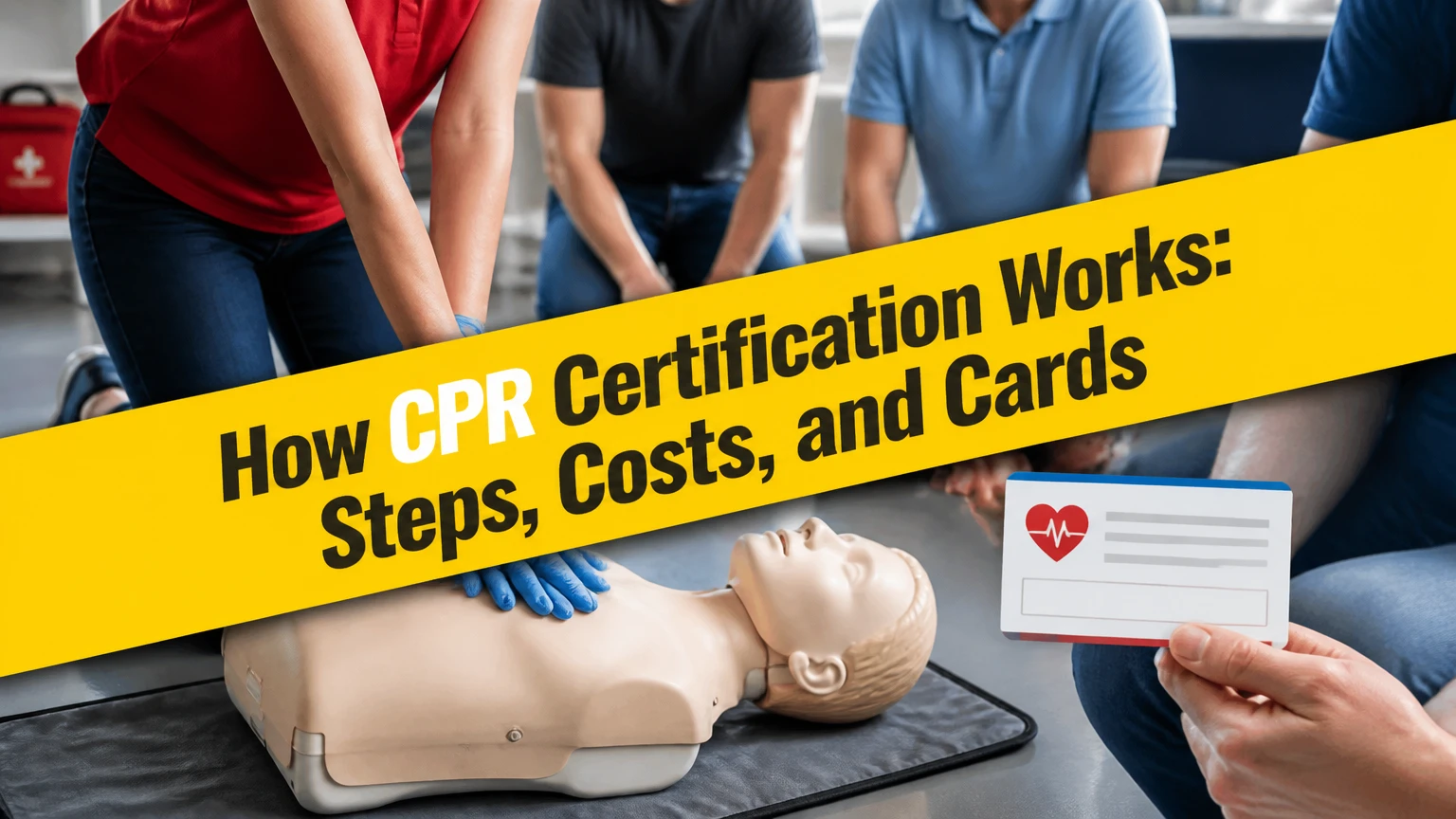
CPR certification is a credential showing that a person completed an approved cardiopulmonary resuscitation course and demonstrated required knowledge and skills. A typical process includes selecting the correct course, completing instruction, passing a knowledge assessment, performing CPR and AED skills on a manikin, and receiving a card with an expiration date.
Key Facts at a Glance
- Most U.S. CPR and BLS credentials are valid for approximately two years, but the issuing organization and employer determine the exact expiration date.
- Heartsaver CPR usually targets non-healthcare responders, while BLS targets healthcare professionals and other personnel expected to perform team-based resuscitation.
- A blended course combines online instruction with an in-person skills session; an online-only course may not satisfy an employer, licensing board, or workplace requirement.
- Adult CPR uses compressions at 100-120 per minute and a depth of at least 2 inches, or 5 centimeters, for an average adult.
- A legitimate course identifies its training organization, course name, instructor or skills evaluator, completion date, and credential verification method.
- CPR certification does not guarantee clinical competence beyond the skills and scope assessed in that particular course.
What CPR Certification Proves
CPR certification proves that a learner met a training provider’s minimum requirements for a defined course on a specified date. The credential normally covers cardiopulmonary resuscitation, automated external defibrillator use, and sometimes choking response or first aid, depending on the course title.
A card does not mean that a person is licensed to practice medicine. It also does not prove that the holder can manage every cardiac arrest scenario, use advanced airways, administer medication, or lead a resuscitation team unless those skills were separately assessed.
Training Versus Certification
CPR training is education and practice. CPR certification adds an evaluation and a documented credential. A free public demonstration, video, or informal workplace presentation can teach useful actions without creating an employment-ready certification card.
The American Heart Association, American Red Cross, Health & Safety Institute, and other organizations publish or license courses through authorized instructors and training centers. The instructor or issuing organization, rather than the U.S. government, generally produces the card.
How the Guideline System Works
The International Liaison Committee on Resuscitation, or ILCOR, reviews resuscitation evidence and publishes international consensus recommendations. National organizations such as the American Heart Association and American Red Cross translate that science into guidelines, courses, and training materials.
Guidelines are updated through formal evidence review rather than through a government certification office. The American Heart Association’s 2020 Guidelines for CPR and ECC, for example, informed widely used U.S. courses, while newer scientific updates can influence future revisions.
How CPR Certification Works
CPR certification works through four linked stages: cognitive instruction, physical practice, competency assessment, and credential issuance. The learner first studies the response sequence, then demonstrates effective compressions, ventilations when required, AED operation, and communication appropriate to the selected course.
Course providers vary in their exact workflow. Some use a separate written exam, some embed quizzes throughout an online module, and some combine a knowledge check with an instructor-led skills evaluation.
What Happens During Training and Testing?
A typical learner completes the following sequence:
- Select a course. Match the course title to the job, school, licensing board, or personal goal.
- Complete cognitive instruction. Study cardiac arrest recognition, CPR technique, AED use, choking response, and age-specific modifications.
- Practice on a manikin. Rehearse hand placement, compression rate, depth, recoil, ventilation, and transitions.
- Complete the assessment. Pass the provider’s written, online, or instructor-led knowledge check.
- Demonstrate physical skills. Perform the required sequence while an instructor or feedback manikin evaluates technique.
- Receive the credential. Obtain a digital card, paper card, or electronic record showing the course and completion date.
A practical assessment may require the learner to recognize an unresponsive person, activate emergency services, request an AED, begin compressions, provide breaths, and follow AED prompts. A healthcare BLS evaluation can also include two-rescuer coordination, bag-mask ventilation, pulse checks, and team communication.
What Skills Must You Demonstrate?
Adult CPR skills generally require compressions in the center of the chest at 100-120 per minute, with a depth of at least 2 inches and complete chest recoil. The rescuer minimizes interruptions, gives effective breaths when trained and willing, and uses an AED as soon as it becomes available.
For adult CPR with breaths, the standard sequence is 30 compressions followed by 2 breaths. Hands-only CPR is an accepted alternative for many untrained or unwilling bystanders, but a certification course may still evaluate conventional CPR with ventilation.
The American Heart Association describes high-quality CPR with the instruction to “push hard and fast,” a concise rule that does not replace the measurable rate, depth, recoil, and interruption standards assessed during training.
Which CPR Course Do You Need?
The correct CPR course depends on the person’s expected role, patient population, and employer or licensing requirement. A lay responder usually needs a Heartsaver-style CPR/AED course, whereas a nurse, physician, EMT, or dental professional commonly needs BLS Provider training.
| Course type | Typical learner | Core skills | Typical U.S. duration |
|---|---|---|---|
| CPR/AED or Heartsaver | Teacher, coach, office worker, babysitter | Adult CPR, AED, choking response | 2-3 hours |
| Pediatric CPR/AED | Childcare worker, nanny, parent | Infant and child CPR, AED, choking response | 2-4 hours |
| BLS Provider | Nurse, physician, EMT, dentist, student clinician | Individual and team CPR, AED, ventilation | 3-5 hours |
| First Aid/CPR/AED | Workplace responder, camp staff, childcare worker | CPR, AED, first aid, choking | 4-8 hours |
| ACLS | Paramedic, emergency nurse, physician | ECG rhythm management, medications, algorithms | 1-2 days |
| PALS | Pediatric emergency clinician | Pediatric advanced life support | 1-2 days |
Heartsaver and Lay-Responder Courses
A Heartsaver or equivalent course suits people who may respond to an emergency but do not provide healthcare as part of their job. Course versions can cover adults only or include children and infants, so the title matters.
A teacher working with preschool children should verify infant and child content. A warehouse employee whose employer requests “CPR/AED” may not need pediatric material, but the employer may require first aid as well.
BLS Provider Courses
BLS is broader than basic public CPR because it assumes a professional response environment. BLS courses commonly assess high-quality single-rescuer and two-rescuer CPR, AED use, rescue breaths, bag-mask ventilation, pulse checks, and coordinated team performance.
BLS does not automatically include advanced cardiac life support. A hospital may require BLS for all clinical staff and ACLS for selected clinicians, with PALS used when the role involves pediatric emergencies.
ACLS and PALS Are Separate Credentials
Advanced Cardiovascular Life Support, or ACLS, and Pediatric Advanced Life Support, or PALS, are advanced courses rather than interchangeable versions of a basic CPR card. They may include rhythm recognition, defibrillation decisions, airway management, medications, vascular access, and team leadership.
A person seeking an entry-level CPR card should not pay for ACLS or PALS unless an employer, school, or license specifically requires it. Advanced credentials usually presuppose healthcare knowledge and may require current BLS certification.
How Much Does CPR Certification Cost?
Typical U.S. CPR certification costs range from $40-$80 for a lay-responder course, $60-$120 for BLS, and $20-$50 for an online-only course. Local wages, equipment, course materials, travel, card fees, and same-day scheduling can move the final price substantially.
| Course or format | Typical price | Typical completion time | Main price variable |
|---|---|---|---|
| CPR/AED classroom | $40-$80 | 2-3 hours | Local instructor fee |
| Pediatric CPR/AED | $50-$100 | 2-4 hours | Infant and child materials |
| BLS classroom | $60-$120 | 3-5 hours | Professional course materials |
| Blended BLS | $70-$140 | 2-4 total hours | Online module plus skills session |
| Online-only CPR | $20-$50 | 30-120 minutes | Card verification and acceptance |
| First Aid/CPR/AED | $80-$160 | 4-8 hours | First-aid scope and equipment |
A low advertised price may exclude the certification card, skills appointment, workbook, or rescheduling fee. Before paying, confirm whether the displayed price covers every required component.
How Long Does Certification Take?
Most lay-responder CPR courses take 2-3 hours, while classroom BLS commonly takes 3-5 hours. Blended training may require 1-2 hours online plus a 30-60-minute in-person skills session, although the total time depends on the learner’s pace and the provider’s assessment design.
| Delivery format | Knowledge portion | Skills portion | Scheduling constraint |
|---|---|---|---|
| Classroom CPR/AED | 60-120 minutes | 45-90 minutes | Fixed class date |
| Classroom BLS | 120-180 minutes | 60-120 minutes | Fixed class date |
| Blended CPR | 45-120 minutes | 30-60 minutes | Separate appointment |
| Blended BLS | 90-180 minutes | 45-90 minutes | Skills deadline varies |
| Online-only | 30-120 minutes | None | Acceptance must be verified |
A learner who fails a quiz or skills check may need additional practice before receiving the card. Same-day completion is possible for some classroom courses, but a blended course can take longer if skills appointments are full.
Are Online-Only CPR Cards Accepted?
Online-only CPR cards are accepted only when the receiving employer, school, regulator, or licensing board accepts that specific format. Many organizations require an instructor-observed skills assessment because a screen-based quiz cannot verify compression depth, recoil, ventilation, or AED handling.
OSHA does not operate a universal CPR certification registry, and OSHA rules do not simply state that every online CPR course is invalid in every workplace. OSHA’s first-aid requirements focus on having adequate first-aid supplies and trained personnel when medical care is not in near proximity; employers and industry rules often impose more specific training requirements.
For a job application, ask the hiring manager or compliance department three questions:
- Which issuing organizations are accepted?
- Must the course include an in-person skills demonstration?
- Is CPR alone sufficient, or is First Aid/CPR/AED required?
Online-only training can be useful for awareness and preparation. It is a poor choice when the card must prove physical competence.
What Is the Difference Between In-Person and Blended Training?
In-person training completes instruction and skills practice in one scheduled session, while blended training separates self-paced online learning from a shorter in-person evaluation. Both can produce an accepted credential when the provider and course meet the receiving organization’s requirements.
| Decision factor | In-person | Blended | Online-only |
|---|---|---|---|
| Instructor contact | Continuous | Skills session only | None or limited |
| Physical assessment | Yes | Yes | No |
| Typical flexibility | Low | Medium-high | High |
| Typical total cost | $40-$120 | $70-$140 | $20-$50 |
| Employer acceptance | Usually high | Usually high | Variable |
| Best use | First-time learners | Busy workers | General awareness |
In-person instruction is often better for a first-time learner who needs correction during practice. Blended learning suits experienced responders who can study independently and attend the required skills session.
When Does CPR Certification Expire?
CPR certification commonly expires two years after completion, but the exact date appears on the credential and controls renewal. The claim that every legitimate card expires exactly at the end of the issuance month is too broad because organizations use different expiration conventions.
Do not assume a grace period. Some employers allow a short administrative window, but an expired card may fail a clinical placement, job onboarding check, childcare inspection, or contract audit.
Renew before the printed expiration date when possible. A renewal course may be shorter for a returning learner, but providers can require a full course if the card has expired or if the learner changed course level.
What Should the Credential Show?
A verifiable CPR credential normally includes:
- Learner’s name
- Course name and level
- Issuing organization
- Training center or instructor
- Completion date
- Expiration date
- Card number, QR code, or verification method when provided
A card that only says “CPR certified” without identifying the course or issuer deserves additional verification. Employers may reject credentials that cannot be traced to an authorized training source.
What Is the CPR Skills Sequence?
The CPR skills sequence begins with scene safety and responsiveness, continues through emergency activation and compressions, and adds ventilation and AED use according to the rescuer’s training. Certification evaluates both the sequence and the quality of each action.
- Check scene safety. Remove hazards before approaching.
- Check responsiveness and breathing. Tap the person and shout; abnormal gasping is not normal breathing.
- Activate help. Direct a specific person to call emergency services and retrieve an AED.
- Start compressions. Place hands on the center of the adult chest and compress at 100-120 per minute.
- Open the airway. Use a head-tilt and chin-lift unless trauma instructions require another approach.
- Give breaths when trained. Deliver two breaths, each lasting about one second, with visible chest rise.
- Apply the AED. Expose the chest, place pads as shown, clear everyone during analysis and shock, then resume compressions immediately.
- Continue until relief arrives. Stop only for safety, signs of life, exhaustion, or direction from emergency professionals.
Adult compressions generally require at least 2 inches, or 5 centimeters, without exceeding 2.4 inches, or 6 centimeters. Child and infant depth targets are about one-third of chest depth, approximately 2 inches for a child and 1.5 inches for an infant, subject to the current course standard.
What Mistakes Cause a Skills Check Failure?
The most common skills-check failures involve poor compression quality, delayed emergency activation, incorrect AED clearance, and failure to follow the evaluator’s required sequence. Feedback manikins can detect rate, depth, recoil, hand position, ventilation volume, and interruption time.
- Compressions are too shallow: Use straight arms and position shoulders over hands; confirm the manikin’s depth indicator.
- The rescuer leans on the chest: Release pressure fully after each compression while keeping hand position.
- The rate is inconsistent: Use an internal rhythm near 100-120 per minute rather than accelerating from fatigue.
- Ventilations are excessive: Give only enough air to produce visible chest rise; forceful breaths can reduce circulation.
- The AED is delayed: Send someone for the AED immediately and turn it on as soon as it arrives.
- The rescuer forgets to clear the victim: Stop contact during rhythm analysis and shock delivery, then resume CPR promptly.
- The sequence becomes disorganized: Practice verbalizing safety, responsiveness, emergency activation, compressions, airway, breathing, and AED steps.
A counterintuitive testing rule is that speed alone does not equal quality. Compressions above 120 per minute can reduce filling time, while long pauses for breaths or repositioning reduce the number of effective compressions.
What Happens If You Fail?
Most providers allow remediation and a retest, but the number of attempts, extra fees, and same-day policy vary by organization and training center. Ask the instructor what happens before class because a failed skills check may require repeating a full session.
Common Recovery Steps
- Ask the evaluator to identify the failed performance element.
- Practice that element on the manikin with feedback.
- Repeat the complete sequence without stopping unnecessarily.
- Retake the knowledge or skills assessment under the provider’s policy.
- Obtain the card only after every required component is recorded as complete.
A failed attempt is often a technique problem rather than a knowledge problem. Learners who understand the steps can still lose points through shallow compressions, excessive ventilation, or failure to verbalize emergency activation.
Which Course Fits Your Situation?
Course selection should follow the receiving organization’s written requirement, not the most advanced credential available. The best course is the least extensive credential that fully satisfies the job, patient population, and assessment requirements.
| Situation | Usually appropriate course | Verify before enrollment |
|---|---|---|
| Office or retail employee | CPR/AED or Heartsaver | Adult-only versus pediatric scope |
| Teacher or childcare worker | Pediatric CPR/AED or First Aid/CPR/AED | State childcare rules and first-aid requirement |
| Nurse or medical student | BLS Provider | School or hospital-approved issuer |
| EMT or emergency clinician | BLS plus ACLS or PALS when required | License and employer renewal rules |
| New parent or grandparent | Family and Friends CPR or certified pediatric course | Whether a formal card is needed |
| Construction or industrial worker | Workplace CPR/AED or First Aid/CPR/AED | Employer and site safety requirements |
Family and Friends CPR can be a sensible choice for relatives who want practical preparation but do not need employment documentation. It is not a substitute for a workplace credential when an employer requires an assessed certification.
How to Verify a Course Before Paying
Verify the course issuer, physical assessment, expiration policy, and receiving organization before registration. A provider’s use of terms such as “nationally recognized” does not prove that a particular employer or licensing board accepts its card.
Use this checklist:
- Find the exact required course name in the job or school instructions.
- Confirm the provider is authorized by the named organization.
- Ask whether an instructor observes hands-on CPR and AED performance.
- Check whether the price includes the credential and all required materials.
- Confirm the class covers adults, children, or infants as needed.
- Ask how the card can be verified after completion.
- Record the expiration date in a calendar with a renewal reminder 30-60 days early.
What the Card Cannot Tell You
A CPR card cannot measure performance under panic, fatigue, crowd pressure, poor lighting, or a complicated medical scenario. It records completion of a defined educational assessment, not continuous readiness.
Skills also decline without practice. The American Heart Association’s 2020 guidance recommends training and education strategies that support retention and performance, which is why brief practice sessions between formal renewals have practical value.
Frequently Asked Questions
Can You Get CPR Certified in One Day?
Yes, many classroom CPR/AED and BLS courses issue a credential the same day after successful completion of instruction and skills testing. Blended courses may also finish in one day if the online module is complete and an in-person appointment is available, but card delivery can be electronic rather than immediate.
Does CPR Certification Include First Aid?
No, CPR certification does not automatically include first aid. A course titled First Aid/CPR/AED includes additional topics such as bleeding, burns, shock, allergic reactions, fractures, and illness response, while a CPR/AED course may cover only resuscitation, defibrillation, and choking.
Can an Employer Reject a CPR Certificate?
Yes, an employer can reject a CPR certificate that lacks an in-person skills assessment, comes from an unapproved issuer, has expired, or omits required pediatric or first-aid content. Employers, schools, licensing boards, and regulators may each publish different acceptance rules.
Do You Need CPR Certification to Perform CPR?
No. A bystander should call emergency services and begin CPR during a suspected cardiac arrest even without certification. Good-faith emergency assistance is generally protected by Good Samaritan laws, but legal protections vary by jurisdiction, so a person should follow dispatcher instructions and act within reasonable training.
Is BLS Harder Than Basic CPR?
BLS is usually more demanding because it assesses healthcare-provider scenarios, two-rescuer coordination, pulse checks, ventilation equipment, and team communication. Basic CPR/AED courses focus on essential responder actions for adults and, when selected, children and infants, without the full professional-rescuer scope.
How Often Should You Practice CPR Skills?
Practice brief CPR and AED skills several times between formal certification courses when equipment and supervision are available. Formal renewal commonly occurs every two years, but practice frequency should increase for healthcare workers, childcare staff, and responders with frequent exposure to emergencies.
The Bottom Line
How CPR certification works is straightforward: choose a course that matches the receiving organization’s requirement, complete knowledge instruction, demonstrate CPR and AED skills on a manikin, pass the provider’s assessments, and verify the resulting credential. Most cards last about two years, but the printed expiration date and employer policy control.
A hands-on Heartsaver or CPR/AED course usually fits the general public, while healthcare workers commonly need BLS and selected clinicians need ACLS or PALS in addition. Online-only training may teach useful fundamentals, but it cannot reliably prove physical performance and may not satisfy workplace or licensing requirements.