Active threat response is the coordinated set of decisions and actions used to protect people during an immediate, ongoing threat such as a firearm attack, stabbing, vehicle assault, or deliberate explosion. The safest response depends on threat location, available exits, barriers, distance, and current information, so people should escape when a safe path exists, secure themselves when escape is unsafe, and resist only as a last resort.
Key Facts at a Glance
- Active threat response applies to more than active shooter incidents, including edged-weapon attacks, vehicle assaults, and some explosive threats.
- Run. Hide. Fight. is a decision framework, not a mandatory sequence that every person must follow.
- Escape routes, locked barriers, distance, and hard cover reduce exposure; concealment may hide a person without stopping bullets or vehicles.
- No universal 10-15-minute incident duration or 3-5-minute police response time can safely guide an individual decision.
- Emergency alerts should use plain language, identify the affected area, state the action required, and be updated when facts change.
- After an incident, responders need visible empty hands, accurate information, preserved evidence, medical triage, and controlled reunification.
What Does Active Threat Response Mean?
Active threat response means taking immediate protective action during an ongoing act of violence. The term includes active shooter response, but a complete plan also considers knives, blunt weapons, vehicles, hostage situations, explosives, and coordinated attacks.
An active threat differs from a general security concern. A suspicious email may require reporting and investigation; an attacker inside a building requires immediate protective decisions. The response period may be short or prolonged, and the threat can move, stop, split into multiple locations, or generate false reports.
The Federal Bureau of Investigation uses the widely recognized phrase “Run. Hide. Fight.” for civilian active shooter guidance. The phrase is memorable because it compresses a complex decision into three options, but it does not replace local emergency procedures, professional security advice, or direct instructions from law enforcement.
Why fixed response numbers can mislead
Published incident data does not establish one dependable duration for every active threat. Some attacks end within minutes, while barricaded subjects, multiple locations, suspicious packages, and delayed discovery can extend the emergency substantially.
A claimed average police response time of 3-5 minutes is not a universal planning standard. Travel distance, call quality, staffing, traffic, building access, and jurisdiction change the actual interval. The same caution applies to claims that casualties occur every 15 seconds. Such figures may describe selected datasets or scenarios, but they cannot predict a specific event.
The operational rule is simple: act on credible danger immediately rather than waiting for confirmation, and do not delay because a plan assumes responders will arrive within a particular number of minutes.
How Does the Core Response Framework Work?
Run. Hide. Fight. works as a conditional decision model. Run means leave the danger area if a safe route exists, hide means secure and conceal yourself when escape is unsafe, and fight means interrupt an imminent attack when no safer option remains.
The OODA Loop, Observe, Orient, Decide, Act, explains why the model must remain flexible. A person observes sounds, movement, alerts, and exits; orients those facts to the threat location; decides among escape, shelter, or last-resort resistance; then acts and reassesses when new information arrives.
Step 1: Recognize and move away from danger
Treat credible indicators such as gunfire, screams, visible violence, or a specific emergency alert as actionable. Do not spend valuable time identifying the weapon, filming the event, collecting belongings, or waiting for a second confirmation.
If an exit leads away from the threat, move quickly and quietly. Encourage nearby people to leave, but do not let someone who refuses to move trap you in danger. Keep hands free, avoid elevators when conditions make them unsafe, and prevent others from entering the affected area when doing so does not expose you.
Success checkpoint: You are outside the attacker’s likely path and continue moving away from the hazard.
Common mistake: Following a familiar fire-drill route without checking whether the route approaches the threat.
Step 2: Secure a room when escape is unsafe
If the threat is between you and a safe exit, enter a room that offers distance and barriers. Lock the door, turn off lights if practical, silence devices including vibration, stay low and out of sightlines, and spread people away from the doorway.
A locked door is useful, but a locked door alone is not a complete barricade. Use heavy furniture only when it can be moved quickly and safely. Do not stand directly behind the door, and do not open it for an unknown voice. Silence is more reliable than a complicated code.
Success checkpoint: The room is locked or blocked, occupants are quiet, and people cannot be seen through doors or windows.
Common mistake: Creating noise by repeatedly checking the hallway or answering unverified messages aloud.
Step 3: Resist only when immediate harm is unavoidable
Physical resistance is a last resort when an attacker is entering your space or confronting you and escape or concealment is no longer viable. The objective is survival and escape, not arrest, pursuit, or recovery of property.
People may use available objects to create distance, disrupt the attacker’s control, or help others escape. Group action can improve resistance, but no civilian should be expected to use a specific weapon or tactic. Do not pursue an attacker after gaining an exit, and do not mistake security equipment for a substitute for evacuation or shelter.
Success checkpoint: You have created an opportunity to escape danger and are moving toward safety.
Common mistake: Leaving a secure position to confront a threat that is not actually reaching you.
What Should You Do During Active Threat Response?
During active threat response, prioritize distance, barriers, and accurate information in that order. Leave if a safe route exists, secure yourself if it does not, and call emergency services when safe to provide location, direction of travel, description, injuries, and hazards.
Emergency calls should be concise. State the exact building, floor, room, entrance, or landmark; explain what you saw or heard; identify the last known threat location; and report injuries or suspicious objects. Do not transmit rumors as facts, because inaccurate messages can send people toward danger.
How do you choose between escape and lockdown?
Choose escape when the route moves away from the threat and does not require passing through an uncertain danger zone. Choose lockdown when the threat location is unknown, the route is exposed, or a secure room provides better separation than movement.
| Condition | Preferred action | Reason | Reassess when |
|---|---|---|---|
| Threat is visible near the main entrance | Use a secondary exit | Main entrance is exposed | A new route becomes unsafe |
| Safe corridor leads away from gunfire | Evacuate immediately | Distance reduces exposure | An alert changes the threat location |
| Threat is outside the room | Lock and barricade | A barrier buys time | Police give an all-clear |
| Route contains an unattended suspicious package | Avoid the package and area | Contact or crowds may increase risk | Emergency officials provide guidance |
| Vehicle attack occurs in an open plaza | Move behind substantial fixed objects | Hard cover can stop or redirect vehicles | The vehicle stops and officials secure the area |
Which protective measures work against different threats?
Hard cover provides physical protection from a specific hazard; concealment mainly prevents visual detection. A concrete structural column may provide ballistic and vehicle protection, while a curtain, bush, or lightweight partition may conceal a person without stopping bullets or impact.
| Threat type | Primary protective priority | Avoid | Useful report detail |
|---|---|---|---|
| Firearm | Distance, locked barriers, hard cover | Glass, thin doors, open corridors | Weapon, direction, floor, clothing |
| Knife or blunt weapon | Escape, distance, barriers | Close engagement and cornering | Weapon type and last location |
| Vehicle assault | Move from vehicle path, hard cover | Canvas tents, bushes, temporary fencing | Vehicle color, direction, plate if safe |
| Suspicious package | Do not touch, isolate area, notify officials | Radios or phones immediately beside package | Exact location, appearance, wires or odor |
| Fire or smoke during attack | Exit away from smoke and threat | Elevators when unsafe, blocked routes | Smoke location and people trapped |
Explosive threats require additional caution because secondary devices and falling debris are possible, but civilians should not attempt to identify, move, disable, or investigate a package. Follow fire, police, and emergency management instructions rather than inventing a new assembly point.
What Happens When Law Enforcement Arrives?
When law enforcement arrives, keep hands visible and empty, avoid sudden movements, follow commands, and move away from the threat when directed. Officers may pass injured people initially because their first task can be stopping the attacker and securing the area.
Do not approach officers for help, point toward another person, hold a phone or bag in your hands, or stop in a doorway. If safe, place belongings down before officers reach you. Expect officers to use direct commands, separate witnesses, restrict movement, and delay casualty collection until the area is cleared.
After reaching safety, provide your name and observations only when requested. Tell responders where victims, attackers, weapons, suspicious packages, and blocked routes are located. Avoid touching shell casings, weapons, doors, phones, or other evidence unless necessary to save a life.
How Should Individuals Prepare Before an Incident?
Individuals can improve readiness without turning ordinary travel into constant fear. When entering a workplace, school, theater, restaurant, or transit facility, note two exits, identify substantial barriers, and understand how local alerts are delivered.
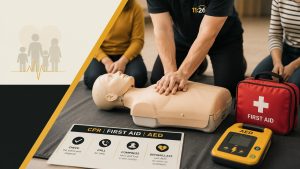
Preparedness should include basic first aid and bleeding-control education. The American College of Surgeons Stop the Bleed program teaches recognition and treatment of life-threatening bleeding, but a tourniquet is not a substitute for training, emergency services, or professional medical care.
A practical personal checklist includes:
- Save the local emergency number and facility security number.
- Learn whether the building uses text, public-address, desktop, or app alerts.
- Identify exits that do not depend on the main lobby.
- Keep shoes, glasses, mobility aids, and essential medication accessible.
- Tell trusted contacts that emergency reunification may take hours.
- Follow official instructions rather than forwarding unverified social posts.
How Do Organizations Build an Active Threat Plan?
Organizations build an effective plan by combining prevention, protective action, communication, response coordination, and recovery. A written policy should assign owners, define plain-language alerts, map accessible exits, establish visitor procedures, and specify how the organization will account for people without forcing them into an exposed assembly area.
The plan should be developed with local police, fire services, emergency medical services, facilities staff, human resources, disability coordinators, and legal counsel. First responders need current floor plans, access points, utility shutoffs, hazardous-material locations, camera views, and contact information.
What should a written plan contain?
| Plan element | Minimum specification | Review interval | Responsible owner |
|---|---|---|---|
| Emergency alert | Plain language, location, action, update channel | Every 6 months | Emergency manager |
| Evacuation | Primary and alternate routes, accessible options | Quarterly walkthrough | Facilities manager |
| Lockdown | Door, visitor, classroom, and remote-worker procedures | Twice yearly | Site leader |
| Police coordination | Maps, keys, access credentials, staging information | Annually | Security director |
| Medical response | First-aid kits, AED locations, bleeding-control supplies | Monthly inspection | Occupational health |
| Reunification | Family contact, privacy, transportation, status reporting | Annually | Human resources |
Alerts should say “Violent threat reported in North Building. Avoid the area. Lock doors or evacuate away from North Building. Await updates,” when those facts are verified. A label such as “Code Red” may be familiar internally but gives visitors, contractors, and public responders little usable information.
How should organizations train and exercise?
Training should begin with awareness and decision-making, then cover alerts, evacuation, lockdown, emergency calling, police arrival, bleeding control, and recovery. Live exercises require careful risk controls, advance coordination, accessibility planning, and psychological safety; surprise simulations that resemble real violence can cause harm and damage trust.
Tabletop exercises are usually safer for testing policy, communications, and command decisions. Functional exercises can test alerts, access control, accountability, and family assistance without actors pretending to be victims.
Measure observable performance:
- Time from alert approval to message delivery.
- Percentage of recipients who receive the message.
- Time needed to secure designated doors.
- Number of accessible routes verified.
- Accuracy of floor plans provided to responders.
- Time required to account for employees and visitors.
- Corrective actions closed by their assigned deadlines.
What Does an Active Threat Program Cost?
Typical costs range from under $50 per person for basic online awareness to tens of thousands of dollars for a physical security assessment or major access-control project. Actual pricing depends on headcount, building complexity, travel, integration, hardware, regulatory requirements, and whether exercises include external responders.
| Program component | Typical cost range | Typical timeframe | Main variable |
|---|---|---|---|
| Online awareness course | $15-$50 per user | 1-2 hours per user | Licensing volume |
| Instructor-led session | $2,000-$10,000 per session | 1-2 training days | Class size and travel |
| Security assessment | $3,000-$15,000 | 2-4 weeks | Site count and scope |
| Mass notification platform | $2-$5 per user per year | 1-4 weeks setup | Integrations and features |
| Bleeding-control supplies | $100-$300 per kit | 1-4 weeks delivery | Contents and quantity |
| Access-control upgrade | $5,000-$100,000 or more | 2-6 months typical | Doors, wiring, permits |
Online training scales efficiently but cannot reveal a door that does not lock, an alert that fails in a basement, or an evacuation route blocked by furniture. Physical audits find those failures but require access, documentation, and qualified assessors. Organizations usually need both education and verification.
Which Training Framework Should an Organization Use?
Run. Hide. Fight. is the strongest baseline for broad recognition in the United States, while Avoid. Deny. Defend. can feel more action-oriented and ALICE offers a more explicitly non-linear teaching model. The best choice is the framework the organization can explain consistently, practice safely, and align with local responders.
| Framework | Core terms | Main advantage | Main limitation | Best use |
|---|---|---|---|---|
| Run. Hide. Fight. | Run, Hide, Fight | Widely recognized | Can be misread as a fixed sequence | General public and workplaces |
| Avoid. Deny. Defend. | Avoid, Deny, Defend | Emphasizes choices and resistance as last resort | Less standardized across jurisdictions | Organizations wanting plain-language options |
| ALICE | Alert, Lockdown, Inform, Counter, Evacuate | Non-linear and information-focused | Requires more training consistency | Institutions with mature emergency programs |
| Site-specific hybrid | Local terms and procedures | Matches building risks and responders | Requires governance and retraining | Campuses, hospitals, industrial sites |
Framework labels do not create safety by themselves. A school with locked interior doors, trained staff, reliable alerts, reunification procedures, and responder coordination is better prepared than a site that displays a poster but cannot execute its instructions.
How Should High-Risk Facilities Adapt the Plan?
Schools should account for children who may not understand alerts, classrooms with different door hardware, substitute teachers, reunification congestion, and students with mobility, sensory, or medical needs. The plan must avoid assuming that every child can move quickly or remain silent without adult support.
Healthcare facilities face a different problem. Patients may be sedated, attached to equipment, unable to walk, or dependent on staff for medication and oxygen. Healthcare plans should define shelter-in-place zones, patient movement priorities, clinical command roles, access-control overrides, and communication with emergency medical services.
Retail and small businesses need simple procedures that work during staffing changes and high customer volume. Managers should identify who can activate an alert, lock stockrooms, guide customers, call emergency services, preserve video, and account for employees without requiring a single person to perform every task.
Remote and hybrid teams need location-aware procedures. A generic office alert can mislead employees working from home, in satellite sites, or at client premises, so notification systems should maintain current work locations and provide separate instructions for each site.
What Are the Most Common Response Failures?
The most common response failures involve delay, ambiguous communication, unsuitable barriers, and poor recovery planning. Organizations reduce these failures by testing decisions under realistic constraints rather than relying on policy documents alone.
Mistaking a violent event for an ordinary disruption
People may interpret loud bangs as construction, fireworks, or equipment failure. Training should establish that credible warning signs justify immediate movement away from danger, followed by confirmation when safe.
Treating Run. Hide. Fight. as a sequence
Running toward a known threat because “Run” appears first is a dangerous interpretation. The framework means select the safest available option based on location, barriers, distance, and current information.
Confusing concealment with cover
A bush, curtain, cubicle panel, or hollow interior door may hide a person but provide little physical protection. Staff should identify structural walls, concrete columns, substantial fixed objects, and locked rooms during site assessments.
Using ambiguous alerts
A coded alert may be misunderstood by visitors and new employees. Every alert should identify the hazard when safe to do so, state the affected area, provide a direct action, and include a reliable update channel.
Creating predictable evacuation crowds
A single assembly point can expose evacuees to traffic, the attacker, weather, or a secondary hazard. Plans need alternate locations, dynamic relocation authority, accountability methods, and instructions not to return for belongings.
Unsafe training simulations
Fake weapons, surprise announcements, screaming actors, or blocked exits can trigger panic and trauma. Use controlled tabletop or functional exercises, obtain informed participation, coordinate with responders, and provide opt-out and support processes.
What Should Happen After the Immediate Threat?
After the immediate threat ends, people need medical care, accountability, accurate information, privacy, family assistance, evidence preservation, and psychological support. An all-clear does not mean the organization can immediately resume normal operations.
Emergency managers should establish a controlled reception area, maintain a verified list of affected people, direct media inquiries to one spokesperson, preserve relevant video and access records, and coordinate with investigators. Employees should avoid posting graphic images, names, or speculation before authorities notify families.
Organizations should also provide confidential mental-health resources, paid time for victim assistance, disability accommodations, and follow-up communication. A structured after-action review should examine what happened, what information was available, which controls worked, and which corrective actions have an owner and deadline.
Active Threat Response Basics FAQ
Is an active threat the same as an active shooter?
No. An active shooter is one type of active threat involving a firearm. Active threat response also covers attacks involving knives, blunt instruments, vehicles, explosives, or other methods of immediate violence, although protective actions vary with distance, barriers, and the hazard.
Should I call 911 during an active threat?
Call 911 or the local emergency number when doing so is safe and does not reveal your location. Give the exact location, threat description, direction of travel, injuries, hazards, and your callback number. If speaking could expose you, use text-to-911 or another local option only where that service is available.
Should I evacuate if I do not know where the attacker is?
Evacuate only if the route is reasonably safe and moves away from the likely danger area. If the threat location is unknown and the route is exposed, a locked room with a barrier may be safer. Reassess when credible alerts, sounds, or responder instructions provide new information.
Are fire extinguishers effective against an attacker?
A fire extinguisher may be an available object during a last-resort defensive action, but it is not a guaranteed or recommended primary response tool. Escape, distance, locked barriers, and concealment or cover should come first when those options are available.
Where should people meet after evacuating?
Use the location designated by emergency officials or the organization’s dynamic evacuation plan, provided it is away from the threat and secondary hazards. Do not automatically use a familiar fire-drill assembly point, and do not return to help others unless trained responders direct you.
How often should active threat plans be reviewed?
Review plans at least annually and after any incident, exercise, building change, staffing change, access-control upgrade, or change in local emergency procedures. Inspect physical controls more often, because locked doors, alert devices, maps, emergency supplies, and accessible routes can fail between formal reviews.
The Bottom Line
Active threat response basics are a decision system for surviving immediate violence: recognize credible danger, run when a safe route exists, hide behind effective barriers when escape is unsafe, and resist only when imminent harm leaves no safer option. Effective organizations add plain-language alerts, accessible procedures, responder coordination, bleeding-control capability, measurable exercises, and recovery support. Use active threat response basics as the starting point, then adapt every action to the facility, threat, and official instructions available at the time.