Employee emergency preparedness training is a structured program that teaches workers how to recognize hazards, protect themselves, communicate, evacuate or shelter, and support an organized response. Effective training combines baseline instruction, role-specific practice, accessible emergency procedures, realistic exercises, and documented improvement rather than relying on an annual online course.
Key Facts at a Glance
Employee emergency preparedness training should match the hazards, layout, workforce, and legal requirements of each worksite.
Every employee needs clear instructions for reporting danger, receiving alerts, evacuating, sheltering, accounting for people, and requesting help.
E-learning efficiently delivers knowledge, but CPR, AED, extinguisher handling, and specialist response require supervised practical training.
OSHA’s Emergency Action Plan standard, 29 CFR 1910.38, addresses procedures such as reporting emergencies, evacuation, accounting for employees, and rescue or medical duties.
A drill is useful only when leaders measure behavior, identify gaps, assign corrective actions, and verify that changes work.
Typical planning costs range from $15-$50 per learner for digital modules to $500-$2,500 for a live corporate session, excluding certification and custom work.
What Is Employee Emergency Preparedness Training?
Employee emergency preparedness training prepares workers to take safe, predefined actions during events such as fire, severe weather, medical emergencies, workplace violence, utility failure, hazardous-material release, or earthquake. The program connects the emergency action plan to human behavior, so employees know what to do before emergency responders arrive.
The purpose extends beyond regulatory compliance. A well-designed program can reduce hesitation, prevent conflicting instructions, improve accountability, protect visitors and contractors, and help an organization resume critical operations. Training cannot eliminate risk, replace emergency services, or make unqualified employees into firefighters, paramedics, or HazMat technicians.
OSHA requires covered employers to maintain an emergency action plan in many circumstances, but the exact duties depend on the workplace, industry, state, local code, and applicable OSHA standard. Employers should verify requirements with a qualified safety professional, the authority having jurisdiction, or the relevant regulator.
What outcomes should the program produce?
A trained employee should be able to identify the alarm or warning, select the correct immediate action, use the designated communication channel, follow an accessible route, report their status when required, and avoid unsafe improvisation. A designated warden or responder needs additional competencies, including sweep limits, accountability, first aid, or incident coordination.
The program should produce observable results. For example, a facility might require 90% of occupants to reach an assembly area within eight minutes, 100% of wardens to carry current rosters, and all employees to identify two exits during a walkthrough. These are internal performance targets, not universal legal thresholds.
How Does Emergency Preparedness Training Work?
Emergency preparedness training works through four linked mechanisms: hazard recognition, decision rules, practiced behavior, and coordinated leadership. Employees first learn what signals mean, then rehearse the correct response under controlled conditions, while leaders test whether instructions, equipment, communication, and accountability function together.
Training fails when it teaches memorized information without the conditions that shape behavior. An employee may pass a fire-safety quiz yet use an inaccessible exit, return for a phone, miss an alert because of hearing loss, or follow a supervisor toward danger. Scenario design must therefore test the whole system.
The training cycle
- Recognize: Identify alarms, smoke, suspicious behavior, weather alerts, chemical odors, injuries, and infrastructure failures.
- Decide: Apply a simple action rule, such as evacuate, shelter, isolate, call, or provide first aid within certification limits.
- Act: Move, communicate, assist, or secure equipment according to the emergency action plan.
- Account: Report status through the defined process without delaying evacuation or exposing people to additional danger.
- Improve: Debrief performance, assign owners, and update procedures, equipment, or training.
Who leads the response?
| Role | Minimum responsibility | Additional preparation | Typical evidence |
|---|---|---|---|
| All employees | Alert, evacuate, shelter, report hazards | 30-60 minute baseline module and walkthrough | Knowledge check and route recognition |
| Floor warden | Direct movement and report conditions | 2-4 hour live session plus drills | Warden roster and drill observation |
| First-aid responder | Provide trained care until responders arrive | CPR, AED, and first-aid certification | Current certification card |
| Incident coordinator | Coordinate decisions and external communication | 4-8 hour incident-management workshop | Exercise log and action record |
| Facilities lead | Shut down systems when authorized | Site-specific equipment and utility training | Shutdown checklist |
| HR or people lead | Support accountability and employee welfare | Roster, accessibility, and recovery procedures | Current contact and assistance plan |
A practitioner rule is to assign duties only to people who can realistically perform them. A warden who works remotely three days each week cannot be the sole evacuation lead, and a person with no medical certification should not be assigned clinical triage.
What Should Employee Emergency Preparedness Training Cover?
The curriculum should cover common employee actions first, then add hazard-specific and role-specific instruction. Training topics should reflect the site’s geography, occupancy, equipment, workforce demographics, operating hours, and credible threat scenarios.
| Topic | Employee competency | Specialist boundary | Typical practice |
|---|---|---|---|
| Fire and evacuation | Raise alarm, use exits, reach assembly area, avoid elevators when directed | Extinguisher selection and firefighting only when trained and conditions permit | 30-60 minute module plus walkthrough |
| Severe weather | Receive alerts, shelter in the designated interior area, protect head and body | Weather monitoring and facility shutdown | 15-minute microlearning plus shelter drill |
| Medical emergency | Call emergency services, retrieve AED, begin trained CPR, control immediate hazards | Advanced trauma care and diagnosis | 4-8 hour certification for responders |
| Workplace violence | Recognize warning signs, follow Run, Hide, Fight or local policy, contact authorities | Threat assessment and law-enforcement coordination | Discussion-based exercise |
| Earthquake | Drop, Cover, and Hold On, then evacuate when safe | Structural inspection and utility isolation | 20-minute briefing plus exercise |
| Chemical release | Raise alarm, isolate area, move upwind or shelter as directed | Spill response, decontamination, and respiratory protection | HazMat-specific live training |
| Power or technology failure | Use backup alerts, lighting, access, and communication procedures | Generator, access-control, and server shutdown | Shift-based walkthrough |
How should fire and evacuation training be delivered?
Fire training should teach alarm recognition, emergency reporting, route selection, assembly behavior, accountability, and the limits of extinguisher use. The PASS sequence, pull, aim, squeeze, and sweep, can be taught for suitable incipient fires, but employees should never fight a fire when smoke is heavy, the exit is threatened, the fire is spreading, or they lack a clear escape path.
Evacuation practice should include employees who work different shifts and visitors who may not know the building. A timed exercise is less valuable than observing blocked routes, alarm audibility, elevator behavior, assembly-area capacity, and accountability accuracy.
What does medical response training include?
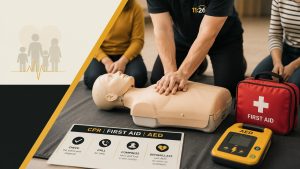
Medical response training teaches employees to call the correct emergency number, provide the exact location, protect themselves from exposure, retrieve an AED, and follow dispatcher instructions. CPR and AED responders require a recognized course from an appropriate provider, with renewal intervals determined by the provider, employer policy, and applicable rules.
First-aid kits and AEDs need inspection schedules, not merely a purchase receipt. Record expiration dates, battery status, pad condition, kit completeness, signage, and access after hours. A locked AED that no shift worker can reach is functionally unavailable.
How should workplace violence training be handled?
Workplace violence training should provide clear reporting routes, behavioral warning indicators, emergency communications, and protective actions. Run, Hide, Fight is widely used in US guidance, but employers should adapt the framework to the facility, occupants, law-enforcement advice, and local terminology.
Avoid theatrical surprise attacks, simulated gunfire, forced participation, or exercises that trap employees. These methods can cause panic, retraumatization, or unsafe flight behavior. Discussion-based scenarios, communication tests, and voluntary role exercises usually reveal planning weaknesses with less harm.
How Do You Build a Workplace Training Program?
A practical program can be built in seven steps over four to twelve weeks, depending on facility complexity. The hazard assessment and the quality of the emergency action plan determine success more than the learning platform or presentation style.
Step 1: Assess hazards and affected people
List credible emergencies by location, severity, likelihood, warning time, and required response. Review fire protection, exits, alarms, utilities, chemicals, machinery, weather exposure, nearby hazards, security incidents, and dependencies such as elevators or network systems.
Include employees with disabilities, temporary workers, contractors, visitors, pregnant workers, night staff, and people with limited English proficiency. Ask how each group receives an alert, travels to safety, and confirms status.
Step 2: Audit the physical and communication systems
Walk every route during normal and reduced lighting. Test alarm audibility and visual notification, emergency lighting, signage, doors, assembly points, radios, public-address systems, mass-notification tools, and backup power.
A useful audit records the exact location of each weakness. “Improve signage” is too vague; “Place a photoluminescent exit sign at the west corridor intersection by June 15” creates an actionable correction.
Step 3: Write role-specific procedures
Define who reports the emergency, who contacts public responders, who communicates with employees, who stops equipment, who assists with accountability, and who authorizes reentry. Establish alternates for absences and every operating shift.
Keep employee instructions short. A one-page emergency card should show the alarm meaning, emergency number, two exits, shelter location, assembly point, and prohibited actions.
Step 4: Build the learning path
Use baseline training for everyone and targeted modules for roles or hazards. Provide captions, transcripts, translated materials, screen-reader compatibility, plain-language instructions, and an alternative for workers without reliable computer access.
New hires should receive basic procedures during onboarding, ideally before independent work begins. Annual refreshers should not be the only exposure, especially where turnover, seasonal staff, or high-risk tasks are present.
Step 5: Practice with proportionate exercises
Use a progression: orientation, walkthrough, announced drill, functional exercise, and discussion-based scenario. Test one or two variables at a time, such as a blocked route or failed announcement, rather than creating uncontrolled chaos.
For active-violence planning, use tabletop discussion and communications testing unless trained specialists design a more intensive exercise. For industrial hazards, isolate equipment and use qualified instructors before any live simulation.
Step 6: Measure behavior and debrief
Observers should record alarm-to-action time, route use, missed occupants, communication delivery, warden visibility, assembly accuracy, equipment access, and unsafe actions. Conduct a debrief while details remain fresh, then separate urgent hazards from longer-term improvements.
Step 7: Correct, document, and repeat
Assign every gap an owner, due date, risk rating, and verification method. Update the emergency action plan after layout changes, new chemicals, staffing changes, incidents, drills, or regulatory amendments.
How Often Should Training and Drills Occur?
Annual refresher training is a common planning baseline, but no single interval fits every workplace or every topic. New-hire instruction, role renewal, hazard changes, incident lessons, and higher-frequency exercises for high-risk operations should supplement the annual cycle.
| Activity | Typical interval | Trigger for earlier repetition | Completion record |
|---|---|---|---|
| Employee baseline training | At onboarding and every 12 months | Plan, site, or job change | LMS record or roster |
| Fire evacuation drill | Every 6-12 months | Route, occupancy, or alarm change | Drill report |
| Warden practice | Every 6-12 months | Turnover or poor drill result | Role checklist |
| CPR and AED certification | Provider-defined, commonly 1-2 years | Expired card or incident | Certification register |
| Severe-weather shelter exercise | Before the relevant season and annually | New warning system or shelter | Exercise log |
| HazMat response practice | Quarterly to semiannually in higher-risk sites | Chemical, process, or PPE change | Competency record |
| Microlearning reminders | Monthly to quarterly | Observed knowledge decay | Delivery analytics |
Skill retention varies by task, complexity, and opportunity to practice. Instead of treating a generalized four-to-six-month retention claim as universal, use short knowledge checks and observed drills to identify when a specific workforce needs reinforcement.
Which Delivery Method Fits the Workplace?
Hybrid delivery is usually the strongest default: digital learning covers common knowledge, while live practice verifies physical skills, routes, equipment, and decisions. E-learning alone is efficient for information but cannot prove that an employee can operate an AED, navigate smoke-free routes, or communicate during a failed network connection.
| Format | Typical cost | Time requirement | Best use | Main limitation |
|---|---|---|---|---|
| E-learning | $15-$50 per learner | 30-45 minutes per topic | Scalable baseline instruction | Cannot verify hands-on performance |
| Live instructor | $500-$2,500 per session | 2-4 hours per session | CPR, AED, fire equipment, role practice | Usually limited to 20-25 learners |
| Hybrid | $25-$100 per learner plus live session | 45-90 minutes online plus 1-3 hours live | Distributed or mixed-risk workforce | Requires completion coordination |
| VR simulation | $5,000-$30,000 setup | 15-45 minutes per scenario | Repeated immersive scenario practice | Hardware, accessibility, and motion concerns |
| Tabletop exercise | $0-$5,000 facilitator cost | 60-180 minutes | Leadership and communication testing | Does not prove physical movement |
VR is useful when realistic exposure is difficult or dangerous, but VR does not replace a building walkthrough, equipment inspection, or live medical skills assessment. A virtual warehouse cannot reveal that a real exit is blocked by inventory.
How Much Does Emergency Training Cost?
Typical workplace emergency training costs $15-$50 per employee for digital content, $500-$2,500 for a live corporate session, and $5,000-$30,000 or more for a custom VR deployment. Total program cost also includes paid release time, translation, accessibility work, equipment inspection, certification fees, facilitators, and corrective measures.
A small office with 25 workers might spend $375-$1,250 on digital baseline training, $1,000-$2,500 on a live session, and additional funds for CPR certification or signage. A manufacturing site can spend substantially more because it may need qualified HazMat instruction, respiratory protection programs, shutdown procedures, multiple shifts, and specialized exercises.
The cheapest course is not the lowest-cost program if it leaves an untested alarm, inaccessible route, or untrained night shift. Budget first for hazard correction and essential competencies, then select technology.
What Makes a Drill Effective?
An effective emergency drill tests a defined objective under safe conditions and produces corrective actions. The objective might be “all night-shift employees receive the alert within two minutes” or “wardens account for assigned zones without reentering the building.”
Use this drill sequence:
- Define the scenario, objective, scope, stop conditions, and observers.
- Notify required stakeholders, including building management and emergency partners.
- Brief participants on safety boundaries without revealing every performance detail.
- Run the exercise and record observable behavior.
- Stop immediately if a real injury, dangerous condition, or uncontrolled panic occurs.
- Debrief employees, wardens, observers, and leaders separately when useful.
- Issue a corrective-action report with owners and deadlines.
- Retest the highest-risk gap.
A practitioner insight is that elapsed evacuation time often receives too much attention. A fast evacuation through one usable exit can be less resilient than a slightly slower evacuation that distributes people safely, accommodates mobility needs, and preserves accountability.
What Problems Commonly Undermine Preparedness?
The most common failures are predictable drills, unclear authority, inaccessible instructions, missing populations, and unverified equipment. Each failure requires a different correction, so repeating the same presentation will not repair the system.
| Failure mode | Observable symptom | Corrective action | Verification |
|---|---|---|---|
| Check-the-box training | 100% completion, poor drill behavior | Add observed tasks and scenario questions | Repeat drill within 90 days |
| Remote-worker exclusion | Home workers miss alerts or lack guidance | Create remote emergency and lone-worker procedures | Communication test by location |
| Warden dependency | One person directs an entire floor | Add alternates and zone assignments | Roster audit each quarter |
| Alert failure | Workers cannot hear or interpret alarms | Test visual, audio, SMS, and backup channels | Document receipt by shift |
| Information overload | Employees cannot name exits | Replace binders with visual action cards | Five-question spot check |
| Unsafe realism | Distress, confusion, or injury during drill | Use tabletop or controlled exercises | Participant safety review |
| Turnover gap | New hires wait months for training | Require onboarding module before independent work | HR-LMS reconciliation |
Leadership participation matters because employees interpret attendance as a priority signal. Senior leaders should participate in briefings and debriefs without taking over operational roles or pressuring workers to perform unsafe actions.
How Should Different Workforces Apply the Program?
Small businesses should prioritize a current emergency action plan, two known exits, reliable alerts, first-aid access, assembly accountability, and a trained backup for every assigned role. Local fire departments may offer site guidance, but the employer remains responsible for making procedures fit the actual premises.
Corporate offices need floor-level coverage, multiple communication channels, visitor procedures, hybrid-worker instructions, and records that reconcile employees, contractors, and guests. A central emergency response team should coordinate standards while local wardens handle building-specific conditions.
Industrial facilities need process-specific training for chemical release, confined space, machinery entanglement, utility isolation, severe weather, and trauma response. Quarterly exercises may be appropriate for high-risk operations, but frequency should follow hazard analysis, incident history, workforce turnover, and regulator requirements.
Remote and hybrid workers need a separate operating model. Provide home-office fire and severe-weather guidance, lone-worker escalation, emergency contact verification, meeting-location procedures, and instructions for reporting a workplace incident away from the primary site.
How Do You Know the Program Works?
Program effectiveness is demonstrated through behavior, not completion percentages alone. Track training completion, assessment scores, alert receipt, evacuation or shelter time, accountability accuracy, equipment readiness, corrective-action closure, and repeat-drill performance.
Useful internal measures include:
- Percentage of new hires trained before independent work.
- Percentage of employees who can identify two exits and the assembly point.
- Alert receipt rate by shift, language, location, and disability accommodation.
- Number of unassigned or unaccounted people during each exercise.
- Median time to close high-risk corrective actions.
- Percentage of AEDs, first-aid kits, radios, and emergency lights passing inspection.
- Repeat performance after a corrective action.
Do not rank departments solely by speed. A department that reports a blocked exit honestly may be performing better than one that records a fast but unsafe evacuation. Near misses and employee feedback are valuable evidence because they expose conditions a polished drill can conceal.
What Happens After an Emergency?
Emergency preparedness training should include the transition from immediate response to recovery. Employees need to know who authorizes reentry, where official updates appear, how to report injuries, how payroll and scheduling will work, and when business operations will resume.
Managers should preserve incident records, protect confidential medical information, support affected workers, and coordinate with insurers, regulators, landlords, emergency services, and business-continuity leaders. Psychological support may be appropriate after violence, serious injury, death, or a distressing event.
Training should never promise that employees will protect company assets at personal risk. Life safety takes priority over equipment, records, inventory, and production targets.
Frequently Asked Questions
Is online emergency preparedness training enough for employees?
Online training is enough for baseline knowledge when the content covers the actual site, alerts, exits, shelter areas, reporting channels, and employee responsibilities. Online learning is not enough to verify CPR, AED, extinguisher, medical, evacuation-leadership, or HazMat skills. Pair digital instruction with a walkthrough or supervised practical assessment.
What is the difference between emergency preparedness and emergency response training?
Emergency preparedness training covers planning, prevention, readiness, communication, evacuation, sheltering, and basic employee actions before and during an incident. Emergency response training goes deeper into specialized duties such as incident command, first aid, firefighting, rescue, hazardous-material control, or law-enforcement coordination.
Should contractors and visitors receive the same training?
Contractors and visitors should receive instructions appropriate to their exposure and expected time on site, but they may not need the same role training as employees. Provide a short site orientation, alarm meaning, exit information, escort responsibility, assembly process, and language or accessibility support before access begins.
How can a company train employees across multiple shifts?
Use the same controlled curriculum across shifts, then schedule repeated walkthroughs or drills during day, evening, night, and weekend operations. Maintain shift-specific wardens, responders, rosters, and alternates. A single daytime drill cannot validate alarm coverage, staffing, lighting, or supervision during overnight work.
What should employees do if an emergency instruction conflicts with a supervisor’s order?
Employees should follow the current emergency action plan and official emergency instructions, especially when a supervisor’s direction creates additional danger. The plan should identify who has authority during an incident, how conflicting messages are resolved, and which emergency-services instructions override internal directions.
How should an employer choose a training provider?
Choose a provider with relevant industry experience, qualified instructors, accessible materials, practical assessment, usable records, and scenarios that match the facility. Request sample objectives, instructor credentials, cancellation terms, language options, equipment requirements, and a method for converting drill findings into plan revisions.
The Bottom Line
Employee emergency preparedness training is effective when workers can recognize danger, choose the right protective action, communicate reliably, and perform assigned duties under realistic workplace conditions. Build the program from a hazard assessment, combine digital knowledge with supervised practice, include every shift and worker population, measure observable performance, and close corrective actions. Employee emergency preparedness training should remain a maintained operational system, not an annual compliance event.