Personal safety habits to learn are repeatable behaviors that reduce exposure to danger, improve early recognition of threats, protect digital and physical boundaries, and create faster escape or help-seeking options. The highest-value habits are situational awareness, route and check-in planning, clear boundary setting, digital privacy, emergency communication, and practiced responses that prioritize distance over confrontation.
Key Facts at a Glance
Situational awareness means noticing a location’s normal pattern and identifying meaningful changes without assuming every stranger is dangerous.
A safety plan should include two exits, a charged phone, one trusted contact, and a clear local emergency number.
Digital location sharing can expose home addresses, routines, schools, workplaces, and live whereabouts.
Verbal de-escalation works best before violence begins; once someone blocks escape or attacks, leaving and calling for help take priority.
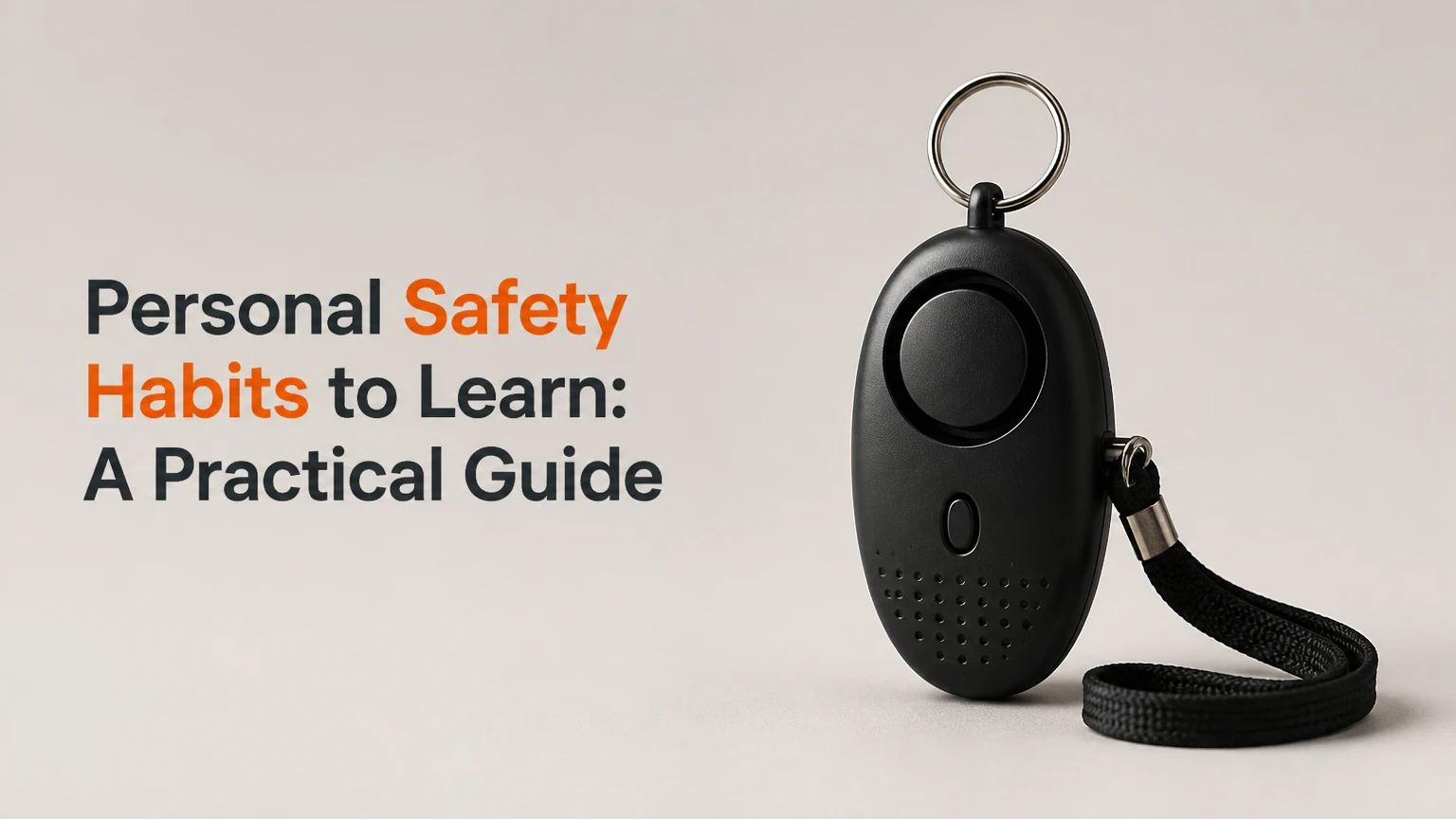
Pepper spray, alarms, and flashlights require lawful carrying, accessible storage, and practice under safe conditions.
Personal safety is risk reduction, not guaranteed protection; no habit eliminates every threat.
What Are Personal Safety Habits?
Personal safety habits are small preventive actions used before, during, and after potentially risky situations. They include environmental scanning, secure communication, route planning, boundary enforcement, privacy management, and emergency preparation, rather than only physical fighting or carrying a defensive device.
The practical goal is to improve four outcomes: avoid preventable exposure, recognize a developing problem earlier, communicate a boundary clearly, and reach safety or assistance quickly. A habit is useful when an ordinary person can repeat it under stress, fatigue, poor lighting, or distraction.
Personal safety does not mean treating unfamiliar people as criminals. It means responding to behavior and context, such as someone repeatedly following you, blocking a doorway, demanding private information, or ignoring a clear refusal. A person’s clothing, race, age, disability, or appearance is not a reliable threat indicator.
The National Highway Traffic Safety Administration has repeatedly warned against distracted driving, and the same attention principle applies to walking: divided attention reduces the information available for navigation and hazard detection. Safety habits should reduce cognitive load, not create constant fear.
Which Personal Safety Habits to Learn First?
Learn seven habits in this order: pause and scan, identify exits, protect distance, state boundaries, use a check-in plan, reduce digital exposure, and rehearse an escape response. These habits cost little, work across many environments, and do not require physical strength or specialized equipment.
1. Pause and scan transitional spaces
Transitional spaces include parking lots, stairwells, building entrances, station platforms, garages, and paths between a vehicle and a destination. Put the phone away before entering them, keep enough hearing available to notice nearby movement, and look around rather than staring at the destination.
2. Identify exits and safer destinations
When entering a restaurant, venue, classroom, hotel, or store, note the main exit and one alternative. Also identify staffed locations, open businesses, security desks, reception areas, or groups of people who could provide assistance.
3. Protect distance and movement
Distance gives you time to decide. Keep enough room to step sideways or turn away, avoid allowing an unfamiliar person to pin you against a wall or vehicle, and move toward visibility when someone behaves intrusively.
4. State boundaries early
Use a short sentence in a steady voice: “No, thank you,” “Please stay back,” or “Do not follow me.” Do not debate your reason with a person who is ignoring the first refusal.
5. Use a check-in plan
Tell a trusted person where you are going, when you expect to arrive, and what action they should take if you miss the check-in. A plan is stronger when it includes a specific deadline rather than “call if something feels wrong.”
6. Reduce digital exposure
Review location permissions, public profiles, shared calendars, photographs, and recovery information. The Federal Trade Commission advises consumers to limit the personal information made publicly available and to use strong authentication for important accounts.
7. Rehearse the first response
Practice saying the boundary phrase, moving toward an exit, unlocking the phone, and calling local emergency services. Rehearsal matters because stress narrows attention and makes unfamiliar actions slower.
How Should You Practice Situational Awareness?
Practice situational awareness as relaxed observation, not permanent alarm. In each new environment, establish the baseline, notice anomalies, choose a safer position, and decide where you would go if conditions changed; the entire scan should take roughly 10-20 seconds.
John Boyd’s OODA Loop describes four stages: Observe, Orient, Decide, and Act. In everyday safety, observation means noticing doors, people, lighting, traffic, and staff; orientation means interpreting what matters; decision means selecting a route or boundary; action means moving, calling, or asking for help.
The Cooper color code can help explain attention states:
| Condition | Practical meaning | Useful action | Main limitation |
|---|---|---|---|
| White | Distracted or unaware | Put away the phone | Leaves little reaction time |
| Yellow | Relaxed alertness | Scan and keep an exit | Requires conscious practice |
| Orange | Specific concern | Increase distance and prepare | Can produce tunnel vision |
| Red | Immediate danger | Escape, call, or defend only to escape | Stress impairs fine motor control |
The color code is a teaching model, not a scientifically validated threat detector. Avoid assigning danger based on stereotypes or isolated harmless behavior. An anomaly deserves attention, not an automatic accusation.
A 10-minute awareness drill
Spend two minutes identifying exits and staffed areas in a familiar location. Spend three minutes walking without headphones while naming five fixed objects, two routes out, and one person or service you could approach.
Use the next three minutes to practice stopping safely before checking a map or message. Finish with two minutes of route planning: identify a well-lit alternative, a contact, and the nearest place open to the public.
How Do Digital Habits Affect Physical Safety?
Digital safety affects physical safety when public information reveals a person’s address, schedule, workplace, school, travel status, or relationship network. Review location permissions monthly, delay posts until after leaving, remove visible address clues from images, and secure accounts with multifactor authentication.
A privacy review should cover:
- Precise location access for social, shopping, gaming, and photo applications.
- Live location links shared with old contacts or broad groups.
- House numbers, school uniforms, license plates, street signs, and recurring landmarks.
- Public profiles that reveal an employer, daily route, children’s school, or regular appointment.
- Password reuse, exposed email addresses, and account recovery questions.
- Data-broker listings that connect a name with a home address.
Manual data-broker removal often costs nothing but takes 1-2 hours initially, with approximately 10 minutes of monthly maintenance. Paid removal services commonly cost about $40-$120 per year, but coverage varies and removal may require repeated requests.
A virtual private network can reduce exposure on some public networks, but it does not make a person anonymous, prevent phishing, or secure a compromised account. Account passwords, multifactor authentication, software updates, and careful sharing remain more important.
How Do Boundaries and De-escalation Work?
Verbal de-escalation is most useful when a conflict is still avoidable, and its immediate purpose is to create space and an exit rather than to win an argument. Keep your hands visible, use a calm voice, acknowledge emotion without accepting blame, and leave when the person ignores the boundary.
Useful scripts include:
- “I cannot help you. Please step back.”
- “I hear that you are upset. I am leaving now.”
- “Do not touch me.”
- “Stop following me. I am going into this business.”
- “Call emergency services. This person will not leave me alone.”
Stand at an angle rather than squarely chest-to-chest, keep your back away from walls when possible, and avoid allowing the other person to control your route. Do not rely on eye contact, a deeper voice, or confident posture to stop someone committed to violence.
The Department of Homeland Security’s public guidance uses the phrase, “If You See Something, Say Something®.” The practical application is specific reporting: describe behavior, location, direction of travel, clothing, vehicle details, and immediate danger rather than making unsupported claims about a person’s identity or motives.
When should you stop de-escalating?
Stop explaining and prioritize escape when a person closes distance after a clear warning, blocks your path, reaches for you, displays a weapon, threatens immediate harm, or follows you despite attempts to move toward safety. Call the local emergency number when safe, attract attention, and do not lead a follower to your home.
Which Personal Safety Tool Should You Choose?
Choose a personal alarm for a low-training, attention-drawing option; choose pepper spray only where lawful and after learning its limitations; choose a flashlight for visibility and signaling; and choose training when you want skills that do not depend on carrying an object.
| Option | Typical cost | Effective range or output | Practice requirement | Important limitation |
|---|---|---|---|---|
| Personal alarm | $15-$30 | 100-130 dB claimed output | Test monthly | Noise may not stop an attacker |
| Pepper spray | $10-$25 | Commonly 8-15 feet | Practice with inert unit | Wind, aim, law, and contamination risks |
| Compact flashlight | $10-$40 | 300-1,000 lumens typical | Battery check monthly | Illumination does not guarantee escape |
| Self-defense class | $75-$200 monthly | Contact distance | Weekly or twice-weekly practice | Skills decay without repetition |
| Emergency phone feature | $0 plus phone plan | Cellular or Wi-Fi dependent | Test settings monthly | Dead battery or poor signal can defeat it |
Personal alarms are useful in public settings because they can attract witnesses without requiring close contact. Their stated decibel ratings are not directly comparable across manufacturers, and a crowded or noisy location may reduce their effect.
Pepper spray can cause severe eye and respiratory irritation, but wind, poor aim, clothing, barriers, and bystander exposure can reduce its value. Laws differ by country, state, city, container size, age, and transport method, so verify local rules before purchase; never carry it on an airplane unless aviation rules expressly permit the specific item.
A flashlight helps identify trip hazards, locate a keyhole, signal others, and maintain awareness in darkness. It is not a substitute for route planning. A defensive object is also a liability if it is buried in a bag, unfamiliar under stress, or taken and used against its carrier.
What Should Self-Defense Training Teach?
Effective personal safety training should teach avoidance, verbal boundaries, balance, movement, escape from common holds, calling for help, and decision-making under pressure. A class that promises guaranteed outcomes or focuses only on aggressive techniques does not match the primary goal of personal protection.
Look for instructors who explain legal and ethical limits, offer progressive practice, accommodate disability and age, and include scenario work without unsafe humiliation. Martial arts can improve fitness and body control, but sport rules may not cover weapons, multiple attackers, confined spaces, or the need to leave immediately.
| Training format | Typical frequency | Typical cost | Useful strength | Common gap |
|---|---|---|---|---|
| General self-defense seminar | 1-8 hours | $25-$150 | Fast exposure to basic responses | Limited retention without practice |
| Boxing or kickboxing | 1-3 sessions weekly | $75-$180 monthly | Footwork, conditioning, composure | Does not automatically teach escape planning |
| Brazilian jiu-jitsu | 1-3 sessions weekly | $100-$220 monthly | Ground movement and control | Ground fighting can be unsafe outdoors |
| Reality-based class | Weekly | $100-$200 monthly | Scenario-based decision practice | Quality varies widely by instructor |
| Adaptive personal safety coaching | Individual plan | $50-$150 per session | Mobility-specific strategies | Requires a qualified local provider |
A reasonable beginner expectation is 3-6 months of regular practice before basic movements feel familiar under moderate pressure. Functional safety still requires periodic refreshers because stress, injury, clothing, surfaces, and surroundings change.
Which Habits Matter During Commuting and Travel?
Commuters benefit most from attention during transitions, route redundancy, and a charged communication method. Travelers need additional hotel, rideshare, document, and location-sharing routines because unfamiliar layouts and local laws increase uncertainty.
| Situation | Before departure | During movement | If conditions change |
|---|---|---|---|
| Walking commute | Share arrival window | Use lit, populated routes | Enter a staffed business |
| Public transit | Check last service time | Stand near staff or other riders | Change carriage or exit at a safe stop |
| Rideshare | Verify plate and driver | Share trip status | End trip at a public location |
| Hotel stay | Save room and front-desk number | Avoid announcing room number | Call reception or emergency services |
| Driving | Fuel, charge, and route check | Lock doors and avoid phone use | Drive to a staffed public place |
Do not enter a vehicle because a driver claims a destination changed. Confirm the vehicle, driver, and route through the official application, then sit where you can exit without climbing over luggage or another passenger.
At a hotel, avoid displaying the room number aloud, keep the door secured, and use only a device permitted by the property and fire-safety rules. A door wedge can interfere with evacuation and should never replace the hotel lock, smoke alarm, or emergency exit plan.
How Should Safety Habits Be Adapted?
Safety habits should be adapted to mobility, sensory, cognitive, age, language, and medical needs rather than copied from a generic self-defense script. The best plan names accessible exits, reliable communication methods, trusted helpers, medication requirements, and realistic transportation options.
For a wheelchair user, inspect ramp and elevator access before an event and identify a route that does not depend on a single lift. For someone with hearing loss, use visual alerts, vibration settings, captioned calls, and prearranged text check-ins.
Children and teenagers need simple rules: identify trusted adults, never keep a threatening secret, ask permission before changing plans, and use a family code word for emergencies. Location sharing should be limited to appropriate caregivers and reviewed as relationships change.
Older adults may benefit from larger-button phones, medical information cards, brighter entry lighting, and rehearsed responses to door-to-door callers. A person experiencing stalking or domestic abuse should avoid confronting the stalker, preserve messages and dates, review account access, and contact a domestic-violence or victim-support service for a personalized safety plan.
What Personal Safety Habits Fail in Practice?
The most common failures are distraction, politeness pressure, inaccessible equipment, overconfidence, and delayed reporting. Each failure occurs because the plan depends on a behavior that becomes difficult under stress or on a tool that was never tested in the real environment.
The phone trap
Looking down while walking hides changes in traffic, people, doors, and surfaces. If a map is necessary, stop in a visible location with your back near a wall, check the route, and resume only after looking around.
The politeness trap
A stranger does not deserve access to your elevator, vehicle, home, name, or time. A brief refusal is safer than prolonged engagement when your instincts identify persistent boundary violations.
The buried-tool trap
A device at the bottom of a purse is unavailable when seconds matter. Carry permitted tools in a consistent, reachable location and test the alarm, battery, or inert practice unit at home.
The false-confidence trap
Training and equipment can encourage risk-taking. The practitioner rule is simple: confidence should increase your willingness to leave early, not your willingness to confront someone.
The tunnel-vision trap
Focusing on one suspicious person can hide traffic, companions, exits, or other hazards. Continue scanning the wider environment while increasing distance from the specific concern.
The reporting-delay trap
Save evidence safely after the immediate danger ends, including dates, screenshots, witness names, and incident numbers. Do not delay emergency contact while trying to collect perfect documentation.
What Do Personal Safety Habits Cost?
A basic safety routine can be established for $0-$30 and 10-20 minutes, while equipment and ongoing training raise the typical annual cost to approximately $100-$2,400. Cost matters less than accessibility, lawful use, maintenance, and whether the person can perform the response under stress.
| Habit or resource | Initial time | Typical cost | Maintenance interval |
|---|---|---|---|
| Exit and route scan | 10-20 seconds per location | $0 | Every unfamiliar stop |
| Check-in plan | 10-15 minutes | $0 | Review every 3-6 months |
| Privacy audit | 30-120 minutes | $0-$120 yearly | Monthly or quarterly |
| Personal alarm | 5-10 minutes setup | $15-$30 | Test monthly |
| Pepper spray | 15-30 minutes legal and safety review | $10-$25 | Check expiry and condition |
| Group training | 1-2 hours weekly | $75-$200 monthly | Continuous practice |
What Is the Safest Response to an Active Threat?
During immediate danger, create distance, move toward a populated or secured location, call local emergency services when possible, and use physical resistance only to break contact and escape. Do not return for belongings, pursue an offender, or assume that recording the event is safer than leaving.
If trapped, make your needs explicit: “Call emergency services,” “This person has a weapon,” or “I need help now.” Follow dispatcher instructions, provide your location first, and tell responders about injuries, weapons, direction of travel, and anyone still at risk.
After reaching safety, seek medical care for injuries, contact a trusted person, preserve relevant evidence, and report through the appropriate emergency, workplace, campus, transit, or victim-support channel. Trauma can affect memory, so write down the sequence as soon as practical without guessing at details.
Frequently Asked Questions
Are personal safety habits only for dangerous neighborhoods?
No. Personal safety habits apply wherever exposure, distraction, unfamiliarity, or boundary violations create risk. Quiet suburban streets, workplaces, campuses, parking garages, hotels, and online platforms each require different precautions. The relevant question is not whether an area has a label, but whether you have a route, communication option, and response plan.
Should I carry pepper spray or a personal alarm?
For many beginners, a personal alarm is simpler because it requires less judgment about aim, wind, distance, and legal restrictions. Pepper spray may provide more distance in some situations, but it requires lawful carrying, accessible storage, expiration checks, and practice with an inert trainer. Neither tool replaces escape planning.
How can I trust my instincts without becoming paranoid?
Treat discomfort as a prompt to create distance and gather information, not as proof that someone is dangerous. Look for observable behavior, such as repeated following, blocked movement, unwanted touching, threats, or refusal to leave. You can change direction or enter a business without accusing anyone.
What should I teach a child about personal safety?
Teach children to identify trusted adults, use a family code word, refuse unwanted touch, move toward staff or families, and tell an adult even when someone demands secrecy. Practice scripts and routes in short sessions. Avoid teaching children that strangers alone are the danger, because familiar people can also violate boundaries.
How often should I practice my safety plan?
Run a short awareness and communication drill monthly, review digital permissions quarterly, test alarms and phone emergency features monthly, and refresh physical training at least weekly when possible. Rehearse after changing jobs, schools, routes, medications, mobility equipment, or household relationships.
The Bottom Line
The most useful personal safety habits to learn are early attention, physical distance, clear boundaries, reliable check-ins, digital privacy, route planning, and practiced escape decisions. Start with a 10-minute awareness drill and a contact plan, then add a lawful alarm, flashlight, or structured training only when the tool fits your abilities and routine.