Situational awareness for beginners is the skill of noticing relevant conditions, understanding what they mean, and anticipating what may happen next so you can make a safer decision. The skill combines perception, comprehension, and projection, and applies to commuting, driving, travel, work, emergencies, outdoor recreation, and ordinary daily choices.
Key Facts at a Glance
Situational awareness has three levels: perception, comprehension, and projection.
The safest beginner goal is calm, relaxed alertness rather than constant suspicion.
Cooper’s Color Code describes mental readiness, not a scientifically measured threat scale.
A useful entry scan takes about 10 seconds and identifies exits, hazards, people, and movement patterns.
Daily practice usually costs nothing; structured introductory courses commonly cost about $50-$150.
Awareness improves decision quality, but it cannot predict every event or replace emergency training.
What Is Situational Awareness?
Situational awareness is the ability to perceive important elements in an environment, understand their significance, and project how conditions may change. Dr. Mica Endsley’s widely cited 1995 formulation describes it as “the perception of the elements in the environment within a volume of time and space, the comprehension of their meaning, and the projection of their status in the near future.”
The concept developed in military aviation, where pilots had to track aircraft, weather, fuel, instruments, mission objectives, and changing hazards simultaneously. Aviation remains a useful example because the cost of a missed cue is high, but everyday awareness is less dramatic and more practical.
A commuter notices that a train platform has become unusually crowded near one entrance. Comprehension adds meaning: a blocked escalator, delayed service, or developing conflict may explain the crowd. Projection produces an option: move to another area, check official updates, or leave before movement becomes unsafe.
Situational awareness is therefore a decision skill, not a personality trait. It does not require staring at strangers, memorizing every face, or expecting violence. It requires identifying information that could change your next action.
Why does situational awareness matter?
Situational awareness matters because early recognition creates more options. A person who notices smoke before an alarm, a cyclist before turning, or a rapidly changing trail condition has more time to pause, move, communicate, or seek help.
The National Highway Traffic Safety Administration identifies distraction as a major road-safety problem, and the National Safety Council distinguishes visual, manual, and cognitive distraction. That distinction matters: looking away is only one way attention can fail. A driver can see a hazard while mentally processing a message and still react too late.
Awareness also supports non-emergency decisions. In an office, noticing a blocked fire door is a safety observation. At home, noticing a gas odor is an evacuation cue. During a hike, noticing a sudden temperature drop and darkening clouds is a weather decision.
How Does Situational Awareness Work?
Situational awareness works as a loop: perceive relevant cues, comprehend their meaning, project likely developments, then act and update your understanding. Endsley’s three levels describe the mental processing involved, although real people often move between levels quickly rather than following a perfectly linear sequence.
Level 1: Perception
Perception means detecting information through sight, hearing, smell, touch, body sensation, instruments, or reliable reports. A beginner might notice a wet floor, a person calling for help, an unusual engine sound, a change in wind, or an exit sign obscured by smoke.
Perception is selective. The human brain cannot consciously process every detail in a crowded station, so effective awareness begins by asking what information matters to the immediate decision. Hands, movement, sounds, open routes, weather, and changes in normal conditions may matter more than clothing, age, or appearance.
Level 2: Comprehension
Comprehension means connecting observed cues with context and assigning practical meaning. A single person running through a station may be harmless, while several people moving quickly away from smoke indicate a different situation.
Comprehension should remain proportional to evidence. A strange sound is a cue to investigate safely, not proof of an attack. Reliable interpretation uses multiple observations, such as direction, timing, behavior, environmental conditions, and information from staff or official alerts.
Level 3: Projection
Projection means estimating what may happen next if conditions continue. A hiker sees water crossing the trail, understands that heavy rain is upstream, and projects that the crossing may become impassable. A driver sees brake lights several cars ahead and reduces speed before the immediate vehicle stops.
Projection is a forecast, not a prophecy. Good projection produces conditional plans: “If the platform becomes more crowded, I will move behind the marked barrier and notify staff.” The plan should identify a trigger, an action, and a safer destination.
What Do the Awareness Conditions Mean?
Cooper’s Color Code describes four mental readiness conditions: White, Yellow, Orange, and Red. The model can help beginners remember attention states, but it should not be treated as a universal scientific measurement of danger or as permission to categorize strangers as threats.
| Condition | Mental state | Appropriate beginner behavior | Common failure |
|---|---|---|---|
| White | Distracted or unaware | Restore attention before entering a risky transition space | Phone use, headphones, inward focus |
| Yellow | Relaxed alertness | Notice exits, baseline, movement, and hazards | Becoming tired from excessive scanning |
| Orange | Specific concern identified | Create an if-then plan and verify information | Fixating on one cue |
| Red | Immediate verified danger | Follow emergency procedures, seek distance, call for help | Freezing or improvising without a plan |
Condition Yellow is the useful everyday target. It means attention remains available without treating normal activity as suspicious. Condition Orange begins when a specific condition deserves focused evaluation, such as a vehicle repeatedly matching your route or a strong smell of smoke. Condition Red is reserved for an immediate, credible hazard requiring action.
A limitation is important here. Cooper’s framework came from firearms and self-defense instruction, while Endsley’s model came from human factors and operational decision-making. The color code can describe readiness, but Endsley’s three levels better explain how awareness is built and lost.
How Can Beginners Practice Situational Awareness?
Beginners can practice with a 10-second scan whenever they enter a new environment, then repeat a shorter check when conditions change. The scan should identify routes, hazards, people who can help, unusual changes, and the next sensible action without turning ordinary surroundings into a threat assessment.
Step 1: Pause before moving
Stop for two or three seconds at the entrance to a restaurant, parking garage, classroom, hotel, station, or trailhead. Avoid walking while looking down at a phone, because transitional spaces combine vehicles, strangers, uneven surfaces, and route decisions.
Success checkpoint: you can name the main exit and one alternate route without reopening your phone.
Common mistake: pausing so long that you obstruct a doorway or create unnecessary anxiety. Move to the side after the initial check.
Step 2: Establish the baseline
Describe what normal looks and sounds like in that specific place. A quiet library, busy market, airport gate, and suburban sidewalk each have different normal levels of noise, movement, lighting, and personal distance.
Baseline is local and temporary. A loud argument may be ordinary in one venue but abnormal in another. Compare current behavior with the immediate environment rather than with a stereotype about a neighborhood, culture, or demographic group.
Step 3: Find exits, helpers, and hazards
Locate the primary exit, an alternate exit, staff or security, fire alarms, first-aid equipment, barriers, stairwells, traffic lanes, and obvious trip or weather hazards. In a hotel, walk the route from your room to the nearest stairwell instead of relying only on a floor map.
Success checkpoint: you know where to move if the main route becomes blocked.
Common mistake: focusing only on exits and missing the safest immediate shelter, a staffed counter, or an accessible route.
Step 4: Scan in layers
Use a simple sequence: near, middle, far, then above and behind when appropriate. Near scanning catches curbs, spills, bags, and bicycles; middle scanning catches people and vehicles; far scanning catches crowd movement, smoke, weather, and blocked routes.
Scanning should be brief and natural. Repeatedly staring at one person can create social friction and target fixation. Notice behavior and movement, not unsupported assumptions about intent.
Step 5: Create one conditional plan
Convert a relevant cue into an if-then statement. “If the bus arrives overcrowded, I will wait for the next one” is more useful than “I should be careful.” “If I smell smoke, I will leave by the nearest safe route and call emergency services” creates a clear response.
A plan should preserve distance and access to help. It should not require confronting, following, filming, or investigating a potentially dangerous person.
Step 6: Review after leaving
Spend 30 seconds reviewing one cue you noticed, one cue you missed, and one decision you would repeat. This creates feedback without encouraging rumination. Write observations in neutral terms, such as “the exit was behind a closed partition,” rather than “the room felt dangerous.”
A 30-day practice schedule
| Period | Practice frequency | Skill target | Typical time |
|---|---|---|---|
| Days 1-7 | 1 entry scan daily | Identify two exits and one helper | 1 minute |
| Days 8-14 | 2 scans daily | Describe the local baseline | 2 minutes |
| Days 15-21 | 2 scans plus one review | Spot changes without fixation | 3 minutes |
| Days 22-30 | Each new setting | Form one conditional plan | 3-5 minutes |
There is no reliable universal evidence that a person “masters” awareness in exactly 21 or 30 days. A 30-day schedule is a practical habit-building target, not a biological deadline. Retention depends on sleep, stress, experience, environment, and whether practice includes feedback.
What Does Situational Awareness Training Cost?
Self-directed practice costs $0 and usually produces the best starting value. Typical introductory personal-safety or emergency-preparedness workshops cost $50-$150, while scenario-based programs commonly cost $300-$1,000 or more, depending on length, equipment, instructor credentials, and location.
| Training pathway | Typical cost | Typical duration | Best use |
|---|---|---|---|
| Self-study and daily practice | $0-$30 | 10 minutes weekly | Concepts and habit formation |
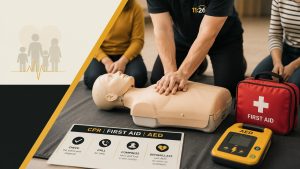
| First-aid or preparedness class | $40-$150 | 2-8 hours | Medical and emergency response |
| Personal-safety seminar | $50-$150 | 2-4 hours | Basic awareness and escape planning |
| Scenario-based course | $300-$1,000+ | 1-3 days | Stress exposure and feedback |
| Workplace emergency drill | $0-$200 per attendee | 30-120 minutes | Site-specific evacuation behavior |
Training quality matters more than price. Look for instructors who explain learning objectives, use controlled scenarios, teach de-escalation and escape, accommodate disabilities, and avoid promising prediction or guaranteed protection.
A seminar is not a substitute for first aid, CPR, fire evacuation, defensive driving, wilderness navigation, or local emergency procedures. Choose a course based on the hazard you actually face.
Which Training Path Fits a Beginner?
Self-study is the best first step for most beginners because it establishes vocabulary and repeatable observation habits at no cost. A certified first-aid, CPR, fire-safety, or wilderness course becomes more valuable when the person’s environment creates a specific response requirement.
| Learner situation | First choice | Useful next step | Main limitation |
|---|---|---|---|
| Daily commuter | Self-guided route scan | Transit safety briefing | Cannot control crowd behavior |
| Office employee | Workplace drill | First aid or CPR | Generic advice may miss site layout |
| Frequent traveler | Hotel and destination planning | Local emergency orientation | Laws and norms vary by country |
| Outdoor hiker | Weather and navigation practice | Wilderness first aid | Forecasts can change quickly |
| Family caregiver | Child and mobility planning | Household evacuation drill | Plans require regular updates |
Avoid courses centered on dramatic “pre-attack indicators” that claim to identify criminals from vague gestures, clothing, eye contact, or body shape. Behavior can provide context, but no isolated cue proves intent. The more reliable indicators are concrete actions, escalating conduct, blocked routes, threats, weapons, environmental hazards, and verified information.
How Should You Adapt Awareness to Different Settings?
Situational awareness changes with the environment’s normal pattern, hazards, available help, and time available for action. A commuter prioritizes movement and personal space, a traveler prioritizes exits and local procedures, and a hiker prioritizes weather, navigation, water, and fatigue.
Commuting and public spaces
Keep one ear available when walking near traffic or boarding transit, but do not assume removing every earbud is necessary in every setting. The practical goal is to preserve enough attention for announcements, vehicles, alarms, and nearby movement.
Stand behind marked platform lines, keep bags closed in dense crowds, and avoid displaying valuables while navigating. If someone makes you uncomfortable, create distance, move toward staff or a populated area, and contact transit security or emergency services rather than confronting the person.
Driving and cycling
Driving awareness requires a forward sightline, mirror checks, speed control, and attention to changing traffic rather than only the vehicle immediately ahead. A useful projection question is, “What could make the next vehicle brake suddenly?”
Cyclists and pedestrians should identify turning vehicles, door zones, blind corners, poor lighting, and escape space. Phone use while moving removes both visual and cognitive capacity, even when the user believes the task is brief.
Travel and hotels
Before travel, save local emergency numbers, confirm the address of your accommodation, identify transport options, and check official advisories. On arrival, locate the stairwell and verify whether the route remains usable from your room.
Hotel room awareness should include door-lock operation, smoke alarms, balcony access, and the location of staff. Do not rely on a single online review or assume that a familiar emergency number works in another country.
Hiking and outdoor recreation
Outdoor awareness prioritizes terrain, weather, daylight, water, navigation, injury risk, and group condition. Sudden wind changes, cloud buildup, falling temperature, rising water, and loss of trail markers deserve attention before a crisis develops.
Carry navigation redundancy rather than relying on a phone alone. A typical day hike plan includes offline maps, a charged phone, water, weather protection, a light, and a communication plan shared with someone outside the group.
What Is Situational Awareness Not?
Situational awareness is not paranoia, mind reading, constant scanning, or a guarantee of safety. It improves the chance of noticing relevant changes early, but it cannot eliminate uncertainty, prevent random events, or replace emergency services and professional instruction.
Situational awareness also differs from intuition. Intuition may produce a rapid feeling based on prior experience, while awareness can examine the observable cues behind a decision. Treat an uneasy feeling as a prompt to pause and create distance, not as proof that a particular person is dangerous.
Mindfulness overlaps with awareness because both can improve attention to present experience. Mindfulness practice often emphasizes nonjudgmental observation, whereas situational awareness adds environmental meaning, prediction, and action. Neither approach requires assuming that every unusual event is hostile.
What Mistakes Do Beginners Make?
Beginners most often fail through distraction, overinterpretation, fixation, and weak planning. The correction is usually simpler than more vigilance: reduce distractions, use neutral descriptions, scan broadly, and decide what action a verified change requires.
| Mistake | What it looks like | Correction | Recovery time |
|---|---|---|---|
| Phone distraction | Looking down in a parking lot | Stop before checking messages | 10-20 seconds |
| Target fixation | Watching one person continuously | Acknowledge, then scan the whole area | 5-10 seconds |
| Confirmation bias | Collecting only threatening cues | Seek a second explanation or source | 30-60 seconds |
| Tunnel vision | Seeing a hazard but missing exits | Name route, helper, and next action | 10 seconds |
| Overconfidence | Assuming a familiar route is always safe | Recheck conditions after changes | 20-30 seconds |
| Paranoia | Treating normal behavior as evidence | Return to baseline and observable facts | Variable |
One practitioner rule is “scan, decide, move.” Observation without a decision can become passive fascination. Once a cue is relevant, choose a low-risk action such as increasing distance, entering a staffed location, calling someone, or following official instructions.
Another rule is to preserve options before investigating. Do not approach an unattended bag, follow a suspected person, or enter smoke to satisfy curiosity. Awareness is valuable because it supports avoidance, not because it makes confrontation safer.
What Are the Limits and Edge Cases?
Awareness methods must be adapted for sensory disabilities, neurodivergence, anxiety, children, fatigue, crowded events, and environments where visual scanning is impractical. The objective is relevant information and workable decisions, not compliance with a single checklist.
People with hearing loss can use visual alarms, vibration alerts, captioned emergency systems, and a companion communication plan. People with vision loss can prioritize tactile route knowledge, auditory orientation, mobility tools, and staff assistance. People with anxiety may benefit from a bounded two-minute scan followed by a deliberate return to ordinary activity.
Children need simple rules rather than threat narratives: identify a trusted adult, stay with the group, tell someone when separated, and never approach a hazard. Families should rehearse meeting points and accessibility needs before an emergency, because stress reduces working memory.
Crowded events create another limitation. A clear exit may become unusable within seconds, so note multiple routes and avoid standing against gates or in narrow bottlenecks. Environmental awareness should include crowd flow, not only individual behavior.
How Can You Measure Improvement?
Measure improvement by decisions and recall, not by how suspicious or tense you feel. After entering a place, check whether you can identify two routes, one source of help, the baseline, and one meaningful change without losing normal social function.
| Measure | Beginner target | Advanced practical target | How to test |
|---|---|---|---|
| Exit recall | 1 route after 10 seconds | 2 routes after 30 seconds | Ask yourself after leaving |
| Baseline description | 2 observable details | 4 relevant details | Record neutral facts |
| Distraction control | Phone away for 2 minutes | Phone away through transitions | Review screen-time behavior |
| Conditional planning | 1 if-then statement | 2 plans for changing conditions | State trigger and action |
| Recovery from fixation | Resume scan within 10 seconds | Maintain broad attention | Use a timed exercise |
The strongest sign of progress is lower cognitive effort with equal or better decisions. If practice causes persistent fear, sleep disruption, compulsive checking, or avoidance of ordinary activities, reduce the exercise and consider support from a qualified mental-health professional.
Beginner Checklist for Any New Environment
Use the following compact checklist at a doorway, trailhead, platform, office, or event. It should take roughly 10 seconds once familiar.
- Where are the primary and alternate exits?
- Who can provide help, and how do I reach them?
- What is normal here right now?
- What has changed from that baseline?
- Where are the hazards, barriers, vehicles, or bottlenecks?
- What is my safest next action if conditions worsen?
- Can I move without a phone, loud audio, or an obstructed route?
Do not use the checklist to label people. Use it to understand conditions, preserve options, and make proportionate decisions.
Frequently Asked Questions
Can situational awareness be learned without self-defense training?
Yes. Beginners can develop the foundation through daily observation, route planning, emergency-procedure review, first aid, and distraction control without learning physical techniques. Self-defense training may add value for specific circumstances, but avoidance, distance, communication, and emergency response usually deserve priority before physical confrontation.
Is situational awareness useful at home?
Yes. Home awareness includes working smoke and carbon-monoxide alarms, clear exits, accessible keys, exterior lighting, medication and first-aid knowledge, and a household meeting point. Residents should also know how to report a gas odor, fire, medical emergency, or suspicious activity through local emergency channels.
How is situational awareness different from hypervigilance?
Situational awareness is flexible attention that returns to normal after a cue is evaluated. Hypervigilance is persistent threat monitoring that can produce exhaustion, anxiety, irritability, sleep difficulty, and avoidance. If safety practice makes ordinary environments feel continuously dangerous, the practice needs boundaries and possibly professional support.
Should I look at people’s hands?
Hands can provide useful behavioral information when a person is approaching, reaching, gesturing aggressively, or holding an object, but hands are only one cue. A safe assessment considers distance, movement, words, exits, context, and verified information. Looking for behavior does not justify racial, cultural, or appearance-based assumptions.
Does the 21-foot rule apply to every threat?
No. The 21-foot rule is a training benchmark associated with reaction time and distance, not a universal safety law or guaranteed outcome. Speed, barriers, awareness, terrain, weapons, lighting, and individual ability change the result. Beginners should treat distance as time to escape and seek help, not as a tactical invitation.
What should I do during an active emergency?
Follow the instructions of emergency personnel and the site’s official procedures. Move away from the hazard when a safe route exists, use cover or shelter when appropriate, help dependents without delaying unnecessarily, silence devices when instructed, and contact emergency services when safe. The correct response depends on the hazard, location, and official guidance.
The Bottom Line
Situational awareness for beginners means noticing relevant information, understanding its meaning, and projecting the next likely change. Start in Condition Yellow: calm, attentive, and connected to your surroundings. Practice a 10-second scan, identify routes and helpers, control phone distraction, form one conditional plan, and review your decisions for 30 days. The aim is not fear. It is earlier information, better options, and proportionate action.