Pistol vs handgun training usually describes the same foundational course because a pistol is commonly a type of handgun, while handgun also includes revolvers. The meaningful training comparison is semi-automatic pistol instruction versus revolver instruction, especially for loading, trigger control, reloads, malfunctions, storage, and the shooter’s intended use.
Key Facts at a Glance
- Handgun is the broad category for firearms designed to be fired while held in one or both hands; pistols and revolvers are common handgun types.
- Pistol training usually means training with a semi-automatic handgun, although some instructors use “pistol” as a synonym for handgun.
- A revolver requires different practice for cylinder loading, trigger control, sight recovery, and reloading.
- A realistic beginner pathway is 8-15 hours of structured instruction, followed by recurring practice rather than a one-time class.
- Dry fire can improve trigger and presentation skills, but it cannot replace live-fire recoil management, hearing protection, range judgment, or instructor supervision.
- The safest platform is the one the shooter can operate, store, and practice with consistently, not necessarily the smallest or highest-capacity model.
What Is the Difference Between a Pistol and a Handgun?
A handgun is a category, while a pistol is either a narrower technical term or a common synonym for handgun. In ordinary American firearms instruction, “pistol class,” “handgun class,” and “basic handgun course” often refer to similar beginner subjects, but the course equipment determines the real difference.
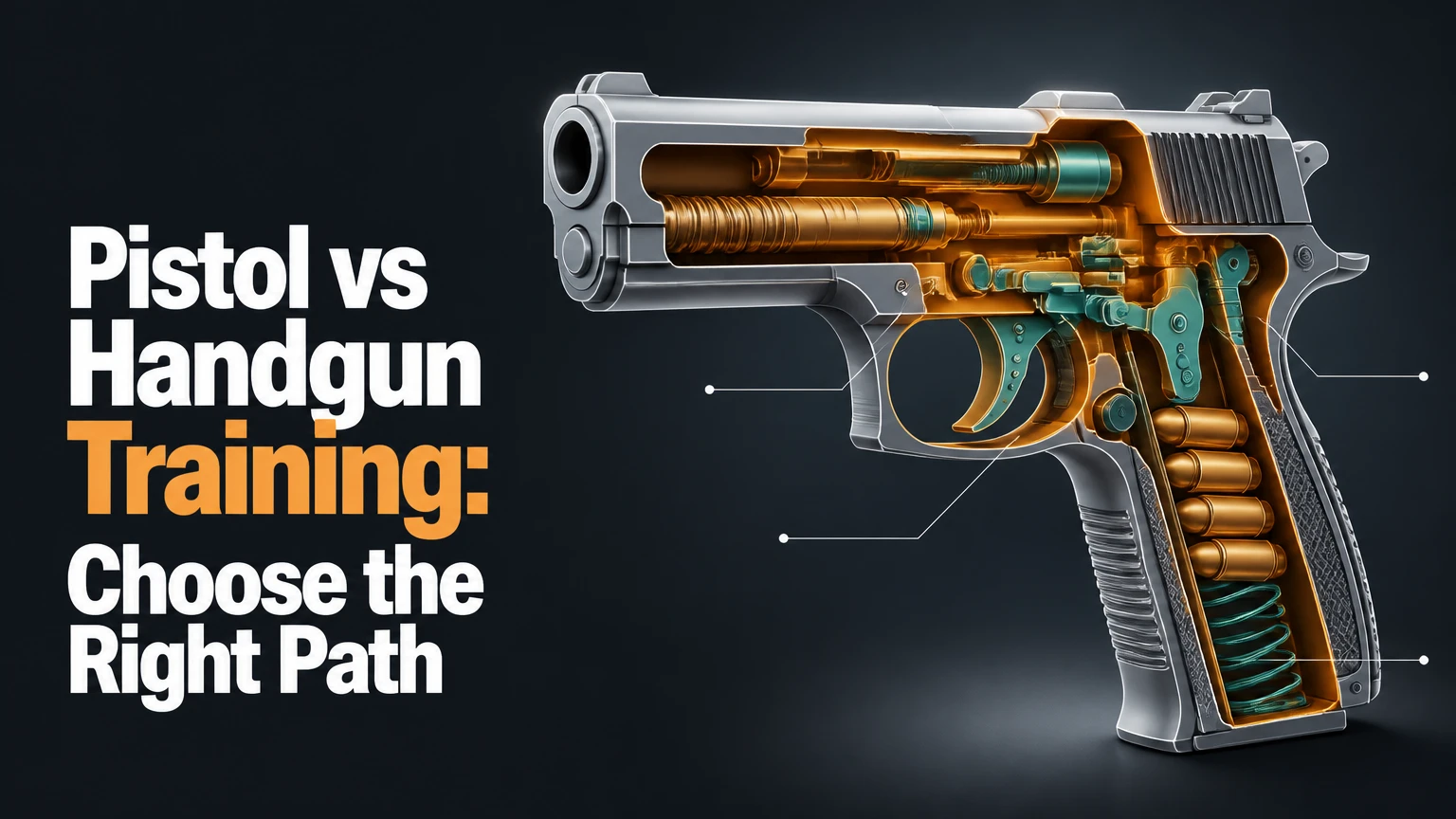
The National Institute of Justice describes handguns as firearms designed to be fired with one hand, although modern instruction commonly emphasizes a two-handed grip. A revolver has a rotating cylinder containing separate chambers. A semi-automatic pistol generally uses a reciprocating slide and a detachable magazine.
The often-repeated definition that a pistol always has a chamber integral with the barrel is incomplete for modern usage. Historical firearms terminology used “pistol” broadly, and many current dictionaries treat pistol as a handheld firearm that can include or overlap with revolvers. For training decisions, action type matters more than the label.
Terminology That Changes the Training Plan
| Term | Typical meaning | Training consequence |
|---|---|---|
| Handgun | Broad category including pistols and revolvers | Confirm the specific action before class |
| Semi-automatic pistol | Handgun using a slide and magazine | Practice magazine changes and slide manipulation |
| Revolver | Handgun using a rotating cylinder | Practice cylinder loading and heavier trigger control |
| Striker-fired pistol | Pistol with an internal striker system | Learn a consistent trigger press and safe administrative handling |
| Hammer-fired pistol | Pistol with an external or internal hammer | Learn whether the first trigger press differs from later presses |
The distinction matters because a shooter who learns a revolver does not automatically understand a semi-automatic pistol’s slide, magazine, chamber-status indicators, or malfunction procedures. Basic muzzle discipline and trigger safety transfer well; manual-of-arms skills do not.
What Does Pistol or Handgun Training Include?
Beginner handgun training normally progresses from safety and identification to supervised live fire, then to maintenance and goal-specific practice. A sound course teaches the student to recognize the firearm’s condition, keep the muzzle controlled, press the trigger without disturbing the sights, and stop when confusion or unsafe handling appears.
The NRA’s widely published safety guidance begins with “Always keep the gun pointed in a safe direction.” Its other core rules include treating every firearm as loaded, keeping the finger outside the trigger guard until ready to fire, and knowing the target and what lies beyond it.
Stage 1: Safety and Familiarization
The first stage typically takes 1-3 hours. It covers range commands, eye and ear protection, ammunition identification, loading and unloading under supervision, grip hazards, safe storage, and the firearm’s controls.
A reputable instructor uses an unloaded firearm or inert training aid before introducing live ammunition. The student should be able to identify the muzzle, trigger, magazine or cylinder, action, sights, and chamber-status indicators without guessing.
Stage 2: Dry-Fire Fundamentals
Dry-fire practice uses a verified unloaded firearm or a purpose-built training device. For live firearms, ammunition should be removed from the practice area, the firearm should be checked according to its manufacturer’s procedure, and the environment should prevent interruption.
Dry fire can improve a smooth trigger press, sight steadiness, grip consistency, and presentation from a safe ready position. It cannot teach the physical response to recoil, confirm ammunition reliability, or substitute for a qualified instructor correcting unsafe handling.
Stage 3: Supervised Live Fire
Live-fire instruction adds recoil, noise, follow-through, target identification, and range communication. Typical fundamentals include a balanced stance, a high and secure firing-hand grip, support-hand contact, front-sight or aiming-reference awareness, and a controlled trigger press.
A modern isosceles stance is common, but stance names matter less than balance, repeatability, and the instructor’s ability to adapt the position to the student. A grip that causes pain, slide contact, or inconsistent trigger access requires correction before speed becomes a training goal.
Stage 4: Maintenance and Goal-Specific Skills
Later lessons may cover field-stripping only as the manufacturer permits, lubrication points, inspection, storage, holster selection, magazine loading, and basic stoppage recognition. Concealed-carry or defensive courses may add legal decision-making, communication, movement around obstacles, and safe presentation from a holster.
Advanced skills should follow demonstrated safety and accuracy. A student should not rush into timed drills, movement, or multiple-target exercises while still sweeping the muzzle, placing a finger on the trigger early, or losing awareness of the backstop.
Which Platform Is Easier to Learn?
For most beginners, a medium-size semi-automatic pistol in a moderate cartridge is easier to practice with because it commonly provides a manageable trigger, higher capacity, faster magazine changes, and less mechanical interruption between repetitions. A revolver can be simple to understand, but its long trigger press and slower reloads often demand more refined control.
“Easier” depends on hand strength, eyesight, recoil tolerance, instructor availability, and the student’s purpose. A small revolver may avoid slide-racking difficulty, yet its narrow grip and heavy double-action trigger can make accurate practice harder. A small semi-automatic pistol may conceal well but produce sharper recoil than a larger training model.
Training Comparison by Action Type
| Training factor | Semi-automatic pistol | Double-action revolver | Practical effect |
|---|---|---|---|
| Typical capacity | 6-17 cartridges | 5-8 cartridges | Pistols provide more repetitions before reloading |
| Primary reload | Magazine insertion | Loose rounds, speedloader, or moon clip | Revolver reload practice takes longer |
| Trigger pattern | Often consistent, or first-shot double action | Long double-action press | Revolver accuracy can require more trigger practice |
| Common manipulation | Slide, magazine, chamber | Cylinder release, cylinder, ejector rod | Each platform needs separate manual practice |
| Malfunction pattern | Feed, extract, eject, magazine issues | Misfire, ignition, cylinder or mechanical issue | Diagnosis differs substantially |
| Concealment profile | Often flatter | Cylinder creates greater width | Clothing and holster choice differ |
| Hand-strength concern | Slide operation can be difficult | Trigger and cylinder operation can be difficult | Test controls before buying |
Expert Insight: Smallest Does Not Mean Easiest
The smallest handgun often creates the least forgiving training environment. Short sight radii, reduced grip area, greater felt recoil, and lighter weight can increase fatigue and degrade accuracy, particularly during a first range session.
A practical rule is to begin with the largest controllable model that fits the shooter’s hands and intended use. The student can later train with a smaller carry firearm, but learning fundamentals on a softer-shooting platform usually produces more useful repetitions.
How Do Striker-Fired and Hammer-Fired Pistols Affect Training?
Striker-fired pistols usually provide a similar trigger sequence for every shot, while many hammer-fired pistols use a longer double-action first press followed by a shorter single-action press. The difference changes trigger practice, sight disturbance, decocking procedures, and the amount of control familiarization required.
A striker-fired system can reduce the number of external controls a beginner must remember, but it does not remove the need to verify the chamber, understand the trigger safety, or use a secure holster that covers the trigger guard. A hammer-fired pistol may provide visible status information, yet its decocker, manual safety, or double-action transition can add tasks.
| Pistol system | Typical trigger sequence | Main training requirement | Common beginner issue |
|---|---|---|---|
| Striker fired | Consistent pull for each shot | Straight, repeatable trigger press | Trigger contact during handling |
| Double-action/single-action | Long first pull, shorter later pulls | Separate first-shot and follow-up control | First shot lands away from later shots |
| Single-action | Short, lighter trigger after cocking | Manual safety and condition awareness | Unsafe handling of a light trigger |
| Double-action-only | Long pull for every shot | Sustained trigger discipline | Fatigue and sight movement |
No action type eliminates negligent discharges. Safe handling depends on muzzle direction, trigger-finger discipline, storage, and deliberate verification.
How Long Does Proficiency Take?
A typical beginner needs 8-15 hours of structured instruction plus several short practice sessions to establish safe, repeatable fundamentals. A 4-8 hour introductory class can explain the skills, but it rarely creates durable proficiency without follow-up practice and feedback.
A useful progression separates knowledge from performance. During the first session, the student should focus on safe handling and consistent fundamentals rather than speed. During later sessions, the instructor can measure group size, repeatability, reload control, and the ability to stop safely when a problem occurs.
| Training phase | Typical time | Typical live ammunition | Performance checkpoint |
|---|---|---|---|
| Safety and orientation | 1-3 hours | 0-25 rounds | Identifies firearm condition and follows commands |
| Fundamentals class | 4-8 hours | 100-250 rounds | Maintains safe grip, sights, and trigger control |
| Follow-up practice | 4-8 sessions | 200-500 rounds total | Repeats fundamentals without constant prompting |
| Carry-focused instruction | 8-16 hours | 150-400 rounds | Handles holster and storage procedures safely |
| Ongoing maintenance | 20-30 minutes monthly | 50-100 rounds monthly | Preserves safe, repeatable performance |
Round counts are typical planning figures, not proficiency guarantees. A student with poor fit, untreated flinching, or limited hand strength may need more coaching and fewer rounds per session.
What Can Dry Fire Improve?
Dry fire can improve trigger control, sight stability, grip consistency, and the careful sequence used to present an unloaded training firearm. Dry fire cannot reproduce recoil, noise, ammunition variation, range commands, or the consequences of an incorrect diagnosis.
Use dry fire only after the firearm’s manual and instructor guidance establish a safe procedure. Remove all ammunition from the room, inspect the firearm, choose a safe backstop, and stop immediately if another person enters the practice area.
A practical session can last 5-10 minutes and use a small number of deliberate repetitions. The goal is identical movement quality, not speed. A laser cartridge or electronic trainer can provide feedback, but the device does not make an unsafe setup safe.
How Much Does Handgun Training Cost?
Typical introductory handgun training costs $100-$250 for a 4-8 hour class, while private instruction commonly costs $50-$150 per hour. A student should also budget for range fees, ammunition, eye and ear protection, targets, transportation, and any legally required permit course.
Prices vary by location, class size, insurance, range access, and whether the student supplies a firearm. Ammunition prices change frequently, so current local range pricing is more reliable than a national estimate.
| Expense | Typical range | Planning quantity | Cost consequence |
|---|---|---|---|
| Beginner class | $100-$250 | 1 enrollment | Main instruction cost |
| Private coaching | $50-$150/hour | 1-3 hours | Faster correction, higher hourly cost |
| 9mm training ammunition | $15-$30 per 50 rounds | 200-500 rounds | $60-$300 for practice ammunition |
| Range visit | $15-$30 | 4-8 visits | $60-$240 before ammunition |
| Eye and ear protection | $20-$100 | 1 set each | Reusable equipment |
| Basic handgun | $400-$750 typical | 1 firearm | Verify fit, reliability, and legal requirements |
The lowest purchase price can create higher training costs if the firearm is uncomfortable, difficult to operate, or incompatible with available ammunition. Rental programs allow a student to compare grip size and controls before buying.
How Does Concealed-Carry Training Differ?
Concealed-carry training adds legal responsibility, safe storage, holster selection, clothing interaction, presentation mechanics, and judgment under stress. The training objective is not merely firing accurately; it is avoiding unsafe handling and recognizing when carrying a firearm is inappropriate.
Permit requirements differ by jurisdiction, and a permit class may not equal comprehensive practical training. A student should verify current rules with the relevant state or local authority, then seek instruction that includes supervised live fire and safe holster work.
A carry handgun must remain secured in a holster designed for that exact model and configuration. The holster should protect the trigger guard, retain the firearm during normal movement, and avoid unsafe contact with the trigger during placement or removal.
What Does Home-Defense Training Add?
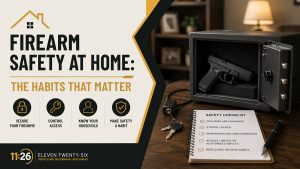
Home-defense training adds secure storage, family communication, identification, emergency planning, and the legal limits of defensive force. The firearm is only one part of the plan, and a safe, locked storage method must prevent unauthorized access while remaining appropriate for the household’s emergency procedures.
Training should address lighting, hearing protection, children or visitors, medical emergencies, and the risk of mistaken identification. A homeowner should also know how to call emergency services, describe the situation, and follow responding officers’ commands.
Home defense is not a justification for searching through a house or confronting unknown people. A qualified instructor can explain avoidance, sheltering, communication, and jurisdiction-specific law without turning a basic course into tactical theater.
What If Slide Manipulation Is Difficult?
Shooters with limited hand strength should test the slide, magazine release, cylinder latch, and trigger before choosing a handgun. A larger grip, easier-to-rack design, reduced-recoil cartridge, or revolver may solve one problem while creating another, so the complete control set must be evaluated.
Helpful adaptations include using the rear slide serrations, pushing the frame forward while pulling the slide rearward, and asking an instructor to check technique. Do not rely on forcing a control that causes pain or prevents reliable operation.
| Shooter concern | Possible option to test | Limitation to check |
|---|---|---|
| Difficult slide operation | Large serrations or reduced-strength design | Confirm reliable cycling and safe handling |
| Heavy trigger | Larger handgun with manageable trigger | A lighter trigger demands disciplined handling |
| Recoil sensitivity | Medium-frame 9mm or .380 ACP | Lower recoil does not guarantee easy operation |
| Small hands | Compact grip circumference | Short grips can increase recoil and reduce control |
| Weak cylinder operation | Larger revolver latch or assisted loader | Double-action trigger may remain demanding |
The correct choice is determined at the range, under supervision, with the exact firearm or a close rental equivalent. Product labels such as “easy” do not replace hands-on testing.
What Happens When a Gun Stops?
When a firearm fails to fire, feed, extract, or eject, keep the muzzle pointed in a safe direction, keep the finger outside the trigger guard, and follow the instructor’s procedure. The correct response depends on the firearm, ammunition, visible condition, and whether a delayed ignition is possible.
A beginner should not improvise a clearance while facing a target or handling an unfamiliar firearm. Stop, announce the problem, maintain direction, and request range or instructor assistance. A qualified instructor can teach platform-specific responses such as recognizing a magazine issue, a trapped casing, or a suspected ammunition defect.
Common Training Problems
- Anticipating recoil: The shooter pushes the gun downward before the shot. Slow the cadence, reduce the session length, and use instructor-supervised diagnostic drills.
- Incomplete support-hand contact: The support hand leaves unused space on the grip. Rebuild the grip at a safe ready position before firing again.
- Poor trigger contact: The finger reaches the trigger at an angle and disturbs the sights. Adjust finger placement under instructor supervision.
- Excessive fatigue: Accuracy deteriorates after repeated recoil. Stop, hydrate, and end the session before unsafe handling begins.
- Confusing platform controls: The shooter applies pistol habits to a revolver or vice versa. Separate practice sessions by firearm type until each manual of arms is automatic and safe.
Expert Insight: Fatigue Is a Safety Signal
A shooter who begins dropping magazines, losing muzzle awareness, or rushing commands has exceeded a productive training dose. More rounds can reinforce poor movement and increase hearing, recoil, and attention fatigue.
How Should You Choose an Instructor?
Choose an instructor who verifies credentials, explains safety before marksmanship, uses a written lesson plan, limits class size, and adapts instruction to the student’s firearm and physical needs. A professional instructor should welcome questions about insurance, emergency procedures, ammunition, range rules, and what the class does not cover.
Look for a course description that identifies the action types taught, required equipment, live-fire round count, student-to-instructor ratio, and prerequisites. Avoid classes that promise advanced defensive performance in a single short session or treat speed as more important than control.
The instructor should correct unsafe behavior immediately and calmly. That standard matters more than an impressive course name.
Which Training Path Fits Your Goal?
Complete Beginner
Choose a basic handgun course using a rental or medium-size semi-automatic pistol if available. Prioritize safety, fit, recoil tolerance, trigger control, and supervised live fire before purchasing a firearm.
Recreational Target Shooter
Choose fundamentals instruction followed by a structured range plan. A pistol may provide more economical repetition through magazine capacity, while a revolver can develop careful double-action trigger control.
Concealed-Carry Student
Complete the legally required course, then add practical instruction covering holster safety, storage, presentation, and decision-making. Do not treat permit completion as proof of defensive proficiency.
Homeowner
Start with safe storage and emergency planning, then learn the selected firearm under supervision. A larger, controllable handgun may be easier to train with than a compact carry model, but household access controls remain non-negotiable.
Shooter With Limited Hand Strength
Rent or borrow several models under instructor supervision. Compare slide force, grip circumference, magazine loading, trigger effort, and recoil rather than selecting solely by capacity or advertised convenience.
Frequently Asked Questions
Is pistol training different from handgun training?
Usually, no. Many training providers use “pistol” and “handgun” interchangeably for a semi-automatic firearm course. The curriculum becomes meaningfully different when the class includes a revolver, because cylinder operation, trigger control, loading, reloading, and stoppage responses require separate skills.
Can someone learn on a revolver and switch to a pistol?
Yes, foundational safety, sight use, grip principles, and trigger discipline transfer between platforms. Slide manipulation, magazine changes, chamber verification, and semi-automatic stoppage recognition do not transfer automatically, so the shooter needs a dedicated transition lesson before independent practice.
Is a revolver safer than a semi-automatic pistol?
Neither platform is inherently safe when handled carelessly. Revolvers have different controls and no detachable magazine, but they still contain ammunition and can fire when the trigger is pressed. Safe direction, trigger discipline, secure storage, and informed handling determine safety.
How many rounds should a beginner shoot in one session?
A typical beginner may start with 50-150 live rounds, depending on recoil, instruction length, and fatigue. Accuracy and safe handling should determine when to stop. A shorter session with attentive repetitions is more useful than firing 300 rounds after technique has deteriorated.
Should a new shooter buy a handgun before taking a class?
A new shooter does not need to purchase first when a reputable range offers rentals and instruction. Taking a class before buying allows comparison of grip size, slide or cylinder operation, trigger effort, recoil, and sight systems without committing to an unsuitable firearm.
Does a concealed-carry permit prove proficiency?
A permit or required classroom certificate proves only that the applicant met the jurisdiction’s stated requirements. It may not establish reliable handling, accurate shooting, holster competence, storage knowledge, or judgment under pressure. Continuing instruction and periodic supervised practice remain necessary.
The Bottom Line
Pistol vs handgun training is usually a terminology question, not a choice between two unrelated disciplines. Handgun is the broad category; pistol commonly identifies a semi-automatic handgun, while revolver training follows a different manual of arms. Choose instruction according to the firearm’s action, your physical capabilities, and your purpose.
For most beginners, a medium-size, controllable semi-automatic pistol provides efficient practice and straightforward progression. A revolver remains a valid choice when its controls, trigger, recoil, storage requirements, and reload method suit the shooter. In either case, start with qualified instruction, follow the four universal safety rules, practice in short deliberate sessions, and treat safe judgment as the primary measure of pistol vs handgun training success.