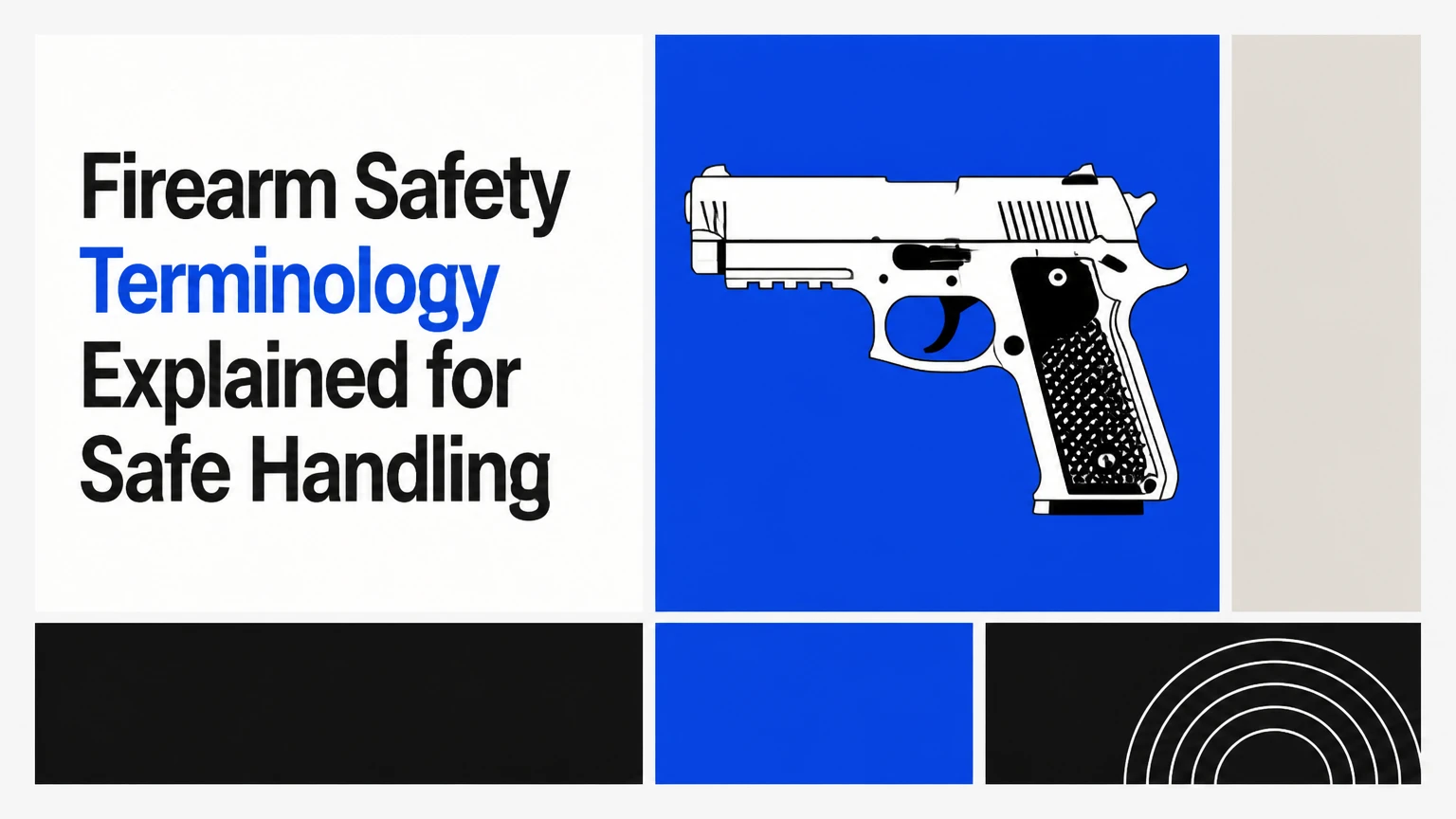
Firearm safety terminology describes the rules, mechanical features, ammunition conditions, and handling states that prevent unintended injury. The essential terms are loaded, unloaded, chamber, muzzle, trigger, safe direction, action, malfunction, and secure storage. Knowing their precise meanings helps a person recognize risk before handling, loading, unloading, cleaning, transporting, or storing a firearm.
Key Facts at a Glance
A firearm is treated as loaded until the handler personally verifies its condition.
A mechanical safety can reduce one firing pathway, but it cannot make unsafe handling acceptable.
Removing the magazine does not necessarily unload a firearm because a cartridge may remain in the chamber.
A squib load can lodge a projectile in the barrel; firing again can damage the firearm and injure the shooter.
A safe-storage device must prevent unauthorized access while fitting the household’s access, portability, and legal requirements.
Every firearm has an owner’s manual that takes priority over generic unloading instructions.
What Does Firearm Safety Terminology Mean?
Firearm safety terminology is a shared vocabulary for describing where ammunition is, what the mechanism can do, and how a person should control risk. The terms distinguish a loaded chamber from an empty magazine, a mechanical stoppage from a dangerous ammunition defect, and a locked container from a merely concealed location.
The vocabulary matters because ordinary language creates dangerous assumptions. “The gun is empty” may mean that someone removed the magazine, even though a cartridge remains in the chamber. “The safety is on” may describe a manual lever position without proving that the muzzle is safe or the trigger is protected.
The National Rifle Association’s basic rule is stated plainly: “Always keep the gun pointed in a safe direction.” The National Shooting Sports Foundation similarly presents safe direction, unloaded handling, trigger discipline, and target awareness as core safety principles. These rules apply regardless of firearm model, action type, or presence of a mechanical safety.
The Four Universal Firearm Safety Rules
The four widely taught rules are complementary barriers against injury:
- Treat every firearm as loaded. Handle an unfamiliar or supposedly unloaded firearm with the same discipline used for a loaded one until you personally verify its condition.
- Keep the muzzle pointed in a safe direction. A safe direction is one where an unintended discharge would cause the least foreseeable injury or property damage, subject to the range’s rules and the bullet’s potential penetration.
- Keep your finger outside the trigger guard. The trigger finger rests straight along the frame or receiver until the shooter has identified the target, aligned the sights, and made the deliberate decision to fire.
- Be certain of the target and what is in front of and behind it. A projectile can miss, pass through a target, or ricochet. Drywall, doors, vehicle panels, and vegetation are not reliable backstops.
These rules remain active during storage, transport, cleaning, dry practice, and malfunction handling. A mechanical safety changes the firearm’s operating condition; it does not cancel any of the four rules.
What Are the Main Firearm Parts and Conditions?
The most useful terms identify ammunition location and the firearm’s mechanical state. A firearm’s condition cannot be inferred reliably from appearance, magazine position, or another person’s statement.
| Term | Precise meaning | Safety significance |
|---|---|---|
| Muzzle | Front end of the barrel where a projectile exits | Controls the direction of potential discharge |
| Chamber | Rear portion of the barrel that holds a cartridge for firing | A cartridge here means the firearm may fire |
| Magazine | Removable ammunition container that feeds cartridges | Removing it may leave the chamber loaded |
| Action | Moving mechanism that loads, fires, extracts, and ejects cartridges | Open action exposes part of the firearm’s condition |
| Bore | Interior passage through the barrel | Must be clear before firing |
| Receiver | Main frame or housing containing operating components | Model-specific inspection and storage reference |
| Trigger guard | Protective loop around the trigger | Keeps objects away from the trigger during handling |
| Breech face | Rear surface supporting the cartridge during firing | Can retain residue or contribute to chamber inspection |
| Slide or bolt | Reciprocating component that cycles the action | Open position can indicate an unloaded condition after inspection |
| Chamber flag | Visible device inserted into an open chamber | Communicates an intended unloaded condition to others |
Loaded, Unloaded, Clear, and Safe
Loaded means ammunition is present in a location that permits the firearm to fire, usually the chamber, magazine, cylinder, or feeding path. Unloaded generally means no ammunition is present in the chamber, cylinder, magazine, or firearm, but the exact definition can vary by range rules and firearm type.
Clear usually means the handler has inspected the chamber, action, magazine well, and ammunition source and found no cartridge. Safe is broader. A firearm can be unloaded but pointed at a person, and therefore unsafe to handle.
A chamber flag communicates status; it does not prove status. The handler still needs to unload the firearm according to the owner’s manual, inspect it, and keep the muzzle controlled.
What Is the Difference Between a Magazine and a Chamber?
A magazine stores and presents cartridges for feeding; the chamber holds the cartridge positioned for firing. Removing a magazine does not unload a chambered cartridge, which is why “magazine removed” and “unloaded” are different safety statements.
A semi-automatic pistol can retain one cartridge after its magazine is removed. A revolver has chambers in a rotating cylinder rather than a detachable magazine. A bolt-action rifle may hold cartridges in both its internal magazine and chamber. Safe terminology must identify the exact ammunition location.
How Do Mechanical Safeties Work?
A mechanical safety is a device that obstructs or interrupts one or more parts of the firing sequence. A manual safety requires deliberate user movement, while a passive safety normally operates automatically when the firearm is properly held or the trigger is intentionally pressed.
Mechanical safety designs differ by manufacturer and model. A lever that blocks the trigger on one pistol may block the sear, hammer, striker, or trigger bar on another. The owner’s manual is the authoritative source for the specific mechanism.
| Safety feature | Typical mechanism | Common examples | Important limitation |
|---|---|---|---|
| Manual thumb safety | Blocks trigger, sear, hammer, or trigger bar | 1911 pistols, some AR-15 rifles | Can be left in the wrong position |
| Grip safety | Prevents firing unless rear grip lever is depressed | 1911 pistols, Springfield XD pistols | Requires a particular grip and may not block every hazard |
| Trigger-blade safety | Interrupts trigger movement unless the central blade is depressed | Glock Safe Action, Smith & Wesson M&P | Objects can still contact the trigger assembly |
| Firing-pin block | Blocks firing-pin movement until the trigger mechanism moves it aside | Many modern pistols | Does not control muzzle direction or ammunition |
| Transfer-bar system | Keeps hammer force from reaching the primer unless trigger movement positions the bar | Many modern revolvers | Model-specific; never assume all revolvers operate alike |
| Decocker | Lowers or releases a hammer safely through a designed control | Beretta 92, SIG Sauer P-series variants | A decocker is not always a manual safety |
| Magazine disconnect | Prevents firing when the magazine is removed | Some Browning Hi-Power variants | Does not mean the chamber is empty |
Active and Passive Safety Terms
An active safety requires a conscious control movement, such as moving a thumb lever to “safe.” A passive safety functions automatically during normal handling or firing, such as a trigger blade or firing-pin block.
Neither category guarantees protection against every discharge. A manual safety may be disengaged during intended firing, and a passive device may not prevent an object from pressing the trigger. The safest operating assumption is that the trigger can fire the firearm whenever ammunition is present.
What Is a Decocker?
A decocker lowers a cocked hammer without firing when the control is used according to the manufacturer’s instructions. A decocker is different from a manual safety: some firearms combine both functions, while others only decock.
A decocker should never be treated as a universal feature. Control direction, hammer behavior, and post-decocking trigger action differ among models. Read the manual and obtain hands-on instruction before operating unfamiliar controls.
How Should Someone Verify an Unloaded Firearm?
To verify an unloaded firearm, control the muzzle, remove the ammunition source, open the action, lock it open when the design permits, and visually inspect the chamber, feeding path, and magazine or cylinder. Never rely on a loaded-chamber indicator, an empty magazine, or another person’s assurance alone.
A Safe General Inspection Sequence
- Control the muzzle. Point the firearm toward the range’s designated safe direction or another direction that minimizes foreseeable harm.
- Keep the trigger finger indexed. Place the finger straight along the frame or receiver, outside the trigger guard.
- Remove the ammunition source. Remove the magazine, open the cylinder, or empty the internal ammunition source according to the firearm’s design.
- Open the action. Retract the slide, open the bolt, cycle the lever, or otherwise expose the chamber using the manufacturer’s procedure.
- Lock the action open. Use the slide stop, bolt catch, open cylinder, or built-in mechanism when available.
- Inspect without inserting a finger. Look into the chamber, feed area, and magazine well under adequate light. A physical check should use an appropriate tool or the manufacturer-approved method, not a finger placed near the chamber or trigger.
- Separate ammunition. Place live ammunition away from the firearm during cleaning, inspection, or dry practice.
- Add a chamber flag if appropriate. A visible flag helps communicate the firearm’s intended condition, especially on a range.
You will know the inspection is complete when the ammunition source is separate, the action is open, the chamber and feeding path are visibly empty, and the firearm remains pointed safely. The common mistake is cycling the action before removing the magazine, which can feed another cartridge into the chamber.
Why Is a Manufacturer Manual Necessary?
Manufacturer manuals specify the correct unloading sequence, control locations, ammunition restrictions, disassembly limits, and storage warnings for a particular model. Generic instructions cannot account for every lever-action, revolver, pistol, rifle, shotgun, or unusual action design.
If the firearm’s condition is uncertain, stop handling it, maintain a safe muzzle direction, keep people away, and contact a qualified instructor, range safety officer, gunsmith, or law-enforcement agency according to local procedures. Do not experiment with unfamiliar controls.
Which Firearm Action Types Use Different Safety Terms?
Action type describes how a firearm loads, locks, fires, extracts, and ejects ammunition. Action type affects the names of controls and the way an unloaded condition is verified, but it does not change the four universal safety rules.
| Action type | Ammunition location to verify | Common control terms | Typical inspection concern |
|---|---|---|---|
| Striker-fired pistol | Chamber, magazine well, feed ramp | Slide stop, trigger safety, chamber indicator | Chamber may remain loaded after magazine removal |
| Hammer-fired pistol | Chamber, magazine well, hammer position | Manual safety, decocker, hammer | Decocked does not always mean unloaded |
| Revolver | Each cylinder chamber | Cylinder latch, hammer, transfer bar | Every chamber must be checked |
| Bolt-action rifle | Chamber, internal or detachable magazine | Bolt handle, safety lever, magazine floorplate | Closing the bolt can chamber ammunition |
| Pump shotgun | Chamber, loading port, tubular magazine | Action release, cross-bolt safety | Shells can remain in the tube after chamber unloading |
| Lever-action rifle | Chamber, carrier, tubular magazine | Lever, hammer, cross-bolt safety | Cycling may change ammunition position |
| AR-15 pattern rifle | Chamber, magazine well, bolt carrier group | Safety selector, charging handle, bolt catch | Magazine removal alone does not clear the chamber |
What Is a Loaded-Chamber Indicator?
A loaded-chamber indicator is a visual or tactile feature intended to show that a cartridge is present in the chamber. It is an aid, not a replacement for direct inspection, because indicators can be misunderstood, damaged, obscured, or absent on a particular model.
What Is a Negligent Discharge?
A negligent discharge is an unintended firing associated with unsafe handling, such as an unprotected trigger, an unsafe muzzle direction, or a failure to identify the target. “Accidental discharge” may suggest an unavoidable mechanical event, while “negligent discharge” focuses on preventable conduct.
A mechanical defect can also cause an unintended discharge without deliberate trigger pressure. The exact legal meaning varies by jurisdiction, so incident reporting should use factual descriptions rather than assumptions about fault.
What Is the Difference Between a Stoppage and a Malfunction?
A stoppage is an interruption that prevents the firearm from completing its operating cycle; a malfunction is a broader term that includes failures caused by the firearm, ammunition, or user interaction. A stoppage may be cleared by trained personnel, while a suspected ammunition or barrel defect requires greater caution.
| Term | Meaning | Visible or audible clue | Safe response |
|---|---|---|---|
| Failure to feed | Cartridge does not enter the chamber correctly | Cartridge remains misaligned | Keep muzzle safe and follow trained or manual-approved procedure |
| Failure to fire | Trigger pressed but cartridge does not fire | Click without normal report | Keep muzzle in a safe direction and treat as a possible hangfire |
| Failure to extract | Fired case remains in chamber | Action opens without removing case | Stop if force is abnormal; seek qualified assistance |
| Failure to eject | Case leaves chamber but remains in ejection port | Case obstructs slide or bolt | Keep finger clear and follow range instruction |
| Stovepipe | Case is trapped upright or partly outside ejection port | Case protrudes vertically | Treat as a stoppage, not proof the firearm is unloaded |
| Double feed | Two cartridges compete for the chamber | Two rounds or a case visibly obstructs feeding | Stop and obtain instruction if the action does not clear normally |
| Hangfire | Delayed ignition after the primer is struck | Click followed by delayed report | Keep muzzle safe and wait according to manual or range rules |
| Squib load | Insufficient firing event leaves a projectile in the bore | Unusually quiet report or weak recoil | Stop firing and have the bore inspected before another shot |
What Should You Do After a Suspected Hangfire?
After a suspected hangfire, keep the muzzle pointed in a safe direction, keep the finger away from the trigger, and wait for the period specified by the firearm or ammunition manufacturer and range rules. Do not immediately open the action or look into the muzzle.
Many training programs use a waiting period of at least 30 seconds, but a universal time cannot safely replace the manufacturer’s instructions. After the waiting period, obtain qualified help if the firearm does not open normally or if the cause remains uncertain.
What Is a Squib Load?
A squib load is a cartridge that produces insufficient energy to drive its projectile completely through the barrel. The warning signs include an unusually soft report, weak recoil, smoke or sound that differs markedly from preceding shots, or a firearm that behaves unexpectedly.
Stop firing immediately. Keep the firearm pointed safely, unload it under the applicable procedure, and have a qualified gunsmith or range professional verify the barrel is clear. Do not attempt another shot to “push out” a suspected obstruction, and do not force a cleaning rod through a barrel without appropriate training.
What Is a Stovepipe?
A stovepipe is a failure to eject in which a fired cartridge case becomes trapped in the ejection port, often pointing upward. The term describes the appearance of the obstruction, not the cause, which may involve ammunition, grip, magazine condition, fouling, or a mechanical problem.
A new owner should follow the specific range instruction or manufacturer-approved clearing procedure. If the action is difficult to move, a live cartridge is positioned unpredictably, or repeated stoppages occur, stop and request assistance rather than applying force.
Which Storage Method Fits the Situation?
The best storage method is the one that prevents unauthorized access, remains secured under the household’s conditions, and complies with applicable law. A lock that is fast to open but accessible to a child fails its primary purpose, while a highly resistant safe may be unsuitable if the owner cannot operate it reliably.
| Storage method | Typical retail range | Typical access time | Best use | Main limitation |
|---|---|---|---|---|
| Cable lock | $10-$35 | 10-30 seconds | Basic transport or locked storage | Does not prevent the firearm from being moved |
| Trigger lock | $10-$40 | 10-30 seconds | Unloaded storage with compatible design | Must never be installed on a loaded firearm |
| Portable lockbox | $25-$150 | 5-20 seconds | Vehicle or travel storage where lawful | Often limited fire and theft resistance |
| Mechanical push-button safe | $150-$500 | 2-8 seconds | No-battery access with stronger construction | Combination can be observed or forgotten |
| Electronic keypad safe | $80-$400 | 2-10 seconds | Quick access and code entry | Batteries and electronics require maintenance |
| Biometric safe | $100-$500 | 2-10 seconds | Authorized rapid access | Fingerprint performance varies with dirt, moisture, and power |
| Full-size gun safe | $500-$3,500 or more | 10-60 seconds | Multiple firearms and theft resistance | Heavy, expensive, and slower to access |
Prices and access times are typical retail and user-operation ranges, not performance guarantees. Fire resistance, burglary ratings, anchoring, lock certification, and construction thickness differ substantially among products.
What Makes Storage Secure?
Secure storage combines a locked container, restricted access, appropriate ammunition control, regular lock testing, and compliance with local requirements. The Bureau of Alcohol, Tobacco, Firearms and Explosives recommends preventing unauthorized access, while the American Academy of Pediatrics emphasizes locked storage when children live in or visit a home.
Consider these operating details:
- Anchor portable safes when the manufacturer permits it and the location allows secure installation.
- Keep keys, codes, override keys, and backup credentials inaccessible to unauthorized users.
- Test electronic batteries on a schedule and retain the manufacturer’s replacement procedure.
- Inspect cables, hinges, locking bolts, and mounting points for damage.
- Confirm whether local law requires a particular lock, container, ammunition separation, or transport condition.
- Do not use a hidden drawer or closet as a substitute for a locked container.
Fire-resistant ratings protect contents from heat for a stated test period; they do not automatically provide strong burglary resistance. A product can have one feature without the other.
What Are Common Firearm Safety Mistakes?
Most preventable errors involve assumptions about condition, direction, or control rather than a complete lack of knowledge. The most dangerous assumption is that one safety feature, such as removing the magazine or engaging a lever, has made every other precaution unnecessary.
| Mistake | Why it creates risk | Better practice |
|---|---|---|
| Removing only the magazine | A chambered cartridge can remain | Inspect the chamber and action directly |
| Pointing at the floor without checking it | Floors may be thin or occupied below | Use the range’s verified safe direction |
| Touching the trigger while handling | Startle or loss of balance can cause movement | Index the finger along the frame |
| Using incorrect ammunition | Cartridge dimensions and pressure may differ | Match caliber and ammunition marking exactly |
| Dry firing without preparation | Live ammunition may be nearby or chambered | Follow a written dry-practice checklist |
| Forcing a stuck action | Force can damage parts or discharge ammunition | Stop and obtain qualified assistance |
| Relying on a chamber indicator | The indicator may be misunderstood or defective | Perform a complete visual inspection |
| Leaving a firearm in a vehicle | Theft and temperature exposure create added risks | Follow local transport law and use secured storage |
Is Dry Practice Safe?
Dry practice can be safe only when the firearm, ammunition, environment, and procedure are controlled. Remove all live ammunition from the room, inspect the firearm according to its manual, choose a direction that would limit harm, keep other people away, and use manufacturer-approved practice methods.
Some firearms can be damaged by repeated dry firing without a snap cap or other approved device. Others have restrictions involving rimfire ammunition, firing pins, or specific parts. Dry practice should be postponed whenever the firearm’s condition or compatibility is uncertain.
What Happens If Ammunition Does Not Match?
Incorrect ammunition can cause a failure to chamber, excessive pressure, a stuck cartridge, or severe firearm damage. The cartridge designation on the firearm and ammunition must match exactly, including relevant variants such as shotshell gauge and chamber length.
SAAMI, the Sporting Arms and Ammunition Manufacturers’ Institute, publishes voluntary industry standards for firearms and ammunition dimensions and performance. SAAMI standards do not authorize mixing cartridges with similar-looking markings. When markings conflict or are unreadable, do not load the ammunition.
How Can Families Build a Safer Handling System?
Families need both physical security and clear behavior rules. Children should never be given unsupervised access to firearms, and a visitor’s unfamiliarity with a firearm should be treated as a predictable safety risk rather than a character judgment.
A household plan should identify:
- Who may access the firearm. Name authorized adults and define whether visitors can access keys, codes, or rooms.
- Where firearms are stored. Use locked storage that cannot be casually opened, removed, or bypassed.
- What children should do. Teach children not to touch a firearm, leave the area, and tell an adult immediately.
- How emergencies are handled. Decide who calls emergency services and who keeps others away from the firearm.
- How condition is communicated. Use direct language such as “magazine removed, chamber inspected, action open,” rather than “probably empty.”
- When instruction occurs. Use a certified firearms instructor and age-appropriate safety education.
An honest limitation matters here: a biometric safe is not automatically safer than a mechanical safe. Fingerprint readers can fail because of batteries, contamination, wet fingers, cold conditions, or poor enrollment. A mechanical lock can also fail through forgotten combinations or worn components. The better choice is the device the authorized user can operate, maintain, and secure consistently.
Frequently Asked Questions
Does a safety make a firearm unloaded?
No. A safety lever or passive safety changes one part of the firing mechanism, while “unloaded” describes the absence of ammunition from the chamber, magazine, cylinder, and feeding path. Keep the muzzle safe, keep the finger away from the trigger, and verify the firearm’s condition directly.
Can a firearm fire without a magazine?
Yes, many firearms can fire without a magazine if a cartridge remains in the chamber. Some models have a magazine disconnect that prevents firing when the magazine is removed, but that feature is model-specific and does not prove the chamber is empty.
What is the safest direction for a firearm?
The safest direction is the range-approved or otherwise verified direction where an unintended discharge would cause the least foreseeable injury and damage. The correct direction depends on the backstop, construction, people nearby, and projectile penetration, so “down” is not automatically safe.
How often should a gun safe be checked?
Check a gun safe whenever it is installed, after moving it, after a battery or lock change, and periodically according to the manufacturer’s maintenance guidance. Test access without exposing the firearm to unauthorized people, inspect mounting and lock components, and replace weak batteries before failure.
Should ammunition be stored separately?
Ammunition should be stored securely and according to local law, preferably in a dry container that prevents unauthorized access. Separation from the firearm can add a safety barrier, but the correct arrangement depends on lawful storage requirements, the household’s risks, and the owner’s emergency-access needs.
Who should clear an unfamiliar malfunction?
A qualified range safety officer, firearms instructor, gunsmith, or other appropriately trained professional should clear an unfamiliar or resistant malfunction. Keep the muzzle in a safe direction, keep the finger outside the trigger guard, and avoid force when a live cartridge or possible barrel obstruction is involved.
The Bottom Line
Firearm safety terminology explained in practical terms reduces dangerous ambiguity: a removed magazine is not necessarily an empty chamber, a mechanical safety is not a guarantee, and a stoppage is not always a routine obstruction. Treat every firearm as loaded, control the muzzle, keep the trigger finger indexed, verify ammunition and target conditions, follow the manufacturer’s manual, and use locked storage that matches the household and legal situation.