Firearm safety course topics usually include universal safety rules, firearm identification, loading and unloading, storage, transport, range procedures, basic marksmanship, legal responsibilities, and emergency response. A complete course combines classroom instruction with supervised practical work, while permit, hunting, and defensive courses add requirements specific to the student’s purpose and jurisdiction.
Key Facts at a Glance
A basic firearm safety course typically takes 4-8 hours and may include classroom and range instruction.
A course completion certificate does not automatically create a legal right to possess or carry a firearm.
Typical course fees range from $75-$250 before local differences, ammunition, rentals, and permit charges.
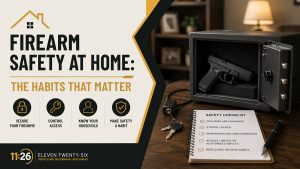
Safe storage instruction should address unauthorized access, transport, locking devices, and the condition in which a firearm is stored.
Live-fire qualifications, written-test scores, renewal periods, and accepted instructors vary by state, province, agency, and course purpose.
Online instruction can explain rules and law, but it cannot replace supervised hands-on evaluation where live-fire or practical training is required.
What Are Firearm Safety Course Topics?
The central firearm safety course topics are safe handling, mechanical familiarity, storage, transport, range conduct, legal duties, and supervised shooting fundamentals. Permit-oriented programs add concealed-carry law and use-of-force decision-making, while hunter education adds wildlife conservation, field behavior, and hunting regulations.
A safety course is education, not a substitute for reading the manufacturer’s manual or checking current government requirements. A student should learn the operating features of the specific firearm used in training, because controls, safeties, chamber indicators, loading procedures, and disassembly methods differ across models.
The National Rifle Association’s published safety rules include the direct instruction, “Always keep the gun pointed in a safe direction.” That rule is meaningful only when the course defines a safe direction for a particular room, range, vehicle, or outdoor setting.
A strong curriculum connects each rule to a decision. Students should know what to do when someone crosses the firing line, a firearm is dropped, a target is unclear, hearing protection fails, or a mechanical problem occurs.
How Is a Firearm Safety Course Structured?
Most firearm safety courses use four stages: classroom instruction, dry practice with an unloaded firearm or approved training aid, supervised live fire, and written or practical assessment. The sequence reduces complexity before ammunition is introduced and gives the instructor checkpoints for correcting unsafe behavior.
Stage 1: Classroom instruction
The classroom portion commonly covers:
- Universal safety rules and range commands
- Firearm parts, action types, and ammunition identification
- Loading, unloading, and clear-condition verification
- Safe storage, transport, and unauthorized-access prevention
- Eye and hearing protection
- Basic marksmanship concepts
- Local possession, purchase, carry, transport, and storage law
- Emergency procedures and range etiquette
Stage 2: Dry practice
Dry practice uses an unloaded firearm, an approved training firearm, or inert training ammunition such as snap caps. The instructor should control when firearms are handled, verify the environment, and establish a clear separation between live ammunition and dry-practice areas.
Dry practice is appropriate for learning grip, stance, sight alignment, loading motions with inert aids, and administrative handling. It is not a license to improvise manipulation drills at home without confirming the firearm is unloaded and following the manufacturer’s instructions.
Stage 3: Supervised live fire
The range phase normally begins with low-complexity tasks, such as handling at a bench and firing individual rounds under direct supervision. Later exercises may address recoil management, sight tracking, accuracy standards, and instructor-directed responses to simulated stoppages.
The exact drill sequence is not universal. A responsible instructor adapts the pace to the student’s experience, the firearm, the range rules, and the applicable qualification standard.
Stage 4: Assessment
Assessment may include a written test, a safe-handling demonstration, a live-fire qualification, or all three. A student can score well on paper and still need more supervised practice before independently handling a firearm.
Which Safety Rules Are Taught?
The four widely taught safety rules are: treat every firearm as loaded, keep the muzzle pointed in a safe direction, keep the trigger finger outside the trigger guard until ready to fire, and identify the target and what lies beyond it. Courses reinforce these rules through repeated handling decisions rather than memorization alone.
1. Treat every firearm as loaded
This rule establishes cautious behavior even when someone says a firearm is unloaded. Students learn to control the muzzle, avoid unnecessary handling, and verify the condition through the firearm’s prescribed procedure.
2. Control the muzzle
A safe direction depends on the environment. A ceiling, floor, berm, bullet-resistant backstop, or designated clearing area may be appropriate in one setting and unsafe in another because of construction, ricochet, or people beyond the surface.
3. Keep the finger indexed
The trigger finger remains straight and outside the trigger guard while moving, loading, unloading, holstering, clearing, or waiting. The finger enters the trigger area only when the sights are on an identified target and the decision to fire has been made.
4. Identify the target and background
A target is not safe merely because it is visible. Students should consider people, buildings, roads, neighboring lanes, hard surfaces, and the possibility of a missed shot or projectile passing through the target.
Which Course Type Fits Your Goal?
The best course type depends on the intended activity, firearm platform, legal purpose, and required credential. A basic handgun class suits a first-time owner, whereas a concealed-carry course must satisfy the relevant jurisdiction and should include decision-making beyond marksmanship.
| Course type | Main platform or purpose | Typical topics | Best starting point |
|---|---|---|---|
| Basic handgun | Semi-automatic pistol or revolver | Rules, parts, loading, grip, sights, storage | First-time handgun owner |
| Rifle or carbine | Bolt-action, lever-action, or semiautomatic rifle | Long-gun handling, position, backstop, transport | Sporting or recreational rifle user |
| Shotgun | Break-action, pump-action, or semiautomatic shotgun | Ammunition identification, safe carry, patterning, clay targets | Shotgun owner or hunter |
| Concealed carry | Permit or carry-authorization process | State law, defensive judgment, holster safety, post-incident duties | Applicant meeting local rules |
| Hunter education | Hunting activity and field conduct | Conservation, ethics, wildlife law, zones of fire, field safety | New or young hunter |
| Private instruction | Student-specific firearm and goals | Customized handling, confidence, accessibility, remediation | Anxious beginner or specialized learner |
Concealed-carry training
A carry course should explain where possession or carry is restricted, when force may be legally justified, the duty to avoid escalation where applicable, interaction with law enforcement, and the importance of legal counsel after a defensive incident. A shooting certificate alone cannot answer every fact-specific legal question.
Hunter education and general safety training
Hunter education is not identical to a general firearm course. Hunter education normally emphasizes conservation agencies, licensing, wildlife identification, hunting ethics, field carry, crossing obstacles, tree-stand risks, and zone-of-fire concepts. It may be mandatory for a hunting license in a particular jurisdiction.
What Mechanical Skills Are Covered?
Mechanical instruction usually covers identifying the action type, locating controls, checking the firearm’s condition, loading and unloading according to the manual, recognizing ammunition, and safely responding when the firearm does not operate as expected. Model-specific instruction matters more than memorizing generic terminology.
| Skill area | Student should demonstrate | Instructor checkpoint |
|---|---|---|
| Condition check | Verify unloaded status using the model’s prescribed method | Muzzle remains controlled throughout |
| Ammunition identification | Match approved cartridge or shell to the firearm | Incorrect or damaged ammunition is rejected |
| Loading and unloading | Follow the manual and range procedure | Finger stays indexed until appropriate |
| Safety controls | Identify the safety, magazine release, action, and chamber indicator | Student avoids assuming all controls work alike |
| Storage preparation | Apply a lock or secure the firearm as directed | Unauthorized access is prevented |
| Field or range stoppage | Stop, keep the muzzle safe, and request guidance | Student does not rush or improvise |
Courses should distinguish a firearm’s “safe” status from an unloaded status. A mechanical safety is a device, not a replacement for muzzle control, trigger discipline, or checking the chamber.
What Happens on the Range?
A supervised range session commonly begins with a safety briefing, equipment inspection, lane assignment, and explanation of commands before the student handles live ammunition. Typical basic courses use approximately 50-100 rounds, but the number depends on the curriculum, qualification, firearm, and local rules.
Students may practice one round at a time before progressing to small groups of rounds. The emphasis should remain on safe loading, stable handling, sight alignment, controlled trigger operation, follow-through, and stopping immediately when the range officer gives a cease-fire command.
A range officer or instructor should explain the local response to a suspected malfunction. The safest universal response is to keep the muzzle pointed in a safe direction, keep the finger outside the trigger guard, stop handling, and notify the instructor. A memorized clearance sequence is not a substitute for supervision, especially when the cause is unknown.
Range equipment and protective measures
Required equipment often includes eye protection, hearing protection, appropriate ammunition, a firearm in approved condition, targets, and a method of securing the firearm during transport. Some ranges require a chamber flag or specific case, while others provide rentals and protective equipment.
Students should report pain, ringing ears, dizziness, loss of concentration, or fear that prevents safe handling. Continuing because a class has a fixed schedule creates more risk than taking a supervised break.
How Are Students Assessed?
Written tests commonly measure safety rules, legal terminology, storage duties, and range commands, while practical assessments measure safe handling and, where required, accuracy. A 70%-80% written threshold and a qualification such as 14 of 20 rounds on a specified target are examples, not universal standards.
| Assessment component | Typical example | What changes by jurisdiction |
|---|---|---|
| Written test | 70%-80% passing score | Number of questions and retake policy |
| Safe-handling test | Demonstrate loading and unloading | Firearm type and instructor checklist |
| Live-fire qualification | 50-100 rounds in a defined course of fire | Distance, target, time, and score |
| Attendance requirement | 4-16 instructional hours | Permit agency and course category |
| Certificate | Issued after required components | Accepted instructor and expiration date |
A certificate proves completion of a particular course under stated conditions. It does not prove advanced proficiency, guarantee permit approval, or establish that the student can safely manage every firearm platform.
How Long Does Training Take?
A basic course commonly takes 4-8 hours, while a multi-state or permit-focused program may take 8-16 hours or more. Private instruction may be divided into 60-120-minute sessions, which helps beginners who need more time to process new controls and range commands.
Course duration should be judged against required content, not the shortest advertised schedule. A two-hour class may be suitable for a narrow orientation, but it may not provide sufficient time for legal instruction, dry practice, live-fire evaluation, storage planning, and individual correction.
How Much Does Training Cost?
Typical firearm safety course fees range from $75-$250, excluding some combinations of ammunition, firearm rental, eye and hearing protection, range fees, permit applications, and optional private lessons. Local government requirements and the instructor’s credentials can change the total substantially.
| Cost item | Typical range | Common price driver |
|---|---|---|
| Basic classroom course | $75-$150 | 4-8 hours and included materials |
| Permit-oriented course | $100-$250 | Legal instruction and qualification |
| Private lesson | $60-$150 per hour | Instructor experience and customization |
| Ammunition | $25-$100 per class | Caliber, quantity, and local supply |
| Firearm rental | $15-$40 per session | Platform and range policy |
| Permit application | $25-$150 | State, county, fingerprint, and background-check fees |
Ask for the complete price before booking. A low course fee may exclude the range, target, ammunition, rental, certificate, or required administrative charge.
Which Training Format Is Best?
In-person instruction is the strongest general choice for a beginner because an instructor can observe muzzle direction, trigger-finger position, grip, loading, and responses to commands. Hybrid training can reduce classroom time, but online-only instruction cannot provide a supervised hands-on evaluation.
| Format | Typical time | Typical price | Strength | Limitation |
|---|---|---|---|---|
| In-person group | 4-8 hours | $75-$250 | Immediate handling correction | Fixed schedule and mixed skill levels |
| Hybrid online plus range | 2-6 online hours plus range | $75-$225 | Flexible theory study | Practical work remains location-dependent |
| Private one-on-one | 1-2 hours per session | $60-$150 per hour | Customized pace and firearm | Higher total cost |
| Online-only | 1-6 hours | $25-$150 | Convenient legal or theory overview | Usually insufficient for live-fire credentials |
Online content is useful for terminology, law overviews, and preparation. Students should confirm that the issuing agency accepts an online certificate before relying on it for a permit application.
How Should You Prepare for Class?
Prepare by confirming the legal requirement, reading the firearm manual, bringing identification and required equipment, and arriving rested enough to follow commands accurately. Do not bring a loaded firearm into a classroom or range unless the facility has given explicit transport and arrival instructions.
Use this preparation checklist:
- Confirm the instructor is accepted by the relevant state, provincial, or local agency.
- Ask whether the course includes range fees, ammunition, rental equipment, and a certificate.
- Bring government identification, prescription glasses, and weather-appropriate clothing.
- Use fitted eye and hearing protection that meets the range’s requirements.
- Wear closed-toe shoes and clothing that does not interfere with safe handling.
- Tell the instructor about limited mobility, hearing loss, vision needs, anxiety, or prior experience.
- Keep personal ammunition and firearms secured during transport and follow facility policy.
An instructor should provide a clear answer about where a firearm may be unloaded, cased, or stored on arrival. If the answer is vague, contact the facility before traveling.
What Storage and Transport Topics Should a Complete Course Include?
A complete course teaches that storage and transport must prevent unauthorized access, comply with local law, and suit the household’s risks. The correct setup differs for a home with children, a vehicle, shared housing, frequent travel, or a person who needs rapid access for a lawful purpose.
Students should compare locked containers, cable or chamber locks, separate ammunition storage, vehicle restrictions, and the possibility that a key, code, or biometric credential may be accessible to another person. A lock does not make unsafe placement acceptable.
Transport instruction should address unloading, casing, vehicle storage, travel routes, prohibited locations, and local or interstate requirements. Laws can change, and federal, state, tribal, provincial, and municipal rules may overlap, so official government sources should control the final decision.
What Mistakes Need Correction?
The most common student errors are trigger-finger placement, muzzle sweeping, failure to identify the backstop, rushing a stoppage, and continuing after losing concentration. Instructors should correct the behavior immediately and explain the hazard, rather than treating a near miss as harmless.
Trigger-finger error
Students often place the finger inside the trigger guard while moving or manipulating controls. The correction is deliberate index-finger placement on the frame or receiver until the firing decision and sight picture are established.
Muzzle sweeping
Turning with a firearm to ask a question can point the muzzle at another person. The student should stop, keep the firearm pointed toward the safe direction, and move only under the range’s handling rules.
Anticipating recoil
Flinching or pushing the firearm downward before discharge can reduce accuracy and increase fatigue. Lowering the pace, using an appropriate training firearm, and receiving individualized coaching are safer remedies than simply firing more rounds.
Suspected malfunction
Failure to feed, failure to eject, or an unusual sound requires a safe stop and instructor notification. “Tap, rack, bang” is not a universal response for every firearm or situation, and students should not apply a memorized sequence without the instructor’s direction.
How Do You Vet a Firearm Safety Instructor?
Choose an instructor who can document current credentials, accepted status for the required permit or agency, liability coverage, range authorization, emergency procedures, and a written curriculum. A professional course explains its limits instead of promising that one class will make a student proficient.
Check these points before payment:
- Credential name, issuing organization, and expiration date
- Government or agency acceptance for the intended application
- Student-to-instructor ratio during live fire
- Firearm and ammunition rules
- Written refund, cancellation, and retake policies
- Accessibility accommodations
- Medical kit, emergency plan, and range cease-fire procedures
- Whether legal instruction is taught by a qualified person and updated for current law
A large class can be affordable but provide less individual correction. Private instruction costs more, yet it may be the better choice for a beginner who cannot safely keep pace with a group.
Which Course Should Each Student Choose?
A first-time owner should begin with a basic platform-specific safety course before taking a defensive or advanced marksmanship class. A person seeking a carry permit should choose the government-accepted course first, then add scenario-based judgment training after meeting the legal minimum.
| Student situation | First course | Useful next step | Avoid as a first choice |
|---|---|---|---|
| First-time handgun owner | Basic handgun, 4-8 hours | Private coaching and storage review | Advanced defensive course |
| Hunting beginner | Approved hunter education | Rifle or shotgun field session | Carry course unrelated to hunting |
| Permit applicant | Accepted CCW course | Legal update and supervised practice | Non-accepted online certificate |
| Household with children | Storage-focused safety class | Lockbox and access audit | Unsecured quick-access setup |
| Older or disabled student | Accessible private lesson | Adapted equipment evaluation | Fixed-pace group class |
| Experienced owner changing platforms | Platform-specific orientation | Supervised live-fire practice | Assuming controls are identical |
A home-defense course should include prevention, secure storage, emergency communication, identification, legal decision-making, and household planning. It should not present a firearm as a substitute for locks, lighting, an alarm, a safe-room plan, or emergency medical preparation.
What Should You Practice After the Course?
Practice the specific skills the instructor evaluated: safe handling, condition checks, loading and unloading, sight alignment, trigger-finger discipline, range commands, storage, and transport procedures. Short, supervised sessions are preferable to infrequent sessions that encourage rushing.
Keep a training record with the date, firearm platform, ammunition type, skills practiced, instructor feedback, and any equipment problem. Return for refresher instruction after a long break, a major equipment change, a stressful incident, or any period in which safe handling feels uncertain.
Expert practice insights
- The safest student is not the fastest student. Speed adds little value when the student is still missing commands, losing muzzle control, or forgetting the firearm’s condition.
- Platform familiarity transfers imperfectly. A student comfortable with one handgun may still mishandle a revolver, rifle, shotgun, or different control layout.
- More ammunition cannot fix a safety problem. If the error is poor decision-making or unsafe handling, additional repetitions reinforce the wrong behavior.
- Storage is part of proficiency. A student who handles a firearm safely at a range but leaves it accessible at home has not completed the safety task.
Frequently Asked Questions
Is a firearm safety course required before buying a firearm?
A firearm safety course is not universally required before purchase, but some jurisdictions impose training, permit, waiting-period, or background-check requirements. Purchase rules and carry rules are separate questions. Check the current requirements from the relevant state, provincial, county, or local government before paying for a course.
Can children attend firearm safety training?
Children can attend age-appropriate hunter education or supervised safety programs where the instructor, parent, and law permit participation. Instruction should emphasize avoiding unauthorized handling, immediately notifying an adult, and never relying on a child’s memory instead of secure storage.
Does a safety certificate expire?
A safety certificate may be lifetime, time-limited, or accepted only for a particular application. Hunter education is often treated as lifetime certification, while carry-training documentation may be subject to renewal rules that commonly fall within 3-5 years. The issuing agency’s current rule controls.
Do I need to bring my own firearm?
Many ranges offer rentals, and some introductory courses provide training firearms, but policies differ. Renting can help a beginner compare platforms, yet the student should eventually receive instruction on the specific firearm they will store, transport, or use.
Is a concealed-carry class the same as a basic safety class?
A concealed-carry class is not the same as a basic safety class. Carry training adds jurisdiction-specific law, eligibility, prohibited locations, defensive-force decisions, interaction with law enforcement, and post-incident responsibilities. A basic class may not satisfy a permit agency.
What should I do if I feel unsafe during class?
Keep the muzzle in the designated safe direction, keep the finger outside the trigger guard, stop handling, and notify the instructor or range officer. Students may request a pause or leave the range. A competent instructor treats a safety concern as a reason to slow down, not as a challenge to overcome.
The Bottom Line
The most important firearm safety course topics are universal safety rules, safe mechanical handling, storage, transport, range procedures, legal responsibilities, and supervised evaluation. Select training by purpose, platform, jurisdiction, instructor credentials, and practical access to feedback. A certificate marks course completion; regular, careful practice and secure storage determine whether the training remains useful. Choose the course that matches your actual goal, then verify every legal requirement with the responsible government agency.