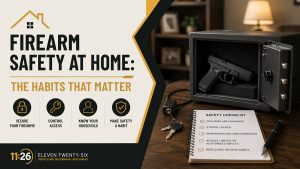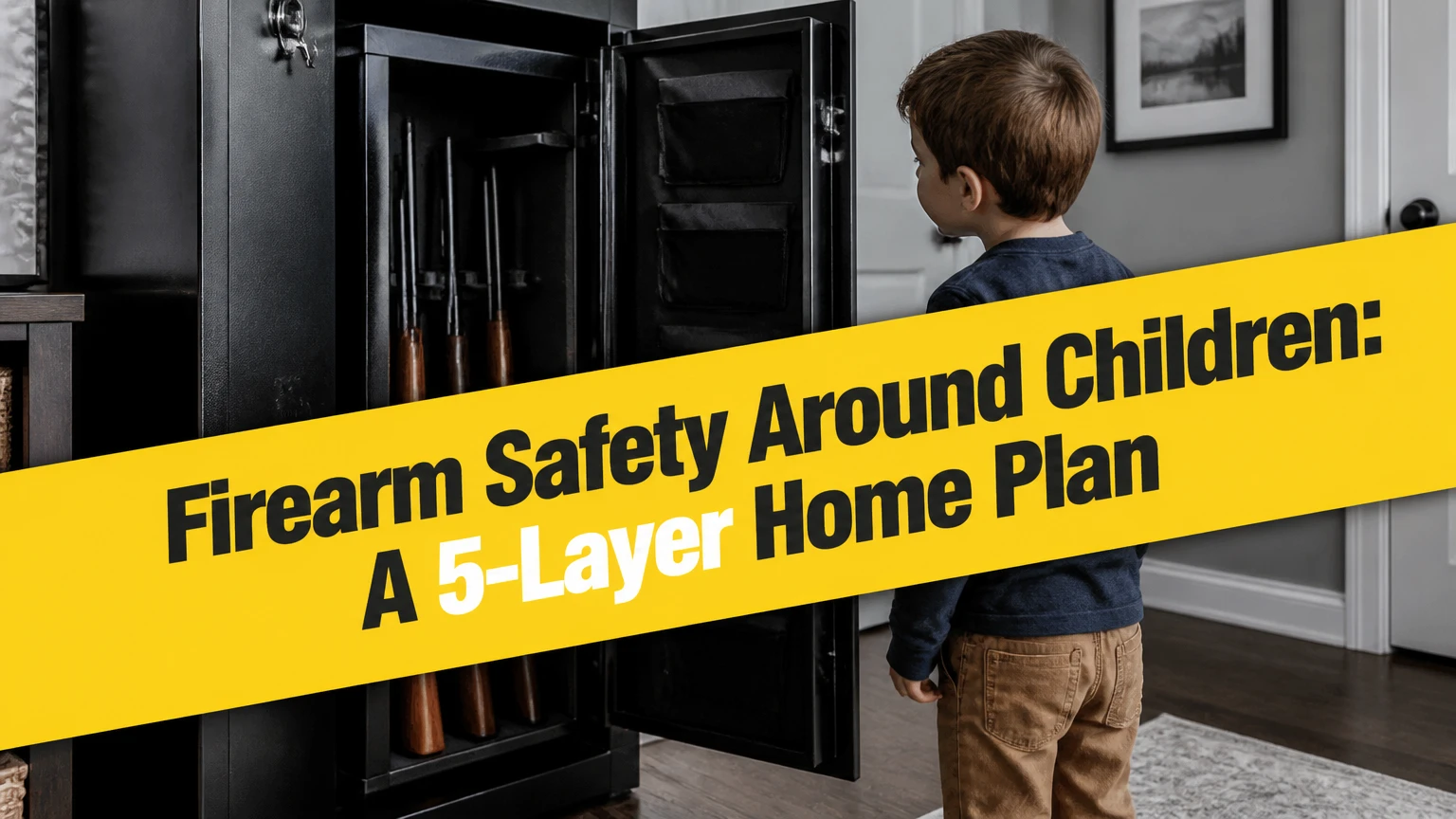
Firearm safety around children requires preventing every unauthorized access path through unloaded storage, a locked container, restricted keys or codes, separate ammunition control, and consistent adult behavior. Education helps children respond safely if they encounter a firearm, but only locked physical storage reliably prevents access when curiosity, peer pressure, or a crisis overrides instructions.
Key facts at a glance
The safest firearm is unloaded, locked in a locked container, and inaccessible to children.
A locked container provides the primary barrier; a cable or chamber lock adds secondary protection.
Ammunition is best stored separately in a locked container, with access limited to authorized adults.
A child who finds a firearm should not touch it, should leave the area, and should tell a trusted adult.
A hidden firearm is not secure storage because children can climb, search, imitate adults, or invite friends.
Storage systems require testing after battery changes, moves, new visitors, and household risk changes.
What does firearm safety around children mean?
Firearm safety around children is a layered system that prevents a child from locating, reaching, handling, or firing a firearm. The system combines physical storage, mechanical security, ammunition control, adult access rules, supervision, and age-appropriate emergency instruction.
The American Academy of Pediatrics states, “The safest home for a child is one without a gun.” When a firearm is present, the American Academy of Pediatrics recommends storing it unloaded and locked, with ammunition locked separately. The recommendation addresses the most controllable risk: unauthorized access.
Firearm injuries can be unintentional, self-inflicted, or inflicted on another person. The Centers for Disease Control and Prevention identifies firearms as a leading cause of death among U.S. children and adolescents, although the exact ranking varies by age group and year. Secure storage reduces opportunity across these injury pathways without relying on a child’s judgment.
How does the defense-in-depth model work?
A defense-in-depth model uses independent barriers, so one failure does not expose an operable firearm. A practical sequence is:
- Behavioral barrier: adults never leave a firearm unattended.
- Condition barrier: the firearm is unloaded when immediate access is not required.
- Mechanical barrier: a chamber, cable, or other manufacturer-approved lock prevents operation.
- Container barrier: the firearm sits inside a locked safe or lockbox.
- Access barrier: keys, combinations, override codes, and biometric enrollment remain limited to authorized adults.
No single layer is absolute. A cable lock can be cut, a code can be observed, and an electronic safe can lose power. Combining barriers reduces the chance that a child, visitor, thief, or distressed household member reaches a usable firearm.
How should firearms be stored in a home with children?
Store each firearm unloaded, secured inside a locked container that children cannot move or open, and inaccessible to unauthorized adults. Keep ammunition locked separately whenever practical, control every key and code, and anchor larger safes according to the manufacturer’s instructions.
Begin with every firearm, including inherited guns, antiques, firearms kept for hunting, and a handgun temporarily brought home. A firearm stored “only for tonight” can become a permanent hazard when routines change.
Same-day safety reset
Complete these actions before comparing products:
- Remove all firearms from casual locations. Check nightstands, closets, vehicles, backpacks, bedside boxes, and unlocked cases.
- Unload each firearm safely. Point the firearm in a safe direction, keep the finger outside the trigger guard, remove the ammunition source, open the action, and visually and physically verify the chamber according to the manufacturer’s instructions.
- Place firearms in locked storage. Use a lockbox or safe immediately, even if the permanent setup is not finished.
- Secure ammunition separately. Use a second locked container or a separately locked compartment that children cannot access.
- Control access credentials. Do not leave keys in a drawer, attach them to a child-accessible key ring, or write a combination beside the safe.
- Check other adults’ firearms. Ask household members, roommates, and frequent visitors to follow the same standard.
A free cable lock can provide temporary protection, but it is not a substitute for a theft-resistant safe. Do not assume that a cable lock keeps every firearm unloaded or prevents all forms of manipulation.
Seven-day setup plan
During the first week, inventory the number and type of firearms, identify every person who might access the home, and choose storage based on the highest household risk rather than the average day. Anchor a safe when its weight, design, or manufacturer instructions require anchoring.
Record the firearm’s make, model, and serial number in a secure location separate from the firearm. A private inventory assists with insurance and law-enforcement reporting if the firearm is lost or stolen. Do not publish serial numbers online.
Which firearm storage device is appropriate?
A locked container is the primary storage device for a home with children. Cable locks and trigger locks are inexpensive secondary barriers, while a portable lockbox suits one handgun and a full-size safe suits multiple firearms; no device is appropriate if authorized adults cannot operate and maintain it reliably.
| Device | Typical cost | Typical access | Main protection | Important limitation |
|---|---|---|---|---|
| Cable lock | $0-$20 | 10-30 seconds | Blocks action or secures firearm to an object | Usually weak against cutting and does not resist theft |
| Trigger lock | $10-$30 | 10-30 seconds | Covers or blocks trigger access | Must follow manufacturer instructions and should not be installed on a loaded firearm |
| Portable lockbox | $30-$150 | 5-20 seconds | Encloses one handgun or small firearm | Cable attachment may resist opportunistic theft, not determined attack |
| Mechanical push-button box | $80-$250 | 3-15 seconds | No battery-dependent keypad | Code privacy and anchoring still matter |
| Electronic or biometric safe | $100-$400 | 2-15 seconds | Fast authorized access in a closed container | Batteries, sensors, codes, and override keys can fail |
| Full-size firearm safe | $400-$3,000 or more | 10 seconds to several minutes | Multiple firearms, theft delay, organized storage | High cost, weight, installation needs, and slower emergency access |
Prices are typical U.S. retail ranges, not guarantees. A product’s security depends on steel thickness, lock design, pry resistance, mounting, placement, and the attacker’s time and tools. “Biometric” describes an access method, not a universal security rating.
What are the main trade-offs?
| Household need | Preferred configuration | Why it fits | What it is not good for |
|---|---|---|---|
| One handgun and young children | Anchored mechanical or electronic lockbox | Restricts child access while keeping one authorized opening method | It does not protect a large collection |
| Several rifles and handguns | Anchored full-size safe | Centralizes inventory and limits access to multiple firearms | It may be too slow for immediate defensive access |
| Renter with drilling limits | Heavy portable lockbox plus secured cable | Adds containment without permanent installation | A cable is not equivalent to a bolted safe |
| Frequent vehicle transport | Locked travel container attached to a fixed structure | Reduces movement during a theft or crash | A locked vehicle is not a secure unattended storage plan |
| Household with electronic reliability concerns | Mechanical combination lockbox | Avoids batteries and fingerprint-reading failures | It can be slower when gloves, darkness, or stress affect entry |
Practitioner rule: choose the least complicated system that every authorized adult can open correctly in darkness, after a move, and after a long period without practice. A theoretically strong safe that remains open because users avoid it creates no effective barrier.
Are trigger locks safe for every firearm?
Trigger locks are not universal safety devices. Some models can be installed incorrectly, interfere with a firearm’s controls, or create dangerous handling during installation; follow the firearm and lock manufacturers’ instructions, and never place a trigger lock on a loaded firearm unless the manufacturer explicitly provides a safe procedure.
A chamber lock, cable lock, or lockbox may fit a particular firearm better. The lock must not allow access to the trigger, muzzle, or action in a way that permits firing. A lock is also not a substitute for unloading and container storage.
Should ammunition be stored separately?
Separate locked ammunition storage adds a meaningful access barrier because a firearm cannot discharge without compatible ammunition. The strongest household arrangement places unloaded firearms in one locked container and ammunition in another locked container, with different access controls when feasible.
Separation is not a replacement for firearm storage. A child who can access a loaded magazine, loose cartridges, or ammunition in a range bag may still create a dangerous situation. Count magazines, speedloaders, loose rounds, and ammunition kept in vehicles or bedside containers during the inventory.
State and local laws vary. Some jurisdictions require locked storage, specific container types, or separate ammunition storage, while others impose requirements after a child gains access. Check the current law where the firearm is stored and follow the manufacturer’s instructions.
What should children do if they find a firearm?
Children should stop, avoid touching the firearm, leave the area, and tell a trusted adult immediately. The rule should apply at home, in a friend’s home, in a vehicle, and when the firearm appears unloaded, broken, or toy-like.
Use simple language that a child can repeat under stress:
- “Do not touch it.”
- “Move away.”
- “Tell an adult.”
- “If no trusted adult is available, call emergency services.”
Age-appropriate instruction is useful, but it cannot replace locked storage. A 2004 study in JAMA found that children who received firearm-safety training still handled firearms when they encountered them, demonstrating why education alone is an inadequate control. Do not test children with a real firearm, a disabled firearm, or a realistic replica. Ask them to explain the rule verbally and rehearse leaving the room without placing a prop in front of them.
For older children and teenagers, add rules about friends, social media, and crisis situations. They should never handle a firearm to impress a friend, retrieve one for another person, or keep knowledge of an unsecured gun secret.
How do household risk and age change the plan?
The storage standard should become stricter when children become mobile, friends visit, adolescents experience a mental-health crisis, an adult uses intoxicating medication or substances, or household conflict escalates. Age does not create a point at which unsecured firearms become safe.
| Situation | Immediate adjustment | Reason |
|---|---|---|
| Crawling or climbing child | Lock every firearm and ammunition container; remove keys from reachable areas | Mobility and exploration increase unexpectedly |
| School-age child with friends | Ask every visiting household about locked firearms | Parents cannot infer another home’s storage practice |
| Teen with depression or suicidal thoughts | Prevent access immediately and involve a clinician or emergency service | Suicide risk can change faster than storage routines |
| Adult impairment or sedating medication | Transfer access control to a sober, trusted adult | Judgment and coordination may be impaired |
| New roommate or partner | Review storage, keys, codes, and firearm inventory | An unfamiliar adult may know where children search |
| Separation, divorce, or domestic conflict | Move firearms outside the home or use legally compliant secure storage | Threat patterns and access permissions can change rapidly |
If a child or adult may be at immediate risk of self-harm or violence, do not confront the person over a firearm while holding or approaching it. Leave danger, call emergency services, and follow local crisis guidance. In the United States, call or text 988 for mental-health crisis support, or call 911 when there is immediate danger.
What should parents ask visitors and caregivers?
Ask caregivers directly whether firearms are present and whether every firearm is unloaded and locked, rather than relying on a general statement that guns are “out of reach.” The same question should cover grandparents, babysitters, playdates, relatives, and short-term houseguests.
A useful script is: “Are there firearms where my child will be staying, and are they unloaded and locked in a container that children cannot access?” A responsible answer should describe locked storage, not a hiding place or a verbal warning.
When visitors bring a firearm into your home, agree in advance on storage. The firearm should not remain in a purse, backpack, bedside drawer, vehicle, or coat pocket where a child can reach it. If the visitor cannot secure it, change the visit arrangement.
How often should firearm storage be checked?
Check access control monthly and perform a complete household audit at least quarterly, with an additional check after travel, relocation, repairs, a new child visitor, a safe battery change, or a change in household risk. Maintenance prevents small failures from becoming access opportunities.
| Check | Typical interval | Verify |
|---|---|---|
| Container locked | Every time the firearm is stored | Lid, bolts, latch, and lock fully engage |
| Battery and keypad | Monthly | Battery status, code function, and backup method |
| Firearm inventory | Quarterly | Count, serial numbers, location, and authorized users |
| Safe anchoring | Every six months | Bolts, floor or wall attachment, and structural integrity |
| Child and visitor review | At each new arrangement | Rules, caregiver storage, and access boundaries |
| Full emergency-access practice | Quarterly | Authorized adult can open the safe without leaving it unsecured |
For biometric safes, enroll more than one authorized finger only when the manufacturer permits it, test several angles, keep the sensor clean, and retain a secure backup method. Never store the override key beside the safe. For electronic safes, replace batteries on the manufacturer’s schedule rather than waiting for a low-power warning.
A safe that emits a loud confirmation tone may reveal its location, but disabling sound is not always possible or advisable. Follow the product manual rather than guessing at programming sequences.
What are the most common storage mistakes?
The most common errors involve relying on concealment, education, or a single lock instead of controlling the entire access chain. Correcting the storage system means securing the firearm, ammunition, credentials, and backup access method together.
- High shelf storage: Children climb, use furniture, and observe adult routines. Move the firearm into a locked container.
- Loaded nightstand storage: A drawer is not a child-resistant barrier. Unload and lock the firearm, or use a properly secured quick-access container if the household has made a deliberate risk decision.
- Keys near the safe: Children search predictable locations. Store keys and codes under adult control in a separate location.
- Open range bags: Ammunition, magazines, and firearms may remain together after a trip. Empty and secure every bag immediately.
- Unanchored heavy safe: A thief can remove a safe that is not secured. Anchor it as directed to suitable structural material.
- Unverified storage after visitors: A borrowed firearm or guest’s handgun may bypass normal routines. Include temporary firearms in every check.
- Testing with realistic props: Practice can encourage handling or create confusion. Teach the response verbally and through age-appropriate discussion.
- Assuming an unloaded firearm is harmless: Mechanical failure, user error, or an unseen cartridge can defeat assumptions. Treat every firearm as loaded until verified safely.
Expert insight: the weakest point is often not the safe. It is the credential pathway, such as a visible code, a key in a common drawer, or a child watching an adult open the container.
What should you do if a child finds a firearm?
If a child reports a firearm, keep the child away from it and have an authorized, competent adult secure the scene without unnecessary handling. If anyone has touched, moved, or discharged the firearm, treat the situation as an emergency and call 911.
Ask the child where the firearm is and whether anyone touched it. Do not punish the child for reporting. A calm response increases the chance that children will disclose future discoveries quickly.
If the firearm is unsecured but no immediate threat exists, keep people out of the area, do not manipulate the trigger or action, and contact law enforcement or another qualified local authority for guidance. If the firearm is in a public place, vehicle, school, or location where another person may reach it, call emergency services immediately.
If a firearm is missing, do not search alone while assuming it was misplaced. Confirm the inventory, identify the last known location, notify law enforcement promptly, and provide the make, model, caliber, and serial number if available. Delayed reporting can complicate recovery and investigation.
How should renters and travelers secure firearms?
Renters should use a portable lockbox that resists prying and attach its security cable only to a genuine structural anchor approved for that purpose. Travelers should follow federal, state, airline, hotel, and local rules, keeping the firearm unloaded and secured during transport.
A vehicle glove compartment is not dependable child-resistant storage. A locked case secured to an immovable structure is stronger, but no vehicle is a suitable long-term unattended firearm locker. Remove the firearm when the vehicle is parked for extended periods and comply with local transport laws.
For hotel stays, ask management about a secure storage option and keep the firearm under the traveler’s exclusive control. Do not leave a portable case where children, housekeeping staff, or other guests can access it.
How much does a safer setup cost?
A basic temporary setup may cost $0-$30, a reliable single-handgun lockbox commonly costs $50-$250, and a multi-firearm safe typically costs $400-$3,000 or more. Installation, anchoring hardware, replacement batteries, and separate ammunition storage can add $25-$300.
| Setup | Typical equipment | Typical total cost | Suitable use |
|---|---|---|---|
| Temporary first day | Free cable lock plus existing locked container | $0-$30 | Immediate risk reduction |
| Single handgun | Lockbox, cable or anchor, ammunition container | $75-$350 | One firearm in an apartment or small home |
| Family collection | Full-size safe, anchor hardware, ammunition container | $500-$3,500 | Multiple long guns and handguns |
| Frequent traveler | Lockable travel case and hardened cable | $50-$250 | Transport and short stays |
| Electronic quick-access setup | Safe, batteries, secondary lockbox | $150-$500 | Authorized rapid access with backup control |
Cost should follow risk. A cheap locked container used consistently is safer than an expensive safe that remains open, but a thin portable box may not deter a determined thief.
FAQ
Is hiding a firearm enough when children are young?
No. Hiding prevents accidental discovery only when the hiding place remains unknown, and children can search, climb, imitate adults, or invite friends. Store the firearm unloaded inside a locked container, secure ammunition separately, and keep keys, codes, and override keys outside children’s access.
Should a home-defense firearm be stored loaded?
A loaded firearm creates faster access but increases the consequence of unauthorized access, so the decision requires a locked quick-access container, reliable training, legal compliance, and an honest assessment of household risk. If those controls are unavailable, unloaded locked storage is the safer choice.
Are smart or biometric safes safer than combination safes?
Neither access method is automatically safer. Biometric safes can open quickly but may fail because of power, sensor, or finger-position problems; mechanical safes avoid batteries but require code memory and disciplined privacy. Test the chosen safe regularly and maintain a secure backup method.
What is the safest way to discuss guns with a child?
Use clear rules without presenting a firearm for handling: do not touch it, move away, and tell a trusted adult. Explain that the rule applies even if a gun looks broken or unloaded, then confirm understanding with questions rather than a surprise test.
Can ammunition stay in the same safe as the firearm?
Ammunition can be stored in the same locked safe where law and manufacturer guidance permit, but separate locked storage adds another access barrier. Keep ammunition, magazines, and loose cartridges out of children’s reach and include them in the household inventory.
What should I do before a child visits another home?
Ask the caregiver whether firearms are present and whether every firearm is unloaded and locked in a container inaccessible to children. If the answer is unclear or unsatisfactory, host the children at your home or choose another supervised activity.
The Bottom Line
Firearm safety around children is effective when physical barriers carry the responsibility that children cannot reliably carry. Unload firearms, lock them inside a suitable container, secure ammunition and credentials, review every visitor and household change, and teach children to leave and report a firearm without touching it. Perform the setup today, then verify it monthly.