Firearm safety rules for beginners are a layered system for preventing negligent discharges, injuries, and unauthorized access. Treat every firearm as loaded, keep the muzzle pointed in a safe direction, keep your finger outside the trigger guard, and identify the target and its surroundings before handling or firing.
Key Facts at a Glance
- The four universal firearm safety rules apply whether the firearm is a handgun, rifle, shotgun, loaded, unloaded, familiar, or unfamiliar.
- A manual safety is only one mechanical control and never replaces muzzle awareness, trigger discipline, or target identification.
- A safe direction requires a reliable backstop that can stop the projectile without endangering people or damaging property.
- Beginners should wear eye protection on every active range and hearing protection whenever firearms are being discharged nearby.
- Secure storage must prevent access by children, unauthorized adults, and thieves; hiding a firearm is not a storage method.
- When a firearm’s condition, direction, or operation is uncertain, stop handling it and ask a qualified instructor or range officer for help.
What Are the Four Firearm Safety Rules?
The four firearm safety rules are universal handling principles: treat every firearm as loaded, never point it at anything you are unwilling to destroy, keep your finger outside the trigger guard until ready to fire, and know the target, foreground, and background. The rules overlap deliberately, creating several barriers against one mistake.
The National Rifle Association’s commonly published first rule is, “Always keep the gun pointed in a safe direction.” Wording varies among organizations, but the operating principles remain consistent. A responsible owner applies all four rules simultaneously rather than selecting the one that seems most convenient.
Rule 1: Treat Every Firearm as Loaded
Assume a firearm can fire until you personally verify its condition using the manufacturer’s instructions. Do not rely on another person’s statement, an open-looking action, an empty magazine, or the position of a safety lever.
When receiving an unfamiliar firearm, keep the muzzle in a safe direction and ask the owner or instructor to demonstrate the specific unloading procedure. Firearm designs differ. A detachable magazine may be empty while a cartridge remains in the chamber, and a revolver requires inspection of every chamber.
Rule 2: Control the Muzzle Direction
Keep the muzzle pointed toward a direction where an unintentional discharge would cause the least possible harm. On a supervised range, that usually means downrange toward the approved backstop; at home, there may be no universally safe direction because walls, floors, and ceilings may not stop a projectile.
Muzzle control must continue while picking up, carrying, loading, unloading, casing, uncasing, or setting down a firearm. Turn your body and move your feet instead of sweeping the muzzle across another person. A useful mental model is an invisible beam extending from the muzzle.
Rule 3: Keep the Finger Outside the Trigger Guard
Place the trigger finger straight along the frame or receiver until the sights are aligned with an identified target and you have consciously decided to fire. The trigger guard is not a finger rest, and touching the trigger during movement removes one important layer of protection.
Startle reactions, loss of balance, sympathetic gripping, and unexpected contact with clothing or equipment can move a finger faster than conscious thought. Trigger discipline therefore matters most during transitions, loading, unloading, holstering, passing a firearm, and responding to a distraction.
Rule 4: Identify the Target and What Surrounds It
Confirm the target, what lies between you and the target, and what lies beyond it before every shot. Cardboard targets do not stop bullets, and common residential materials such as drywall, doors, wood fencing, and thin metal can be penetrated.
The background can change after a person enters the area, a vehicle moves, light fades, or a target shifts. Stop shooting whenever you cannot positively identify the target or the backstop. “I thought the area was clear” is not an adequate identification standard.
How Should a Beginner Verify a Firearm Is Unloaded?
A beginner should verify an unloaded firearm with the muzzle in a safe direction, the ammunition source removed, the action open, and the chamber and magazine area inspected according to the firearm’s manual. Visual inspection is essential, but lighting and angle can hide ammunition, so an instructor may also demonstrate a physical chamber check.
Use this general sequence only as a safety framework, not as a substitute for the manufacturer’s instructions:
- Keep the muzzle directed toward the approved safe direction.
- Keep your finger straight and outside the trigger guard.
- Engage the manual safety if the firearm has one and the manual directs you to do so.
- Remove the ammunition source, such as the magazine or shells in an accessible carrier.
- Open the action, cylinder, or breech using the firearm-specific procedure.
- Lock the action open when the design permits it.
- Inspect the chamber, action, magazine well, and cylinder chambers.
- Ask a qualified instructor to confirm the condition if anything is unclear.
A magazine is an ammunition source, not the chamber. Removing it does not prove the firearm is unloaded. Semi-automatic pistols, rifles, shotguns, revolvers, and lever-action firearms each have different unloading details, so beginners should read the owner’s manual before handling a new model.
What Does a Mechanical Safety Actually Do?
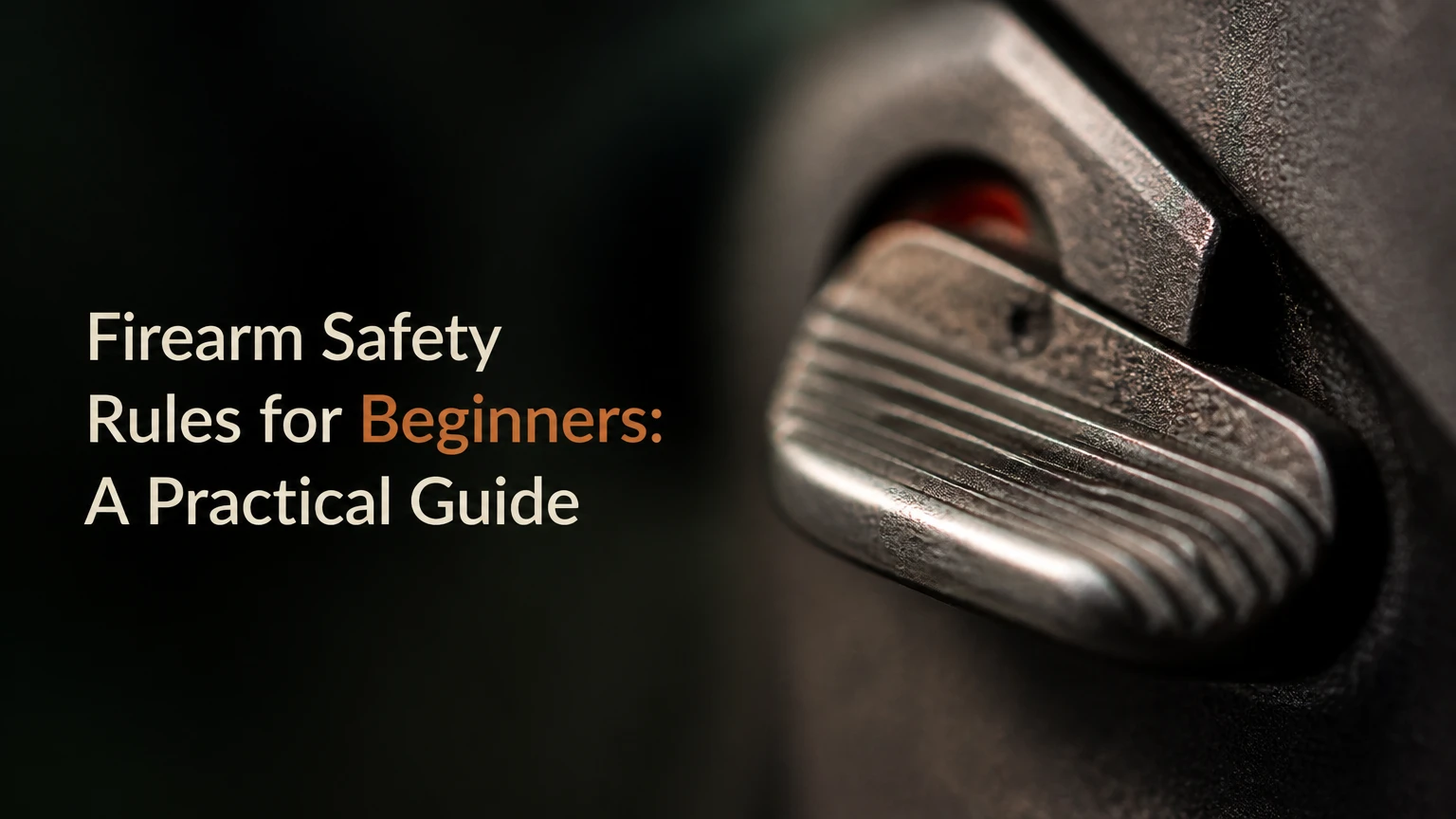
A mechanical safety blocks or restricts part of the firing system, but it does not control muzzle direction, ammunition status, target identification, or a person’s finger. A firearm with its safety engaged must still be treated as capable of firing.
| Safety mechanism | Typical function | Prevents or reduces | Does not prevent |
|---|---|---|---|
| Manual safety | Blocks trigger, sear, or firing mechanism | Some trigger movement or firing conditions | Unsafe muzzle direction, wrong target, poor storage |
| Grip safety | Requires grip pressure on a rear lever | Firing when the grip is not properly held | Trigger contact after the grip safety is depressed |
| Trigger safety | Integrates a lever into the trigger face | Some lateral or drop-related trigger movement | Objects entering the trigger guard |
| Firing-pin block | Blocks firing-pin travel until a condition is met | Some drop discharges | Negligent handling or ammunition mistakes |
| Drop safety | Uses internal geometry to resist impact firing | Certain impact-related discharges | A pulled trigger or unsafe target |
| Chamber indicator | Shows or signals a chamber condition | Some status confusion | A substitute for personally checking the chamber |
Mechanical devices can wear, break, become obstructed, or be misunderstood. The more important beginner habit is to use the safety lever according to the manual while continuing to obey all four universal rules.
How Do Safety Priorities Differ by Firearm Type?
The four rules remain unchanged across handguns, rifles, and shotguns, but each firearm type introduces different handling hazards. The action, ammunition capacity, moving parts, weight, and method of carry determine which mistakes require extra attention.
| Firearm type | Beginner hazard | Handling checkpoint | Typical safe practice |
|---|---|---|---|
| Handgun | Muzzle sweeps during movement or holstering | Keep trigger finger high on the frame | Use a rigid holster that covers the trigger guard |
| Rifle | Long muzzle can cross people during turns | Keep the muzzle elevated or downrange as directed | Carry with the action open when range rules require it |
| Shotgun | Shells may remain in the chamber or magazine tube | Confirm chamber and tube status separately | Open the action when moving between stations |
| Revolver | Multiple chambers require inspection | Open cylinder and check each chamber | Keep cylinder open during inspection or handoff |
| Semi-automatic firearm | Magazine removal may leave a chambered round | Remove magazine, open action, inspect chamber | Use a chamber flag where the range requires one |
Long guns can be difficult for shorter users or children to control because of their length and weight. A muzzle that feels manageable while stationary may sweep another person during a turn. Beginners should ask an instructor to demonstrate the approved carry position for the specific range.
What Equipment Does a Beginner Need?
A beginner needs properly rated eye protection, hearing protection, secure storage, a firearm-specific owner’s manual, and access to qualified instruction. A firearm, ammunition, or accessory should not be selected before the user understands safe handling and the laws governing possession, transport, and storage.
| Equipment | Typical specification or cost | Use | Limitation |
|---|---|---|---|
| Ballistic eyewear | $20-$50; ANSI-rated lenses | Protects eyes from fragments and ejected cases | Ordinary fashion glasses may not provide adequate coverage |
| Passive earmuffs | $20-$50; approximately 20-30 dB NRR | Reduces impulse noise | Makes spoken range commands harder to hear |
| Electronic hearing protection | $50-$150; amplified speech mode | Reduces loud impulses while passing conversation | Batteries and fit require regular checks |
| Chamber flag | $2-$10; firearm-compatible size | Visually indicates an open, empty action | Does not prove the chamber was inspected |
| Trigger or cable lock | $10-$40; model-compatible design | Adds a physical disabling layer | Must not replace locked storage |
| Lockbox or safe | $30-$200 or more; steel construction | Restricts unauthorized access | Cheap containers may be portable or vulnerable to theft |
Hearing protection should not prevent you from hearing range commands. Electronic muffs can help, but users should still face the range officer and follow posted communication procedures. Eye protection should remain on while firearms are active, including during loading, unloading, and cease-fire transitions.
How Should a Firearm Be Stored at Home?
A firearm should be stored unloaded, locked in a robust container, inaccessible to unauthorized people, and separated from ammunition when that arrangement fits the household’s risk profile and local law. Storage must address access, theft, and speed of authorized retrieval rather than relying on concealment.
| Household situation | Recommended control | Access priority | Additional check |
|---|---|---|---|
| Young children | Locked safe or lockbox anchored to a solid structure | Child resistance and reliable adult access | Keep keys and codes inaccessible to children |
| Shared housing | Locked container inside a controlled private area | Prevent roommates and visitors from access | Do not disclose the combination casually |
| Frequent travel | Locked, portable container during transport | Prevent loss and unauthorized handling | Follow destination and transport laws |
| Home-defense staging | Purpose-built quick-access safe | Fast authorized access without open exposure | Rehearse access without handling ammunition casually |
| Theft concern | Anchored steel safe with layered locks | Resist removal and forced entry | Inventory firearms and secure spare keys |
Project ChildSafe and the Bureau of Alcohol, Tobacco, Firearms and Explosives both emphasize secure storage and preventing unauthorized access. Hiding a firearm in a drawer, closet, vehicle, or bedside table is not equivalent to locking it. Storage choices must also comply with state, local, and other applicable laws.
A lock should not create a new hazard. Follow the lock manufacturer’s instructions, avoid devices that damage the firearm, and never use a locking method that leaves ammunition accessible to an unauthorized person. When children or visitors are present, assume curiosity and opportunity will eventually meet.
How Much Do Training and Safety Equipment Cost?
Typical beginner safety costs range from $40-$100 for basic eye and passive hearing protection, $30-$200 or more for a lockbox or safe, and approximately $75-$250 for an introductory class, although prices vary by location, range, instructor, and firearm type. A first supervised session commonly takes 2-4 hours.
| Item | Typical range | Main price driver | Budget decision |
|---|---|---|---|
| Introductory safety class | $75-$250 | Instructor credentials and live-fire hours | Prioritize supervised instruction over accessories |
| Eye protection | $20-$50 | Lens rating, fit, and coverage | Buy one pair that fits securely |
| Passive hearing protection | $20-$50 | Seal, comfort, and noise reduction rating | Suitable for basic range use |
| Electronic hearing protection | $50-$150 | Speech amplification and electronics | Useful where commands are frequent |
| Trigger or cable lock | $10-$40 | Design compatibility and construction | Confirm it fits before purchase |
| Steel lockbox or safe | $30-$200 or more | Thickness, anchor points, and access system | Choose based on household access risk |
Training is not optional knowledge for a new owner. A certified instructor can identify unsafe muzzle movement, incorrect action status, and poor grip habits before those behaviors become automatic. Beginners should also budget for range fees, ammunition, transportation, and any required membership or eye-protection rental.
Which Beginner Mistakes Create the Greatest Risk?
The highest-risk beginner mistakes combine uncertainty with movement, distraction, or misplaced trust in equipment. The most common examples are flagging another person, placing a finger inside the trigger guard, assuming a removed magazine means unloaded, and continuing after a safety command.
Flagging People During Movement
Flagging occurs when the muzzle crosses another person or the handler’s own body. It often happens while turning, casing a firearm, changing shooting positions, or responding to conversation.
Fix the problem by stopping, keeping the finger outside the trigger guard, and asking an instructor to reset the position. Move your feet around the firearm’s orientation rather than swinging the muzzle through the room.
Relying on the Safety Lever
A safety lever can create false confidence when the user forgets the firearm’s condition or assumes the mechanism cannot fail. Keep treating the firearm as loaded and keep the muzzle controlled with the safety engaged.
Touching the Trigger Too Early
Beginners sometimes place the finger on the trigger while presenting, aiming, or waiting for instructions. Keep the finger straight along the frame until the decision to fire has already been made.
Handling While Distracted or Fatigued
Phone use, conversation, alcohol, recreational drugs, sleep deprivation, and some medications can impair attention or coordination. Do not handle or shoot when judgment, reaction time, or balance is impaired.
Ignoring a Range Command
“Cease fire” means stop immediately, keep the muzzle pointed safely, remove the finger from the trigger, and wait for the range officer’s instructions. Do not attempt to finish a shot, clear another person’s firearm, or resume shooting without authorization.
What Should a Beginner Do if a Firearm Malfunctions?
A beginner should keep the muzzle pointed in a safe direction, remove the finger from the trigger, and stop manipulating the firearm until a qualified instructor or range officer gives direction. Do not look down the barrel, repeatedly pull the trigger, or attempt an unfamiliar repair.
| Situation | Immediate action | Do not do | Qualified help |
|---|---|---|---|
| Firearm does not fire | Keep muzzle safe and wait for instructions | Do not immediately open the action | Range officer or instructor |
| Delayed or unusual report | Maintain direction and stop handling | Do not assume the projectile left the barrel | Instructor checks procedure |
| Failure to feed or eject | Keep finger off trigger | Do not force controls aggressively | Firearm manual and instructor |
| Suspected obstruction | Make the firearm safe only as trained | Do not fire another round | Gunsmith or qualified armorer |
| Dropped firearm | Do not grab it impulsively | Do not chase or catch it | Range officer directs recovery |
| Unknown condition | Stop and maintain muzzle control | Do not pass it casually | Certified instructor |
A weak, unusually quiet, or abnormal report deserves special caution because ammunition or a projectile may not have behaved normally. The correct response depends on the firearm and ammunition, so beginners should follow the range’s procedure rather than improvise.
Is Dry Practice Safe for Beginners?
Dry practice is safe only when the firearm is unloaded, all ammunition is removed from the practice area, the firearm’s manual permits the activity, and the user has received appropriate instruction. Beginners should not begin dry practice with an unfamiliar firearm or depend on memory for its unloaded condition.
Before any dry practice:
- Select a location with no people in the potential muzzle direction.
- Remove all ammunition from the room or practice area.
- Verify the firearm’s condition using the manual.
- Use a safe direction and keep the trigger finger disciplined.
- Practice only the actions your instructor has authorized.
- Stop and recheck the firearm if a person, phone call, or distraction interrupts you.
Dry practice is not a replacement for live-fire instruction, safe storage, or legal guidance. It is also unsuitable for experimenting with unfamiliar modifications. A beginner should first learn the firearm’s controls under supervision.
How Should a Beginner Behave at a Shooting Range?
A beginner should check the range rules before arrival, obey the range officer, keep the firearm pointed downrange, and handle it only during authorized periods. Range procedures differ, so posted commands and local instructions control when they are more restrictive than general guidance.
Before Shooting
Arrive with identification and required protective equipment, if the range requires them. Tell the staff that you are new, disclose the firearm type, and request a safety briefing or supervised lane if available.
Keep the firearm unloaded and cased during transport inside the facility unless staff instructs otherwise. Do not uncase it at the counter, parking area, or lane before receiving direction.
During a Cease-Fire
Stop immediately, remove your finger from the trigger, keep the muzzle in the approved direction, and place the firearm in the condition required by the range. Do not touch firearms, ammunition, bags, or targets until the range officer declares the line safe.
After Shooting
Unload according to the range’s procedure, leave the action open when required, and use a chamber indicator if the range mandates one. Clean up brass only when permitted, and case the firearm with the muzzle controlled and the action visibly open.
What Changes for Home, Outdoor, and Hunting Use?
The four rules apply in every environment, but the backstop, visibility, people, and legal restrictions change substantially. An indoor range usually provides a designed backstop, while a backyard, public-land area, or hunting location may not provide adequate projectile control.
| Environment | Primary hazard | Required verification | Beginner boundary |
|---|---|---|---|
| Indoor range | Neighboring lanes and commands | Confirm lane direction and range rules | Shoot only at the assigned target |
| Outdoor range | Uncontrolled people and changing terrain | Confirm berm, firing line, and downrange area | Stop when the area cannot be seen clearly |
| Public land | Hikers, roads, buildings, and ricochet | Check current land restrictions and map boundaries | Do not shoot without a verified backstop |
| Home | Thin walls, occupants, and unknown background | Identify every person and structural hazard | Do not assume a wall stops a projectile |
| Hunting area | Other hunters and movement | Identify target and species before firing | Never shoot at sound, movement, or color alone |
Weather and light affect safety. Fog, dusk, glare, rain, and vegetation can conceal people or make target identification unreliable. A legal place to discharge a firearm is not automatically a safe place to discharge one.
How Can a Beginner Choose Appropriate Training?
A beginner should choose an in-person course that teaches safe handling before marksmanship, uses the firearm type the student plans to handle, and provides direct instructor correction. A typical introductory course takes 2-4 hours, but a student may need multiple sessions before handling becomes consistent.
Look for:
- A recognized instructor credential and verifiable experience.
- A written curriculum covering the four rules, storage, loading, unloading, range commands, and malfunctions.
- A student-to-instructor ratio that permits direct observation.
- Firearms and ammunition appropriate for first-time users.
- Clear procedures for stopping a lesson or requesting help.
- Local legal information presented as general guidance, with referrals to current official rules.
A course that focuses only on shooting accuracy is incomplete for a beginner. Accuracy cannot compensate for an unsafe muzzle, unidentified target, or unsecured firearm.
When Should a Beginner Stop and Ask for Help?
A beginner should stop immediately when the firearm’s condition, function, direction, ammunition, target, or instruction is uncertain. Asking for help is the correct safety response, not evidence of failure.
Stop handling when:
- You cannot identify whether a round is chambered.
- The action will not open or close normally.
- The firearm was dropped or struck.
- The sound or recoil differs sharply from normal.
- Someone enters the downrange area.
- You feel rushed, angry, tired, impaired, or distracted.
- Another person gives conflicting instructions.
- You cannot identify a safe backstop.
- The firearm does not match the ammunition or manual.
- You are unsure how to store or transport it legally.
The safest beginner habit is a deliberate pause. A range officer, instructor, gunsmith, or law-enforcement agency can provide more reliable help than guesswork or an internet comment.
Frequently Asked Questions
Are the four firearm safety rules enough?
The four rules provide the foundation, but safe ownership also requires training, secure storage, appropriate ammunition, maintenance, legal compliance, and sound judgment. The rules reduce risk during handling, yet they do not replace a firearm-specific manual or qualified instruction for unfamiliar controls and malfunctions.
Should ammunition be stored separately from the firearm?
Separate storage can add a useful access-control layer, especially in homes with children or unauthorized visitors, but local law and the household’s safety plan govern the exact arrangement. The firearm and ammunition should never be accessible to an unauthorized person, whether stored together or separately.
Can a child be taught to leave a firearm alone?
Children should be taught never to touch a firearm and to leave the area, but education cannot replace locked storage. Curiosity, peer access, and developmental limits make physical access control necessary even when a child has received safety instruction.
Is a loaded firearm automatically unsafe?
A loaded firearm is not automatically being handled unsafely when an authorized, trained person uses it in an appropriate context, but it requires strict muzzle control, trigger discipline, target identification, and storage. A loaded firearm in an unlocked drawer, unattended vehicle, or uncontrolled environment creates an unacceptable access hazard.
What is the safest firearm for a beginner?
The safest firearm is not determined by one action type or marketing label. A suitable beginner firearm fits the user’s strength and reach, has controls they can understand, accepts appropriate instruction, and can be securely stored; an instructor should help evaluate those factors before purchase.
What should I do if someone violates a safety rule?
Keep your own muzzle controlled, stop handling if necessary, and notify the range officer or responsible instructor immediately. Do not argue while people are handling firearms. At home, create distance, tell the person to place the firearm in a safe condition if they are trained, and contact qualified help when needed.
The Bottom Line
Firearm safety rules for beginners work as a redundant system: treat every firearm as loaded, control the muzzle, keep the finger outside the trigger guard, and identify the target and its entire surroundings. Add firearm-specific instruction, protective equipment, lawful secure storage, and a willingness to stop whenever uncertainty appears. No mechanical safety, lock, or range procedure can replace disciplined human behavior.