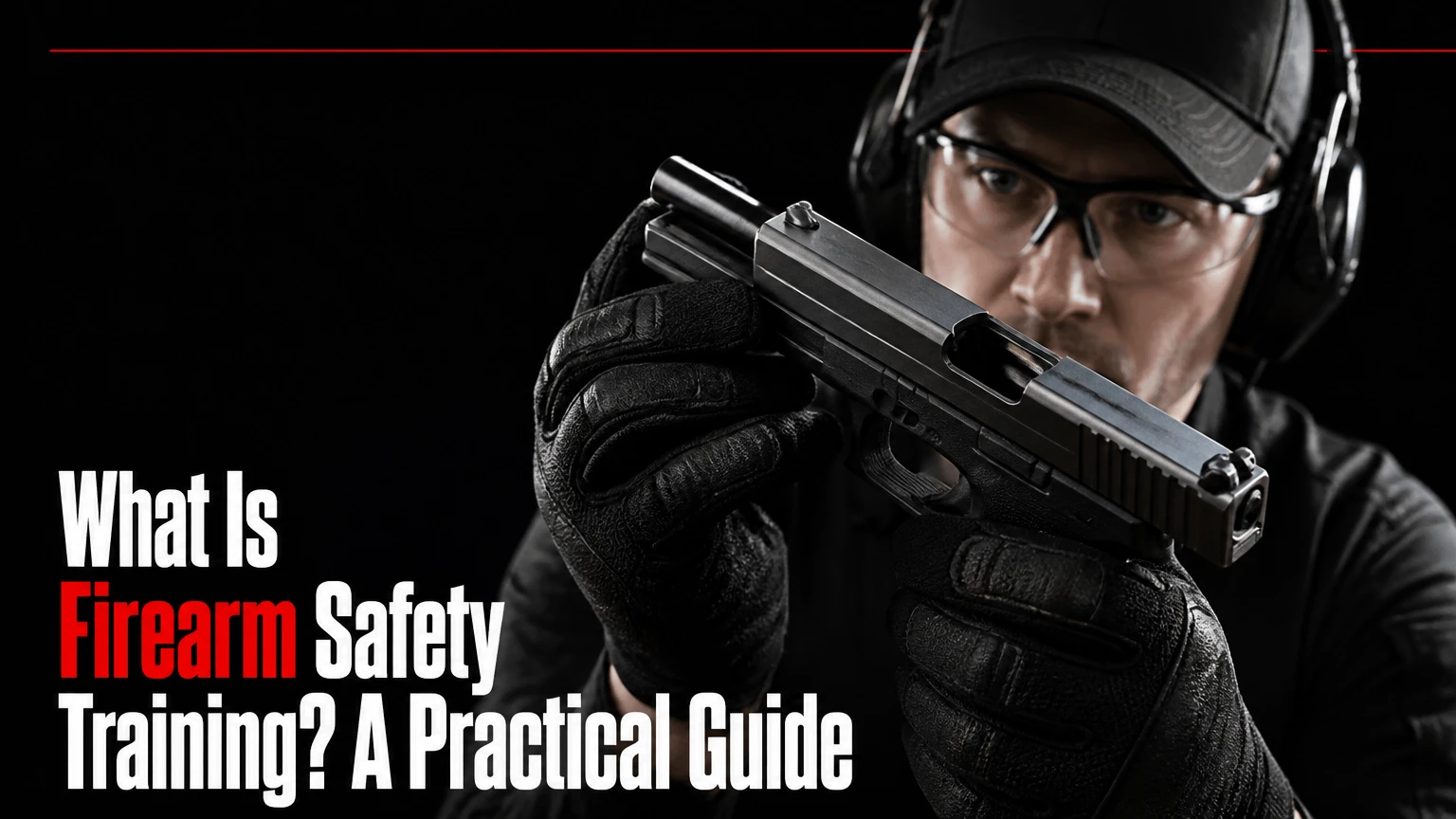
Firearm safety training is structured education that teaches people to handle, operate, store, transport, and maintain firearms without creating avoidable risk. A complete course combines safety rules, supervised handling, ammunition awareness, range procedures, and applicable law. Its purpose is responsible decision-making, not simply improved accuracy or faster shooting.
Key Facts
Firearm safety training begins with safe handling and decision-making before live firing.
The four universal rules require treating every firearm as loaded, controlling the muzzle, keeping the trigger finger indexed, and identifying the target and its background.
A typical introductory course takes 4-8 hours, although legal or licensing courses may require longer.
Online lessons can explain theory, but they cannot replace supervised hands-on assessment.
Course prices commonly range from $75-$300 before ammunition, range fees, equipment, and licensing charges.
A training certificate does not automatically create permission to own, carry, transport, or use a firearm.
What Is Firearm Safety Training?
Firearm safety training is a supervised learning process for building safe habits around a specific firearm platform and its ammunition. The curriculum normally covers the firearm’s controls, loading and unloading concepts, storage, transport, range commands, misfire response, and local legal responsibilities.
Safety instruction is broader than marksmanship. A student may shoot accurately and still mishandle a muzzle, misunderstand storage obligations, or fail to recognize incompatible ammunition. Responsible instruction therefore measures conduct and judgment as well as target performance.
The familiar “crawl, walk, run” sequence is useful when applied carefully: learn the rules, handle an unloaded firearm under supervision, then progress to live fire only after the instructor confirms safe behavior. The sequence is not a license to rush. A learner who cannot consistently keep the trigger finger outside the trigger guard should not advance to more complex exercises.
Firearm safety training is also platform-specific. A semi-automatic pistol, revolver, rifle, and shotgun have different controls, loading systems, sighting arrangements, and storage considerations. Training on one firearm creates transferable principles, but it does not establish competence with every other model.
What Do the Four Safety Rules Require?
The four universal firearm safety rules require constant muzzle control, trigger-finger discipline, firearm-status verification, and awareness of the target and its surroundings. The rules work together because one missed rule can defeat the others.
- Treat every firearm as if it is loaded. Handle an unfamiliar or supposedly unloaded firearm with the same discipline as a loaded one. A verbal assurance, open action, or magazine removal is not a substitute for a physical safety check performed according to the manufacturer’s instructions.
- Never point the muzzle at anything you are unwilling to destroy. A safe direction depends on the environment, construction, and range design. “Pointed down” is not automatically safe if people are below the muzzle or if the surface can cause a dangerous ricochet.
- Keep the trigger finger outside the trigger guard until the sights are on the intended target and the decision to fire has been made. The index finger should rest along the frame or receiver, where movement, conversation, or a startle response is less likely to activate the trigger.
- Know the target and what is beyond it. A projectile can pass through common interior walls and some objects can conceal people. A target identification decision includes the background, foreground, neighboring lanes, and any changing conditions.
Jeff Cooper’s compact formulation, “All guns are always loaded,” expresses the mindset behind the first rule, although safe handling requires all four rules rather than a slogan alone. The National Shooting Sports Foundation and Project ChildSafe also emphasize responsible storage, access prevention, and education as parts of safe ownership.
How Does a Firearm Safety Course Work?
A typical beginner course uses four stages: classroom instruction, supervised unloaded handling, controlled live fire, and an assessment of safe conduct. The total duration is commonly 4-8 hours, but a licensing course, private lesson, or specialized long-gun program may take longer.
Stage 1: Learn the Rules and Controls
The instructor introduces firearm terminology, operating controls, ammunition identification, storage options, transport rules, and range commands. Students should learn how to identify the firearm’s status without relying on memory or another person’s statement.
Legal content varies by jurisdiction. A reputable instructor identifies the relevant authority and course limits instead of presenting general information as legal advice.
Stage 2: Handle an Unloaded Firearm
Students practice grip, stance, sight alignment, trigger-finger position, loading and unloading concepts, and safe movement with an unloaded firearm or approved training aid. The instructor should control when firearms are handled and should correct unsafe conduct immediately.
Dry practice requires a genuinely unloaded firearm, no live ammunition in the practice area, a suitable backstop or safe direction, and manufacturer guidance about whether the model permits the activity. Students should not improvise dry-fire procedures from internet videos.
Stage 3: Follow Range Procedures
Live-fire instruction begins only after the student understands the range commands and demonstrates safe handling. The range safety officer or instructor controls when firearms may be handled, loaded, fired, and cleared.
A first session normally emphasizes deliberate, controlled shots rather than speed. Accuracy matters, but safe response to a command, stoppage, dropped object, or distraction matters more.
Stage 4: Complete an Assessment
Some courses include a written test, a practical demonstration, a live-fire standard, or all three. Passing thresholds differ by provider and jurisdiction, so an advertised score such as 80% should never be assumed to apply everywhere.
A certificate usually confirms course completion under that provider’s rules. It may satisfy one licensing prerequisite, but it does not prove universal competence or authorize conduct that local law prohibits.
What Does Training Cover?
A comprehensive firearm safety curriculum covers handling, operation, ammunition, storage, transport, maintenance, range conduct, and emergency decisions. Marksmanship is one component, not the definition of the course.
| Curriculum area | Typical lesson content | Competence checkpoint |
|---|---|---|
| Handling | Muzzle direction, trigger-finger position, status checks | Student maintains safe control during movement |
| Operation | Controls, action status, loading and unloading concepts | Student identifies controls without guessing |
| Ammunition | Cartridge identification, damage inspection, compatibility | Student does not use unidentified ammunition |
| Storage | Locked containers, access control, separate ammunition decisions | Unauthorized users cannot readily access the firearm |
| Transport | Local vehicle and public-transport rules | Student follows jurisdiction-specific requirements |
| Maintenance | Manufacturer-approved inspection and cleaning | Student follows the manual and avoids unsafe improvisation |
| Range conduct | Commands, lane boundaries, cease-fire response | Student stops and secures the firearm on command |
| Legal awareness | Ownership, carry, discharge, reporting, use-of-force limits | Student knows where current rules must be verified |
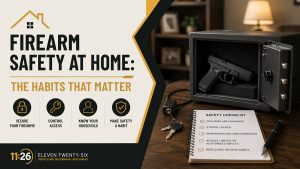
The storage lesson should account for the household, not only the owner. The Bureau of Alcohol, Tobacco, Firearms and Explosives advises secure storage and preventing unauthorized access, while Project ChildSafe provides safety resources and locking-device information. A biometric lock can be convenient, but a responsible plan also considers battery failure, backup access, children, visitors, theft, and emergency access.
The CDC’s public-health guidance identifies secure storage as a prevention measure, and RAND Corporation’s 2020 review found supportive evidence that child-access-prevention laws reduce unintentional firearm injuries among children. Training cannot eliminate every risk, but it can improve the decisions that control access and handling.
Which Types of Training Exist?
The main course types are introductory safety, pistol, long-gun, concealed-carry or licensing, defensive, and competition instruction. The correct choice depends on the learner’s firearm, legal purpose, prior experience, and ability to practice safely.
| Course type | Typical duration | Typical tuition | Primary learner | Main boundary |
|---|---|---|---|---|
| Introductory safety | 2-4 hours | $50-$150 | New owner or household member | Basic handling, not advanced shooting |
| Basic pistol | 4-8 hours | $100-$300 | First-time pistol student | Limited defensive decision-making |
| Rifle or shotgun | 4-8 hours | $100-$350 | Hunter, sport shooter, long-gun owner | Platform-specific instruction |
| Carry or licensing | 8-16 hours | $150-$500 | Applicant subject to local rules | Legal requirements vary by jurisdiction |
| Defensive application | 1-3 days | $300-$1,000+ | Experienced student | Requires strong foundational safety |
| Competition skills | 1-2 days | $200-$800 | Sport shooter with basics | Sport performance is not defensive training |
Prices are typical North American ranges, not universal rates. Ammunition, targets, eye and ear protection, firearm rental, range access, travel, licensing, and renewal fees can add $25-$200 or more to the total.
A defensive or tactical class should not be a beginner’s first course. Movement, low-light conditions, unusual positions, or scenario pressure increase the consequences of weak fundamentals. The safer progression is introductory instruction, supervised practice, a platform-specific course, and only then specialized training.
Which Delivery Format Fits?
In-person instruction is the strongest primary format for beginners because an instructor can observe muzzle direction, trigger-finger position, loading behavior, and responses to commands. Private coaching offers more individualized correction, while online theory works best as preparation or review.
| Delivery format | Typical duration | Typical price | Feedback level | Best use |
|---|---|---|---|---|
| Group classroom and range | 4-8 hours | $75-$300 | Moderate, often 1 instructor per 4-10 students | First course and legal orientation |
| Private coaching | 1-4 hours | $75-$200 per hour | High, one-to-one correction | Anxiety, accessibility, platform transition |
| Online theory | 2-6 hours | $0-$150 | Low for physical skills | Rules, terminology, legal review |
| Hybrid course | 4-10 total hours | $100-$400 | High during range session | Flexible scheduling with live assessment |
Online training cannot verify physical habits, safe muzzle movement, or response to range commands. It may satisfy a local administrative requirement, but validity depends on the issuing authority and course provider. Students should confirm acceptance before paying.
Private instruction is not automatically safer. A private instructor with poor credentials, weak range procedures, or pressure to advance quickly creates risk. Ask about instructor certification, emergency procedures, student-to-instructor ratio, insurance, range rules, firearm rental, and ammunition requirements.
What Should You Do Before Enrolling?
Before enrolling, verify the provider, legal relevance, equipment policy, and safety controls. A careful student can screen most poor courses with a short checklist before arriving at the range.
- Confirm the jurisdiction. Check the current government or licensing authority website for required curriculum, minimum age, renewal rules, and certificate acceptance.
- Ask what the price includes. Request separate figures for tuition, ammunition quantity, range fee, rental firearm, targets, eye protection, ear protection, and certificate fee.
- Check instructor credentials. Ask for recognized instructor certification, recent teaching experience, first-aid or emergency training, and the course syllabus.
- Describe your situation. Tell the provider whether you are a first-time learner, use a wheelchair, need language support, have hearing limitations, or are unfamiliar with the firearm platform.
- Arrive prepared. Follow the range’s clothing and footwear rules, bring government identification if required, and do not bring a loaded firearm unless the provider has given explicit transport instructions.
- Separate live ammunition from dry practice. Live ammunition should remain outside any designated dry-practice area unless the instructor directs otherwise.
A competent provider welcomes questions about safety. Evasive answers about credentials, costs, emergency plans, or legal scope are reasons to choose another course.
How Much Does Firearm Safety Training Cost?
Firearm safety training commonly costs $50-$500 for introductory or licensing instruction, with advanced private or multi-day courses reaching $1,000 or more. The final price depends on instructor time, range access, ammunition, equipment rental, licensing administration, and travel.
| Expense | Typical amount | When charged | Cost-control option |
|---|---|---|---|
| Introductory tuition | $50-$150 | Course registration | Compare syllabus and class size |
| Pistol or long-gun tuition | $100-$350 | Course registration | Use a group class for fundamentals |
| Ammunition | $25-$150 | At purchase or range | Confirm required quantity first |
| Firearm rental | $20-$60 | Range visit | Use an approved personal firearm |
| Eye and ear protection | $10-$80 | Purchase or rental | Buy properly rated reusable equipment |
| Range fee and targets | $20-$75 | Live-fire session | Select a course with fees included |
| License or application fee | $25-$200+ | Government submission | Verify official fee schedule |
The cheapest class is not necessarily the least expensive decision. A course that omits range time may require a second paid session, while a large class may provide little individual correction. Compare total cost, instructor ratio, live-fire supervision, and legal acceptance.
What Mistakes Need Correction?
The most dangerous beginner errors involve trigger contact, muzzle direction, firearm-status assumptions, and rushed responses to malfunctions. Instructors should correct these behaviors before working on speed or accuracy.
Trigger-Finger Creep
Trigger-finger creep occurs when the index finger enters the trigger guard during movement, conversation, or manipulation. The correction is consistent indexing on the frame or receiver until the decision to fire has been made and the sights are aligned with the intended target.
Muzzle Sweeping
Muzzle sweeping occurs when the firearm points across a person, the student’s own body, or an unsafe surface. Turning, holstering, clearing, and picking up a dropped object are common moments for this error. Stop the movement, maintain control, and follow the instructor’s procedure rather than attempting a hurried correction.
Assuming a Firearm Is Unloaded
A removed magazine does not prove that a firearm is unloaded, and an open action does not replace the required status check. Students should use the specific inspection and unloading procedure taught for that model and ask the instructor when uncertain.
Anticipating Recoil
Anticipating recoil can cause a student to tense the hands or push the firearm before discharge, producing low or inconsistent hits. An instructor may use inert training ammunition or a controlled ball-and-dummy exercise, but only under a safe range procedure that prevents students from handling ammunition casually.
Rushing a Malfunction
A malfunction is a safety event before it is a performance problem. Keep the muzzle in a safe direction, keep the trigger finger indexed, and follow the firearm-specific procedure taught by the instructor or manufacturer. Internet shortcuts are a poor substitute for supervised instruction.
Failing to Hear a Range Command
Hearing protection can reduce speech clarity, especially for students with hearing loss or electronic devices configured poorly. Tell the instructor before live fire, confirm the visual cease-fire signal, and stop handling the firearm whenever a command is unclear.
Which Course Should You Take?
New owners should begin with introductory safety or basic pistol instruction, depending on the firearm involved. People seeking a carry license should take the jurisdiction-approved course, while experienced students should choose specialized training only after demonstrating safe fundamentals.
| Learner situation | Recommended first course | Minimum useful outcome | Avoid initially |
|---|---|---|---|
| No prior handling experience | Introductory safety | Safe status checks and storage plan | Tactical or speed class |
| New pistol owner | Basic pistol | Safe operation and range conduct | Unsupervised defensive drills |
| Rifle or shotgun owner | Platform-specific long-gun course | Safe loading concepts and handling | Assuming pistol skills transfer fully |
| Carry-license applicant | Approved licensing course | Required law and qualification | Non-approved online certificate |
| Household member | Safety and access course | Storage, boundaries, emergency plan | Handling without owner or instructor |
| Experienced sport shooter | Competition or technical clinic | Rules-compliant performance | Treating sport skills as legal advice |
For Families and Household Members
The responsible objective is controlled access, clear communication, and age-appropriate education. Children should not be asked to act as the household security system; adults must use secure storage and follow local requirements.
For Home-Defense Interests
Start with basic safety, storage, legal education, and conflict avoidance. A home-defense course should address identification, communication, emergency services, and the legal consequences of force, not merely shooting in low light.
For Professional Security
Professional users need employer-approved instruction, documented qualification, recurrent training, medical response, reporting procedures, and jurisdiction-specific law. A civilian recreational class rarely covers those organizational duties.
Can Online Training Replace In-Person Instruction?
Online firearm safety training can replace some classroom theory, but it cannot replace supervised practical instruction for a beginner. A video cannot observe trigger-finger placement, muzzle direction, loading behavior, or a student’s response to a live-fire command.
Online material is useful for learning terminology, reviewing the four rules, preparing questions, and studying legal topics from an authoritative source. It becomes inadequate when a provider claims that watching videos alone establishes safe handling competence.
A hybrid program can work when the in-person component includes direct observation and a meaningful assessment. Confirm whether the certificate is accepted by the relevant government authority before enrolling, because course recognition is a legal question rather than a marketing claim.
When Is Refresher Training Necessary?
Refresher training is appropriate after a long gap, a firearm-platform change, a storage or household change, a safety incident, or a period of discomfort and uncertainty. A practical interval is once every 12-24 months for casual owners, although law, employment, licensing, and personal practice requirements may be more demanding.
Short supervised sessions are often more useful than occasional high-pressure classes. Rehearse the four rules, storage plan, range commands, and model-specific handling before adding any new skill.
Training also has limits. It cannot make an unsafe firearm reliable, determine whether a particular use of force is lawful in every circumstance, or substitute for secure storage and sound judgment. Legal advice should come from a qualified local attorney or official authority.
Frequently Asked Questions
Is firearm safety training required to own a firearm?
Firearm safety training is required in some jurisdictions and optional in others, with separate rules often applying to purchase, possession, carry, hunting, employment, or licensing. Check the current government authority for the exact requirement. A voluntary course remains valuable even where no certificate is legally required.
How old must someone be to attend a firearm safety course?
Minimum ages vary by jurisdiction, provider, firearm type, and whether a parent or guardian attends. Some youth programs use supervised training firearms or .22-caliber rifles, while licensing courses may require an older applicant. Confirm the provider’s written age policy before registration.
What should a beginner bring to class?
A beginner should bring identification if required, comfortable clothing, closed-toe footwear, eye and hearing protection if the range does not provide them, and any documents requested by the provider. Do not bring ammunition or a personal firearm until the instructor explains the approved transport and storage procedure.
How often should firearm safety training be repeated?
A casual owner should consider a supervised refresher every 12-24 months and whenever the firearm platform, household, law, or storage arrangement changes. Carry professionals and license holders may have shorter mandatory intervals. Repetition should reinforce safe conduct, not encourage speed before control.
Does passing a course prove that someone is a safe shooter?
Passing a course demonstrates performance against that provider’s standard on a particular day. It does not prove permanent competence, legal knowledge in every situation, or safe behavior under stress. Continued practice, secure storage, honest self-assessment, and periodic instruction remain necessary.
The Bottom Line
Firearm safety training teaches safe handling, operation, storage, transport, range conduct, and legal awareness through structured instruction and supervised practice. What is firearm safety training in practical terms? It is the foundation that helps a person control access, recognize risk, operate a specific firearm responsibly, and stop when uncertainty appears.
Choose an in-person introductory course if you are new, verify legal recognition if a certificate is involved, and compare the complete cost rather than tuition alone. Advanced carry, defensive, competition, and professional courses should follow demonstrated safety fundamentals, not replace them.