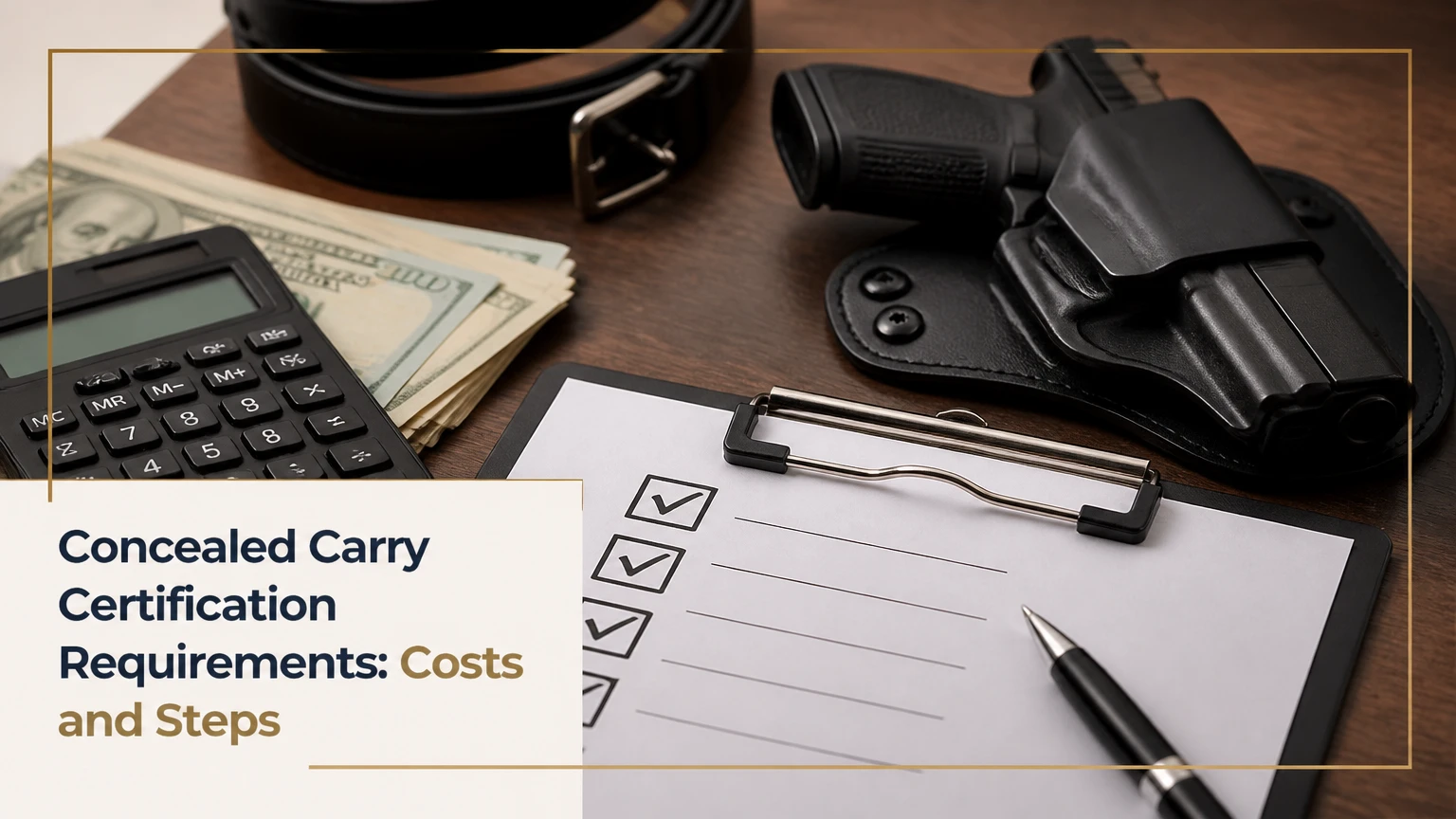
Concealed carry certification requirements are the state and local conditions for legally carrying a hidden firearm, usually through a concealed-carry permit or license. Requirements commonly include eligibility screening, an approved safety course, fingerprints, an application fee, and a background check, but some states allow permitless carry and do not require certification.
Key Facts
A concealed-carry training certificate is evidence of course completion; it is not automatically a legal carry permit.
The issuing authority is usually a state police agency, county sheriff, or municipal licensing office.
Training can range from no mandatory course to classroom instruction plus live-fire qualification.
Federal firearm prohibitions and state permit rules are separate tests, and passing one does not guarantee passing the other.
A permit issued by one state does not create a nationwide right to carry in another state.
Typical applicant expenses total about $100-$500 before firearm, ammunition, storage, and private legal-advice costs.
What Do Concealed Carry Certification Requirements Mean?
Concealed carry certification requirements are the conditions a jurisdiction imposes before issuing, recognizing, or renewing authority to carry a concealed handgun. The legal document may be called a concealed handgun license, concealed weapon permit, concealed pistol license, firearms license, or CCW permit.
The word “certification” creates a common misunderstanding. A state-approved instructor may issue a training certificate after a student completes a course, but only the designated government agency can issue the license or permit. A class certificate therefore proves one prerequisite, not the complete authorization to carry.
The definition also depends on the weapon and location. Some statutes regulate only handguns, while others cover any firearm or “weapon” concealed on the person or within immediate reach in a vehicle. A firearm hidden under clothing, in a purse, or in a vehicle console can trigger different rules depending on the jurisdiction.
The Bureau of Alcohol, Tobacco, Firearms and Explosives, or ATF, applies federal prohibited-person rules to firearm possession and transfer. State licensing agencies apply additional standards, such as residency, training, fingerprints, waiting periods, and character-related restrictions.
Who Sets the Rules?
State legislatures create the main carry framework, but local agencies often administer applications and some federal laws apply nationwide. A county sheriff may accept the application while the state police conduct the background check, and federal facilities remain governed by federal law even when state carry is lawful.
The Supreme Court’s 2022 decision in New York State Rifle & Pistol Association v. Bruen rejected New York’s discretionary “proper cause” standard for ordinary public carry applicants. The decision did not make concealed carry uniform across the United States, remove training requirements, or invalidate location restrictions generally.
Four Common Carry Systems
| System | Permit requirement | Typical decision rule | Important limitation |
|---|---|---|---|
| Permitless or constitutional carry | None for qualifying carry | Eligibility is determined by statute | Restricted places, age rules, vehicle rules, and prohibited-person laws still apply |
| Shall-issue licensing | Usually required for licensed carry | Agency issues after objective criteria are met | Complete applications and qualifying training remain necessary |
| Discretion-limited licensing | Required in some jurisdictions | Agency conducts statutory vetting | Post-Bruen rules still vary and may face litigation |
| Highly restrictive licensing | Required | Narrow statutory eligibility or difficult application process | A permit may still be available even where requirements are demanding |
“Constitutional carry” does not mean every person may carry everywhere. It generally means a qualifying person may carry without obtaining a state permit, subject to age, prohibited-person, location, vehicle, manner-of-carry, and notification rules.
What Are the Main Concealed Carry Certification Requirements?
Most regulated applications involve six requirement categories: legal eligibility, identity and residency, approved training, fingerprints, background screening, and fees. The exact combination changes by state, and some jurisdictions require additional photographs, references, interviews, mental-health records, or proof of firearms qualification.
Eligibility Screening
Federal law prohibits firearm possession by categories that include many people convicted of crimes punishable by more than one year, fugitives, unlawful users of controlled substances, certain people adjudicated as mentally defective or committed to a mental institution, and people subject to qualifying domestic-violence restrictions. The exact statutory definitions matter.
State permit applications may impose additional disqualifiers or waiting periods for misdemeanors, pending charges, protective orders, probation, substance-related conduct, or mental-health events. An expungement, pardon, set-aside, or restoration of rights may change the outcome, but applicants should not assume that an old record disappeared from every database.
Age, Residency, and Identification
Many states set a minimum permit age of 21, while others issue some licenses at 18, especially for military members or applicants who meet different statutory categories. Permitless-carry age limits can differ from permit-application ages inside the same state.
Typical documents include a government photo ID, proof of current address, birth or naturalization information, and proof of military status when an exemption applies. A driver’s license may establish identity without proving every residency condition required by the issuing agency.
Training and Firearms Qualification
Mandatory training may cover safe handling, storage, transportation, lawful use of force, conflict avoidance, and state-specific carry restrictions. Some states require live-fire qualification with minimum accuracy or a specified distance, while others accept classroom-only instruction or recognize prior military, law-enforcement, or hunter-safety credentials.
| Training model | Typical classroom time | Live-fire requirement | Common proof |
|---|---|---|---|
| No mandatory course | 0 hours | None | No training certificate |
| Basic safety course | 2-4 hours | None or optional | State-approved completion record |
| Classroom plus range | 4-8 hours | Often required | Certificate and instructor qualification form |
| Extended initial course | 8-16 hours | Usually required | Certificate, target, or range record |
| Renewal or refresher | 1-8 hours | State-specific | Renewal training certificate |
An online course is legally sufficient only when the issuing state expressly accepts that format and the course meets its current standards. A generic internet certificate usually cannot substitute for a required state-approved class or live-fire test.
How Do You Apply for a Concealed Carry Permit?
The standard application sequence takes four weeks to six months, depending on the jurisdiction, fingerprint scheduling, background-check workload, and whether the agency requests additional records. The state’s official issuing authority determines the valid forms, fees, training providers, and statutory processing period.
Step 1: Confirm the Issuing Authority
Identify the agency that accepts applications for your residence. In many states it is the county sheriff, but state police, a department of public safety, a court clerk, or a municipal licensing office may handle the process.
Use the agency’s official website or telephone line. Commercial reciprocity maps and instructor pages can be useful starting points, but they should not replace the current statute, application instructions, or agency notice.
Step 2: Check Eligibility Before Paying for Training
Review age, residency, criminal-history, protective-order, substance-use, mental-health, and citizenship or lawful-presence rules before enrolling. A paid course cannot cure a statutory disqualification.
Applicants with uncertain records should obtain certified court dispositions and consult a firearms attorney in the relevant state before submitting an application. An inaccurate answer can create a separate problem even when the underlying incident would not have barred issuance.
Step 3: Complete the Correct Approved Course
Choose an instructor listed by the state or issuing agency, confirm the course version, and ask whether the certificate is valid for an initial permit or only renewal. Bring the firearm and ammunition only when the instructor’s written range instructions require them.
A successful course normally produces a certificate containing the student’s legal name, completion date, instructor identification, course type, and any qualification result. Keep the original and a secure digital copy.
Step 4: Assemble the Application Packet
Common packet items include the completed application, government identification, training certificate, photographs, proof of residency, military records when relevant, and payment. Some agencies require separate forms for personal history, medical release, references, or supplemental disclosures.
Do not guess at questions about arrests, convictions, restraining orders, or controlled substances. Read the statutory definitions and provide the requested explanation or certified record.
Step 5: Submit Fingerprints and Biometrics
Fingerprinting may use electronic LiveScan or ink cards, and the agency may specify an approved location. Prints can be rejected because of poor image quality, incorrect cards, missing signatures, or submission to the wrong agency.
Record the fingerprint appointment date and confirmation number. A replacement fingerprint submission can add several weeks to an otherwise complete application.
Step 6: Pay Every Required Fee
Typical expenses include the class, range and ammunition costs, fingerprints, photographs, application, and renewal fee. Some agencies collect state and local charges separately, so the advertised application price may not represent the total.
| Expense | Typical amount | When paid | What changes the amount |
|---|---|---|---|
| Initial training | $50-$250 | Before application | Course hours, range use, instructor market |
| Application and license | $40-$150 | At filing | State statute and local processing |
| Fingerprints | $15-$60 | At appointment | LiveScan vendor and service fee |
| Photos and records | $0-$40 | Before filing | Passport photos and certified dispositions |
| Total typical initial cost | $105-$500 | Across the process | Required training, records, and local fees |
Step 7: Track the Background Check and Notice
The agency may check state criminal-history systems, court records, federal databases, and other legally authorized sources. Processing time is not proof of approval or denial.
Respond promptly to requests for clarification. Keep copies of the submission, receipt, certificate, fingerprints, and every agency communication.
Step 8: Read the Permit and Current Carry Rules
Confirm the name, expiration date, license class, firearm restrictions, and renewal instructions when the permit arrives. A permit may authorize concealed carry without authorizing open carry, vehicle storage, school carry, or carry in every location.
The permit card is evidence of authorization. It is not a substitute for checking the destination state’s current law.
What Do Resident and Nonresident Permits Allow?
A resident permit comes from the applicant’s home state, while a nonresident permit comes from a state where the applicant does not maintain primary residence. Their practical value depends on the issuing state, destination-state reciprocity, training standards, age, and whether the destination recognizes nonresident licenses.
| Permit option | Typical applicant | Main benefit | Main limitation |
|---|---|---|---|
| Resident permit | Person living in issuing state | Primary local authorization | Requires compliance with home-state rules |
| Nonresident permit | Person living elsewhere | May add recognition in selected states | Some states recognize resident permits only |
| Permitless carry | Qualifying person in a permitless state | Avoids application and renewal | Often provides little interstate value |
| Multiple permits | Frequent interstate traveler | Can expand lawful destinations | Requires checking each permit separately |
A nonresident permit is not a universal travel license. For example, a state may recognize a resident license from another state but reject that state’s nonresident license, or it may impose a different minimum age and training rule.
Permitless Carry or Licensed Carry: Which Is Better?
Permitless carry may be simpler for lawful in-state carry, while a valid resident permit usually provides better documentation and potential reciprocity. A permit can also provide benefits under state law, such as recognition of training or an exemption from a purchase-related background-check procedure, but those benefits are not nationwide.
| Decision factor | Permitless carry | Resident permit | Nonresident permit |
|---|---|---|---|
| Upfront application | $0 | Typically $40-$150 | Typically $50-$150 |
| Mandatory training | Often $0 | State-specific | State-specific |
| Renewal interval | Not applicable where lawful | Commonly 2-7 years | Commonly 2-5 years |
| Interstate recognition | Often limited | Depends on destination | Depends on destination and residency |
| Processing wait | None for carry eligibility | Commonly 30-180 days | Commonly 30-180 days |
| Proof of training | Usually none | Certificate or agency record | Certificate or agency record |
Permitless carry is not ideal for someone who travels across state lines, because the traveler must independently satisfy each destination’s carry and transport rules. A licensed permit is not ideal for someone seeking a quick local option when the home state allows lawful permitless carry and offers no meaningful permit benefit.
What Is the Best Choice for Different Situations?
- Local carry only: Verify whether permitless carry applies to your age and status, then consider a permit for formal training and clearer documentation.
- Frequent interstate travel: Start with the resident permit, then compare nonresident options against official reciprocity rules.
- Moving soon: Apply in the state where you currently qualify, but verify whether the permit remains valid after establishing a new residence.
- New firearm owner: Treat the legal course as a minimum compliance requirement, not complete defensive training.
- Uncertain criminal record: Resolve eligibility before purchasing a course or firearm.
Where Can’t You Carry With a Permit?
A concealed-carry permit does not override prohibited-location laws. Common restricted places include courthouses, secure government facilities, schools, correctional facilities, airports beyond screening, and federal buildings, although the exact list and exceptions vary.
Federal law separately restricts firearms in federal facilities and certain other federal locations. The U.S. Postal Service also applies federal regulations to postal property. Private businesses may prohibit firearms through signage, direct notice, or another method defined by state law.
Alcohol rules differ significantly. Some states prohibit carry in establishments that primarily sell alcohol, while others regulate carry based on alcohol consumption, blood alcohol concentration, or the premises’ percentage of alcohol revenue. Driving with a firearm creates separate storage and access questions.
Notification and Vehicle Rules
A state may require an armed person to disclose possession during a law-enforcement encounter, only when asked, or not at all. Vehicle rules may distinguish between a firearm on the body, inside a locked container, in a glove box, or within reach of the driver.
A practical compliance check asks four questions before entering a location:
- Does the destination state recognize this exact permit?
- Is the person eligible under the destination’s age and residency rules?
- Is the location restricted by state, federal, or private-property law?
- Does the vehicle, storage, alcohol, or notification rule change the result?
What Happens If an Application Is Delayed or Denied?
A delayed application requires a written status inquiry, while a denial requires review of the agency’s stated reason and the applicable appeal deadline. Common problems include incomplete forms, rejected fingerprints, undisclosed records, identity confusion, unpaid fees, and training certificates that fail state criteria.
Request the denial letter and preserve the envelope or electronic timestamp. Many states impose short appeal periods, sometimes 30-60 days, and the appeal may require a hearing, administrative filing, court petition, or correction through a separate records agency.
Common Failure Modes
- Wrong course: Ask the issuing agency whether the instructor and curriculum were approved before retaking training.
- Fingerprint rejection: Schedule a compliant reprint promptly and confirm that the agency received it.
- Old record mismatch: Obtain certified court dispositions and request correction from the database or court.
- Incomplete disclosure: Submit a truthful written clarification rather than relying on an informal phone explanation.
- Expired permit: Stop carrying under the expired license unless current law expressly provides a grace period.
- Reciprocity assumption: Remove the firearm before entering a jurisdiction whose rules have not been verified.
A firearms attorney is especially appropriate when the issue involves domestic violence, probation, a protective order, mental-health adjudication, expungement, restoration of rights, or conflicting state and federal records.
What Are the Most Important Practitioner Rules?
A training certificate is not the carry license. Applicants sometimes leave a class believing they can carry immediately. The legal authority begins only when the relevant statute allows permitless carry or the issuing agency grants a valid permit.
Reciprocity is a destination-state question. The issuing state cannot promise that another state will honor its license. Check the destination’s official government source immediately before travel because recognition, restricted locations, vehicle rules, and duty-to-inform requirements can change independently.
A permit does not replace competence. A minimum qualification may establish legal compliance without teaching safe holster selection, retention, decision-making, medical response, or defensive marksmanship. New carriers should separate legal training from supervised skills practice and secure-storage planning.
Frequently Asked Questions
Does taking a concealed-carry class let me carry immediately?
Usually no. A class generally produces a training certificate, while a state agency issues the permit after application, fingerprints, fees, and background screening. The exception is a state that allows qualifying residents to carry without a permit, but permitless carry still requires compliance with age, prohibited-person, location, and manner-of-carry rules.
Can I get a concealed-carry permit without being a resident?
Some states issue nonresident permits, but eligibility and usefulness vary. A nonresident license may be rejected by states that recognize resident permits only, and the application may still require an approved course, fingerprints, photographs, and a background check. Verify the issuing state’s current rules before paying for training.
How long does concealed-carry certification take?
A typical regulated application takes about 30-180 days from filing, although fingerprint delays, incomplete records, agency backlogs, and appeals can extend the period. Training may take one day, while obtaining certified court documents can take longer. The issuing agency’s published processing period is the controlling estimate.
Are online concealed-carry courses valid?
An online course is valid only when the applicable state expressly accepts online instruction for that permit and the course meets its approval rules. Many states require in-person instruction, a live-fire qualification, or both. A nationally advertised online certificate cannot establish legal eligibility by itself.
Can a felony or domestic-violence conviction prevent a permit?
Yes, a felony conviction or qualifying domestic-violence conviction can create a federal or state prohibition, but the result depends on the offense, sentence, record status, protective orders, and restoration of rights. Expungement or a pardon may change eligibility in some circumstances. Obtain legal advice before applying if the record is complex.
Does a concealed-carry permit work in every state?
No. Each destination state decides whether it recognizes another jurisdiction’s permit and under what conditions. Recognition may exclude nonresident permits, impose a different minimum age, or leave location and vehicle restrictions unchanged. Carrying across state lines requires checking the destination’s current official rules, not relying solely on a reciprocity map.
The Bottom Line
Concealed carry certification requirements usually combine eligibility screening, approved training, fingerprints, an application, fees, and a background check, but the controlling rules come from the state and local issuing authority. Permitless carry can remove the licensing step without removing location, age, prohibited-person, or travel restrictions.
For a lawful application, verify the current official requirements first, complete only approved training, preserve every record, and check each destination state before carrying there. A permit is one legal credential within a larger system, not nationwide permission to carry.