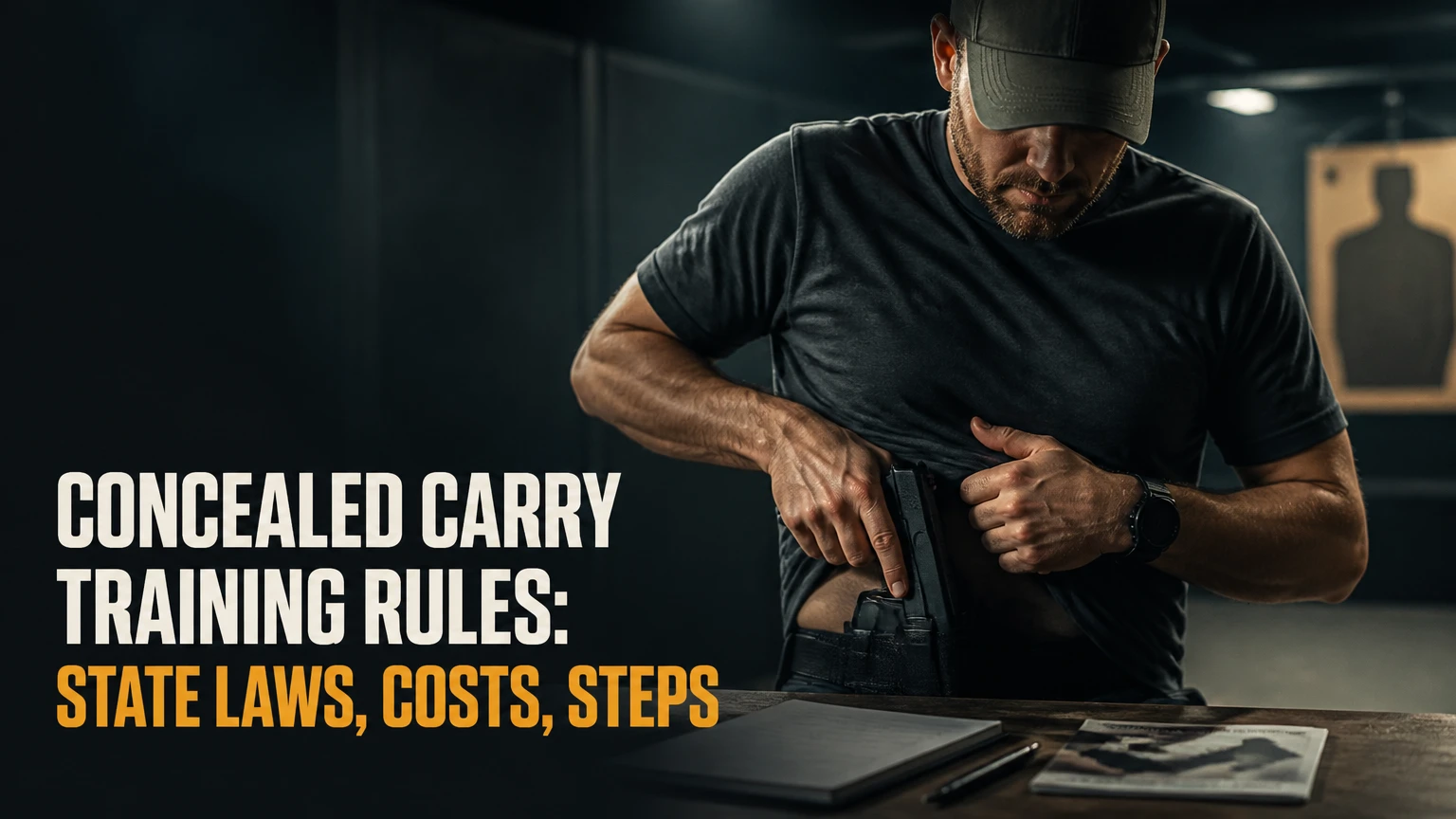
Concealed carry training rules are the state and local requirements governing safety instruction, firearm handling, legal education, and sometimes live-fire qualification for carrying a hidden handgun. Some states require an approved course before issuing a license, while others allow permitless carry but still impose eligibility, location, storage, and use-of-force restrictions.
Key Facts at a Glance
Federal law does not create one nationwide concealed-carry training curriculum or permit.
A training certificate usually supports a permit application; it does not independently authorize public carry.
Permitless-carry states may still offer licenses for reciprocity, and a license may carry different requirements than unlicensed carry.
Typical basic course prices range from $50-$150 in short-format programs and $200-$300 or more in longer programs.
Live-fire qualification, fingerprints, photographs, renewal training, and application fees depend on the issuing state.
A permit holder must verify both destination-state law and location-specific restrictions before carrying across state lines.
What Are Concealed Carry Training Rules?
Concealed-carry training rules are jurisdiction-specific standards for demonstrating safe firearm handling and understanding the law governing concealed weapons. The standards may cover handgun operation, storage, transport, prohibited locations, defensive-force law, and a written or practical examination, but no single national rule applies to every applicant.
The first legal distinction is between eligibility, training, and authorization. Federal and state law may prohibit certain people from possessing firearms, a state may require training for a license, and an issuing agency may separately approve the application. Completing a class does not cure a disqualifying criminal conviction, domestic-violence prohibition, restraining order, age restriction, or other statutory bar.
The Bureau of Alcohol, Tobacco, Firearms and Explosives publishes federal firearm-prohibition information, but ATF does not issue ordinary civilian concealed-carry permits. The relevant authority is usually a state police department, attorney general, county sheriff, court, or licensing agency.
State terminology also differs. Florida uses a concealed weapon license, Maryland uses a Wear and Carry Permit, and Illinois issues a Concealed Carry License. “CCW,” “CPL,” “CWP,” and “license to carry” can describe different legal systems, so applicants should use the official agency’s terminology when searching.
Is Training Legally Required in Every State?
No. Training is not legally required for every form of concealed carry in the United States, but permitless carry does not eliminate the need to verify eligibility and restrictions. A state can allow unlicensed carry while still requiring training for a license, imposing location bans, or applying stricter rules to nonresidents.
State counts change when legislatures amend statutes, and summaries often produce conflicting totals because they count permitless carry categories differently. Some states allow permitless concealed carry only for adults above a specified age; others distinguish residents from nonresidents, loaded from unloaded firearms, or handguns from other weapons.
| Legal situation | Training requirement | Separate authorization | Main verification point |
|---|---|---|---|
| Permit-required concealed carry | Usually mandatory | State license or permit | Approved course and application agency |
| Permitless resident carry | Often none for carry | No license for qualifying residents | Age, eligibility, location, storage, force law |
| Permitless carry with optional license | May be required for license | License remains available | Reciprocity and license-specific benefits |
| Nonresident carry | State-specific | Permit, recognition, or neither | Destination-state statute and reciprocity |
| Renewal application | None, reduced, or full course | Existing license renewal | Expiration date and renewal curriculum |
A license may still be useful in a permitless state. The license can provide recognition in selected states, simplify purchase or transport rules in some jurisdictions, or document training for a future application. Those benefits are not universal.
How can applicants verify the current rule?
Use the issuing state’s official website first, then read the applicable statute or administrative rule when the agency summary is incomplete. Confirm the required course name, instructor credential, minimum hours, expiration period for certificates, qualification score, fingerprint procedure, fee, and application deadline.
A responsible verification sequence is:
- Identify the state where the firearm will be carried.
- Find the official licensing agency, not merely a commercial course page.
- Confirm eligibility before paying for instruction.
- Check whether the course and instructor appear on the approved list.
- Confirm whether online hours, military experience, prior licenses, or out-of-state certificates qualify.
- Save the rule page and application instructions on the enrollment date.
- Recheck the rule before carrying because statutes and agency policies can change.
How Does the Licensing Process Work?
A typical permit-required process has six stages: verify eligibility, complete approved training, pass any written and live-fire tests, submit the application, complete background and fingerprint checks, and wait for the agency’s decision. The sequence varies, because some states accept applications before training while others require the certificate first.
Step 1: Verify eligibility and select an approved course
Confirm minimum age, residency, criminal-history restrictions, mental-health disqualifiers, citizenship or lawful-presence rules, and any required identification. A commercial class that says “valid in all 50 states” cannot replace the issuing agency’s approval.
Ask the instructor for the exact statutory or agency authority for the course. Confirm whether the certificate identifies the student’s legal name, completion date, instructor number, course hours, qualification result, and expiration date.
Step 2: Complete classroom instruction
The classroom portion commonly covers the four universal firearm-safety rules, handgun parts and controls, loading and unloading, storage, transport, child access prevention, concealed-carry equipment, and state-specific restrictions. Legal modules often address defensive force, brandishing, duty to retreat where applicable, protection of third parties, prohibited locations, and interaction with law enforcement.
A strong course explains the difference between a defensive shooting and a merely unjustified display of a firearm. It also explains what happens after a defensive incident, including securing the weapon, requesting medical assistance, identifying oneself appropriately, and obtaining legal representation.
Step 3: Pass a written assessment
Written tests usually evaluate safety rules and state law rather than advanced marksmanship. Questions may concern prohibited places, permit expiration, storage around minors, justified force, transport, alcohol or drug impairment, and the legal effect of carrying in another state.
Read the state rule directly if the instructor’s handout uses broad language. “Carrying is prohibited in schools” may conceal exceptions for vehicles, school programs, secure storage, or license holders.
Step 4: Complete live-fire qualification
A live-fire qualification tests safe manipulation and minimum accuracy under a prescribed course of fire. States may specify distances, target types, round counts, time limits, passing scores, and permitted firearm categories, so a generic “3, 5, and 7 yards” description is not a national standard.
| Qualification feature | Typical range | Why it matters |
|---|---|---|
| Firing distance | 3-15 yards | State course of fire controls the required distance |
| Round count | 10-50 rounds | Determines ammunition and qualification duration |
| Target type | Paper silhouette or bullseye | Scoring area may differ by state |
| Passing score | 70%-80% or agency formula | A commercial instructor cannot substitute personal scoring |
| Firing position | Standing, sometimes supported | Safe stance and control are evaluated |
| Retest policy | Same day or scheduled retest | Instructor and agency rules determine recovery |
The student should demonstrate safe muzzle direction, trigger-finger discipline, loading, unloading, stoppage response, and range commands. A person who cannot safely manipulate the firearm should not treat a passing score as the end of training.
Step 5: Submit the application
Typical application materials include a government identification document, training certificate, photographs, fingerprints, application fee, residency evidence, and answers to eligibility questions. Maryland’s State Police Wear and Carry Permit process, for example, publishes specific application and documentation requirements; applicants should follow that agency’s current instructions rather than a third-party checklist.
Match every document exactly. A certificate using a middle initial, former address, misspelled surname, or different birth date can trigger a correction request or delay.
Step 6: Complete review and receive the decision
The agency may conduct criminal-history checks, fingerprint-based checks, records review, and statutory eligibility verification. Processing periods range from short statutory windows to several months, depending on the state, application volume, fingerprint quality, and records requiring review.
Do not carry merely because an application was submitted. Carry only after the license is issued or after the state’s current permitless-carry rule independently authorizes the conduct.
What Does a Concealed-Carry Course Cover?
A basic course covers safe possession, legal boundaries, and minimum handling competence; it is not usually a complete defensive-skills program. The student should leave knowing how the state defines lawful carry, where carry is restricted, how the firearm operates, and what the qualification standard requires.
| Curriculum area | Basic course content | Advanced follow-up |
|---|---|---|
| Safety | Four rules, loading, unloading, storage | Scenario-based safety and decision practice |
| Law | Carry restrictions, force, transport | Case analysis and post-incident procedures |
| Equipment | Firearm, ammunition, holster, eye and ear protection | Fit testing and concealment assessment |
| Marksmanship | Grip, sights, trigger control, qualification | Movement, distance, low light, and positional work |
| Administration | Certificate and application requirements | Renewal and multi-state compliance review |
A permit class is a poor substitute for a beginner handgun course when the student has never safely operated a handgun. The legal lecture can consume most of the class, leaving limited time to correct grip, sight alignment, trigger control, or unsafe loading habits.
A practitioner rule of thumb is to separate the license course from the competence plan. The first establishes a legal minimum. The second builds repeatable safety and decision-making through supervised practice.
How Long and How Much Does Training Cost?
Basic concealed-carry training commonly takes 4-16 hours and costs approximately $50-$300, before ammunition, range, fingerprinting, permit, travel, and equipment expenses. Actual mandatory hours and fees are controlled by the state, and long initial courses often have separate renewal requirements.
| Expense | Typical amount | When charged |
|---|---|---|
| Short basic class | $50-$150 | Enrollment |
| Longer state course | $200-$300+ | Enrollment |
| Ammunition | $20-$80 | Live-fire session |
| Range fee | $15-$40 | Qualification day |
| Fingerprinting | $20-$75 | Application |
| Permit application | $40-$150+ | Initial or renewal filing |
A realistic first-application budget is often $150-$500 before buying a firearm, safe, belt, holster, or additional instruction. A longer course in a high-regulation state can exceed that range once fingerprints, photographs, ammunition, and travel are included.
Online pricing requires special caution. A $30 web certificate may be useless if the issuing state requires in-person hours, a state-approved instructor, or an agency-specific live-fire qualification.
Can Online Training Satisfy the Rules?
Online training satisfies concealed-carry rules only when the issuing state expressly accepts the format and the course meets its documentation requirements. A web class may cover legal knowledge, but it cannot automatically replace an in-person safety evaluation or live-fire qualification.
Before enrolling, verify four points:
- The state accepts electronic or remote instruction.
- The provider is authorized for that state’s permit.
- The certificate identifies the required instructor and completion data.
- Any required range qualification remains available through an approved process.
Online instruction can be useful for reviewing statutes and terminology, but it has a known limitation: the instructor cannot reliably observe muzzle discipline, trigger-finger placement, loading technique, or holster safety through a generic video module. It is especially weak as a first exposure for a new handgun owner.
What Is the Difference Between Basic and Advanced Training?
Basic permit training establishes a legal and handling floor; advanced defensive training develops judgment, equipment familiarity, and performance under controlled pressure. Advanced classes can include concealment garments, one-handed operation, movement, verbal decision-making, low-light work, vehicle considerations, and post-incident planning, but they require safe foundational skills first.
| Training format | Typical duration | Typical cost | Best use |
|---|---|---|---|
| Introductory handgun course | 4-8 hours | $75-$200 | New or inexperienced shooter |
| State permit course | 4-16 hours | $50-$300+ | Meeting licensing requirements |
| Live-fire skills class | 4-8 hours | $100-$250 | Improving accuracy and handling |
| Defensive carry class | 8-16 hours | $200-$500+ | Applying skills under supervision |
| Private coaching | 1-2 hours | $75-$150 per hour | Correcting specific weaknesses |
The advanced label is not a quality guarantee. Ask whether the instructor uses inert training tools, defined safety protocols, medical equipment, student-to-instructor ratios, and measurable performance standards.
Advanced training is not a substitute for legal advice. Scenario instruction can illustrate judgment, but a particular shooting’s legality depends on jurisdiction, facts, evidence, and applicable law.
Permitless Carry or a License: Which Is Better?
A license is usually the more useful choice for frequent interstate travel, while permitless carry may be simpler for an eligible resident who carries only within the home state. The better option depends on reciprocity, age, location restrictions, application cost, training access, and whether the person can comply with each state’s separate rules.
| Decision factor | Permitless carry | State license |
|---|---|---|
| Training before in-state carry | Often not required | Usually required |
| Application process | None for qualifying carry | Application, records check, often fingerprints |
| Reciprocity | Usually limited or unavailable | May be recognized by selected states |
| Proof of authorization | Statutory eligibility | Physical or digital license |
| Renewal obligation | None for carry authority | Expiration and renewal rules apply |
| Legal complexity | Still substantial | Added permit conditions and duties |
Permitless carry does not mean unrestricted carry. Prohibited places, private-property demands, government buildings, school zones, alcohol-related restrictions, vehicle rules, and defensive-force laws may still apply.
A license also does not create nationwide permission. Reciprocity agreements can change, and the destination state may require the visitor to obey its magazine, storage, notification, signage, or location rules.
How Do Reciprocity and Travel Rules Work?
Reciprocity means one jurisdiction recognizes another jurisdiction’s license under specified conditions; it does not make the issuing state’s rules portable. Travelers must check the destination’s official law, recognition list, prohibited locations, vehicle rules, and any duty to inform law enforcement.
Use the following travel checklist:
- Verify the destination state’s recognition of the exact license.
- Confirm resident or nonresident status requirements.
- Check age, firearm type, magazine, ammunition, and location restrictions.
- Review transport rules for every state crossed.
- Secure the firearm when entering a prohibited location.
- Carry the permit and government identification when required.
- Recheck official sources immediately before departure.
Commercial reciprocity maps are useful discovery tools, not final legal authority. The issuing state, destination state police, attorney general, or legislative website controls when summaries conflict.
What Should a Student Bring to Class?
Students should bring the identification, unloaded firearm, approved holster if required, ammunition quantity specified by the instructor, eye and ear protection, and clothing that matches normal carry conditions. Students should never bring a loaded firearm into a classroom or range unless the instructor’s written rules expressly direct a safe procedure.
Confirm these requirements before class:
- Government-issued photo identification
- Unloaded firearm in a secured case
- Factory ammunition of the correct caliber
- Two or more magazines if the firearm uses them
- Sturdy belt and safe holster
- Eye and ear protection
- Pen, legal notes, and application documents
- Weather-appropriate clothing for the range
A loose pocket holster, soft trigger-covering pouch, or unfamiliar firearm can create avoidable problems. The holster must fully protect the trigger guard and remain stable during ordinary movement.
Do not buy an expensive concealment system before receiving basic instruction. A student’s body shape, clothing, firearm controls, and instructor feedback often reveal fit issues that product descriptions do not.
What Commonly Goes Wrong?
The most common failures involve choosing an unapproved course, confusing a certificate with a permit, arriving with unsafe equipment, and submitting inconsistent application documents. Each failure has a different remedy, and repeating the class is not always necessary.
| Problem | Likely cause | Corrective action |
|---|---|---|
| Certificate rejected | Unapproved instructor or expired form | Confirm agency approval before retaking |
| Live-fire failure | Recoil anticipation or poor trigger control | Obtain supervised fundamentals coaching |
| Application delay | Fingerprint quality or mismatched data | Contact the agency and correct documents |
| Unsafe holster | Trigger exposure or poor retention | Replace it before carrying |
| Reciprocity mistake | Old commercial map or wrong license class | Check destination-state official sources |
| Expired permit | Missed renewal deadline | Stop relying on the expired license and follow agency procedure |
Dry practice can improve trigger control only when the firearm is unloaded, ammunition is in another room, the direction is safe, and the manufacturer’s safety instructions are followed. Dry practice cannot replace live-fire coaching, and it should not involve improvised holster drills in a crowded home.
A counterintuitive safety point is that carrying comfortably can increase complacency. Familiarity with a concealed firearm may reduce conscious attention to muzzle direction, trigger access, and secure storage, so periodic supervised review remains valuable.
Which Course Should Each Person Choose?
A first-time handgun owner should take an introductory handgun course before the state permit class. The introductory course creates enough mechanical familiarity to make the legal class productive, while the permit class supplies the state-specific documentation and law.
| Student profile | First course | Next step | Avoid |
|---|---|---|---|
| No handgun experience | Introductory handgun class | State-approved permit course | Starting with dynamic drills |
| Experienced local shooter | Approved permit course | Legal and defensive refresher | Assuming experience replaces law |
| Permitless-carry resident | Safety and legal seminar | Supervised defensive class | Treating no permit as no duties |
| Frequent traveler | Approved license course | Reciprocity review and travel class | Relying on one state’s rules |
| Office or vehicle commuter | Permit course with equipment review | Controlled concealment practice | Carrying with an unsafe holster |
Daily commuters should practice ordinary access problems only under qualified supervision. Seatbelts, seated positions, winter clothing, office restrictions, and public restroom environments create equipment and retention concerns that a short qualification may never address.
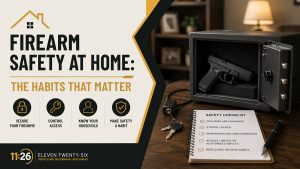
A person carrying around children should prioritize secure storage and access control. A permit course may mention storage, but a dedicated home-safety assessment can identify loaded-firearm access risks, lockbox placement problems, and unauthorized handling.
What Are the Limits of a Concealed-Carry Class?
A concealed-carry class cannot guarantee legal immunity, defensive success, or competent performance in every real-world event. Most basic courses provide limited repetitions, no meaningful force-on-force judgment training, and insufficient practice for low-light, vehicle, crowded-space, or post-incident conditions.
The legal certificate also says little about judgment. A student may satisfy a qualification with a small number of shots and still lack safe habits, reliable accuracy, medical knowledge, conflict-avoidance skills, or a plan for contacting counsel after an incident.
Responsible preparation therefore has layers:
- Legal education from the current state authority.
- Safe firearm fundamentals with a qualified instructor.
- Regular live-fire practice using measurable standards.
- Secure storage and transport planning.
- Conflict avoidance, communication, and emergency planning.
- Periodic legal review before travel or renewal.
The firearm is only one part of the system. Avoidance and de-escalation often prevent risks that marksmanship cannot solve.
Frequently Asked Questions
Does a concealed-carry certificate expire?
A certificate may expire before or after a permit application, depending on state law and agency policy. Some jurisdictions accept a course certificate for a fixed period, while others require a recent class or accept certain prior permits as evidence of training. Confirm the certificate’s validity with the issuing agency before submitting an application.
Can military service replace concealed-carry training?
Military service may satisfy a training exemption in some jurisdictions, but it is not a nationwide substitute. The state may require discharge papers, a military identification record, a firearms-training document, or proof that the training covered a handgun. Submit only the documents listed by the official licensing agency.
Do I need a permit to carry in my own vehicle?
Vehicle carry rules differ by state, firearm condition, residency, license status, and destination. A state may allow a loaded concealed handgun in a vehicle for license holders but apply different rules to unlicensed residents or visitors. Check the state’s vehicle and transport provisions separately from its general carry rule.
Can I carry at work after receiving a permit?
A permit does not override an employer’s policy, private-property rights, posted restrictions, or statutory workplace bans. Some states regulate locked firearms in vehicles while others prohibit possession in particular workplaces. Review the employer policy, property rules, and applicable statute before carrying.
Should I carry a round in the chamber?
The answer depends on the firearm design, manufacturer instructions, holster protection, training, and the carrier’s ability to maintain safe control. A person should not carry in a condition they cannot safely manage. A qualified instructor can evaluate the specific handgun and holster without substituting personal preference for safety guidance.
What should I do after moving to another state?
Treat the move as a new legal review. Determine whether the new state recognizes the existing permit, requires a resident license, accepts prior training, imposes a new qualification, or changes the rules for storage and prohibited locations. Do not assume the former state’s permit remains valid after residency changes.
The Bottom Line
Concealed carry training rules depend on the state where the firearm is carried, not merely the state where a course was purchased. Verify eligibility, use an approved instructor, complete every required classroom and live-fire component, submit accurate documents, and wait for actual authorization when a permit is required.
Permitless carry removes one administrative step in some states, but it does not remove legal restrictions or the need for competence. The most reliable training plan combines the state-required course with beginner fundamentals, supervised practice, secure storage, and an official reciprocity check before every interstate trip.