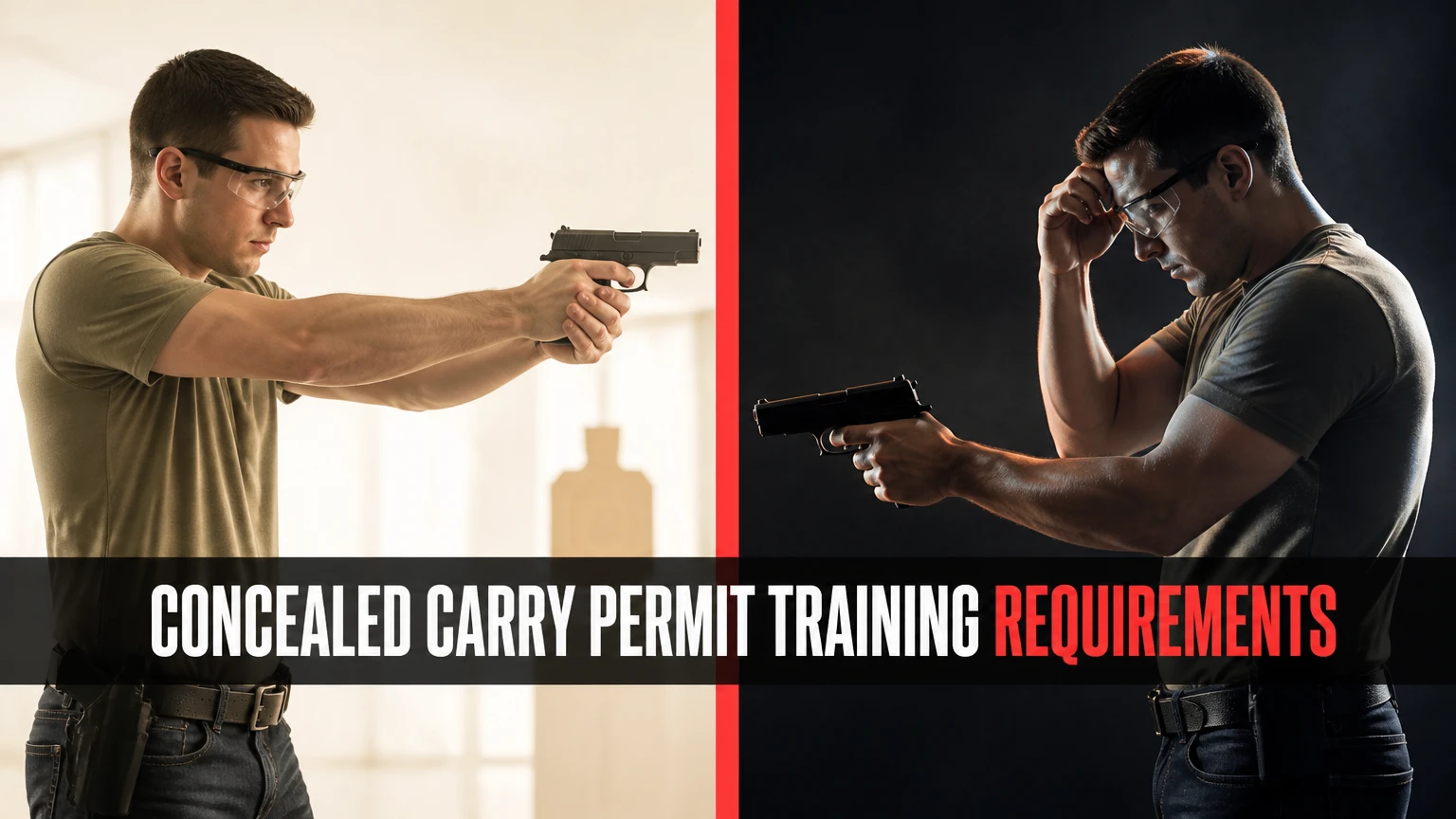
Concealed carry permit training requirements are state-specific rules governing the instruction, testing, and documentation required before a licensing authority may issue a permit to carry a hidden handgun in public. The United States has no national concealed-carry license, so the controlling law is usually the applicant’s state, with additional restrictions in destination states.
Key facts at a glance
A training certificate is not a carry permit; lawful carry generally begins only when the issuing authority approves the application and the permit becomes valid.
Required instruction commonly ranges from 4 to 18 hours, but some permitless-carry states require no training for qualifying adults.
A state may require classroom instruction, live-fire qualification, a written test, or a combination of those elements.
Typical total applicant cost is about $150-$500 after tuition, ammunition, fingerprints, photographs, and government fees.
An online certificate is valid only when the issuing jurisdiction expressly accepts that course for the specific permit.
Reciprocity is separate from qualification. A permit accepted in another state does not override that state’s prohibited locations or carry rules.
What Do Concealed Carry Training Requirements Mean?
Concealed carry training requirements are statutory prerequisites attached to a state license, permit, or concealed handgun authorization. The requirements may specify instructor credentials, minimum classroom hours, subjects, shooting qualification, examination standards, certificate wording, and how recently the course must have been completed.
The issuing authority is often a state police agency, department of public safety, county sheriff, or local police department. The correct agency depends on the permit type and applicant’s residence. Maryland, for example, administers its Wear and Carry Permit through the Maryland State Police, while other states use county-level sheriffs or centralized state portals.
Training is only one eligibility condition. Age, residency, criminal history, domestic-violence restrictions, mental-health disqualifiers, pending charges, and citizenship or lawful-presence rules can also matter. A completed course cannot overcome a statutory prohibition.
The Supreme Court’s decision in NYSRPA v. Bruen changed the constitutional analysis surrounding public carry, but it did not create a federal permit or eliminate state licensing procedures. Justice Clarence Thomas wrote that “the Second Amendment’s plain text covers an individual’s conduct,” while the Court’s decision still recognized that objective licensing systems may exist. State law remains the operational source for application details.
Which States Require Permit Training?
States differ in both whether training is mandatory and what counts as acceptable proof. Some require a short safety course and range test, some require extensive instruction, and some allow qualifying adults to carry without a permit while still offering a license for reciprocity or additional legal privileges.
The table below shows representative patterns rather than a complete legal chart. Requirements change through legislation, agency rules, and court decisions, so applicants should confirm the current rule with the issuing authority before paying for a course.
| Jurisdiction example | Initial training pattern | Live-fire requirement | Issuing authority or source |
|---|---|---|---|
| Illinois CCL | 16 hours, including approved curriculum | Required as part of qualification | Illinois State Police |
| New York concealed-carry license | 16 hours classroom plus 2 hours live fire | Required | New York State Police standards |
| Maryland Wear and Carry | Commonly 16 hours initial instruction | Qualification required under state standards | Maryland State Police |
| Ohio concealed handgun license | 8 hours training under statutory options | Competence demonstration required | Ohio Attorney General guidance |
| Utah concealed firearm permit | 4 hours approved instruction | No standard live-fire requirement for the permit class | Utah Bureau of Criminal Identification |
| Permitless-carry states | No training prerequisite for qualifying permitless carry in some circumstances | No permit test where no permit is required | State statute and local agency guidance |
“Shall-issue” and “may-issue” labels are less useful than they once were because state statutes and constitutional decisions have altered discretionary standards. The practical question is whether the agency applies objective eligibility criteria, what documents it demands, and whether a permit remains available to residents, nonresidents, or both.
What Does a Permit Course Usually Teach?
A compliant course normally combines firearm safety, legal responsibilities, handling skills, and jurisdiction-specific rules. The exact curriculum matters more than the course title, because a generic “defensive handgun” class may not satisfy a statutory permit requirement.
Typical subjects include:
- The four fundamental safety rules and muzzle control
- Loading, unloading, chamber checks, and malfunction procedures
- Safe storage, transport, and child-access prevention
- Basic marksmanship and use of sights
- Concealed-carry equipment and safe presentation
- Deadly-force law, defense of others, and retreat rules where applicable
- Prohibited locations and restricted persons
- Conflict avoidance, de-escalation, and post-incident conduct
- Cleaning, maintenance, and ammunition identification
- Written testing or instructor evaluation
A permit class is not necessarily a complete defensive-handgun program. Many statutory courses provide only the minimum competency needed for licensing. They may not include low-light shooting, movement, force-on-force exercises, medical response, holster selection, or judgment training under realistic stress.
That limitation matters. A person can satisfy a permit rule while remaining unprepared to carry responsibly. A separate fundamentals class followed by supervised practice is often the safer sequence for someone who cannot safely load, unload, grip, and store the firearm before the permit course begins.
How Many Hours and What Tests Are Required?
Training requirements commonly fall between 4 and 18 hours, but the decisive details are the state statute and approved curriculum. Some jurisdictions require a written exam, some require live-fire qualification, and some accept prior military, law-enforcement, or approved firearms instruction as a substitute.
| Training pattern | Typical duration | Testing or proof | Representative use |
|---|---|---|---|
| Short permit class | 4 hours | Attendance and knowledge assessment | Utah-style permit training |
| Standard state course | 8 hours | Classroom test plus competence demonstration | Ohio-style statutory pathway |
| Extended initial course | 16 hours | Classroom subjects and range qualification | Illinois, Maryland examples |
| Enhanced New York course | 18 hours | 16 classroom hours plus 2 live-fire hours | New York concealed-carry licensing |
| Renewal or refresher course | 2-8 hours | State-defined renewal proof | Varies by jurisdiction |
Live-fire qualifications usually specify a distance, target, number of rounds, time limit, firearm type, and minimum score or instructor judgment. Those details can change even when the course-hour requirement remains constant. Ask the instructor for the current course of fire before class, including whether the range requires a particular caliber, ammunition type, eye protection, or holster.
A written exam may cover statutory definitions and prohibited places rather than marksmanship. Passing one test does not prove that the other requirement has been met.
How Do You Apply for a Concealed Carry Permit?
Applicants generally complete six stages: verify eligibility, select an approved course, finish every required training component, assemble documents, submit biometrics and fees, and wait for the agency’s decision. The agency may reject an otherwise complete packet when a certificate, photograph, address history, or identity record does not match its instructions.
Step 1: Confirm the correct permit and jurisdiction
Identify whether you need a resident permit, nonresident permit, concealed handgun license, concealed weapon permit, or another state-specific credential. Confirm the agency that accepts applications, because a sheriff may issue one permit while a state police portal handles another.
Step 2: Check eligibility before booking
Review the official age, residency, criminal-history, domestic-violence, mental-health, and lawful-presence rules. Applicants with expunged convictions, diversion records, protective orders, military discharges, or uncertain prohibitions should obtain qualified legal advice before submitting a sworn application.
Step 3: Verify the instructor
Check the instructor’s current approval number, the course name, the permit class covered, and the certificate’s expiration or submission window. Ask whether the provider is authorized for your state, not merely nationally advertised.
Step 4: Complete classroom and range requirements
Bring only the equipment the instructor or range permits. Do not assume that a personal handgun is required, because some classes provide a rental or allow a qualified substitute, while others impose specific firearm or holster rules.
Step 5: Prepare a matching application packet
Common items include government identification, proof of residence, training certificate, fingerprints, photographs, address history, military records where relevant, and the application fee. Use the same legal name and address format across every document.
Step 6: Submit and track the application
Save the receipt, confirmation number, certificate copy, fingerprint receipt, and payment record. Processing may take days, several weeks, or months depending on statutory deadlines, background-check workload, local agency capacity, and whether the agency requests additional information.
Do not carry merely because the class is complete. Carrying before the permit is valid can create criminal, licensing, employment, or firearm-disqualification consequences.
How Much Does Training and Licensing Cost?
Typical tuition is $50-$150 for a short or standard course and $200-$400 for an extended course in a highly regulated jurisdiction. Total cost is higher because applicants may pay separately for ammunition, range access, fingerprints, photographs, equipment, and the government application.
| Expense | Typical amount | When charged | Cost-control detail |
|---|---|---|---|
| Permit class tuition | $50-$400 | Before or at class | Confirm state approval before paying |
| Ammunition | $25-$100 | During range qualification | Quantity may range from 50-150 rounds |
| Range or lane fee | $15-$40 | At the range | Some courses include the lane |
| Fingerprinting | $20-$75 | At application submission | Live Scan pricing varies by vendor |
| Passport photographs | $10-$25 | Before submission | Some agencies capture photos onsite |
| Government application fee | $40-$200 | At filing | Usually nonrefundable |
| Private remedial lesson | $60-$150 per hour | After failed practice or qualification | Ask for a state-specific lesson |
A realistic total is approximately $150-$500 for many applicants, with higher totals possible when a state requires an extended course, multiple fingerprinting attempts, private instruction, or travel to an approved range. Government fees and course tuition are separate transactions, so a low advertised class price does not represent the complete licensing cost.
Which Training Format Should You Choose?
In-person instruction is the safest default for a beginner because an instructor can identify unsafe muzzle direction, trigger-finger placement, loading errors, and poor range behavior immediately. Online or hybrid instruction may be useful for legal education, but it is acceptable for licensing only when the state expressly recognizes it and any required practical component is completed separately.
| Format | Typical time | Typical cost | Main limitation |
|---|---|---|---|
| In-person group class | 4-18 hours | $50-$400 | Fixed schedule and mixed skill levels |
| Online classroom course | 2-8 hours | $30-$150 | Often cannot replace live fire or hands-on evaluation |
| Hybrid course | 4-16 total hours | $75-$350 | Requires separate in-person completion |
| Private instruction | 1-4 hours per session | $60-$150 hourly | Higher cost and separate permit paperwork |
| Basic safety class before permit course | 2-8 hours | $50-$200 | Adds time but reduces beginner errors |
A private lesson is valuable for a novice who cannot safely manipulate the firearm or for an applicant who failed a qualification. It is not a substitute for an approved permit course unless the state expressly recognizes that instructor and curriculum.
A multi-state permit class also requires caution. A Utah or Arizona nonresident permit can expand lawful carry opportunities in some states, but reciprocity maps do not authorize carry everywhere, and each destination state controls prohibited places, vehicle rules, disclosure duties, and recognition conditions.
What Changes in Permitless-Carry States?
Permitless carry removes the permit requirement for certain qualifying people in specified circumstances; it does not make every form of concealed carry lawful. Age limits, prohibited-person rules, sensitive locations, private-property restrictions, vehicle requirements, and alcohol-related restrictions can remain enforceable.
A permit may still provide practical benefits. Other states may recognize a permit but not permitless carry, and a permit can sometimes simplify background-check procedures or provide a formal license for travel. The benefit depends on the issuing state and the destination state’s reciprocity statute.
A safety course remains useful even when the law does not require one. The course should cover storage, negligent-discharge prevention, use-of-force limits, local carry locations, and emergency procedures. Permitless carry is a legal status, not evidence of competence.
What Are the Most Common Application Problems?
Most avoidable problems involve document mismatch, unapproved instruction, stale training, and incorrect assumptions about reciprocity. Applicants can reduce delays by treating the certificate and application as controlled legal records rather than ordinary class paperwork.
- The certificate is not accepted. Verify instructor approval and course category before enrollment. If rejected, ask the agency whether a corrected certificate or new course is required.
- The applicant carries after class but before issuance. Training completion creates no automatic license. Wait for official approval and a valid permit.
- The course is online-only in a state requiring live evaluation. Complete the required in-person classroom or range component through an approved provider.
- The identity records do not match. Correct middle names, suffixes, prior addresses, and dates of birth across the application, identification, fingerprints, and certificate.
- The applicant fails the shooting qualification. Request the exact score, distance, target, and course-of-fire requirements, then use supervised remedial practice rather than repeating random drills.
- The applicant relies on an outdated reciprocity map. Confirm recognition through the destination state’s official statute or attorney general publication immediately before travel.
- The agency requests additional information. Respond by the stated deadline and retain proof of delivery. Silence can result in closure or denial.
An administrative denial may have a short appeal period, often measured in days rather than months. The denial notice controls the deadline and procedure. A firearms attorney is appropriate when the issue involves a criminal record, domestic-violence order, mental-health record, immigration status, or constitutional challenge.
How Should Different Applicants Prepare?
Preparation should match the applicant’s risk point, not the advertised course length. A novice needs safe manipulation and storage skills; an experienced shooter needs legal and judgment preparation; a traveler needs destination-state research.
| Applicant situation | Best preparation | Common mistake | Practical checkpoint |
|---|---|---|---|
| New firearm owner | Basic safety lesson before permit class | Arriving unable to unload safely | Demonstrate safe handling without coaching |
| Experienced target shooter | Study force and location law | Assuming accuracy equals legal readiness | Explain when carry is prohibited |
| Renewal applicant | Check new statute and renewal interval | Reusing an expired certificate | Confirm current agency checklist |
| Frequent interstate traveler | Verify each destination’s recognition rules | Treating reciprocity as blanket permission | Save official rules for every destination |
| Firearm renter | Confirm rental and ammunition policy | Bringing prohibited ammunition or equipment | Reserve the approved firearm before class |
Practitioner rule: never choose a course solely because it advertises the shortest duration. The correct course is the shortest one that the issuing authority accepts and that matches the applicant’s actual handling ability.
Another counterintuitive point is that a higher shooting score does not compensate for unsafe conduct. Instructors and agencies may treat negligent handling as disqualifying even when the applicant hits every target.
A third rule concerns travel. A permit is usually less important than the destination state’s current location restrictions, because a recognized permit can still leave the carrier prohibited from schools, courthouses, posted private property, government buildings, or other sensitive places.
What Happens After Approval?
Read the permit for its effective date, expiration date, limitations, endorsement, and address requirements. Some permits are valid immediately upon issuance, while others specify a future effective date or require the applicant to receive the physical credential.
Store a digital copy of the issuing agency’s instructions, but carry the physical permit and required identification when state law demands it. Report a lost permit, address change, name change, or firearm change according to the issuing agency’s deadline.
Renewal rules vary substantially. Some states require a refresher course or updated qualification, while others require only a renewal application, fee, and background check. Do not assume that the initial 16-hour course must be repeated, or that no renewal training is required, without checking the current rule.
How Can You Verify a Course Before Paying?
Use the issuing agency’s website as the controlling source and ask the provider for evidence that answers five questions:
- What agency approved the instructor?
- What permit or license does the course satisfy?
- Does the course include every required classroom hour?
- Is live-fire qualification mandatory, and who administers it?
- How long is the certificate valid for application purposes?
Avoid providers that promise a permit in one day without naming the governing statute, claim universal acceptance across all states, or sell reciprocity as a guaranteed national authorization. Marketing language is not legal approval.
State agencies sometimes publish approved curricula, instructor lists, application checklists, and reciprocity warnings. The National Conference of State Legislatures tracks broad state firearm-law developments, but its summaries do not replace the issuing agency’s current application instructions.
Frequently Asked Questions
Can I carry immediately after completing the class?
No. Completing a concealed-carry course normally proves training compliance only. The applicant must still submit the application, pass the required background review, satisfy all other eligibility rules, and wait until the issuing authority approves and activates the permit. Carrying before that point may violate state law.
Do I need to own a handgun before taking the course?
Usually not. Many instructors provide a loaner or coordinate firearm rentals, although range rules may require a specific caliber, ammunition type, or approved holster. Ask before class, because a rental firearm may require advance reservation, additional fees, or separate safety instruction.
Can military or law-enforcement experience replace the required course?
Sometimes. States may recognize specified military training, peace-officer credentials, prior permits, or approved firearms qualifications, but the substitution rules are narrow and documentation-heavy. A discharge document alone may not prove the exact subjects or practical qualification required by the issuing authority.
Can a nonresident obtain a concealed-carry permit?
Some states issue nonresident permits, while others limit applications to residents or people with a qualifying connection. A nonresident permit does not create authority in the issuing state alone, and recognition by another state depends on that destination’s current law.
Is a background check required if I already passed one to buy a firearm?
Often yes. A firearm-purchase background check and a carry-permit investigation are separate legal processes with different purposes, records, and statutory requirements. The permit agency may require fingerprints, additional address history, court records, or mental-health disqualifier checks.
What should I do if the application is delayed?
Check the agency portal, email, mail, and spam folder for requests for information, then contact the issuing office with the confirmation number. If the statutory processing period has passed, document each inquiry and consult a lawyer about available administrative remedies rather than carrying without approval.
The Bottom Line
Concealed carry permit training requirements are controlled by the state and permit category, not by a national standard. Expect a course lasting roughly 4-18 hours, but verify the approved instructor, classroom subjects, live-fire rules, testing method, certificate validity, application documents, fees, and processing timeline with the issuing authority.
The safest sequence is to confirm eligibility first, complete a state-approved course, submit an accurate application, and wait for official permit approval before carrying. For travel, separately verify reciprocity and destination-state restrictions. The exact concealed carry permit training requirements in your jurisdiction determine whether a certificate is sufficient, whether a range qualification is mandatory, and when lawful carry may begin.