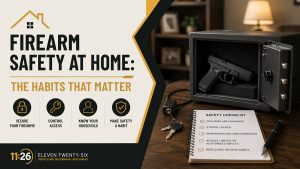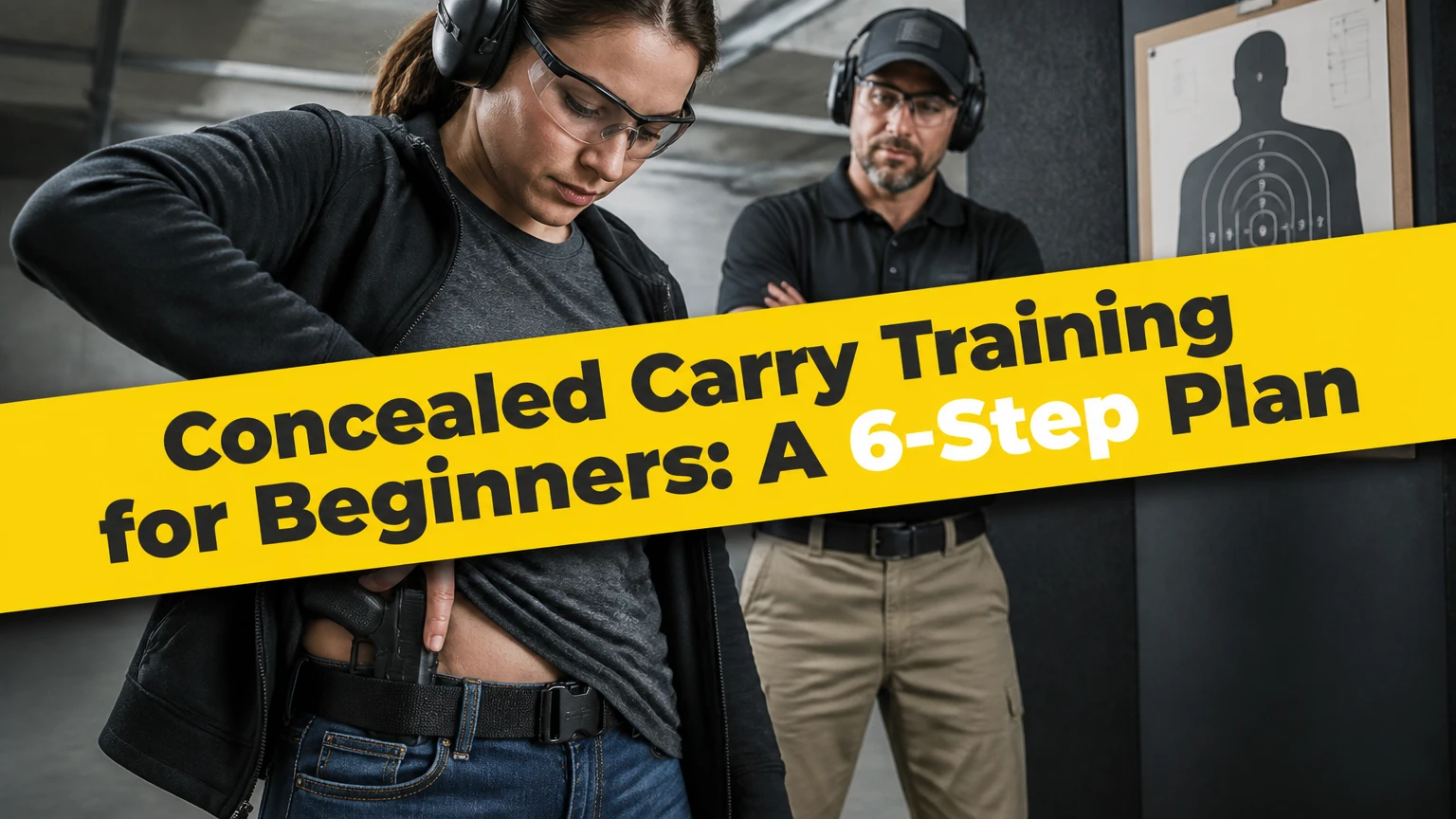
Concealed carry training for beginners combines firearm safety, handgun operation, state-specific law, judgment, and live-fire qualification. A permit class may satisfy a legal requirement, but it rarely creates complete defensive proficiency. Beginners should verify local rules, take hands-on instruction, qualify safely, and continue practicing before carrying in public.
Key Facts at a Glance
A state-approved permit course commonly takes 4-16 hours and costs approximately $75-$150 before ammunition and application fees.
A live-fire qualification commonly uses 10-50 rounds at distances selected by the state or instructor.
Constitutional carry does not eliminate the need to understand use-of-force law, prohibited locations, or safe handling.
A beginner who cannot safely load, unload, holster, and unload a handgun should take a basic pistol class before a permit course.
A permit certificate proves course completion; it does not prove that the holder can safely draw, move, communicate, or make decisions under stress.
State statutes, administrative rules, and the issuing authority control eligibility and permit requirements.
What Does Concealed Carry Training Teach?
Concealed carry training teaches a private citizen how to possess, transport, handle, and carry a hidden handgun within applicable law. The curriculum normally combines the four universal safety rules, handgun controls, loading and unloading, ammunition knowledge, storage, use-of-force concepts, and a supervised shooting qualification.
The legal component matters as much as marksmanship. Students may study prohibited places, defensive display, brandishing, transportation, duty to retreat, stand-your-ground rules, civil liability, notification duties, and interactions with law enforcement. These rules differ substantially by state and sometimes by location within a state.
The National Rifle Association’s published safety guidance states, “Always keep the gun pointed in a safe direction.” That rule remains valid during loading, unloading, holstering, clearing a malfunction, and responding to a qualification problem.
A permit class is usually an entry requirement, not a complete defensive program. Many courses do not provide enough repetitions for safe concealment draws, movement, low-light work, verbal de-escalation, or decision-making around bystanders. A responsible training path treats the permit class as the legal and safety foundation.
What skills should a beginner demonstrate?
A beginner should demonstrate safe muzzle control, trigger-finger discipline, reliable loading and unloading, correct use of the firearm’s safety system, and the ability to stop immediately on command. Shooting accuracy matters, but unsafe gun handling is the more serious failure.
A competent instructor should also explain what the student must do when a firearm malfunctions. During qualification, the student keeps the muzzle pointed downrange, removes the trigger finger from the trigger, and requests help without turning around or attempting an unfamiliar repair.
How Does the Permit Process Work?
The concealed carry permit process normally has six stages: verify eligibility, select an approved course, complete instruction, pass any examination, complete live-fire qualification, and submit the application to the designated authority. States vary on age, residency, training hours, fingerprints, fees, renewal, and processing time.
Step 1: Verify eligibility and local law
Start with the issuing authority, usually a state police agency, sheriff, county clerk, or department of public safety. Confirm the current statute and application instructions rather than relying only on a training company’s summary.
Check these items before paying for a course:
- Minimum age and exceptions for military personnel
- Residency and nonresident application rules
- Disqualifying convictions, restraining orders, and pending charges
- Mental-health or domestic-violence restrictions
- Required identification and proof of residence
- Prohibited places and vehicle-carry rules
- Training-hour, examination, and range requirements
- Permit validity, renewal deadlines, and fees
Federal restrictions also matter. The Bureau of Alcohol, Tobacco, Firearms and Explosives publishes guidance on prohibited persons, but state eligibility rules can be broader or use different terminology. A person with a potentially disqualifying record should obtain qualified legal advice before possessing or carrying a firearm.
Step 2: Select a state-approved instructor
Confirm that the instructor and course are authorized for the specific permit, state, and applicant category. An NRA instructor credential may demonstrate instructor training, but it does not automatically prove that every course satisfies every state’s permit rules.
Ask the instructor for written answers to these questions:
- Which agency approves this course?
- How many classroom and range hours are included?
- Is the certificate accepted by the issuing authority?
- What firearm and ammunition must students provide?
- What is the maximum class size and instructor ratio?
- What happens if a student cannot safely operate a handgun?
- Are makeup sessions and qualification retests available?
- Are legal materials updated when statutes change?
A low student-to-instructor ratio is especially valuable for a first-time handgun owner. One instructor for 4-8 students usually allows more observation than a large class with one instructor supervising a crowded firing line, although local rules and assistant qualifications determine the actual level of support.
Step 3: Complete the classroom phase
The classroom phase covers state law, safe storage, transportation, firearm components, ammunition, defensive-force limits, and the responsibilities attached to carrying in public. Students should leave with specific answers about where they may carry, when they must disclose, and what conduct can create criminal or civil exposure.
Good instruction uses scenarios rather than slogans. For example, a student should understand that “stand your ground” does not authorize force whenever a person is rude, trespasses, threatens property, or refuses to leave. The lawful use of deadly force generally turns on facts such as an objectively reasonable fear of imminent death or serious bodily harm, but the exact standard depends on jurisdiction.
The classroom should also address children, unauthorized access, off-body storage, vehicle storage, alcohol or drug impairment, and interactions with police. A course that spends most of its time selling equipment or repeating generic safety phrases has limited value.
Step 4: Pass the written examination
Many permit courses use a written examination, often with a typical passing threshold of 70%-80%, although the required score and retest policy are jurisdiction-specific. The test may cover safety rules, storage, use of force, prohibited locations, transportation, and state terminology.
Read the questions literally. Confusing a firearm’s lawful possession with lawful use is a common error. Keep the course handbook and official statute available while studying, because a generalized online quiz may describe another state’s rules.
Step 5: Complete live-fire qualification
The live-fire portion verifies safe handling and a minimum level of accuracy under a prescribed course of fire. Typical programs use 10-50 rounds from distances such as 3, 5, 7, or 15 yards, but the exact round count, target, time limit, and passing score belong to the state or approved curriculum.
Students should expect commands to load, fire, cease fire, unload, and show clear. The instructor may evaluate muzzle direction, trigger-finger position, stance, grip, loading procedure, and response to a stoppage in addition to hits on the target.
The qualification is not a realistic simulation of every defensive encounter. It usually occurs on a square range with known distances, a visible target, and a controlled pace. Passing demonstrates compliance with a minimum standard, not mastery of concealed carry.
Step 6: Submit the permit application
The application commonly requires a training certificate, government identification, fingerprints, consent for a background check, photographs, and a fee. Some authorities accept online applications, while others require an appointment or submission through a local office.
Processing times vary from several weeks to several months. Keep copies of the certificate and receipt, verify that names and dates match across documents, and apply before the training certificate expires if the jurisdiction imposes a validity period.
Which Course Format Fits a Beginner?
An in-person class is usually the strongest first choice for a beginner because an instructor can identify unsafe handling immediately. Hybrid courses reduce classroom travel, while advanced defensive courses add concealment and stress skills that a basic permit class usually omits.
| Format | Typical duration | Typical price | Range component | Best use |
|---|---|---|---|---|
| In-person permit class | 4-16 hours | $75-$150 | 1-4 hours, 10-50 rounds | First-time applicant |
| Hybrid online and range | 3-8 online hours plus 1-2 range hours | $60-$120 plus range fees | In person, state dependent | Experienced learner with schedule limits |
| Basic pistol course | 4-8 hours | $100-$250 | 50-150 rounds | Person unfamiliar with handguns |
| Defensive concealed-carry course | 8-16 hours | $200-$500 or more | 200-500 rounds | Permit holder seeking practical skill |
| Private coaching | 1-3 hours per session | $75-$200 per hour | Individually prescribed | Correcting a specific safety or accuracy problem |
In-person training
Traditional instruction offers immediate feedback during loading, unloading, grip changes, and range qualification. It also lets a beginner test whether the instructor explains legal concepts clearly and responds safely to uncertainty.
The limitation is scheduling. A long classroom day can also cause fatigue, which reduces retention and attention on the firing line. Ask whether the course includes breaks, a separate range day, or a beginner orientation.
Hybrid and online training
Online coursework can work for a person who already handles handguns safely and needs flexible scheduling. It is a weaker first experience when the student has never loaded, unloaded, or holstered a handgun under direct supervision.
Verify that online completion is legally accepted. Some states require in-person instruction, a live demonstration, a particular instructor, or a range qualification that an online certificate cannot replace.
Advanced defensive training
Advanced training should follow basic safety competence and permit instruction. Typical content includes drawing from concealment, presentation to a target, shooting from unusual positions, movement, cover, verbal commands, low-light considerations, and malfunction procedures.
A responsible advanced course does not begin with speed contests. The instructor should establish a safe baseline, use clear commands, control muzzle direction, and increase complexity only when students perform safely.
What Does the Training Process Cost?
A realistic beginner budget is approximately $200-$650 before purchasing a firearm, depending on course fees, ammunition, range charges, application costs, fingerprints, and equipment. State fees vary widely, so the issuing authority’s fee schedule should control the final estimate.
| Expense | Typical low | Typical high | When paid |
|---|---|---|---|
| Permit class | $75 | $150 | Registration |
| Basic pistol class | $100 | $250 | Before introductory training |
| Practice ammunition, 100 rounds | $35 | $80 | Before or after class |
| Qualification ammunition, 50 rounds | $18 | $40 | Range day |
| Range or target fee | $15 | $50 | Range visit |
| Fingerprints and photographs | $20 | $100 | Application |
| State or county application fee | $40 | $250 or more | Application |
| Basic eye and ear protection | $15 | $60 | Equipment purchase |
These figures are typical planning ranges, not guaranteed prices. Ammunition costs change by caliber and market conditions, and some classes include targets, range fees, or ammunition while others charge separately.
The lowest advertised class price may not be the lowest total cost. A $75 course that requires a separate $50 range fee, $40 of ammunition, and a second trip can exceed a $125 package with those items included.
What Should You Bring to Class?
Bring government identification, the required course confirmation, eye protection, hearing protection, closed-toe shoes, weather-appropriate clothing, water, and only the firearm and ammunition specified by the instructor. Do not bring a loaded firearm into a classroom unless the instructor’s written policy expressly explains how to transport it.
| Item | Beginner specification | Reason |
|---|---|---|
| Eye protection | ANSI-rated shooting glasses | Reduces risk from fragments and ejected cases |
| Hearing protection | Electronic or passive earmuffs rated for firearms | Protects hearing during live fire |
| Clothing | Closed shoes, high neckline, fitted but flexible shirt | Reduces hot-brass and trip hazards |
| Ammunition | Exact caliber listed by instructor | Prevents unsafe ammunition mismatch |
| Firearm | Instructor-approved, mechanically sound handgun | Supports safe qualification |
| Targets and notebook | Two targets plus written notes | Records corrections and legal questions |
Do not buy a holster, magazine carrier, or concealment garment solely because an advertisement calls it “tactical.” A holster must cover the trigger guard, retain the firearm, remain stable, and permit safe reholstering without placing a finger near the trigger.
Should a Complete Beginner Take Another Class First?
A complete beginner should take a basic pistol or firearms-safety class before a permit course when they cannot confidently identify the handgun’s controls or perform loading and unloading safely. The extra 4-8 hours usually produce more value than struggling through a crowded qualification class.
An instructor can teach the basic grip, sight alignment, trigger control, recoil management, and safe administrative handling without the legal pressure of a permit deadline. Renting two or three suitable handguns at a supervised range may help with fit, but rental policies and state law differ.
A small handgun is not automatically easier to use. Compact and micro-compact pistols can have sharper recoil, shorter grips, smaller controls, and more difficult sight pictures than a slightly larger handgun. The most suitable firearm is the one the student can operate safely, control consistently, and carry in a compliant holster.
What should you practice before range qualification?
Practice only with the instructor’s written approval and a firearm confirmed to be unloaded. A safe dry-fire session uses a separate room, no ammunition in the room, a backstop that would contain a projectile, a repeated chamber-and-magazine inspection, and a final inspection before leaving the practice area.
Begin with five-minute sessions. Practice grip placement, aligning the sights, pressing the trigger without moving the sights, and manipulating the controls. Do not add speed until the movement is safe and repeatable.
How Do You Choose a High-Quality Instructor?
Choose an instructor who can document state approval, explain current law without promising legal immunity, control the firing line, and define measurable safety and qualification standards. Credentials matter, but teaching behavior matters more during a beginner’s first hands-on experience.
Use this screening checklist:
- Confirm approval through the issuing authority.
- Request the current curriculum and certificate wording.
- Ask for the class size and assistant-instructor roles.
- Confirm the range’s distance, target, ammunition, and score rules.
- Ask whether loaner firearms and beginner coaching are available.
- Check the cancellation, retest, and certificate-replacement policies.
- Look for written safety procedures and a clear loaded-firearm policy.
- Avoid instructors who encourage unsafe speed or guarantee permit approval.
A course cannot guarantee approval because the issuing authority controls background checks and eligibility. An instructor who makes that promise is confusing training completion with government approval.
What Problems Do Beginners Commonly Encounter?
Beginners most often struggle with anticipation, grip inconsistency, unfamiliar controls, fatigue, and confusion during a stoppage. The safest correction is slower supervised practice, not immediate speed, heavier ammunition, or a more complicated firearm.
| Problem | Likely cause | Safe correction | Success checkpoint |
|---|---|---|---|
| Shots consistently low | Anticipating recoil or disturbing trigger press | Slow dry-fire and supervised live fire | Sights remain aligned through the click |
| Shots spread horizontally | Uneven grip or trigger-finger placement | Rebuild grip and confirm trigger contact | Group narrows at 3-7 yards |
| Difficulty at 15 yards | Limited sight picture and recoil control | Reduce pace and confirm fundamentals | Hits remain inside the required scoring area |
| Malfunction during qualification | Ammunition, magazine, or firearm issue | Keep muzzle downrange and request instructor help | Student follows cease-fire commands |
| Unsafe reholstering | Clothing or equipment obstructs holster | Stop, look, clear clothing, and reholster slowly | Trigger remains untouched until secured |
| Fatigue and confusion | Long class or excessive first-day shooting | Take breaks and follow instructor pacing | Safe handling remains consistent late in class |
Do not turn around with a malfunctioning firearm. Keep the muzzle downrange, remove the trigger finger, and notify the instructor. The instructor may direct a specific clearance procedure, but a beginner should not improvise one during a qualification.
A flinch is a training problem, not a character flaw. Reducing pace, using a stable grip, and receiving direct feedback usually works better than trying to overpower recoil or firing hundreds of rounds while repeating the same error.
What Changes in Constitutional-Carry States?
Constitutional carry may remove a permit requirement for some eligible adults, but it does not erase location restrictions, prohibited-person rules, use-of-force law, or private-property policies. A permit can also provide reciprocity benefits, but recognition depends on the destination state and the permit holder’s circumstances.
A voluntary course is particularly useful when the state does not require training. It creates a structured opportunity to study local law, safe storage, transportation, and lawful defensive conduct before carrying. Travelers should verify reciprocity through official state sources because agreements and restrictions can change.
Constitutional carry also creates a practical distinction between legal permission and competence. A person may be legally allowed to carry while still lacking the ability to draw safely, recognize a threat, avoid negligent handling, or make a sound decision under stress.
How Often Should You Practice After Certification?
A practical maintenance schedule is one supervised range session every 1-3 months, brief dry-fire sessions once or twice weekly, and a formal refresher or defensive class every 12-24 months. The schedule should become more conservative when the firearm, holster, carry position, or legal environment changes.
Practice should measure safety and consistency rather than dramatic speed. Useful benchmarks include safe loading and unloading, reliable manipulation, controlled hits at 3-15 yards, safe presentation from the selected concealment garment, and an immediate response to a cease-fire command.
Dry fire requires strict separation from live ammunition. Unload the firearm and magazines, remove all ammunition from the practice area, inspect the chamber and magazine well, and use a safe direction or suitable backstop. Restore live ammunition only after the session ends and the firearm is inspected again.
What Equipment Should a New Carrier Delay Buying?
A beginner should delay buying a large equipment package until the firearm, carry position, clothing, and holster have been evaluated together. The first priority is a reliable firearm and a holster that fully covers the trigger guard and stays secured during normal movement.
A rigid belt may improve stability, but a specialized tactical belt is not always necessary. A carrier should also consider safe storage at home, vehicle restrictions, weather, workplace rules, seated comfort, and access by children or visitors.
The most important equipment failure is often poor fit. A holster that shifts, collapses, exposes the trigger, or requires awkward reholstering creates a safety problem regardless of price.
Frequently Asked Questions
Can I take concealed carry training without owning a gun?
Yes, many instructors provide loaner handguns or allow students to rent a firearm, but policies vary. Contact the instructor before registering, ask whether ammunition is included, and confirm that the loaner model is suitable for the student’s hand size and strength. Never borrow an unfamiliar firearm without receiving direct operating instruction.
Is an online CCW class enough to get a permit?
An online class is enough only when the issuing jurisdiction accepts online classroom instruction and the course includes any required in-person qualification. Some states require classroom attendance, instructor observation, or a specific approved curriculum. Verify acceptance with the issuing authority before paying for an online certificate.
Can I carry a different handgun from the one used in class?
Usually, a student may carry a different handgun after qualification, but the rule depends on state law and course requirements. The different firearm may have another action, controls, caliber, grip, or sight system. Train with and function-check the actual carry handgun before carrying it in public.
What happens if I fail the shooting qualification?
The instructor may provide coaching, a retest, or a separate makeup session, depending on the approved curriculum. Ask about the policy before class. If unsafe handling caused the failure, additional basic instruction should come before another attempt; repeatedly shooting for score without fixing the safety issue is inappropriate.
Does passing a CCW class mean I am ready for self-defense?
No. Passing a CCW class generally demonstrates completion of a legal and safety curriculum plus a minimum range standard. It does not establish proficiency in concealment draws, movement, communication, low-light conditions, medical response, or judgment under stress. Those abilities require separate, supervised practice.
Do permit holders need to understand reciprocity?
Yes. Reciprocity determines whether one state recognizes another state’s permit, and recognition can include conditions involving residency, age, vehicle transport, prohibited locations, or notification. Check the destination state’s official law-enforcement or attorney-general source immediately before travel rather than relying on an old map.
The Bottom Line
Concealed carry training for beginners should begin with official eligibility checks, a state-approved instructor, hands-on safety instruction, supervised qualification, and a complete permit application. The best beginner path is usually a basic pistol class followed by an in-person permit course, then continuing practice and concealment-specific instruction.
A certificate is a legal document, not a substitute for competence. Carry only when the firearm, holster, storage plan, legal knowledge, and decision-making standards are ready for the responsibility.