Concealed carry training is a state-approved combination of firearms safety, legal education, and supervised shooting qualification that may support a concealed handgun permit application. The class usually tests whether a student understands local carry and deadly-force rules and can handle a handgun safely, but completing the minimum course does not establish defensive mastery.
Key Facts
Concealed carry training requirements are set by state and sometimes local issuing authority, not by one nationwide curriculum.
A typical basic course combines classroom instruction with a live-fire qualification and may take 4-16 hours.
Typical basic-course ammunition requirements range from 50-100 rounds, although advanced courses may require 200-500 rounds.
A training certificate is not the same document as a concealed carry permit.
Online coursework may satisfy the classroom requirement in some jurisdictions, but a live-fire requirement cannot be assumed away.
Permitless, or constitutional, carry does not eliminate restrictions on prohibited places, prohibited persons, storage, or lawful use of force.
What Is Concealed Carry Training?
Concealed carry training prepares a private citizen to carry a concealed handgun within the limits of applicable law and safe firearms practice. A permit course normally addresses eligibility, prohibited locations, storage, transportation, use of force, handgun operation, and a supervised qualification, while advanced defensive training addresses decision-making and performance beyond the legal minimum.
The central distinction is between certification and competence. Certification means the student completed a government-recognized course or met an application requirement. Competence means the person can consistently handle the firearm safely, recognize when force is unlawful, manage stress, and make sound decisions without creating unnecessary danger.
The National Rifle Association states a foundational firearms rule as: “Always keep the gun pointed in a safe direction.” That rule applies during instruction, dry practice, loading, unloading, holster work, and every range transition.
What Does a CCW Class Actually Test?
A CCW class usually tests knowledge in two domains: legal comprehension and safe physical handling. The written portion may use multiple-choice questions, while the range portion evaluates safe gun manipulation and accuracy against a state-defined course of fire.
| Assessment area | Typical content | Common result |
|---|---|---|
| Legal examination | Deadly force, prohibited places, carry restrictions, transport | Pass or remediation |
| Safety examination | Muzzle direction, trigger control, loading, unloading | Pass or removal from range |
| Firearm handling | Grip, stance, chamber checks, magazine changes | Instructor observation |
| Live-fire qualification | 3-15 yard strings, 50-100 rounds, silhouette target | Qualify or retest |
| Administrative completion | Attendance, identity, certificate paperwork | Certificate issued |
A qualification is not generally a realistic simulation of a violent encounter. It is a controlled assessment performed on a known range with known targets, predictable commands, and protective procedures. Students should not confuse passing a qualification with being ready for movement, low light, crowded environments, or complex decisions.
How Does Concealed Carry Training Work?
A standard concealed carry course moves from rules and responsibilities to safe equipment handling and then to supervised live fire. The student first learns the jurisdiction’s requirements, demonstrates safe manipulation with an unloaded firearm, completes classroom assessments, and performs a qualification only after the instructor confirms range readiness.
Step 1: Verify Your State Requirements
Start with the issuing authority’s current website, such as a state police department, Department of Public Safety, county sheriff, or equivalent licensing agency. Confirm whether the jurisdiction requires a permit, approved instructor, minimum hours, live fire, fingerprints, a background check, a written examination, and renewal training.
Do not rely on a course advertisement as the final legal source. State rules can change, and neighboring states may use different terms, forms, or issuing authorities.
| Requirement | Typical range or rule | Why it matters |
|---|---|---|
| Course length | 4-16 hours | Determines schedule and certificate validity |
| Live-fire ammunition | 50-100 rounds | Affects firearm, range, and ammunition planning |
| Qualification distance | 3, 5, 7, or 15 yards | Varies by state and instructor course |
| Written-test threshold | 70%-80% | A failed exam may require remediation |
| Application fee | $20-$150 or more | Paid separately to the government agency |
| Renewal period | 2-8 years | Expiration and refresher rules differ |
“Constitutional carry” describes permitless carry in some circumstances, not universal permission to carry anywhere. A person may still face restrictions based on location, age, prohibited-person status, firearm type, manner of carry, alcohol or cannabis use, or other state-specific conditions.
Step 2: Choose an Approved Instructor and Course
Choose an instructor whose approval can be verified through the relevant state agency. Ask for the exact course name, approval number if applicable, classroom and range locations, equipment policy, refund terms, certificate expiration, retest policy, and whether the class accommodates beginners.
A sound instructor explains safety commands before ammunition enters the range. The instructor should maintain a controlled student-to-instructor ratio, separate loaded and unloaded firearm handling, provide eye and ear protection requirements, and stop unsafe conduct immediately.
Step 3: Complete the Classroom Portion
The classroom portion usually covers state statutes, definitions, ethical responsibilities, conflict avoidance, safe storage, transport, and the consequences of a defensive shooting. Some courses use a full-day lecture, while hybrid courses place approved legal modules online before an in-person range session.
The strongest classes teach decision boundaries rather than slogans. “Stand Your Ground” and “Castle Doctrine” are legal labels with jurisdiction-specific limits; neither label automatically authorizes force. Students need to understand concepts such as imminence, necessity, proportionality, ability, opportunity, jeopardy, retreat rules where applicable, and the difference between displaying a firearm and using deadly force.
A defensive shooting can trigger police interviews, evidence preservation, witness identification, civil litigation, and emotional trauma. A permit class cannot provide individualized legal advice, so students should identify a qualified local attorney before carrying if they need advice about a particular circumstance.
Step 4: Demonstrate Safe Firearm Handling
Before live fire, the instructor normally checks that the student can identify the firearm’s controls and safely perform basic operations. Depending on the handgun, this can include verifying unloaded status, inserting and removing a magazine, locking the slide open, checking the chamber, applying or understanding a safety, and responding to range commands.
| Skill checkpoint | Student action | Failure consequence |
|---|---|---|
| Muzzle control | Keep muzzle within the approved safe direction | Immediate correction or removal |
| Trigger discipline | Keep trigger finger indexed until firing | Safety violation |
| Loading and unloading | Follow instructor commands and sequence | Remediation before firing |
| Malfunction response | Keep muzzle safe and await or follow instruction | Unsafe improvisation prohibited |
| Holster handling | Use only an approved, secure holster when authorized | No holster draw if unsafe |
A basic permit course may not permit drawing from concealment at all. Some instructors require students to begin from a low-ready or bench position because introducing a holster before safe gun handling creates avoidable risk.
Step 5: Complete the Live-Fire Qualification
The live-fire qualification is a prescribed shooting exercise conducted under range commands. Typical courses use a silhouette or B-27-style target, several distances between 3 and 15 yards, and a minimum hit or score requirement, but the exact round count, time limits, target zones, and scoring method belong to the jurisdiction or approved course.
A typical sequence may include slow fire at a short distance, controlled strings from farther away, and administrative loading or unloading. Those examples are not universal requirements. The instructor’s written course document and state agency rules control.
Students should arrive already able to operate the firearm safely. Range day is a poor time to learn basic loading, grip, sight alignment, or trigger control for the first time.
What If You Fail the Shooting Test?
If a student fails the qualification, the instructor may provide coaching and a retest, require another class, or issue no certificate, depending on state and course rules. A student should ask about retesting before booking because some programs charge a separate range fee or require a new application.
Failure often results from unfamiliar equipment, poor zeroing, anxiety, inadequate practice, or misunderstanding the scoring zone. The safe response is additional supervised instruction, not faster shooting or unsafe shortcuts.
Step 6: Apply for the Permit
After successful completion, the instructor provides a signed certificate or electronically submits completion information according to state procedure. The applicant then submits the permit application, identification, photographs where required, fingerprints, background-check authorization, and government fee to the designated authority.
The issuing agency, not the instructor, decides whether the applicant qualifies for the license. Processing times can range from several days to several months, depending on state workload and background-review procedures.
What Subjects Are Covered in CCW Training?
CCW instruction normally connects four subjects: law, safety, firearm operation, and concealed-carry planning. The balance differs by state, so a legally sufficient course may provide only limited shooting instruction.
Law and Use of Force
The legal module explains when possession and carry are lawful, where carry is restricted, how force law defines an immediate threat, and what obligations follow a defensive incident. It may also address duty to retreat, defense of others, protection of property, brandishing, warning shots, and interactions with law enforcement.
Rules change at state borders. Reciprocity agreements can be limited, suspended, or subject to conditions such as resident status, minimum age, or recognition of the issuing state’s permit type.
Firearm Safety and Mechanics
Students learn the four widely taught safety principles, basic handgun components, ammunition identification, safe storage, child access prevention, and transportation. A responsible course also discusses negligent discharges, unauthorized access, and the difference between a loaded firearm and a secured firearm.
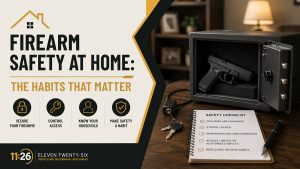
Safe storage is not merely an equipment issue. Storage decisions must account for children, visitors, household members, theft risk, rapid access, and the law in the relevant jurisdiction.
Defensive Shooting Fundamentals
Entry-level courses usually introduce stable shooting positions, sight use, trigger control, recoil management, and accuracy. Advanced defensive classes may add movement, low-light identification, one-handed operation, cover, communication, and scenario-based judgment, but those subjects require more supervision and should follow demonstrated basic competence.
The practical objective is controlled, accountable performance. Speed has value only after the student can keep the muzzle safe, identify the target, and place hits where legally and tactically justified.
Concealment and Carry Equipment
A concealed-carry system includes the handgun, holster, belt or support garment, clothing, and a safe method of access. Appendix, strong-side hip, and other positions involve trade-offs in comfort, concealment, access, muzzle orientation, and safe reholstering.
| Carry factor | Common option | Practical trade-off |
|---|---|---|
| Position | Appendix inside waistband | Strong concealment, requires careful holster fit |
| Position | Strong-side hip | Familiar access, can print under short garments |
| Holster retention | Rigid trigger-guard coverage | Reduces trigger contact risk |
| Belt support | Purpose-built gun belt | Reduces sag and shifting |
| Clothing | Untucked overshirt | Improves concealment, may slow access |
| Storage | Lockbox or quick-access safe | Balances access with unauthorized-entry control |
A holster must fully cover the trigger guard, retain the firearm, remain stable during normal movement, and permit safe reholstering. A loose pocket, soft container, or unprotected waistband is not an equivalent substitute.
Which Training Format Fits Your Situation?
In-person instruction is the safest default for a new handgun owner because an instructor can correct unsafe handling in real time. Hybrid training can improve scheduling flexibility when the state permits it, but online lessons cannot replace physical coaching, live-fire practice, or a required qualification.
| Format | Typical time | Typical cost | Best fit | Main limitation |
|---|---|---|---|---|
| In-person permit class | 4-16 hours | $75-$300 | Beginners and first-time applicants | Fixed schedule |
| Hybrid classroom and range | 2-8 online hours plus range | $75-$250 | Experienced students with schedule limits | Less live classroom interaction |
| Online-only course | 2-8 hours | $30-$150 | Only where legally accepted | May not satisfy live-fire rules |
| Advanced defensive course | 8-24 hours | $200-$1,000 | Permit holders seeking broader skills | Higher cost and ammunition use |
Online validity is jurisdiction-specific. A course certificate from one state may not satisfy another state’s application requirement, and a course that issues a certificate may not confer reciprocity elsewhere.
How Much Time, Money, and Ammunition Should You Plan?
A typical basic permit pathway takes one class day plus application-processing time and costs approximately $95-$450 before purchasing a firearm, holster, secure storage, or additional practice ammunition. The largest variables are state fees, course length, fingerprinting, local range prices, and whether the applicant already owns suitable equipment.
| Expense or resource | Typical amount | Usually paid or used when |
|---|---|---|
| Basic course | $75-$300 | Registration |
| State application | $20-$150+ | Permit submission |
| Fingerprinting | $15-$75 | Application appointment |
| Practice ammunition | 50-100 rounds | Class and qualification |
| Eye and ear protection | $20-$80 | Range session |
| Additional practice | $25-$150 per session | After certification |
These figures are planning ranges, not national mandates. Some states require no training for a permitless-carry category, while other states require substantially longer instruction or a particular approved curriculum.
What Should a Beginner Do Before Class?
A beginner should verify the law, select an approved instructor, bring the requested identification and equipment, and avoid purchasing a handgun solely because it is small or inexpensive. A rental or introductory class can reveal whether the student can operate the controls, manage recoil, and reach the trigger safely.
Use this preparation checklist:
- Confirm the instructor’s state approval and class requirements.
- Read the range’s firearm and ammunition rules.
- Bring government identification, payment, water, and closed-toe shoes.
- Use properly fitting eye and hearing protection.
- Bring only the firearm and ammunition the instructor authorizes.
- Tell the instructor about limited experience, hearing concerns, vision needs, mobility restrictions, or language barriers.
- Do not handle a firearm outside the instructed procedure.
A beginner who has never handled a handgun safely may benefit from a basic firearms orientation before the permit class. That extra session can reduce range delays and prevent the student from treating qualification as an introductory lesson.
What Does Training Not Teach?
A minimum CCW course does not guarantee accurate shooting under stress, lawful judgment in every circumstance, safe concealed access from every position, or competent medical and post-incident response. It also does not provide a permanent update when statutes, prohibited-place rules, or reciprocity agreements change.
This limitation matters because the permit system measures a narrow threshold. A student can pass a written test and qualification while lacking practice with their actual carry equipment, ordinary clothing, low-light identification, communication, or emergency planning.
A practical continuing plan should include periodic safety review, supervised live-fire practice, dry practice only with strict unloaded-firearm procedures, and legal updates from authoritative state sources. Advanced force-on-force training should be considered only after basic handling is reliable and the instructor uses safe, purpose-built training equipment.
What Common Problems Occur During Qualification?
Qualification problems usually involve unfamiliar equipment, poor preparation, unsafe handling, or anxiety rather than an inherently difficult target. Each problem requires a safety-first correction, and students should follow the instructor instead of attempting improvised fixes.
| Problem | Likely cause | Safe correction |
|---|---|---|
| Shots consistently miss | Unfamiliar sights or trigger | Pause for instructor coaching |
| Recoil feels unmanageable | Poor fit or excessive ammunition load | Use authorized equipment and slower strings |
| Malfunction occurs | Ammunition, magazine, or technique issue | Keep muzzle safe and follow commands |
| Student freezes | Anxiety or unclear commands | Ask for repetition before acting |
| Unsafe muzzle movement | Fatigue or weak habits | Stop, unload as directed, and remediate |
| Failed score | Insufficient practice or wrong scoring zone | Confirm scoring and schedule retest |
A right-handed shooter who hits low and left may be anticipating recoil or disturbing the trigger press, but that pattern is not a diagnosis by itself. Grip, sight alignment, ammunition, firearm fit, and target distance also matter, so an instructor should evaluate the shooter rather than apply a single internet correction.
What Happens After Certification?
After certification, the applicant submits the permit materials and waits for the issuing authority’s decision. Once approved, the permit holder must carry according to current law, observe prohibited locations, maintain secure storage, and verify reciprocity before crossing state lines.
A permit does not transfer the instructor’s authority to the student. The permit holder remains responsible for knowing current rules, including signage requirements, government buildings, schools, private-property restrictions, alcohol-related provisions, and vehicle transport rules.
Post-class practice should focus first on safe handling and consistent accuracy with the actual carry system. A permit holder should also develop a plan for securing the firearm at home, in a vehicle where lawful, and during activities where carrying is prohibited.
How Often Should Permit Holders Train?
No universal practice interval creates competence, but a reasonable plan includes short, regular safety and handling reviews plus periodic supervised live fire. New carriers should practice more frequently during the first months because equipment fit, concealment, and safe administrative handling are still unfamiliar.
The training cycle should change when the firearm, holster, carry position, clothing, eyesight, physical ability, or governing law changes. Renewal requirements are legal minimums, not performance recommendations.
What Are the Main Edge Cases?
Several situations require extra verification before a person relies on a basic certificate or permit:
- Moving to another state: A new state may reject the old certificate, require residency, or impose separate training.
- Crossing state lines: Reciprocity is not automatic, and federal or state transport rules may apply.
- Permit expiration: An expired permit may remove carry privileges even when renewal is pending.
- Online completion: Digital attendance may be accepted for one jurisdiction and rejected by another.
- Disability or language needs: Ask the approved provider and issuing authority about lawful accommodations before class.
- Prior criminal or mental-health records: Eligibility questions require the issuing authority or a qualified attorney, not an instructor’s guess.
- Private property: A private owner may impose restrictions that differ from public-place rules.
- Defensive incident: Contact emergency services, follow lawful instructions, and obtain qualified legal counsel; do not treat a training certificate as legal representation.
Frequently Asked Questions
Is concealed carry training the same as a gun-safety class?
No. A gun-safety class may focus on storage, basic handling, and safe operation, while concealed carry training adds jurisdiction-specific permit law and often a live-fire qualification. Some permit courses assume prior familiarity, so beginners may need a separate orientation before attending.
Can you take concealed carry training without owning a handgun?
Often, yes, if the instructor supplies or permits a rental firearm and the range allows it. Students should confirm caliber, ammunition, holster, eye protection, and rental policies in advance. Purchasing a handgun before receiving instruction can create avoidable fit and recoil problems.
Does passing the shooting qualification mean I am ready to carry?
No. Passing proves only that the student met a defined course threshold under controlled conditions. It does not establish competence with concealment, movement, low-light identification, legal judgment, communication, or emergency response. Additional supervised practice is the responsible next step.
Can an online CCW class qualify you for a permit?
Sometimes, but only when the relevant jurisdiction accepts that format and all required components are completed. Many jurisdictions still require in-person instruction, live fire, or both. Verify the course with the issuing authority before paying for a certificate.
Does a concealed carry permit work in every state?
No. Recognition depends on reciprocity law, permit type, residency, age, and compliance with the destination state’s restrictions. A permit holder should check official state information immediately before travel because agreements and prohibited-location rules can change.
What should you do if you feel unsafe during class?
Tell the instructor immediately and keep the firearm pointed in the range’s approved direction unless directed otherwise. A competent instructor can pause the exercise, unload the firearm, provide coaching, or stop participation. Safety concerns should never be concealed to avoid embarrassment.
The Bottom Line
How concealed carry training works is best understood as a staged qualification process: verify state rules, complete legal and safety instruction, demonstrate controlled firearm handling, pass any written exam, complete the live-fire requirement, and submit the permit application. The certificate may satisfy a legal threshold, but continuing practice and current legal knowledge determine whether carrying is responsible.