Defensive gun use in the United States is estimated at anywhere from roughly 60,000 to 2.5 million incidents per year, but no study can establish how many lives guns save. The range reflects different survey designs and definitions, while many reported incidents involve deterrence without a shot and cannot prove that a death would otherwise have occurred.
Key Facts at a Glance
- Defensive gun use means using or displaying a firearm to resist an actual or perceived criminal threat.
- Published annual estimates range from about 60,000-120,000 incidents in federal victimization data to approximately 2.2-2.5 million in the 1993 Kleck and Gertz survey.
- A defensive gun use is not automatically a life saved, because the counterfactual outcome is usually unknown.
- Most reported defensive uses do not involve firing the weapon, although the exact proportion varies by study and question wording.
- FBI justifiable-homicide counts measure a narrow category of killings, not the total number of defensive incidents or lives preserved.
- Firearm access can also create risks, including suicide, accidental injury, theft, and unauthorized access, so net safety cannot be inferred from DGU counts alone.
What Counts as a Defensive Gun Use?
A defensive gun use occurs when a civilian uses, displays, or retrieves a firearm in response to criminal victimization or a perceived criminal threat. Researchers may include pointing a gun, showing a gun, threatening to shoot, firing at an attacker, or shooting an intruder, so the estimate changes with the definition.
The central entity is the defensive gun use, commonly abbreviated DGU. A DGU is not the same as a legally justified shooting. It is also not automatically proof that a firearm prevented a murder. A respondent may believe a gun stopped an assault, robbery, burglary, or rape, while researchers cannot observe what would have happened without the firearm.
| Event category | Firearm involvement | Does it prove a life saved? |
|---|---|---|
| Gun displayed during an assault | Yes, no shot required | No, the alternative outcome is unknown |
| Warning or threat with a firearm | Yes, no injury may occur | No, the offender may have fled anyway |
| Defensive shot fired, no fatality | Yes, discharge occurred | No, injury prevention remains difficult to measure |
| Civilian kills attacker | Yes, fatal shooting | Establishes a death, not necessarily a life saved |
| Police classify shooting as justified | Yes, official review | Measures legal classification, not total DGUs |
The distinction matters because “guns save lives” is a causal claim. A frequency survey usually records what respondents say happened; it does not run a controlled comparison between an armed and unarmed version of the same event.
How Often Do Guns Save Lives?
No reliable national statistic measures lives saved by guns. The best-supported statement is narrower: United States studies have estimated tens of thousands to several million defensive gun uses annually, while the number of deaths prevented cannot be observed directly.
The low and high estimates are not competing measurements of exactly the same outcome. The National Crime Victimization Survey, or NCVS, asks crime victims about defensive actions within a large federal survey. Private surveys, including the 1993 National Self-Defense Survey by Gary Kleck and Marc Gertz, ask respondents directly about defensive firearm use and can capture events never reported to police.
| Estimate or source | Approximate annual result | What it measures | Main limitation |
|---|---|---|---|
| NCVS analyses | 60,000-120,000 | DGUs connected to surveyed victimization | Small numbers and survey undercount concerns |
| Kleck and Gertz, 1995 | About 2.2-2.5 million | Respondent-reported firearm defenses | Recall, classification, and false-positive concerns |
| William English survey, 2021 | About 1.6 million | Respondent-reported defensive uses | Sampling and self-report criticism |
| FBI justifiable-homicide records | Historically several hundred civilian cases annually | Narrow official fatal-shooting category | Not a count of all lives saved or all DGUs |
Kleck and Gertz described firearms as used defensively “about 2.5 million times a year,” a frequently quoted conclusion from their survey. That estimate remains influential, but it does not establish that 2.5 million killings were prevented. RAND Corporation’s review of defensive-gun-use research rates the evidence as inconclusive, because studies produce materially different results and face measurement problems.
Why Are the Estimates So Different?
The estimates differ because researchers sample different people, ask different questions, use different time periods, and classify different events as defensive. A federal victimization survey and a gun-owner survey can both be conducted competently while producing incompatible totals.
What the NCVS can and cannot capture
The NCVS is administered by the U.S. Census Bureau for the Bureau of Justice Statistics and surveys households about crime victimization. Its design connects defensive actions to reported or discovered victimization, which reduces the chance that an ordinary threatening interaction is counted as a criminal event.
That design also excludes or underrepresents some incidents. People may not report crimes, may misunderstand the question, may refuse to disclose illegal firearm possession, or may not describe a confrontation as a victimization. Rare events create another problem: a small change in responses can produce a large change when researchers annualize the result nationally.
Why private surveys produce higher numbers
Private surveys can ask directly whether a respondent used a firearm for protection during a specified period. They may capture incidents involving burglars, strangers, family disputes, animals, or perceived threats that never entered official crime records.
The same breadth creates false-positive risk. Respondents may count brandishing during an argument, misunderstand the legal meaning of self-defense, remember an event inaccurately, or report a defensive action that did not stop a crime. The survey may also overrepresent firearm owners who are more attentive to defensive-use questions.
| Measurement issue | Lower estimate tendency | Higher estimate tendency |
|---|---|---|
| Sampling frame | Crime victims in surveyed households | Gun owners or broad adult samples |
| Event definition | Confirmed or reported victimization | Perceived threat or self-described defense |
| Recall period | Shorter, structured period | Longer period with annual extrapolation |
| Reporting behavior | Missed unreported crime | Misclassified noncrime encounters |
| Statistical effect | Fewer counted incidents | More nationalized incidents from rare responses |
Neither side can simply dismiss the other. The NCVS may miss private defensive actions, while private surveys may count events that do not meet a consistent criminal or legal standard.
Are Shots Usually Fired?
Most reported defensive gun uses do not involve firing, but the exact percentage is study-specific rather than a universal 81.9% rule. Deterrence may occur when a person displays a firearm, verbally announces it, or causes an aggressor to leave before physical violence escalates.
The often-repeated figure of approximately 82% comes from analyses associated with defensive-use surveys, not from a single permanent national measurement. Different surveys define “used” differently, and respondents may report a firearm that was present but never displayed. A nonfiring DGU can still involve serious danger, especially when a firearm is taken from storage during a fast-moving household confrontation.
| Reported defensive outcome | Typical description | Interpretation limit |
|---|---|---|
| Threat ended after display | Aggressor leaves or stops | Cannot prove a shooting would have occurred |
| Threat ended after verbal warning | Firearm may remain unseen | May reflect other factors |
| Shot fired without fatality | Attacker injured, missed, or fled | Does not measure prevented death |
| Attacker killed | Fatal defensive shooting | Requires separate legal and factual review |
| Firearm used unsuccessfully | Gun malfunction, loss, or escalation | Shows access does not guarantee protection |
The practical implication is important: the common DGU event is not necessarily a gunfight. It is a tense encounter whose outcome may depend on distance, escape opportunities, other people present, police arrival, and the aggressor’s original intent.
What Does “Save a Life” Actually Mean?
“Save a life” means that a person would otherwise have died and that firearm intervention changed the outcome. Most DGU research cannot demonstrate that counterfactual, so researchers should report defensive incidents separately from lives saved.
A firearm may prevent an assault without preventing a homicide. A burglar may flee before intending violence. An aggressor may stop because a neighbor arrives. In other cases, a displayed gun may escalate a dispute, be taken by another person, or be fired at an innocent bystander. The same event can be described as successful deterrence by one respondent and an unsafe escalation by another.
Official justifiable-homicide data provide a narrower but more verifiable category. FBI records historically show several hundred civilian justifiable homicides in a typical year, though reporting practices and category definitions have changed. That count confirms fatal defensive shootings, not the number of lives preserved, because it cannot reveal whether the deceased attacker would have killed anyone.
Why official fatality counts are not a denominator
A death prevented has no body and usually no independently measurable counterfactual. Police records can document a shooting, witnesses, injuries, and legal findings, but they cannot normally document the exact fatal outcome that would have occurred if the defender had been unarmed.
Researchers therefore use terms such as “defensive gun use,” “defensive shooting,” and “justifiable homicide” carefully. Treating them as interchangeable inflates certainty and makes the public debate less precise.
Does Location Change the Answer?
Location changes both the opportunity for defensive use and the risks of firearm access. A home, vehicle, workplace, and public street present different distances, escape options, bystanders, storage conditions, and legal standards.
A firearm in a home may be relevant during a burglary, but household members can also encounter the gun during a family dispute, suicidal crisis, or unauthorized search. A concealed firearm may be carried in public, but crowded spaces increase the chance that a mistaken identification or missed shot harms someone else. These factors prevent one national average from answering every household’s risk question.
| Setting | Potential defensive circumstance | Distinctive risk or constraint |
|---|---|---|
| Home | Burglary or violent intrusion | Children, visitors, and storage access |
| Vehicle | Carjacking or roadside threat | Limited movement and nearby traffic |
| Workplace | Armed assault or robbery | Employer rules and bystanders |
| Public space | Robbery or attack | Identification errors and crowded surroundings |
| Rural property | Trespass or animal threat | Long distances and delayed emergency response |
A firearm is not a substitute for escape, a locked door, emergency communication, or medical planning. In many situations, creating distance and contacting emergency services reduces danger without introducing a weapon into the encounter.
Does Firearm Type Determine How Often Guns Save Lives?
Firearm type does not determine how often guns save lives. Research estimates concern incidents and outcomes, not a proven advantage for handguns, revolvers, or shotguns, and no credible national dataset shows that one category produces a known number of saved lives.
The equipment debate often confuses capability with outcome. A compact handgun may be easier to carry, a revolver may have simpler controls, and a shotgun may be difficult to maneuver in a confined home. None of those attributes establishes that the firearm prevented a death. Safe handling, lawful possession, secure storage, judgment, and training conditions affect risk more directly than marketing categories.
| Firearm category | Common characteristic | Limitation relevant to safety |
|---|---|---|
| Semi-automatic handgun | Typical capacity of 10-17 rounds | More controls and possible manipulation errors |
| Revolver | Common capacity of 5-6 rounds | Reloading can be slower under stress |
| 12-gauge shotgun | Large platform with high recoil | Difficult storage, movement, and wall penetration concerns |
| .380 ACP handgun | Smaller cartridge and compact size | Reduced control for some users and limited grip area |
This is not a recommendation to acquire a firearm. People who already possess one should follow the manufacturer’s manual, local law, and instruction from a certified firearms educator rather than internet drills or improvised handling advice.
How Should Firearms Compare With Alternatives?
Firearms should be compared with layered safety measures, not treated as the only response to crime. Better locks, lighting, alarms, emergency communication, escape planning, and secure storage can reduce exposure to danger without creating the same risks associated with a loaded weapon.
No alternative has a universal success rate. The relevant question is which intervention addresses the household’s specific threat while minimizing foreseeable harm. A person facing repeated stalking, for example, may need documentation, address protection, police reporting, workplace coordination, and a safety plan rather than relying on a weapon alone.
| Safety measure | Typical cost range | Primary benefit | Key limitation |
|---|---|---|---|
| Exterior deadbolt and reinforced strike plate | $40-$250 | Delays forced entry | Does not stop an occupant already inside |
| Monitored alarm | $20-$60 monthly | Sends an alert after activation | Response time varies by location |
| Exterior lighting | $30-$200 per fixture | Improves visibility and deterrence | Does not prevent all entry |
| Emergency phone plan | $0-$100 monthly | Enables rapid communication | Requires access and signal |
| Firearm with secure storage | $300-$1,000+ plus training | May provide defensive capability | Adds injury, suicide, theft, and misuse risks |
The honest limitation is that no study can convert these prices into a universal number of lives saved. Cost-effectiveness depends on the baseline threat, household behavior, storage discipline, and whether residents can use the measure safely under stress.
What Safety Practices Change the Balance?
Secure storage changes the risk profile more reliably than simply purchasing a firearm. The Centers for Disease Control and Prevention identifies firearm injury and death as including homicide, suicide, unintentional injury, and other categories, so a household assessment must count both potential defensive benefit and access-related harm.
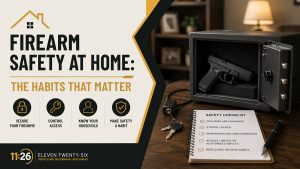
A responsible storage plan keeps firearms inaccessible to unauthorized users, uses a locking device or locked container, stores ammunition securely, and separates access from children or visitors. The exact arrangement must remain compatible with local law and the owner’s safety plan, but “loaded and unlocked” should never be treated as a default.
Household factors to assess
- Children and adolescents: Include visiting children, not only residents.
- Suicide risk: Temporary crisis, depression, substance use, or prior attempts change the safety calculation.
- Domestic violence: Firearm access can increase lethality during intimate-partner violence.
- Cognitive impairment: Dementia, medication effects, and severe intoxication create access risks.
- Unauthorized users: Theft and informal borrowing can extend risk beyond the home.
- Training and storage consistency: A plan that fails during travel or panic is not a complete plan.
RAND’s evidence reviews find stronger evidence for some firearm-harm interventions than for claims that defensive ownership produces a measurable population-wide reduction in homicide. That does not prove that no individual has benefited from a firearm. It means individual anecdotes cannot establish a national rate.
Does Defensive Use Always Mean a Lawful Use?
Defensive use does not always mean lawful use. Legality depends on jurisdiction and facts such as whether the threat was imminent, whether the defender reasonably believed force was necessary, whether the response was proportionate, and whether the defender was legally permitted to possess or carry the firearm.
“Stand your ground” and “duty to retreat” are shorthand labels, not complete legal advice. States differ on retreat, home-defense presumptions, carrying in prohibited places, brandishing, warning shots, and civil liability. A person should consult current state statutes and a qualified local attorney before relying on a legal assumption.
Police classification is also not a final universal truth. Prosecutors, courts, and civil proceedings may evaluate the same incident differently, while survey respondents may call an event self-defense even when authorities would classify it as unlawful brandishing or assault.
Can the Figures Be Applied Internationally?
United States DGU estimates should not be applied to other countries. Firearm prevalence, reporting systems, survey wording, self-defense law, emergency response, and criminal patterns differ enough to invalidate a direct international comparison.
The NCVS is a United States survey, and the Kleck and Gertz estimate describes the United States in the early 1990s. A country with lower firearm ownership may record fewer firearm defenses but also different rates of armed crime and different risks from household access. International comparisons require matched definitions and comparable samples.
What Can Researchers Conclude?
Researchers can conclude that civilian defensive firearm use occurs and that annual estimates vary dramatically, but researchers cannot produce a settled national count of lives saved. The most defensible answer combines a range for reported DGUs with an explicit warning that incident counts are not mortality-prevention counts.
The evidence supports four statements:
- Low-end federal survey estimates count tens of thousands of annual incidents.
- High-end private surveys count more than one million self-reported incidents.
- Many reported uses end without a shot, although the exact share is disputed.
- The causal number of lives saved remains unknown.
The question also has a population-health dimension. Defensive benefits, accidental injuries, suicides, homicides, theft, and legal consequences all belong in the analysis. A serious answer cannot count only successful defenses while ignoring harms associated with firearm availability.
FAQ
How many people are killed in defensive gun uses?
A relatively small number of defensive incidents end with a civilian killing an alleged attacker. FBI justifiable-homicide records historically report several hundred civilian cases in a typical year, but the number varies with reporting and classification. Those deaths are not equivalent to lives saved, because the attacker’s intended future harm cannot be measured.
Do guns prevent more crimes than they cause?
No single national dataset answers that comparison with confidence. Studies count defensive use, firearm injury, suicide, homicide, and accidental injury through different systems, while the causal effect of firearm access varies by setting. A household-level answer requires considering storage, domestic violence, suicide risk, children, local crime, and alternatives.
Are defensive gun uses reported to police?
Some are reported, but many are not. A person may call police after a crime or shooting, while another person may leave without reporting a confrontation that ended after a firearm was displayed. Underreporting can lower official estimates, but private surveys can overcount events that were not crimes or legally justified defenses.
Do most defensive gun uses happen at home?
Available surveys identify homes and other private locations as important settings, but the exact share depends on the study’s sample and definitions. Home incidents also involve distinctive risks because firearms may be accessible to children, visitors, or household members in crisis. Location alone does not establish that a firearm improved the outcome.
Does owning a gun make a household safer?
Ownership does not guarantee greater safety. A firearm may provide a defensive option in a specific confrontation, but unsecured access increases risks involving suicide, accidental injury, theft, misuse, and domestic violence. Safety depends on lawful possession, secure storage, training, judgment, household conditions, and the availability of nonfirearm protective measures.
What is the most accurate answer to the query?
The most accurate answer is that guns are used defensively in the United States somewhere from tens of thousands to more than one million reported incidents annually, depending on the method, but the number of lives actually saved is unknown. The evidence does not support one universally accepted annual total.
The Bottom Line
How often do guns save lives? No study can supply a verified frequency of lives saved. Research supports a broad range of annual defensive gun-use estimates, from approximately 60,000-120,000 in federal victimization analyses to about 2.2-2.5 million in the influential Kleck and Gertz survey, but those figures measure reported defensive incidents rather than proven deaths prevented. A sound decision weighs potential protection against firearm access, storage, legal, and health risks in the specific household.