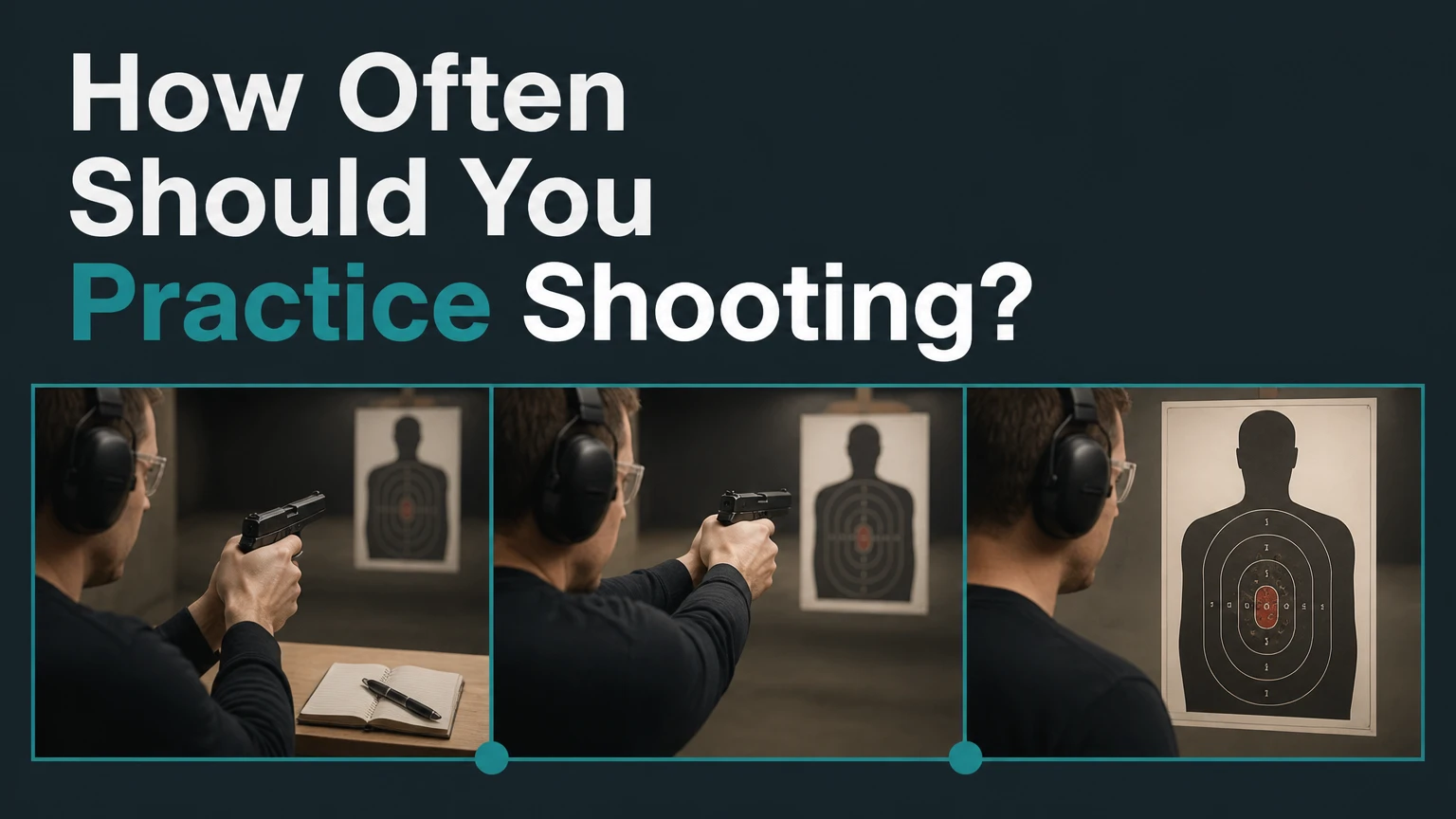
How often you should practice shooting depends on your goal, experience, firearm, and ability to train safely. For most firearm owners, 10-15 minutes of supervised-quality dry fire 3-5 times weekly plus one structured live-fire session every 2-4 weeks maintains and gradually improves basic skill; beginners should add professional instruction before increasing speed or volume.
Key Facts at a Glance
Firearm proficiency declines when trigger control, visual processing, and recoil management are not reinforced.
A practical baseline is dry fire 3 times weekly for 10 minutes and live fire once monthly.
A live-fire session should have one or two measurable objectives, not an arbitrary round count.
Fifty to 100 carefully observed rounds can provide more useful feedback than several hundred unfocused rounds.
Dry fire cannot reproduce recoil, muzzle blast, ammunition function, or shot-to-shot recovery.
Stop when concentration, safe handling, grip control, or shot quality deteriorates.
What Counts as Shooting Practice?
Firearm practice includes dry fire, live fire, formal instruction, simulator work, and deliberate review of performance. Each method develops a different part of the skill, so frequency should be planned as a combination rather than treated as a single weekly number.
Dry fire means practicing with ammunition completely absent from the firearm and practice area. It can reinforce a consistent grip, sight or optic presentation, trigger press, breathing, and manipulation, but it cannot verify that the firearm cycles or that the shooter manages recoil.
Live fire adds recoil, noise, ammunition feeding, shot recovery, and real target feedback. Professional instruction adds error diagnosis that a shooter may miss alone. A simulator can provide repetition and visual feedback, but simulator timing and visual behavior do not perfectly represent a physical range.
The National Shooting Sports Foundation describes the four fundamental safety rules as treating every firearm as loaded, keeping the muzzle in a safe direction, keeping the finger off the trigger until ready to fire, and knowing the target and what lies beyond it. Those rules apply before frequency, drills, or performance goals.
Why Does Shooting Skill Fade?
Shooting skill fades because practice-dependent motor behavior becomes less reliable when timing, attention, and sensory feedback are not reinforced. Trigger control may remain familiar while recoil anticipation, visual focus, and safe manipulation degrade more quickly after a long gap.
The phrase “muscle memory” is convenient but incomplete. The brain stores learned movement patterns, while vision, balance, grip force, hearing, and decision-making contribute to the final result. A shooter can remember how a pistol feels yet still press the trigger poorly under recoil.
Retention also varies by skill. A person who shoots monthly may retain a stable bench-rest group but lose speed during transitions or become less comfortable with one-handed control. A new owner may need frequent instruction because the basic safety sequence has not become automatic.
How Long Does Skill Usually Last?
There is no universal expiration date for shooting proficiency. Typical practice experience suggests that a trained shooter may retain basic accuracy for several weeks, while speed, recoil tolerance, and manipulation confidence can noticeably decline after 30-90 days without reinforcement.
The useful answer is measurement, not a calendar promise. Compare a cold group or standardized qualification at the start of a session with previous results. If accuracy, safe handling, or time falls outside your chosen limit, schedule a refresher instead of assuming that ownership equals readiness.
How Often Should You Practice Shooting?
Most recreational firearm owners should begin with 10 minutes of dry fire three times per week and one focused live-fire session every month. New shooters should prioritize an instructor-led lesson, while concealed-carry and competition goals require more frequent practice because those activities add time pressure, equipment, and movement.
A sustainable schedule beats an ambitious schedule that lasts two weeks. A 10-minute session on Monday, Wednesday, and Saturday creates regular reinforcement without demanding a daily commitment. A monthly range visit then checks whether the dry-fire work transfers to recoil and live ammunition.
Practice frequency should increase only when the shooter can maintain safe handling and consistent accuracy. More repetitions are not automatically better. Repeating a flinch, rushed trigger press, or unsafe sequence gives the error more opportunities to become familiar.
How Often Should Beginners Practice?
Beginners should receive professional instruction first, then practice 2-3 times weekly for 5-10 minutes under a strict unloaded-firearm protocol. A beginner should usually attend a supervised live-fire session every 2-4 weeks until loading, unloading, grip, sight alignment, trigger control, and range etiquette are consistent.
New shooters often benefit from shorter sessions than experienced shooters. Attention drops quickly when every movement is new, and fatigue can make a safe sequence feel confusing. The first goal is repeatability, not speed or a large ammunition count.
A qualified instructor can adapt the schedule to local law, range rules, firearm design, eyesight, hearing, and physical limitations. Dry fire should never begin until the firearm manual has been read and the shooter knows how to confirm that the chamber, magazine well, and surrounding area are clear.
How Often Should You Dry Fire?
Dry fire 3-5 times per week for 10-15 minutes when each session remains focused and safe. Beginners can start with two 5-10 minute sessions weekly, while experienced shooters may use short daily sessions to maintain a specific movement or trigger skill.
Every dry-fire session should use ammunition separation, a safe direction, and a defined stopping point. Remove all ammunition from the room, inspect the firearm according to its manual, and do not rely on memory or a previous check. After practice, stop handling the firearm or perform a complete safety check before bringing ammunition back.
Dry fire is especially useful for low-cost repetition. It is not a substitute for live fire, recoil exposure, zero confirmation, ammunition-function checks, or training with an unfamiliar firearm.
How Long Should a Session Last?
A useful dry-fire session lasts 5-15 minutes, while a focused live-fire session usually lasts 45-75 minutes, including safety preparation and target review. The correct endpoint is declining concentration or shot quality, not the clock or the number of cartridges remaining.
A short practice block can contain a review of safety, one technical focus, several slow repetitions, and a final quality check. Live fire should include a cold assessment, deliberate repetitions, target analysis, and a written record.
| Session type | Typical frequency | Typical duration | Typical ammunition |
|---|---|---|---|
| Beginner dry fire | 2-3 times weekly | 5-10 minutes | 0 rounds |
| Maintenance dry fire | 3-5 times weekly | 10-15 minutes | 0 rounds |
| Maintenance live fire | Every 2-4 weeks | 45-75 minutes | 50-100 rounds |
| Structured development | Weekly or twice monthly | 60-120 minutes | 100-250 rounds |
These figures are practical planning ranges, not universal medical or instructional prescriptions. Local range limits, firearm type, ammunition availability, and instructor advice can change the appropriate duration.
How Many Rounds Should You Fire?
Most maintenance sessions need 50-100 rounds, provided the shooter assigns each group of rounds to a measurable purpose. Development sessions may use 100-250 rounds, but round volume should fall when recoil, grip fatigue, noise, or attention begins to affect safe performance.
A useful allocation might reserve the first small group of rounds for a cold accuracy check, use the middle portion for one technical objective, and finish with a repeatable confirmation. The exact drill depends on the firearm, target, distance, and instructor’s plan.
What Is the Best Round Count by Goal?
| Goal | Typical live-fire frequency | Typical rounds | Main measurement |
|---|---|---|---|
| Basic recreational accuracy | Every 4-8 weeks | 40-80 | Group size at a chosen distance |
| Home-defense readiness | Every 4-8 weeks | 50-100 | Safe handling and reliable hits |
| Concealed-carry maintenance | Every 2-4 weeks | 75-150 | Accuracy, presentation, and control |
| Practical competition | Weekly or twice monthly | 100-250 | Score, time, penalties, and consistency |
| Rifle zero and field practice | Every 1-3 months | 20-60 | Zero, position, and first-round hit |
Round counts vary widely by caliber and discipline. A .22 LR session may permit more repetitions at lower cost and recoil, but it cannot prove how a centerfire pistol or rifle behaves with its normal ammunition.
Dry Fire Versus Live Fire: Which Is Better?
Dry fire is better for inexpensive repetition of safe mechanics, while live fire is necessary for recoil, blast, ammunition function, and confirmation of real-world performance. Neither method replaces the other, so a balanced plan uses dry fire frequently and live fire often enough to test transfer.
| Practice method | Typical cost | Best development use | Important limitation |
|---|---|---|---|
| Dry fire | $0, excluding optional tools | Trigger press and presentation | No recoil or ammunition function |
| Live fire, .22 LR | Typical $5-$15 per 50 rounds | Low-cost accuracy and fundamentals | Different recoil and operation |
| Live fire, 9mm | Typical $15-$40 per 50 rounds | Centerfire pistol confirmation | Noise, cost, and range access |
| Professional lesson | Typical $75-$200 per hour | Diagnosis and safe skill building | Instructor availability and price |
| Simulator or laser system | $0-$300 initial typical cost | Visual feedback and repetition | Software and hardware differ from live fire |
One practitioner rule is simple: use dry fire to build the movement, then use live fire to test whether the movement survives recoil. A laser score or perfect empty-chamber trigger press cannot certify live-fire accuracy.
What Should a Live-Fire Session Contain?
A structured live-fire session should start with a cold, safe assessment, continue with one or two technical objectives, and end with target review and notes. The session should take about 45-75 minutes and stop before fatigue causes unsafe handling or visibly poorer shots.
Use this sequence with an instructor or within the range’s rules:
- Set the objective. Choose a single primary focus, such as consistent accuracy, trigger control, or recoil recovery.
- Prepare safely. Follow the range’s loading, muzzle, eye-protection, hearing-protection, and cease-fire procedures.
- Take a cold assessment. Use the first planned group to measure current performance before warm-up changes the result.
- Practice deliberately. Change one variable at a time, such as distance, target size, stance, or pace.
- Review the target. Record group location, spread, unexplained misses, and ammunition or equipment observations.
- Stop at the quality threshold. End the session when attention, grip, or safe manipulation declines.
The “cold” group is valuable because it reveals the skill available before extensive repetition. It should not be treated as a test of courage or a reason to rush. Safety procedures remain more important than obtaining a clean baseline.
What Does Regular Practice Cost?
A casual monthly plan commonly costs about $40-$100, while a dedicated plan may cost $150-$350 or more, depending on ammunition, range fees, instruction, and firearm caliber. Dry fire reduces recurring expense, but it does not eliminate the cost of periodic live-fire verification.
| Monthly plan | Dry-fire time | Live-fire use | Typical monthly cost |
|---|---|---|---|
| Minimal maintenance | 20-40 minutes | 50 rounds of .22 LR or 9mm | $25-$80 |
| General owner | 30-60 minutes | 50-100 rounds of 9mm | $50-$140 |
| Carry-focused | 45-90 minutes | 75-150 rounds of 9mm | $90-$250 |
| Competition-focused | 4-8 hours | 400-1,000 rounds | $250-$800+ |
Typical range fees fall around $15-$30 per visit, while targets and disposable supplies often add $5-$10. Ammunition prices change by region and market, so a written monthly budget should use current local prices rather than a national estimate.
The least expensive plan is not always the safest plan. A single lesson that corrects a persistent error may produce more improvement than several unstructured range visits.
How Should Carry Holders Practice?
Concealed-carry holders should dry fire 3-5 times weekly for 10-15 minutes and complete a structured live-fire session every 2-4 weeks. Carry practice should emphasize safe equipment handling, accuracy, consistent presentation where legally and safely permitted, and judgment rather than theatrical speed.
Carry holders should practice with the holster, belt, sights, and ammunition configuration they actually use, subject to range rules and competent instruction. A change in holster, grip, optic, ammunition, or carry position deserves a slower re-familiarization session.
A person who carries should also practice access and handling decisions without assuming that every problem is solved by drawing. Avoid practicing around household members, pets, or distractions. Do not use dry fire to rehearse actions that local law or range policy prohibits.
When Is Weekly Practice Worthwhile?
Weekly live fire is worthwhile for competition, an upcoming qualification, a new firearm transition, or a time-limited skill-building block. Weekly practice is not required for every owner, and 150-300 rounds each week can create fatigue, cost, and repetitive errors when the shooter lacks a defined performance goal.
Competitive shooters often combine short dry-fire sessions with one or two structured range visits weekly. The useful metrics may include stage score, hit percentage, time, penalties, and consistency across several runs. A coach can identify whether the limiting factor is visual processing, movement, equipment, or trigger control.
Hunters and rifle users may need less frequent volume but more position-specific work. A small number of carefully observed rounds from supported, kneeling, standing, or field positions can be more relevant than high-volume pistol-style repetition.
How Do You Measure Progress?
Measure shooting progress with the same firearm, ammunition class, distance, target, and scoring method whenever possible. Record accuracy, group size, time when appropriate, safety errors, and subjective factors such as fatigue or equipment changes.
A simple log should include:
- Date, firearm, ammunition, distance, and target.
- Number of rounds and the session objective.
- Cold result and final result.
- Group size, hit percentage, or formal score.
- Malfunctions, discomfort, equipment changes, and instructor notes.
- The next dry-fire focus.
Progress is not always a faster time. A smaller group at the same pace, fewer unsafe handling corrections, or consistent results across several sessions may represent more meaningful improvement than one unusually quick run.
When Should You Retest Your Skill?
Retest after 30 days for regular maintenance, after 90 days without live fire, and after any major change in firearm, sights, ammunition, or carry equipment. Retesting after a long break should begin slowly and under supervision if confidence or handling has declined.
A useful benchmark is personal consistency rather than an arbitrary internet standard. If the shooter cannot meet a preselected accuracy or safety threshold twice in a row, the next session should return to fundamentals or professional coaching.
What Changes After a Long Break?
After a break of 60-90 days, reduce speed, use a smaller round count, and treat the first live-fire session as a re-familiarization session. Begin with safety, grip, sight picture, trigger control, and slow accuracy before adding any complex movement or time pressure.
Long breaks also justify checking equipment. Inspect the firearm according to the manufacturer’s instructions, confirm the condition of magazines and ammunition, and verify that hearing and eye protection fit correctly. A new prescription, injury, medication change, or persistent pain can alter performance and deserves attention before training volume increases.
Do not compensate for lost practice with a marathon range day. A 50-round controlled session followed by a second visit a few weeks later usually provides better information than 300 rushed rounds in one afternoon.
Common Mistakes and How Do You Fix Them?
The most common practice errors are unfocused repetition, unsafe dry fire, excessive volume, equipment inconsistency, and failure to record results. Each problem has a practical correction.
| Failure mode | Observable sign | Correction | Restart point |
|---|---|---|---|
| Plinking without an objective | Large target, no score or notes | Choose one measurable skill | Next session’s first group |
| Dry-fire safety lapse | Ammunition in the practice room | Stop immediately and reset the area | Recheck the full protocol |
| Excessive volume | Grip weakens or groups spread | End the session and reduce rounds | Next visit at 50-75 rounds |
| Chasing speed | Misses increase as time falls | Slow down until hits stabilize | Resume only below the error limit |
| Changing equipment often | Results cannot be compared | Keep one configuration for a block | Retest after 2-3 sessions |
| Ignoring pain or hearing issues | Flinch, discomfort, ringing ears | Stop and address fit or medical concerns | Resume only when safe |
The counterintuitive rule is that a session can be successful even when the shooter fires fewer rounds than planned. Stopping before degraded mechanics protects the quality of future practice.
Another practitioner rule is to change one variable at a time. Altering distance, ammunition, grip, target, optic, and pace together makes the target impossible to interpret.
How Do You Build a Sustainable Schedule?
Build a schedule around the smallest repeatable practice unit, then add live fire at an interval that exposes the limitations of dry fire. For many owners, the sustainable cycle is 10 minutes of dry fire three times weekly, one 50-100-round range session monthly, and a formal review every three months.
A sample four-week cycle looks like this:
| Week | Dry-fire plan | Live-fire plan | Review task |
|---|---|---|---|
| Week 1 | 3 sessions, 10 minutes each | None | Select one technical goal |
| Week 2 | 3 sessions, 10-15 minutes each | None | Check consistency and safety |
| Week 3 | 2-3 sessions, 10 minutes each | 50-100 rounds | Record cold and final results |
| Week 4 | 2 sessions, 5-10 minutes each | None | Adjust the next month’s focus |
A person with limited time can use two 5-minute dry-fire sessions and one 30-minute range visit monthly. A person with more time should first add coaching and analysis, then add volume only if results remain stable.
What If You Cannot Afford Monthly Live Fire?
Use frequent dry fire, occasional professional instruction, and lower-cost rimfire practice when compatible with the firearm and objective. Budget substitutions can reinforce movement and sight behavior, but they cannot confirm centerfire recoil control, ammunition reliability, or the exact performance of the defensive firearm.
A 9mm owner might alternate a 50-round centerfire session with a .22 LR practice session if the platform and range permit it. The centerfire session remains necessary for confirmation. A simulator can add visual repetition, but software scores should not replace target-based accuracy and safe handling checks.
How Do Firearm Types Change Frequency?
Firearm type changes the most useful practice content, not the need for regular reinforcement. Pistols often need more frequent short sessions because grip, trigger control, and sight presentation are sensitive to small errors; rifles and shotguns may need more position, mounting, zero, and ammunition-specific work.
| Firearm | Dry-fire emphasis | Live-fire interval | Special verification |
|---|---|---|---|
| Semi-automatic pistol | Grip, trigger press, sight presentation | Every 2-4 weeks | Recoil recovery and ammunition function |
| Revolver | Trigger control, safe manipulation | Every 4-8 weeks | Double-action consistency |
| Centerfire rifle | Position, trigger, optic alignment | Every 1-3 months | Zero and field positions |
| Shotgun | Mounting, sight picture, movement pattern | Every 1-2 months | Patterning and recoil tolerance |
| .22 LR firearm | Fundamentals and volume | Every 2-6 weeks | Transfer to intended caliber |
Shotgun patterning deserves separate attention because the point of impact and spread can vary with ammunition and distance. Rifle users should confirm zero after transport, optic changes, or ammunition changes. Pistol users should not assume that dry-fire performance predicts recoil recovery.
FAQ
Is Practicing Shooting Once a Month Enough?
Once-monthly live fire can maintain basic familiarity for some experienced shooters when paired with regular dry fire, but it is a weak plan for beginners, concealed-carry holders, or competition goals. Use 10-minute dry-fire sessions between range visits and retest accuracy and safe handling at the start of each monthly session.
Can You Practice Shooting Every Day?
Daily practice can work when sessions last 5-15 minutes and remain technically focused. Daily live fire is unnecessary for most people and may increase cost, fatigue, hearing exposure, and repetitive errors. Daily dry fire should follow strict ammunition-separation procedures and should stop when attention declines.
Is Ten Minutes of Dry Fire Useful?
Ten minutes of deliberate dry fire can reinforce trigger press, grip, sight presentation, and consistent manipulation. Ten minutes of distracted or unsafe handling has no training value. Use a written objective, slow initial repetitions, and a stopping rule based on safe, consistent execution.
Should You Practice Shooting Before Carrying a Firearm?
Yes. A person should receive competent instruction, understand local law, and demonstrate safe handling and reliable accuracy before carrying a firearm. Carrying a firearm is a legal and safety responsibility, not a substitute for training. Practice should include the actual equipment configuration under safe, authorized conditions.
How Often Should You Take a Shooting Lesson?
A beginner should take an initial lesson before independent practice, then consider a follow-up after the first few range visits. Experienced shooters can benefit from coaching every 3-12 months, after a plateau, or after changing firearm systems. A qualified instructor may correct errors that self-recording fails to reveal.
What Is the Best Practice Schedule for Home Defense?
A reasonable baseline is dry fire twice or three times weekly for 5-10 minutes, live fire every 1-2 months, and periodic professional instruction. Home-defense preparation should prioritize safe storage, family safety planning, legal knowledge, identification, communication, and reliable accuracy rather than speed-focused drills.
The Bottom Line
How often should you practice shooting? For most firearm owners, practice dry fire for 10 minutes three times weekly and shoot live ammunition every 2-4 weeks, using 50-100 deliberate rounds per session. Beginners should add instruction, carry holders should verify their real equipment monthly, and competitors should train more often only when structured measurement and safe technique support the extra volume.