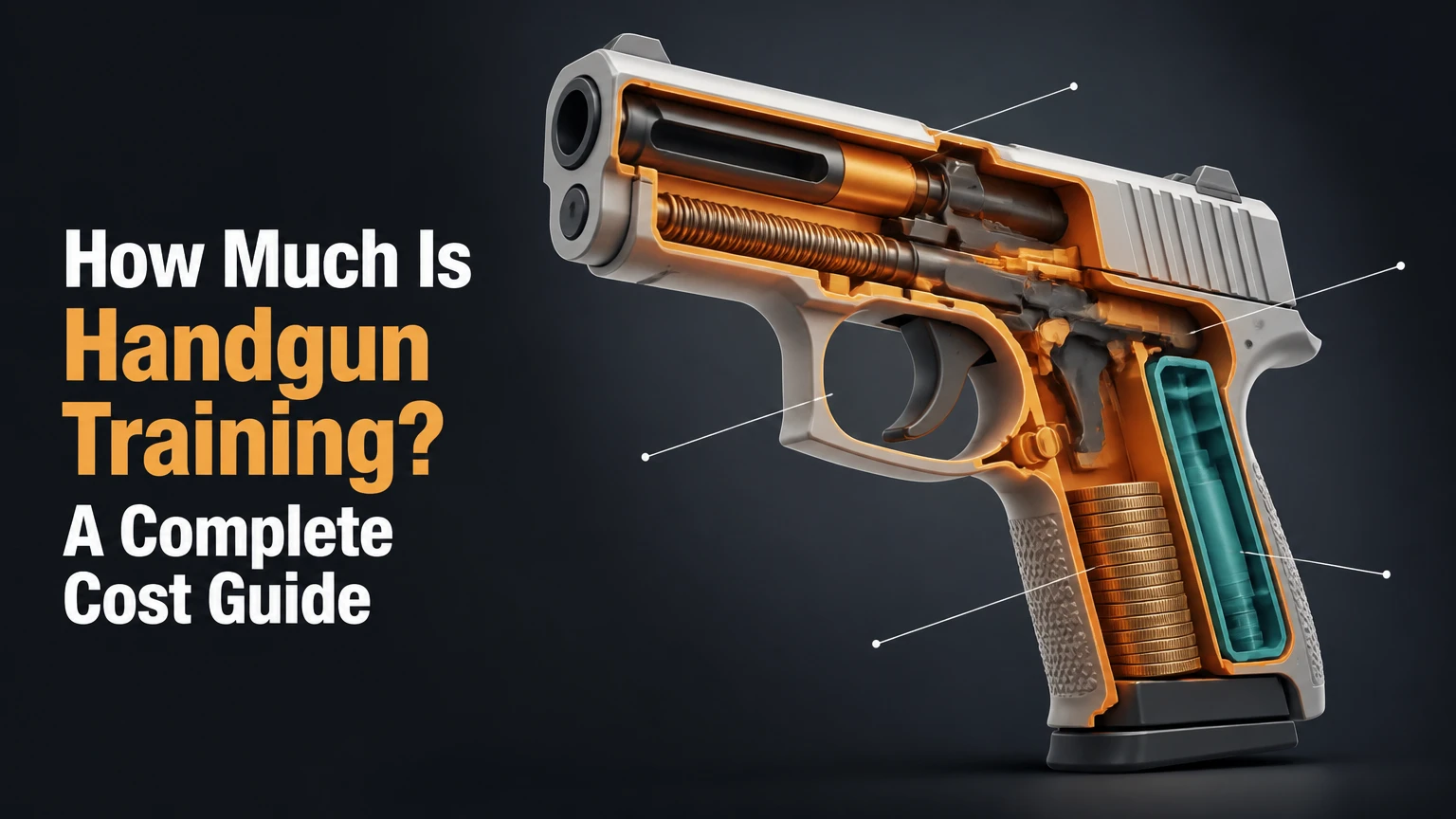
Handgun training typically costs $50-$250 for a basic group course, $50-$150 per hour for private instruction, and $150-$500 or more for advanced defensive training. A realistic total budget is often $100-$350 after adding ammunition, range fees, eye and ear protection, and a firearm rental when needed.
Key Facts at a Glance
Basic handgun instruction commonly costs $50-$150 and takes 2-6 hours.
Concealed-carry courses commonly cost $50-$150 before permit, fingerprinting, and application fees.
Private handgun lessons commonly cost $50-$150 per hour.
Advanced defensive classes commonly cost $200-$500 per training day before travel and equipment.
A first range session may add $60-$200 for ammunition, rental, range access, and safety equipment.
Online instruction can explain laws and terminology, but it cannot replace supervised live-fire coaching.
How Much Is Handgun Training?
Handgun training costs about $50-$250 for most basic consumer courses, but the final bill depends on the course goal, instructor format, ammunition requirement, range policy, and state law. A beginner using a rented handgun may spend $150-$300 in total, while a student bringing a firearm and equipment may spend less.
The tuition price alone is therefore an incomplete answer. A $75 class that excludes 150 rounds of ammunition and a $25 range fee can cost more than a $125 class that includes range access, targets, and loaner equipment. Ask for the complete student supply list before comparing advertised prices.
Typical pricing varies by location. Urban commercial ranges often charge more for lane access and rentals than rural clubs, while specialized instructors may charge more because they limit enrollment to four or six students. A low price is useful only when the course still provides safe supervision, appropriate equipment, and enough practice time.
What Determines the Price?
Four variables explain most handgun-training prices:
- Instruction format: Group classes cost less per student than one-on-one coaching.
- Course purpose: A safety class has fewer teaching hours than defensive or competition instruction.
- Live-fire volume: Ammunition and range time increase with round count.
- Legal requirements: A state-mandated carry class may include documentation, qualification, or administrative work.
The National Rifle Association’s basic safety guidance includes the direct rule, “Always keep the gun pointed in a safe direction.” A legitimate beginner class should teach that rule in context, then verify that students can apply it while handling an unloaded firearm before introducing live ammunition.
What Does Handgun Training Cover?
Handgun training combines safe gun handling, firearm operation, marksmanship, legal education, and supervised practice. A beginner course should cover the handgun’s controls, loading and unloading procedures, safe storage, ammunition identification, basic stance and grip, sight alignment, trigger control, and range commands.
Most entry-level courses have a classroom or briefing component followed by practical instruction. The classroom portion may use inert training aids, diagrams, or unloaded firearms. The live-fire portion lets an instructor observe muzzle direction, finger placement, loading behavior, target awareness, and safe responses to commands.
Course labels are not standardized. “Basic pistol,” “new shooter,” “firearm safety,” and “introductory handgun” may describe similar material, while “defensive pistol” often assumes prior competence. Read the syllabus rather than relying on the title.
What Should a Beginner Class Include?
| Course element | Typical beginner standard | Warning sign |
|---|---|---|
| Class size | 4-12 students | 20 or more students with one instructor |
| Classroom time | 1-3 hours | No safety briefing before range use |
| Live-fire time | 1-3 hours | No supervised shooting component |
| Ammunition | 50-150 rounds | Unstated round requirement |
| Equipment | Eye and ear protection, targets | Mandatory purchases with no alternatives |
| Student screening | Safety orientation and age rules | Immediate holster or rapid-fire work |
A first class does not need tactical scenarios, movement drills, or concealed drawing. Those activities introduce additional safety and legal considerations and belong after the student demonstrates consistent control with a stationary, unloaded handgun and then on a supervised firing line.
How Much Do Different Handgun Courses Cost?
Basic group instruction generally costs $50-$150, CCW instruction $50-$150 before government fees, private coaching $50-$150 per hour, and advanced defensive training $150-$500 or more per day. These are typical United States consumer ranges, not fixed national prices.
| Training type | Tuition range | Typical duration | Typical live-fire amount |
|---|---|---|---|
| Safety orientation | $40-$100 | 1-3 hours | 0-50 rounds |
| Basic pistol class | $50-$150 | 2-6 hours | 50-150 rounds |
| CCW or permit class | $50-$150 | 4-16 hours | 50-100 rounds |
| Private lesson | $50-$150 per hour | 1-3 hours | 50-150 rounds |
| Defensive pistol course | $150-$500 per day | 1-3 days | 200-600 rounds |
| Competition preparation | $100-$300 per session | 2-4 hours | 100-300 rounds |
A course charging $250 is not automatically expensive. If the price includes a full day of instruction, 300 rounds, range access, targets, loaner equipment, and a small class, the package may cost less than a low-tuition class with multiple add-ons.
A course charging $60 may be appropriate for a short safety orientation, but it should not be represented as equivalent to a full defensive curriculum. Training level, not the label, determines the meaningful comparison.
What Extra Costs Should You Budget For?
A student should usually add $50-$200 to advertised handgun-course tuition for ammunition, range access, a rental firearm, and protective equipment. Permit application charges, fingerprinting, photographs, background checks, and travel can add another $25-$200 or more, depending on the jurisdiction.
| Additional cost | Typical price | When it applies | Cost-control option |
|---|---|---|---|
| 9mm practice ammunition | $15-$30 per 50 rounds | Most live-fire classes | Buy only the listed quantity |
| Range fee | $15-$35 | Independent or commercial range | Choose an inclusive course |
| Handgun rental | $10-$25 | Student lacks a suitable firearm | Ask whether rental includes magazines |
| Eye and ear protection | $15-$60 | Student has no equipment | Buy reusable protection |
| Targets and supplies | $2-$15 | Some ranges charge separately | Confirm course inclusions |
| Permit application | $25-$150 | State or local carry process | Check the issuing agency |
| Fingerprints and photographs | $15-$75 | Required in some jurisdictions | Use approved low-cost provider |
Ammunition is usually the largest variable expense. A 50-round introductory session may add $15-$30, while a 500-round advanced class may add $150-$300 or more depending on caliber and local supply.
Rental policies deserve special attention. Some ranges require students to use range-owned ammunition, prohibit personal ammunition, or require a specific handgun model for a class. A rental may also exclude additional magazines, which can slow supervised practice and alter the instructor’s lesson plan.
What Does a First Training Session Really Cost?
| Student situation | Tuition | Added expenses | Expected total |
|---|---|---|---|
| Owns handgun and equipment | $75-$150 | $20-$50 | $95-$200 |
| Owns handgun, needs ammunition | $75-$150 | $40-$90 | $115-$240 |
| Rents handgun and buys equipment | $75-$150 | $60-$125 | $135-$275 |
| Takes private lesson | $100-$300 | $40-$100 | $140-$400 |
| Attends advanced one-day class | $200-$500 | $100-$300 | $300-$800 |
These figures exclude the firearm purchase itself, transportation, storage equipment, and travel. They are planning ranges, not quotes from a specific provider.
How Much Does a CCW Class Cost?
A concealed-carry or CCW class commonly costs $50-$150 for tuition, but the complete permit process may cost $100-$350 or more after application, fingerprinting, photographs, background-check, and license fees. Requirements differ by state, county, permit type, and whether the course is approved by the issuing authority.
Some states require classroom hours, a live-fire qualification, or both. Others recognize permitless carry for eligible adults but still offer training as a safety and legal-risk reduction measure. A course advertised as “CCW approved” should identify the approving authority and the current rule it satisfies.
Permit training is a compliance course first. It may explain storage, prohibited locations, transport, use-of-force law, and interaction with law enforcement, but the required shooting qualification may be brief. Passing the qualification does not demonstrate broad defensive competence.
Before paying, verify:
- The instructor’s approval or credential under current state rules.
- Required classroom hours and live-fire hours.
- Whether the shooting qualification uses your intended handgun.
- Whether the certificate expires or has an application deadline.
- Whether the tuition includes targets, ammunition, and range access.
- The separate government fees and payment methods.
How Long Does Training Take?
A basic handgun course takes 2-6 hours, a CCW course 4-16 hours, a private lesson 1-3 hours, and advanced instruction one to three full days. The calendar time is shorter than the time needed to retain safe habits, so most students benefit from multiple shorter sessions rather than one expensive immersion course.
| Goal | First session | Follow-up frequency | Reasonable learning milestone |
|---|---|---|---|
| Safe ownership | 2-3 hours | 1 refresher within 30 days | Consistent unloaded handling |
| Recreational shooting | 3-5 hours | Every 4-8 weeks | Safe range routine |
| Carry qualification | 4-16 hours | 1 legal refresher yearly | Meets current state requirement |
| Home-defense preparation | 4-8 hours | 2-4 supervised sessions | Safe decision-making under stress |
| Competition entry | 3-6 hours | Weekly or biweekly | Safe movement under match rules |
Training duration should match the student’s starting point. A new owner who struggles with loading, unloading, or keeping the trigger finger indexed should not move into a rapid-fire or movement course simply because the course is available.
What Is the Safest Training Progression?
The safest progression is orientation, dry practice with an unloaded firearm, static live fire, supervised skill development, and only then specialized training. Students should advance when they can follow range commands, maintain muzzle awareness, keep the trigger finger indexed until ready to fire, and safely stop when confused.
A practical sequence is:
- Safety and orientation: Learn the firearm’s controls, ammunition type, safe direction, storage method, and range commands.
- Unloaded handling: Practice checking the chamber and magazine well under instructor supervision.
- Dry practice: Rehearse sight presentation and trigger movement only after confirming the firearm is unloaded and following a safe dry-practice setup.
- Static live fire: Fire at a controlled distance while concentrating on consistent grip, sight alignment, and trigger control.
- Skill correction: Use a private lesson or small group to address repeatable accuracy or handling problems.
- Goal-specific instruction: Select a legal-compliance, home-defense, competition, or defensive course based on the demonstrated foundation.
Dry practice must be physically separated from live ammunition. A common practitioner rule is to remove ammunition from the room, verify the firearm condition, and follow the manufacturer’s instructions before any dry-fire session.
Is Private Handgun Instruction Worth the Price?
Private instruction is usually worth the extra cost when a student needs individualized correction, feels anxious on a public range, uses an unfamiliar handgun, or has repeated problems that a large class cannot diagnose. At $50-$150 per hour, one focused lesson can cost less than repeating an unsuitable group class.
Private coaching is less valuable when the student has not taken basic safety instruction and expects the instructor to provide a complete curriculum in one hour. A private lesson can identify problems quickly, but it cannot replace the repetition required to build reliable habits.
A useful first private lesson has a narrow objective, such as safe operation of a new pistol, basic accuracy diagnosis, or preparation for a state qualification. Ask whether the instructor charges range fees separately and whether the hourly rate includes the instructor’s ammunition, targets, or lane time.
Expert insight: Instructors often diagnose equipment problems before technique problems. A poorly fitted grip, heavy trigger, unsuitable caliber, or ammunition incompatibility can produce results that dry-fire practice will not fix.
Is Online Handgun Training Enough?
Online handgun training is useful for terminology, legal orientation, safety concepts, and course preparation, but it is not enough to establish safe live-fire competence. Many jurisdictions do not accept online-only instruction for a permit requirement because the format cannot verify handling or shooting performance.
An online course may cost $20-$80 and help a student understand firearm parts or state terminology before attending a range. It cannot observe muzzle direction, trigger-finger placement, loading behavior, recoil response, or the student’s reaction to a stoppage.
Use online material as preparation, not validation. Confirm that the instructor or organization is current, identifies its sources, and distinguishes general education from state-specific legal advice. Laws change, and a generic national video may not match the rules in the student’s jurisdiction.
Which Training Fits Each Goal?
The right course depends on the desired outcome, not the lowest advertised tuition. Recreational shooters generally need basic safety and marksmanship; prospective carriers need current legal instruction plus safe equipment handling; home-defense students need decision-making and storage education before specialized scenarios.
| Student goal | Recommended first course | Typical tuition | Next useful step |
|---|---|---|---|
| New handgun owner | Basic pistol or safety class | $50-$150 | Private correction lesson |
| Recreational range use | Basic marksmanship class | $50-$150 | Monthly supervised practice |
| Public carry | State-approved CCW class | $50-$150 | Carry-equipment and legal refresher |
| Home protection | Safety and home-defense fundamentals | $100-$300 | Storage and decision-making lesson |
| Competition | Beginner practical-pistol class | $100-$300 | Match-specific coaching |
| Returning owner | Refresher or private lesson | $50-$150 per hour | Basic live-fire evaluation |
A home-defense course should not begin with dramatic scenario work. The student first needs a safe storage plan, a way to identify household members, knowledge of local law, and a realistic understanding that avoidance, communication, and emergency services may be safer than confronting a perceived threat.
Honest limitation: No handgun course can guarantee accuracy, calm decision-making, or legal immunity during a violent encounter. Training improves preparation, but it does not remove uncertainty, mechanical failure, poor visibility, or the risk of harming an innocent person.
How Do You Choose a Qualified Instructor?
Choose an instructor by checking credentials, curriculum, student-to-instructor ratio, safety procedures, insurance or business information, and current legal recognition. A polished website is less important than a written syllabus that identifies prerequisites, ammunition requirements, range rules, and what the course does not teach.
Before booking, ask these questions:
- What organization or agency recognizes the instructor?
- How many students attend each range block?
- Is a second instructor present for a large class?
- What handgun types and calibers are permitted?
- How many rounds must each student bring?
- Are rentals, magazines, targets, and protection included?
- What happens if a student is unsafe or needs a pause?
- Does the course satisfy a specific state requirement?
- Can the student reschedule for weather, illness, or equipment failure?
A responsible instructor should welcome safety questions and explain that a student may stop an exercise when confused. Instructors who promise instant mastery, dismiss legal questions, or encourage advanced drills before basic competence are poor choices regardless of price.
How Can You Reduce the Cost Safely?
The safest savings come from comparing complete packages, borrowing approved protective equipment, choosing a smaller local class, and scheduling practice efficiently. Do not reduce cost by skipping instruction, buying unsuitable ammunition, using defective protective gear, or joining an advanced class without prerequisites.
Use this budgeting method:
- Get the tuition price in writing.
- Add the exact ammunition quantity and caliber.
- Add range, rental, target, and equipment fees.
- Confirm permit and government fees separately.
- Compare the total cost per supervised training hour.
- Select the least expensive course that meets the actual goal.
A class with eight students may provide a better value than a class with 16 if both have one instructor. Individual attention affects how quickly a student receives correction, and repeating a poor lesson can erase the initial savings.
Expert insight: Cost per training hour is a weak metric without supervision quality. A two-hour class with a six-to-one student ratio may produce more useful correction than a four-hour lecture followed by an overcrowded firing line.
What Problems Commonly Increase the Cost?
The most common cost increases come from incomplete fee disclosure, incorrect ammunition, unsuitable rental firearms, missed permit deadlines, and enrolling in an advanced course too early. Each problem can force a second visit, a replacement purchase, or a nonrefundable rescheduling fee.
Ammunition and Rental Mismatch
A student may arrive with the wrong caliber or ammunition type. Confirm whether the range requires factory-new ammunition, prohibits steel-case cartridges, or sells only range-approved ammunition. Ask whether the rental handgun is compatible with the class holster or magazine requirements.
Class-Level Mismatch
A beginner in a defensive course may spend the day trying to keep up instead of learning safely. A returning shooter in a basic lecture may pay for material already mastered. Ask for prerequisites and request an instructor recommendation when uncertain.
Equipment Purchases Made Too Early
A student does not need an expensive optic, competition belt, or specialized holster for an introductory class. Start with eye protection, hearing protection, appropriate ammunition, and a safe storage solution; buy specialized equipment after an instructor identifies a real need.
Recoil and Grip Problems
Recoil anticipation can cause a student to push the handgun downward before the shot breaks. A weak or inconsistent grip can also affect comfort and reliable cycling. An instructor should diagnose these issues through observation and controlled exercises, not by telling the student to grip harder without explaining the reason.
Unsafe Dry Practice
Dry practice with ammunition nearby creates an avoidable risk. Establish a designated unloaded practice area, remove ammunition, verify the firearm condition, and stop immediately if another person enters the space.
What Questions Should You Ask Before Paying?
Ask for a written total-cost estimate, the round count, the course prerequisites, the instructor credentials, and the applicable state approval. These questions reveal whether a low advertised price is a genuine value or only an entry fee followed by mandatory add-ons.
A useful message to a provider is: “What will I pay from arrival through completion if I need a rental handgun, 100 rounds of ammunition, eye and ear protection, targets, and any required range fee?” The answer should identify each charge.
Also ask whether a certificate proves only attendance or confirms a shooting qualification. Those documents have different practical and legal meanings, and confusing them can delay a permit application.
Frequently Asked Questions
Can I take handgun training without owning a handgun?
Yes, many ranges and instructors allow beginners to train with a rental handgun, provided the student meets age, identification, and range requirements. Confirm the rental cost, compatible ammunition, magazine availability, and whether the instructor recommends a specific size or caliber before booking.
Should I buy a handgun before taking a class?
Usually, no. A beginner can often learn safe handling with an instructor’s loaner or a rental, then make a better purchase decision after experiencing fit, controls, recoil, and maintenance requirements. If you already own one, bring it only after confirming that the class accepts its model and caliber.
Does handgun training include the firearm?
Usually, the tuition covers instruction rather than a firearm. Some providers include a loaner, while commercial ranges commonly charge a separate rental fee of $10-$25. Ask whether the rental includes magazines, whether ammunition must be purchased from the range, and whether the firearm is suitable for the course.
How often should a handgun owner take refresher training?
A new owner should consider a supervised follow-up within 30 days, then practice or receive coaching every four to eight weeks while building consistency. Experienced owners may schedule annual safety and legal reviews, with additional instruction after changing firearms, storage arrangements, or carry methods.
Is a cheap handgun class safe?
A low-cost class can be safe when it has qualified supervision, a clear curriculum, controlled enrollment, and adequate range time. Price alone does not establish quality. Review the instructor ratio, live-fire plan, equipment rules, emergency procedures, and total cost before deciding.
The Bottom Line
How much is handgun training? Budget $50-$150 for basic tuition, $50-$150 per hour for private instruction, or $150-$500 or more per day for advanced training. Add ammunition, range access, rentals, protective equipment, and any state permit charges before comparing providers.
For most first-time students, a realistic all-in budget is $100-$300 for a basic supervised session. The best value is the course that matches the student’s goal, discloses every fee, limits class size, and builds safe competence before introducing specialized skills.