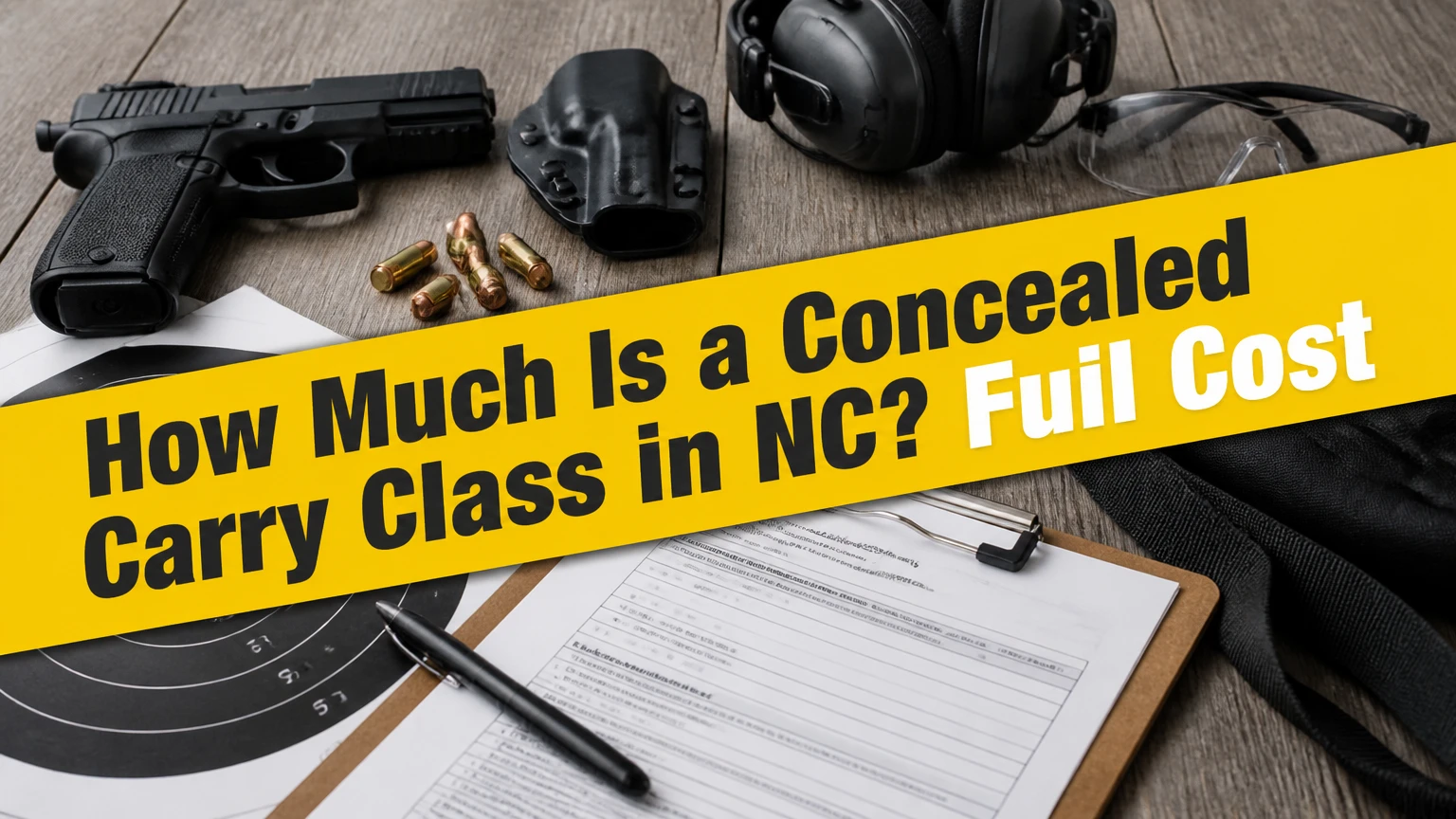
A North Carolina concealed carry class typically costs $75-$150 for tuition, with lower-priced courses usually excluding the firearm, ammunition, range fee, and safety equipment. A realistic first-time budget is often about $175-$275 including the class and permit application expenses, although county fees, fingerprinting, rentals, ammunition, and package inclusions can change the final amount.
Key Facts at a Glance
A North Carolina concealed handgun course commonly costs $75-$150.
A basic class may require separate payment for ammunition, firearm rental, range use, and eye and ear protection.
North Carolina training generally includes at least eight hours of classroom instruction plus live-fire qualification.
The commonly published qualification format uses 30 rounds at 3, 5, and 7 yards, with many instructors requiring at least 21 hits in the target area.
The concealed handgun permit application is separate from class tuition and is handled through the applicant’s county sheriff.
Online-only instruction does not replace the complete in-person training and shooting requirements.
What Does a Concealed Carry Class Cost in North Carolina?
A standard North Carolina concealed carry class costs $75-$100, while an all-inclusive range course generally costs $125-$150. Private or semi-private instruction commonly starts around $200 and can exceed $400, depending on class size, travel, range access, and scheduling.
| Course format | Typical tuition | Usually included | Common extra cost |
|---|---|---|---|
| Budget group class | $75-$85 | Classroom, exam, certificate paperwork | $20-$60 ammunition or range charges |
| Standard group class | $85-$110 | Classroom, exam, qualification instruction | $15-$50 firearm or equipment charges |
| All-inclusive range class | $125-$150 | Gun, ammunition, target, range, eye and ear protection | $0-$25 administrative surcharge |
| Private instruction | $200-$400+ | Individual instruction and flexible scheduling | $25-$100 ammunition or travel |
The advertised price is not always the checkout price. A $79 class can become a $125 purchase after adding 50 rounds of ammunition, a handgun rental, range access, and protective equipment. An apparently expensive $145 package may be cheaper for a beginner if those items are already included.
North Carolina’s official training requirement is tied to a Concealed Handgun Permit, not to a generic recreational shooting course. The North Carolina Department of Justice describes the process as requiring an approved firearms safety and training course, and the course must address both safe handgun handling and applicable law.
What Is the Cheapest Legitimate Option?
The cheapest legitimate option is usually a group class priced around $75-$85, provided that the instructor, course content, certificate, and live-fire qualification satisfy North Carolina requirements. A low price is useful only when the instructor clearly identifies every excluded charge.
Before paying, ask these questions:
- Is the course approved or otherwise accepted for a North Carolina concealed handgun permit?
- Does tuition include the live-fire qualification?
- Must students bring a handgun?
- How many rounds are required?
- Is ammunition included, and what calibers are permitted?
- Are range, target, eye protection, and hearing protection included?
- Is the certificate issued immediately after passing?
- What happens if a student does not qualify?
A cheap course that requires a $40 range fee and $35 ammunition purchase may cost more than a $125 package. Price comparison must use the all-in class total, not the headline tuition.
What Does the North Carolina Course Include?
The North Carolina concealed handgun course normally includes a minimum classroom segment, instruction on firearms safety and state law, a written examination, and a live-fire qualification. Students who pass the required portions receive a certificate of completion for use in the permit application process.
Typical classroom subjects include:
- Safe storage, transportation, loading, unloading, and handling
- Handgun parts, operation, maintenance, and cleaning
- Marksmanship fundamentals and responsible shooting practices
- North Carolina statutes affecting concealed carry
- Self-defense and the use of deadly force
- Locations where carrying may be restricted or prohibited
- Interaction with law enforcement
- Legal and practical consequences of negligent handling
The exact order differs by instructor. Some providers teach all classroom material in one Saturday session, while others split instruction across two evenings and schedule the range qualification separately.
How Long Is a North Carolina Concealed Handgun Class?
A North Carolina concealed handgun class generally requires at least eight hours of classroom instruction, followed by additional time for the shooting qualification. A single-day schedule may run from approximately 8:00 a.m. to 5:00 p.m. or later, while split-format courses often use two four-hour sessions.
| Schedule type | Classroom time | Range time | Typical total schedule |
|---|---|---|---|
| Single Saturday | 8 hours | 1-3 hours | 9-11 hours |
| Two evening sessions | 4 hours per session | 1-3 hours | 9-11 hours over 2-3 days |
| Classroom plus separate range day | 8 hours | 1-2 hours | 2 scheduled days |
| Private course | 8 hours minimum | 1-3 hours | Varies by instructor |
The course is not designed to replace beginner handgun instruction. A new shooter may need a separate basic pistol lesson before attempting the qualification, especially when the class uses a firearm the student has never handled.
How Does the Shooting Qualification Work?
The commonly published North Carolina qualification uses 30 rounds, often divided into 10 rounds at 3 yards, 10 rounds at 5 yards, and 10 rounds at 7 yards. Many instructors identify 21 hits out of 30 within the designated target area as the passing threshold, but students must follow the course’s current instructions and target standard.
The qualification commonly proceeds as follows:
- The instructor explains the range commands and safety procedures.
- The student loads and fires under supervision.
- The student shoots the required strings at the specified distances.
- The instructor evaluates the target against the course standard.
- The student receives a completion certificate after passing both classroom and shooting requirements.
Do not assume that accuracy alone is the only issue. Safe muzzle direction, trigger discipline, obeying range commands, and proper handling between strings can determine whether an instructor allows a student to continue.
Practitioner rule: treat the qualification as a safety evaluation with a shooting component, not as a casual range visit. Arrive rested, use a reliable full-size or compact handgun, and practice slow, controlled shots before class day.
How Much Ammunition Do You Need?
A student should usually budget for at least 30 qualification rounds plus 20 additional rounds, or approximately 50 rounds total, unless the instructor specifies a different quantity. The extra ammunition allows for familiarization, sighting, demonstrations, or a second attempt when the course permits one.
Typical ammunition costs vary by caliber and local availability:
| Ammunition example | Typical quantity | Typical price range | Booking question |
|---|---|---|---|
| 9 mm Luger | 50 rounds | $15-$30 | Is brass ammunition required? |
| .380 ACP | 50 rounds | $20-$40 | Does the rental handgun accept range ammunition? |
| .40 S&W | 50 rounds | $20-$40 | Does the range impose a caliber restriction? |
| .45 ACP | 50 rounds | $30-$50 | Is ammunition supplied by the facility? |
Never bring live ammunition into a classroom unless the instructor gives explicit directions. Follow the provider’s transport and storage instructions, because some facilities require ammunition and firearms to remain secured until the range portion begins.
Which Course Package Is Best for Your Situation?
An all-inclusive course is usually the best value for a beginner who does not yet own a suitable handgun or protective equipment. A budget group class makes more sense for an experienced owner who already has a reliable firearm, compatible ammunition, and range gear.
| Applicant situation | Best format | Expected class cost | Why it fits |
|---|---|---|---|
| First-time handgun student | All-inclusive range class | $125-$150 | Rental firearm and safety gear reduce logistical problems |
| Experienced shooter | Standard group course | $75-$110 | Existing equipment keeps the total lower |
| Nervous or accessibility-conscious student | Private or semi-private | $200-$400+ | Instructor can control pace and provide individual support |
| Small group of friends or family | Semi-private booking | $250-$500 total | Per-person cost may fall with several students |
| Schedule constrained applicant | Split or private format | $125-$400+ | Evening or customized dates may justify higher tuition |
A private class is not automatically better. Private instruction is useful when the student needs a slower pace, has mobility concerns, cannot attend a fixed Saturday, or wants concentrated coaching. It is poor value when the student already shoots safely and only needs the required certificate.
What Is Usually Included in an All-Inclusive Class?
An all-inclusive class commonly includes the instructor fee, classroom materials, written test, live-fire range fee, target, eye protection, hearing protection, a rental handgun, and a specified amount of ammunition. “All-inclusive” remains a provider-defined marketing term, so confirm whether the certificate fee, lunch, taxes, and reshooting are included.
A package may still exclude:
- Additional ammunition beyond the stated quantity
- A second qualification attempt
- Personal transportation
- Permit application and fingerprinting charges
- Firearm cleaning supplies
- A required background check for rental use
- Cancellation or rescheduling fees
Request the written inclusions before booking. Screenshots of the registration page can help resolve disputes over advertised equipment or refund terms.
What Does the Permit Cost After the Class?
The permit application is separate from the North Carolina concealed carry class. Applicants generally submit the certificate, identification, fingerprints, and other required information through the county sheriff, then pay the applicable application and processing charges established by law or county procedure.
A commonly cited new-applicant permit fee is $90, with fingerprinting or electronic processing often adding approximately $5-$10. Counties can publish different administrative instructions, appointment procedures, and payment methods, so the applicant should verify the current amount directly with the sheriff’s office.
| Cost component | Typical amount | Paid to or arranged through | When paid |
|---|---|---|---|
| CCH class tuition | $75-$150 | Instructor or training provider | Course registration |
| Ammunition | $15-$50 | Range, retailer, or provider | Before or during class |
| Handgun rental | $15-$40 | Commercial range | Range session |
| Eye and ear protection | $0-$20 | Range or student-owned | Range session |
| New permit application | Commonly $90 | County sheriff | Permit application |
| Fingerprinting or processing | Commonly $5-$10 | Sheriff or designated provider | Permit application |
A practical budget for a first-time applicant is therefore about $175-$275, with private instruction, premium ammunition, travel, or additional range practice pushing the total higher. The sheriff’s office is the authoritative source for the current application fee and county-specific procedure.
How Long Does Permit Processing Take?
North Carolina law provides a processing framework that can allow up to 45 days after the sheriff receives required background and mental-health records, but appointment availability and incomplete applications can affect the practical timeline. The class itself usually takes one day; the permit process can take considerably longer.
Apply promptly after receiving the certificate. Some sheriff’s offices apply local administrative policies concerning older certificates even though applicants may not find a single universal certificate-expiration period in the statute. A recent certificate reduces the chance of a county office requesting updated training documentation.
Can You Take the North Carolina Class Online?
An online-only course does not satisfy the complete North Carolina concealed handgun training requirement because the process includes in-person instruction and live-fire qualification. Online videos can supplement preparation, but they do not replace the classroom, written examination, supervised shooting, and certificate issued by an eligible instructor.
Online material can still help with:
- Reviewing firearms terminology before class
- Studying North Carolina deadly-force concepts
- Learning basic handgun safety
- Understanding range commands
- Preparing questions for the instructor
Be skeptical of any provider promising a permit certificate after watching videos alone. Confirm the course format, instructor credentials, physical location, and range qualification before submitting payment.
How Do You Apply After Passing the Class?
After passing the course, apply through the sheriff’s office in the North Carolina county where you reside. The usual sequence is to schedule the appointment, submit the application and certificate, complete fingerprinting and required background checks, pay the applicable fee, and monitor the application through the county’s process.
Step 1: Confirm the County Requirements
Read the sheriff’s concealed handgun permit page before attending class. Check identification requirements, appointment availability, payment method, fingerprint procedure, and any documents requested beyond the course certificate.
Step 2: Keep the Original Certificate Secure
Ask the instructor whether the sheriff requires an original signed certificate or accepts a specific copy. Store the document flat and legibly, because missing signatures, incorrect names, or damaged paperwork can delay submission.
Step 3: Submit the Application and Fingerprints
Complete the application accurately and disclose requested information. Fingerprinting and mental-health record checks are part of the sheriff’s review, and the applicant should not assume that class completion guarantees approval.
Step 4: Track the County Timeline
Retain the receipt, confirmation number, and contact information for the permitting office. Contact the sheriff’s office when the published processing window passes or when the office requests additional documentation.
Passing the class demonstrates training completion. It does not itself create permission to carry concealed, and it does not override location restrictions, firearm prohibitions, or rules governing the use of deadly force.
What Mistakes Increase the Final Cost?
The most expensive mistakes usually occur before or after the classroom session, not during tuition payment. Applicants often pay for the wrong course, arrive without compatible ammunition, or postpone the county application until paperwork becomes difficult to verify.
- Choosing a course without confirming acceptance: A certificate from an unsuitable online or incomplete course may require paying for training again. Confirm the course before registering.
- Underestimating equipment charges: Add ammunition, rental, range, and protective-gear fees to the advertised tuition.
- Bringing an unfamiliar pocket pistol: Small handguns can be harder to control and may be less reliable for a first qualification. Use a dependable firearm approved by the instructor.
- Skipping practice: The class is not a comprehensive beginner shooting course. A 60-minute fundamentals lesson can be less expensive than a failed qualification or additional private session.
- Ignoring ammunition restrictions: Some ranges prohibit steel-case, aluminum-case, or certain projectile types. Ask before purchasing a full box.
- Delaying the permit application: County procedures and certificate-age policies can create avoidable paperwork problems when an applicant waits months or years.
- Assuming a pass guarantees a permit: The sheriff still conducts the required eligibility and background review.
An instructor may allow a student to correct a problem or reshoot, but policies differ. Ask about remediation before class day rather than relying on an unadvertised second attempt.
What Should You Ask Before Booking?
Ask the provider for an itemized total before entering payment information. The following checklist identifies the details that most often separate a $90 class from a $160 class.
- What is the complete price after taxes and registration fees?
- Is the eight-hour classroom portion held in person?
- Is live fire included on the same date?
- Does the package include 30 qualification rounds, or 50 total rounds?
- Can students use a rental handgun?
- Which handgun calibers and ammunition types are allowed?
- Are eye protection, hearing protection, targets, and range fees included?
- What identification or documents must students bring?
- What is the policy for failing the written test or shooting qualification?
- Is the certificate issued immediately after successful completion?
- What is the cancellation and rescheduling policy?
- Does the instructor provide reasonable accessibility accommodations?
A provider that cannot explain the qualification, inclusions, or certificate process clearly deserves caution. Transparent pricing is part of responsible firearms instruction.
Frequently Asked Questions
Is $100 a normal price for a North Carolina concealed carry class?
Yes. $100 is within the normal range for a North Carolina concealed handgun class, especially when the course includes classroom instruction, testing, and some range services. Determine whether ammunition, firearm rental, protective equipment, and the live-fire range fee are included before comparing the $100 price with other providers.
Can I use my own handgun in the class?
Usually, a student may use a personally owned handgun if the firearm is safe, functional, and allowed by the instructor and range. Confirm the permitted caliber, ammunition type, magazine requirements, and transport procedure in advance. A rental handgun may be preferable if the student’s firearm is unfamiliar or difficult to control.
Do I need to own a gun before taking the course?
No. Many commercial ranges offer handgun rentals, and some all-inclusive courses include a rental in tuition. A student should not buy a handgun solely to meet the class requirement without first learning which firearm size, grip, controls, and caliber can be handled safely.
What happens if I fail the shooting qualification?
The result depends on the instructor’s written policy and the range’s safety rules. Some providers offer coaching or a reshoot for an additional fee, while others require the student to enroll in another qualification session. Ask about remediation before booking and practice controlled trigger presses before class.
Does the NC concealed handgun permit allow carry everywhere?
No. A North Carolina concealed handgun permit does not eliminate location restrictions or other firearm laws. Prohibited places, private-property rules, posted restrictions, alcohol-related circumstances, government facilities, schools, and federal regulations can affect whether carry is lawful. Read current statutes and county or agency guidance before carrying.
Does a renewal require another concealed carry class?
Do not assume that renewal follows the same process as an original permit. Renewal requirements, fees, deadlines, and training-document rules can change, and the county sheriff’s office handles the application. Verify the current renewal instructions before the permit expires so an applicant does not rely on outdated course information.
The Bottom Line
The answer to how much is a concealed carry class in NC is usually $75-$150 for tuition. Budget approximately $175-$275 for a first application when class, equipment, ammunition, fingerprints, and the commonly cited $90 application fee are combined, then confirm current charges with the course provider and county sheriff.
Choose a $75-$110 group course when you already own suitable equipment. Choose a $125-$150 all-inclusive package when you need a firearm, ammunition, and range gear. Choose private instruction above $200 when scheduling, accessibility, or beginner support matters more than the lowest price. Verify the eight-hour in-person requirement, live-fire qualification, total package cost, certificate procedure, and county application rules before booking.