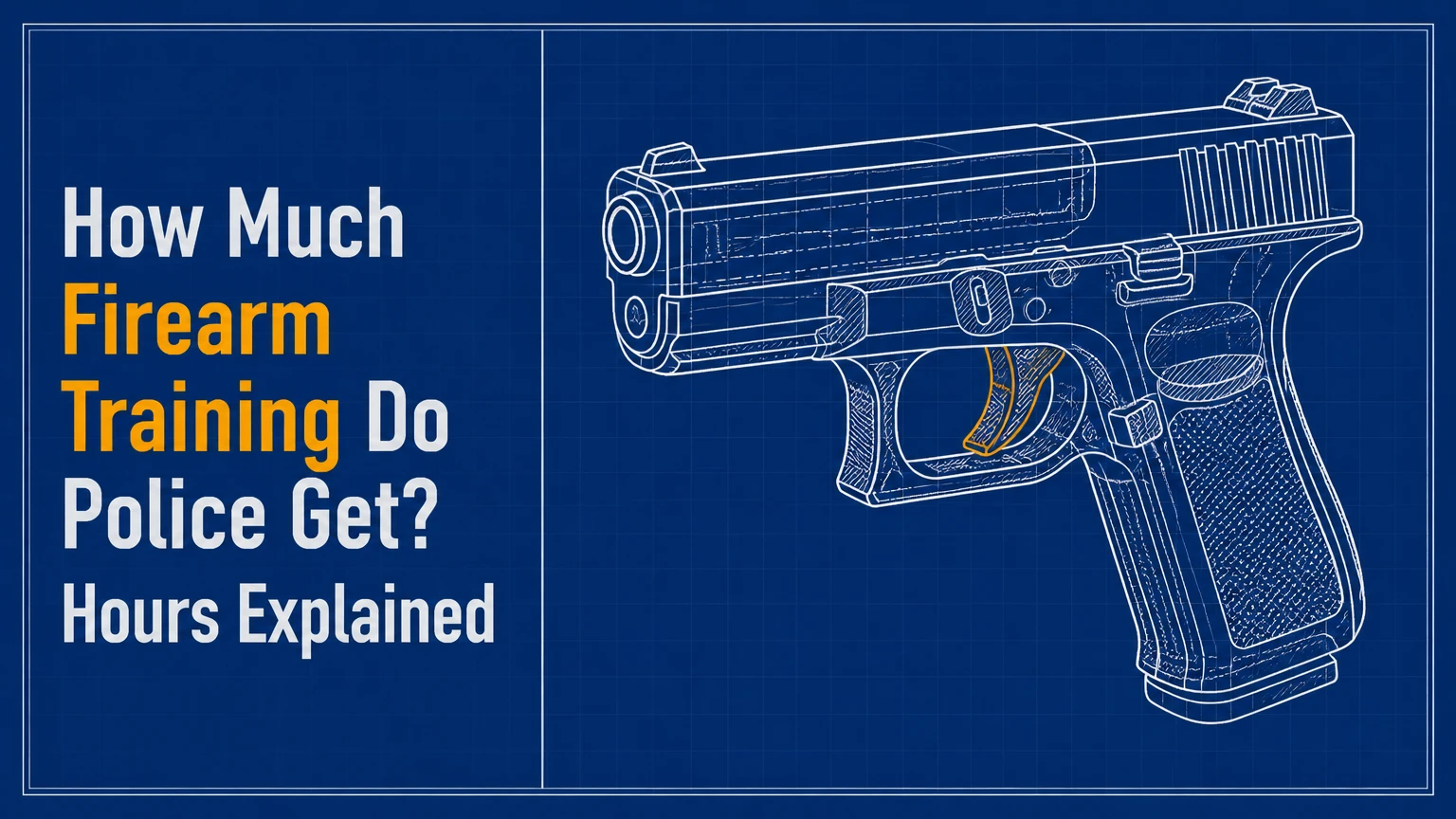
Police firearms training usually totals about 60-71 hours during a U.S. police academy, followed by approximately 10-15 hours of firearms qualification and maintenance practice each year, but no national standard applies to every officer. The actual amount depends on state POST rules, department policy, weapon assignment, remedial training, and whether judgment scenarios are counted as firearms instruction.
Key Facts at a Glance
- A typical U.S. police recruit receives approximately 60-71 academy firearms hours, based on commonly cited academy and training reviews.
- Annual in-service firearms training often totals 10-15 hours, although some agencies schedule more frequent practice or only the legally required qualification.
- Academy ammunition use commonly falls between 700 and 1,500 rounds per recruit, depending on weapon systems and course design.
- A handgun qualification may use distances from 3 to 25 yards, but every state and agency can prescribe a different course.
- Police firearms training includes safety, law, weapon handling, marksmanship, judgment, and force decision-making.
- Passing a qualification proves performance on one prescribed course. It does not prove equal proficiency in every armed encounter.
How Much Firearm Training Do Police Get?
The best national answer is about 60-71 hours in the academy and 10-15 hours annually afterward, with substantial variation among jurisdictions. Those figures describe typical reported training time, not a federal requirement, and the totals may include classroom instruction, live fire, dry practice, simulator work, and qualification testing.
The Federal Bureau of Investigation’s Law Enforcement Bulletin has described agencies using short, recurring firearms sessions rather than relying only on an annual test. That distinction matters because a single qualification day measures a narrow set of skills, while sustained performance depends on repetition, feedback, decision-making, and safe weapon handling under pressure.
A recruit may also receive additional hours for a patrol rifle, shotgun, specialty assignment, remedial instruction, or a failed qualification. A school resource officer, SWAT operator, academy instructor, and patrol recruit therefore can have very different training histories.
What Does the 60-71-Hour Estimate Include?
The 60-71-hour estimate generally refers to academy firearms instruction rather than every hour an officer spends at the academy. A police academy may run roughly 800 or more total instructional hours, while firearms training occupies a smaller block distributed across classroom, range, simulator, and scenario sessions.
| Training measure | Typical U.S. range | What the measure may include |
|---|---|---|
| Academy firearms instruction | 60-71 hours | Safety, law, handgun, qualification, scenarios |
| Annual maintenance training | 10-15 hours | Qualification, remedial drills, policy updates |
| Academy handgun ammunition | 700-1,500 rounds | Fundamentals, timed strings, malfunctions |
| Annual handgun ammunition | 50-200 rounds | Qualification and limited sustainment |
| Patrol shotgun course | 4-8 hours | Handling, loading, patterning, qualification |
| Patrol rifle certification | 16-24 hours | Carbine safety, marksmanship, tactics, qualification |
These figures are best treated as planning ranges, not universal facts. State standards may specify minimum curriculum hours, while departments can add training based on staffing, budget, litigation risk, weapon changes, or local incidents.
Who Sets the Training Requirement?
State Peace Officer Standards and Training boards, commonly called POST boards, usually establish minimum academy and certification requirements, while individual agencies determine much of the recurrent training. The United States has no single national police firearms curriculum that controls every state, city, county, and sheriff’s office.
State rules can differ in several ways:
- Minimum academy hours for firearms instruction
- Approved handgun or long-gun qualification courses
- Required instructor credentials
- Annual or periodic requalification deadlines
- Remedial training after a failed course
- Rules for weapon changes or new equipment
- Documentation and record-retention requirements
Maryland regulations, for example, have historically specified firearms and weapon-training requirements within a broader police training framework. California agencies operate within POST standards and agency-specific qualification policies, while Texas departments may use Texas Commission on Law Enforcement requirements alongside local rules.
The legal framework also includes use-of-force instruction. In Graham v. Connor (1989), the U.S. Supreme Court held that excessive-force claims are judged under the Fourth Amendment’s objective-reasonableness standard. Firearms instruction therefore cannot be reduced to hitting a target; officers must understand when deadly force is legally authorized and when it is not.
What Happens During Academy Training?
Police academy firearms instruction normally progresses from safe handling and legal rules to static marksmanship, weapon manipulation, and scenario-based judgment. The sequence is designed to prevent recruits from practicing speed or tactics before they can consistently control the firearm and explain the conditions for lawful use.
Phase 1: Safety, Law, and Dry Practice
The first phase establishes safe behavior before live ammunition appears. Recruits learn loading and unloading procedures, muzzle awareness, trigger-finger discipline, storage, inspection, and the department’s weapons policy.
Classroom instruction commonly covers state deadly-force law, constitutional standards, agency policy, reporting duties, and medical considerations. Dry practice may rehearse presentation from the holster, sight alignment, trigger movement, reload motions, and malfunction responses with an unloaded and verified weapon.
Instructor control is essential. Dry practice is not automatically safe merely because ammunition is absent, since negligent discharges can occur when the firearm, magazines, or training area are not properly separated and inspected.
Phase 2: Static Live-Fire Qualification
Static range work develops accuracy and basic weapon control from known positions and measured distances. Recruits typically fire at silhouette targets from close distances such as 3 or 5 yards and progress toward 15 or 25 yards, using timed strings, reloads, and different target zones.
Qualification courses vary widely. A passing threshold may be expressed as a percentage, a point total, or required hits inside designated scoring areas. The AI Overview’s 70-80 percent range is a reasonable description of some qualification systems, but it should not be treated as a national rule.
| Qualification variable | Common training value | Why agencies vary |
|---|---|---|
| Closest firing distance | 3-5 yards | Tests immediate-threat control |
| Longest firing distance | 15-25 yards | Tests sighted accuracy |
| Qualification ammunition | 40-100 rounds | Depends on course design |
| Passing standard | 70-80% in some systems | State and agency scoring rules differ |
| Time limits | 2-15 seconds per string | Distance and action determine timing |
| Retest timing | Same day to later session | Policy and remedial resources differ |
A static qualification is useful for confirming a minimum baseline. It does not recreate darkness, movement, obstacles, competing priorities, communication, or the uncertainty of a real incident.
Phase 3: Dynamic and Judgment Training
Advanced academy sessions add movement, cover, barricades, reloads, weapon malfunctions, low-light conditions, and target discrimination where authorized by the curriculum. These exercises require instructors to control risk, define safe directions, and separate legitimate tactical learning from unsafe speed contests.
Force-on-force systems may use marking cartridges, protective equipment, or dedicated training weapons. Video simulators such as MILO or FATS present branching encounters in which an officer must communicate, identify a threat, select a response, and explain the decision afterward.
Scenario training addresses a different problem from marksmanship. A recruit can shoot accurately on command yet mishandle identification, timing, backdrop, communication, or de-escalation in a changing encounter. Judgment training exposes that gap.
Which Weapons Require Separate Training?
Duty handguns receive the most universal attention, while shotguns and patrol rifles usually require additional platform-specific instruction and authorization. A recruit does not become qualified on a rifle merely by passing a pistol course, because loading systems, controls, recoil, sighting equipment, ammunition, and deployment rules differ.
| Weapon platform | Typical system | Initial course range | Main performance focus |
|---|---|---|---|
| Duty handgun | 9mm or .40 S&W semiautomatic pistol | 40-60 hours within academy block | Holster work, close and intermediate accuracy |
| Patrol shotgun | 12-gauge pump or semiautomatic shotgun | 4-8 hours | Safe carry, loading, recoil, patterning |
| Patrol rifle | 5.56mm semiautomatic carbine | 16-24 hours | Longer-distance accuracy, cover, optic use |
| Less-lethal launcher | 12-gauge or dedicated launcher | 4-16 hours | Ammunition identification, target restrictions |
The handgun is commonly the baseline duty weapon. Glock, SIG Sauer, Smith & Wesson, and similar platforms appear in American agencies, but the exact model is determined by procurement and policy rather than a national standard.
Shotgun instruction may include buckshot, slugs, or less-lethal ammunition, and ammunition identification becomes a safety issue. Patrol-rifle instruction often adds sling use, optic zeroing, barricade positions, longer-distance shooting, and rules for deployment. Specialty officers receive more extensive courses.
Does Firearms Training Include Tasers and Other Tools?
Firearms training does not automatically qualify an officer to use a Taser, baton, chemical agent, or other less-lethal tool. Each weapon system normally has separate instruction covering activation, authorized targets, medical risks, reporting, storage, and legal policy.
A simulator may present firearm and less-lethal choices in one scenario, but combined decision training is not the same as technical certification. The distinction prevents agencies from treating a general use-of-force block as proof of competence with every issued tool.
How Often Do Officers Practice After Graduation?
Most officers complete a recurring qualification at least once during a defined certification period, but the frequency and depth of practice depend on state law and department policy. The commonly cited 10-15 annual hours can include a qualification course and limited maintenance drills, rather than monthly or quarterly practice.
Some agencies schedule two short range sessions each year. Others use quarterly training, shift-based practice, or additional simulator sessions. Staffing shortages, range access, ammunition prices, overtime, and instructor availability all affect how often officers actually train.
| Post-academy activity | Typical frequency | Typical duration | Primary purpose |
|---|---|---|---|
| Formal handgun qualification | 1-2 times per year | 2-6 hours per session | Certification baseline |
| Skills maintenance block | 2-4 times per year | 1-4 hours | Repetition and correction |
| Simulator judgment session | 1-4 times per year | 1-3 hours | Decisions and communication |
| Rifle requalification | 1-2 times per year | 4-8 hours | Platform authorization |
| Remedial training | As needed | 2-16 hours | Correct documented deficiency |
Annual qualification is a compliance event. Maintenance training is skill development. The two overlap, but they are not interchangeable.
How Much Ammunition Is Used?
A police recruit typically fires 700-1,500 rounds during academy firearms training, while an active officer may fire 50-200 duty-handgun rounds per year in formal maintenance and qualification sessions. The range changes with the curriculum, ammunition availability, weapon platform, instructor methodology, and number of retests.
Ammunition cost is only one expense. Agencies also pay for range staff, protective equipment, targets, facility access, training weapons, overtime, maintenance, medical coverage, and simulator contracts.
| Cost item | Typical per-officer amount | Main cost driver |
|---|---|---|
| Academy ammunition | $300-$900 | 700-1,500 rounds and caliber |
| Annual handgun ammunition | $25-$150 | 50-200 rounds and local price |
| Range and instructor time | $100-$1,000 | Facility, staffing, and overtime |
| Simulator session | $50-$500 | Contract, equipment, and instructor hours |
| Rifle or shotgun course | $100-$800 | Ammunition, optics, and qualification |
The AI Overview’s estimated annual agency cost of $200-$500 per officer can be plausible when ammunition, range use, and routine instruction are included, but specialty courses and overtime can push the actual figure much higher.
What Determines the Training Budget?
Department size, procurement contracts, local range availability, and staffing determine the real firearms-training budget more than ammunition price alone. A small rural agency may have fewer training hours because it lacks a nearby range, while a large metropolitan agency may spend more on overtime and scenario infrastructure.
Budget comparisons should therefore identify whether a figure includes only ammunition or the full delivered cost. A $400 ammunition allocation is not equivalent to $400 of complete annual firearms training.
Is Annual Qualification the Same as Proficiency?
Annual qualification is not the same as broad firearms proficiency because a qualification measures a defined course under known conditions. Qualification results can confirm a minimum standard, but they cannot fully measure performance during movement, low light, stress, communication, uncertain identification, or changing backdrops.
The difference is counterintuitive. A course with predictable distances and commands may reward careful execution, while a real encounter demands rapid perception and judgment before a shot is fired.
The National Institute of Justice and police-training research commonly distinguish marksmanship from use-of-force decision-making. The distinction has practical consequences:
- Accuracy: Can the officer place rounds within the required scoring area?
- Weapon handling: Can the officer draw, reload, holster, and secure the firearm safely?
- Judgment: Can the officer identify a lawful threat and select a proportionate response?
- Communication: Can the officer issue commands and coordinate with other personnel?
- After-action control: Can the officer scan, assess injuries, preserve evidence, and report accurately?
No single score captures all five dimensions.
What Happens After a Failed Qualification?
An officer who fails a firearms qualification commonly receives documented remedial training and a retest, but the exact process comes from state rules and agency policy. Some departments restrict carrying a firearm in an official capacity until the officer passes, while others impose temporary reassignment or additional supervision.
A responsible remediation process identifies the failure rather than simply repeating the entire course. Instructors may examine sight alignment, trigger control, reload timing, weapon familiarity, vision, stance, stress response, or misunderstanding of the course commands.
A failed qualification can result from a new weapon, injury, medication, vision change, long absence, or unfamiliar optic. It should trigger an individualized evaluation, not an assumption that the officer lacks all firearms competence.
What Are the Main Training Failure Modes?
The most common training failures involve unsafe handling, poor trigger control, inadequate malfunction response, and decision errors under stress. Each problem requires a different correction, and additional ammunition alone will not solve every deficiency.
- Low-left impacts for a right-handed shooter: Often associated with anticipation or excess hand tension, although diagnosis requires an instructor and target pattern.
- Slow or unsafe presentation: Usually linked to inconsistent grip, holster unfamiliarity, or poor equipment setup.
- Malfunction confusion: Addressed through controlled repetitions with inert training devices and instructor supervision.
- Visual fixation: Scenario practice can require environmental assessment and communication after the immediate threat changes.
- Target-identification errors: Judgment simulations and force-on-force exercises can test discrimination better than a paper target.
- Unsafe muzzle movement: Immediate correction and removal from live fire may be necessary.
A practitioner rule matters here: instructors should diagnose the specific error before adding speed. Faster repetition can automate the wrong movement.
What These U.S. Figures Do Not Prove
The reported U.S. training ranges do not prove that every officer receives identical instruction, that every state requires the same passing score, or that American police receive less training than all other countries. International comparisons are unreliable unless they align academy hours, firearms hours, annual practice, ammunition, qualification rules, and armed-duty assignments.
The figures also do not show how much training an individual officer completed over an entire career. An officer may accumulate hundreds of hours through academy, annual qualification, instructor courses, specialty assignments, and remedial sessions, while another may receive only minimum recurrent training.
Training quality depends on feedback and realism as much as duration. More hours spent repeating a narrow static course may produce less operational value than shorter sessions that combine safe handling, judgment, communication, and scenario review.
How Should Readers Interpret a Police Training Number?
Readers should ask four questions whenever a department publishes a firearms-training figure: What counts as an hour, how many rounds were fired, what weapons were covered, and what standard had to be passed? Without those details, a total can exaggerate or understate actual preparation.
A credible training report should identify:
- Academy hours and recurrent hours separately
- Live-fire, classroom, simulator, and force-on-force time
- Handgun, shotgun, rifle, and less-lethal modules
- Ammunition quantity and qualification-course design
- Passing score and retest policy
- Instructor qualifications and training records
- Remedial training after failure
- The date and jurisdiction of the data
This reporting standard creates a fairer comparison. A 70-hour academy block dominated by static shooting is not equivalent to 70 hours divided among legal instruction, dynamic drills, judgment scenarios, and supervised performance review.
Frequently Asked Questions
Do Police Officers Carry Guns Without Practicing?
Police officers generally must meet a state or agency qualification requirement before carrying a duty firearm, but the required practice may be much less frequent than the public assumes. A qualification may occur annually or semiannually, while additional practice depends on local policy, staffing, range access, and ammunition funding.
Do Police Recruits Learn to Shoot Before the Academy?
Police recruits may have prior firearm experience, but academy firearms programs are designed to teach or standardize safe handling regardless of background. Agencies should not assume that civilian shooting experience covers police holster procedures, use-of-force law, duty equipment, reporting, or scenario-based judgment.
How Long Does It Take to Become Qualified With a Police Handgun?
A recruit may spend roughly 40-60 hours on handgun-focused instruction inside a broader 60-71-hour academy firearms block, then pass a prescribed qualification course. A new weapon, remedial requirement, injury, or agency-specific standard can extend that timeline substantially.
Do Police Train for Shooting While Moving?
Some police academies and agencies include movement, cover, barricades, reloads, and low-light or scenario-based exercises, but the exact curriculum is jurisdiction-specific. Static qualification remains common because it is easier to standardize and supervise, even though it cannot reproduce every operational condition.
Can an Officer Lose Firearms Certification?
An officer can lose authorization to carry or use a duty firearm after failing qualification, violating safety rules, changing assignments, remaining absent for an extended period, or failing remedial training. The consequence may be retraining, restricted duty, reassignment, or decertification under applicable state and agency rules.
The Bottom Line
Police firearms training usually means approximately 60-71 academy hours and 10-15 annual hours afterward, but the figures describe typical U.S. ranges rather than a universal national requirement. State POST boards establish minimum standards, departments set additional policy, and specialized weapons require separate qualification.
The most important distinction is between passing a qualification and maintaining operational competence. A paper-target score measures a narrow baseline; effective training also requires safe handling, legal knowledge, judgment, communication, realistic scenarios, and repeated feedback. Therefore, the answer to how much firearm training do police get is best expressed as a range with its jurisdiction, weapon system, training type, and qualification standard clearly identified.