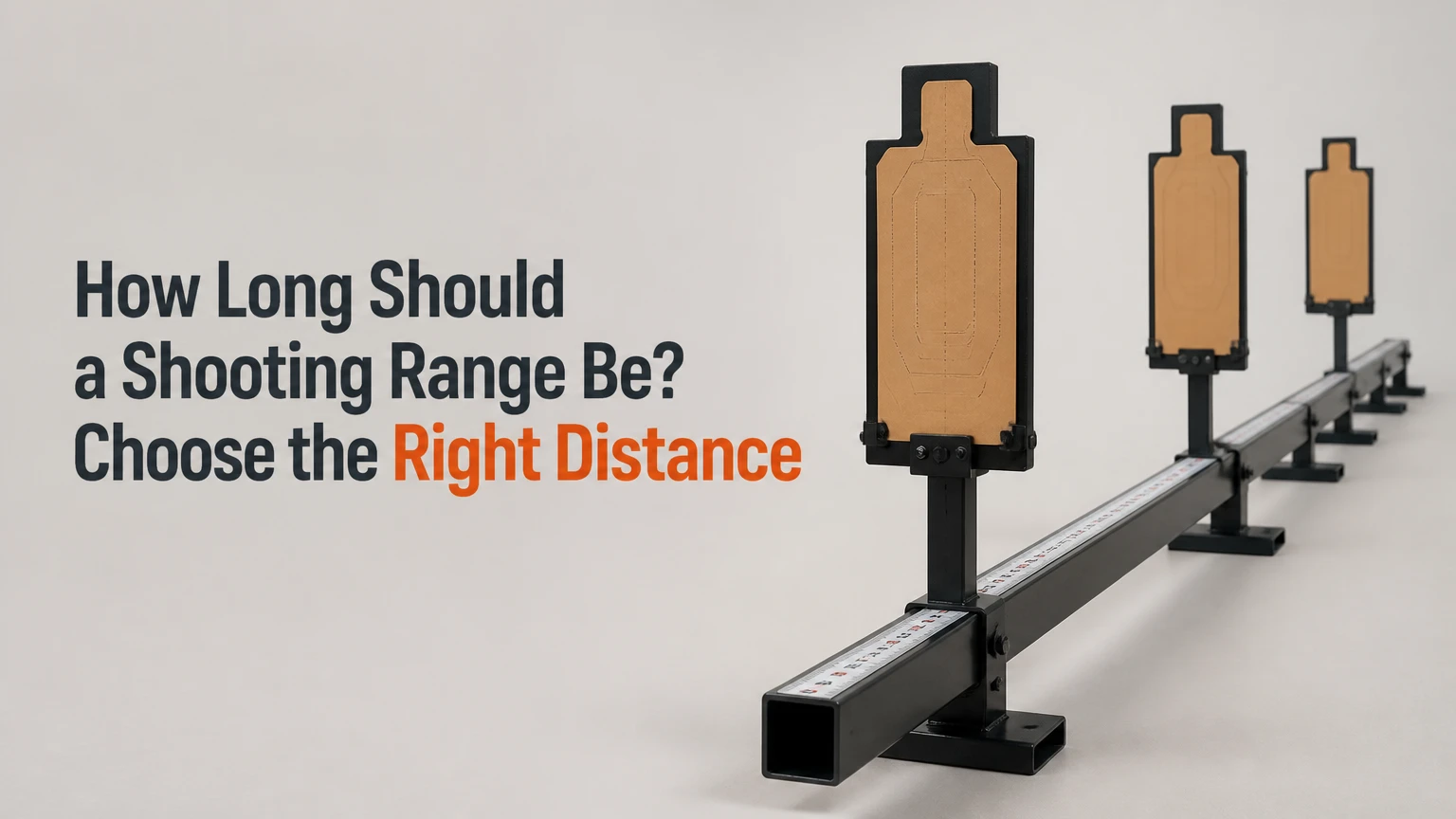
A shooting range should be as long as its intended shooting distance requires, plus space for the firing line, target system, bullet trap or backstop, and safe circulation. Typical facilities use 50 feet or 25 yards for indoor pistol practice, 100-300 yards for general rifle work, and 500-1,000 yards or more for precision shooting. Local law and professional ballistic design control the final layout.
Key Facts at a Glance
- A shooting range’s usable distance is measured from the firing line to the target face or intended impact point.
- A 50-foot range measures 16.67 yards, so it is shorter than a 25-yard range by 8.33 yards.
- A 25-yard indoor range commonly supports handgun training, qualification courses, and some approved rimfire or carbine use.
- A 100-yard outdoor range supports basic centerfire rifle zeroing, while 200-300 yards adds meaningful trajectory and wind practice.
- A 500-1,000-yard facility is usually required for long-range precision training, but the safe downrange area can extend far beyond the target line.
- Total property length is not the same as shooting distance because backstops, safety zones, access roads, setbacks, and terrain also consume land.
What Does Shooting Range Length Mean?
Shooting range length means the horizontal distance from the firing line to the target face, target carrier, or designated impact point. A 25-yard range therefore provides 25 yards of shooting distance, even though the room must be longer than 75 feet to accommodate equipment and people.
The measurement needs a defined reference point. Indoor designers typically measure from the shooter’s permitted position to the target presentation plane, while outdoor range plans may identify several firing points at different distances. A range with 25-, 50-, and 100-yard positions has three usable distances, not one average length.
Total facility depth includes more than the firing distance. Designers may need room behind the firing line for a controlled entrance, equipment, observation, storage, and circulation. Downrange space may include target carriers, a bullet trap, a backstop face, drainage, maintenance access, and structures that prevent unauthorized entry.
Why does usable length differ from building length?
Usable length differs from building length because a bullet trap, target mechanism, rear walkway, walls, and safety equipment occupy space. As a typical planning allowance, an indoor 25-yard shooting distance may require roughly 85-95 feet of clear room length, but the exact figure depends on the trap design and manufacturer requirements.
A target carrier can require several feet beyond the target face. A bullet trap may occupy more depth when it uses granular media, angled steel, or a staged impact system. The firing-line side also needs enough separation for doors, a control booth, benches, and safe movement.
Architectural drawings should label “firing line,” “target face,” “trap face,” and “clear usable distance” separately. That labeling prevents a common error: ordering a 75-foot room for a nominal 25-yard range and discovering that the target face sits too close to the shooter.
How Long Should an Indoor Pistol Range Be?
An indoor pistol range should usually be 50 feet or 25 yards, depending on the training program and available building. A 50-foot facility suits many qualification and defensive-training uses, while a 25-yard facility offers a more conventional handgun sight-in and marksmanship distance.
Indoor ranges often use motorized target carriers, fixed lanes, acoustic treatment, ballistic ceiling protection, and mechanical ventilation. The shooting distance is only one design variable. Cartridge approval, bullet-trap rating, lane geometry, fire protection, lead management, and emergency control can determine whether a proposed length is workable.
A commercial operator should select the longest distance that customers will use regularly, rather than maximizing distance at the expense of lane count. A 25-yard range with 10 lanes may support more routine consumer traffic than a 50-yard range with fewer lanes, but the decision depends on zoning, rent, clientele, and permitted firearms.
| Indoor distance | Typical use | Common firearm scope | Planning implication |
|---|---|---|---|
| 10 meters | Olympic-style air rifle or pistol | Airguns, .177-caliber pellets | Specialized target and lighting system |
| 50 feet | Qualification and defensive practice | Handguns, approved low-energy firearms | Compact room with shorter carrier travel |
| 25 yards | General handgun practice | Handguns, rimfire, selected carbines | Common commercial configuration |
| 50 yards | Extended handgun and rimfire work | Handguns, .22 LR, approved rifles | Higher containment and equipment demands |
Is 50 feet the same as 25 yards?
Fifty feet is not the same as 25 yards. Fifty feet equals 16.67 yards, whereas 25 yards equals 75 feet, making a 25-yard range 50 percent longer than a 50-foot range.
The difference affects target scale, sight alignment practice, qualification scoring, and sight-in results. A shooter training for a course that specifies 25 yards should not assume that a 50-foot lane reproduces the same conditions. The facility should publish the actual distance and the permitted ammunition.
How Long Should an Outdoor Rifle Range Be?
An outdoor rifle range should be 100 yards for basic zeroing, 200-300 yards for general rifle marksmanship, and 500-1,000 yards or more for precision and long-range practice. A 100-yard range remains the practical baseline because many rifle sights and scopes are commonly confirmed at that distance.
A longer range adds information that a short range cannot reproduce. At 200-300 yards, trajectory, wind drift, ammunition consistency, and shooter position become more apparent. At 500 yards and beyond, ballistic data, atmospheric conditions, optic tracking, and wind calls become central to the session.
Outdoor range length also increases the complexity of the safety plan. The designer must evaluate the surface danger zone, adjacent property, roads, trails, buildings, terrain, ricochet potential, projectile type, and unusual firing angles. A visible earth berm does not by itself prove that the site is safe.
| Outdoor distance | Primary purpose | Typical firing systems | Main limitation |
|---|---|---|---|
| 25-50 yards | Handguns, rimfire, shotgun patterning | Pistol, .22 LR, selected shotgun work | Limited rifle trajectory data |
| 100 yards | Rifle zeroing and basic qualification | Centerfire rifles, carbines | Modest wind and drop exposure |
| 200-300 yards | General rifle marksmanship | Centerfire rifles and service carbines | Larger land and safety footprint |
| 500-600 yards | Precision practice and matches | Precision rifles, designated match firearms | Wind, access, and maintenance costs |
| 1,000 yards or more | Long-range and ELR training | Specialized precision systems | Extensive land, terrain, and controls |
Which range length is best for rifle zeroing?
A 100-yard range is the most versatile rifle-zeroing distance for general civilian use. A 50-yard position can support rimfire and initial sight alignment, while a 200-yard position helps confirm trajectory and point-of-impact behavior when the firearm, ammunition, and optic are intended for longer distances.
The appropriate distance depends on the rifle’s purpose. A .22 LR rifle may be adequately evaluated at 50 or 100 yards. A centerfire hunting rifle commonly benefits from 100 and 200-yard confirmation. A precision rifle user may need 300 yards or more to validate ballistic predictions, but that longer distance does not replace safe equipment checks and a confirmed close-range zero.
Does Range Length Equal the Land Needed?
Range length does not equal the land needed for an outdoor shooting facility. A 100-yard firing distance may require substantially more than 100 yards of property because the site also needs a backstop, safety zone, setbacks, access, drainage, neighboring-property protection, and room for unusual trajectories.
The surface danger zone is site-specific. Military, federal, state, and local authorities may use different templates based on weapon, ammunition, firing position, target elevation, terrain, and containment features. The often-repeated figure of three miles is not a universal requirement, and no generic online distance can approve a particular parcel.
The United States Army’s range safety framework, including DA PAM 385-63, uses weapon-specific danger-zone analysis rather than one universal property length. Civilian projects may also involve state environmental agencies, county zoning departments, fire authorities, building officials, and insurers.
What determines an outdoor range safety footprint?
An outdoor safety footprint depends on projectile energy, ammunition construction, firing angle, target elevation, backstop geometry, side containment, ricochet hazards, and the land surrounding the facility. A professional range-safety assessment must model the actual firearm categories and operating rules.
Important site variables include:
- Backstop and terrain: Earth composition, height, width, slope, drainage, and erosion resistance affect containment.
- Side and overhead control: Berms, baffles, roofs, and natural terrain can reduce lateral or elevated escape paths.
- Firing-point control: Fixed benches, limited positions, and supervised ceasefires reduce unpredictable muzzle orientation.
- Neighboring exposure: Roads, homes, trails, utilities, watercourses, and public access change the acceptable layout.
- Maintenance condition: Erosion, bullet pockets, steel damage, and vegetation can alter the original safety assumptions.
The practical rule is simple: treat a range plan as an engineered safety project, not as a dirt-moving exercise. A licensed designer should identify the controlling standard before construction begins.
What Distance Does a Shotgun Range Need?
A shotgun range usually uses target distances rather than a single fixed lane length. Trap and skeet layouts launch clay targets across defined flight paths, while patterning boards often sit at 25-40 yards, depending on the ammunition, choke, firearm, and evaluation purpose.
Shotgun ranges require attention to shot fall, target flight, launch machinery, spectator locations, and lead-management practices. A rifle-style berm alone may not address the complete pattern of shot discharge and clay fragments. Sporting-clays courses can spread stations over large areas with different angles and target paths.
| Shotgun activity | Typical evaluation distance | Facility feature | Main planning issue |
|---|---|---|---|
| Patterning board | 25-40 yards | Large backstop and marked board | Safe shot containment and retrieval |
| Trap | 16-yard firing positions, longer target flight | Trap house and marked arc | Target path and shot-fall zone |
| Skeet | 8 stations on a compact field | High and low houses | Crossing flight paths and spectator control |
| Sporting clays | 20-60 yards of target travel | Multiple stations and launchers | Large dispersed site and varied angles |
These figures describe common sporting layouts, not universal legal standards. A range operator must use the rules of the governing discipline and the requirements of the local authority having jurisdiction.
What Safety Systems Determine Practical Range Length?
Safety systems determine whether a proposed shooting distance can operate lawfully and reliably. The essential systems include projectile containment, controlled access, ventilation for indoor facilities, acoustic treatment, fire protection, emergency communication, lighting, drainage, and inspection procedures.
Indoor ventilation deserves precise treatment. OSHA’s lead standard, 29 CFR 1910.1025, requires employers to control occupational lead exposure, but it does not establish one universal 75-feet-per-minute airflow value for every shooting range. Designers commonly use range-specific airflow targets and pressure relationships developed through industrial hygiene practice, then verify performance with measurements and exposure monitoring.
The National Institute for Occupational Safety and Health has documented lead exposure concerns in indoor firing ranges, while the Environmental Protection Agency regulates hazardous-waste considerations that may apply to spent ammunition components and range soil. Facility owners need an industrial hygienist and qualified mechanical engineer, not a copied fan specification.
What should an indoor range include beyond the target distance?
An indoor range should include a rated bullet trap, ceiling and side ballistic protection, controlled airflow from the clean zone toward the impact area, washable surfaces, lead housekeeping procedures, emergency controls, and manufacturer-approved ammunition limits. Each component must match the expected projectile and operating volume.
Typical planning allowances vary, but a designer may need 4-8 feet behind the firing line for circulation and control functions, plus 6-12 feet beyond the target face for the trap and service access. These are planning examples, not construction specifications. Trap manufacturers and local building officials control the final dimensions.
Acoustic treatment must also be compatible with ballistic protection. Soft acoustic panels cannot be placed where bullets can strike them unless the system has been specifically rated for that location. Range operators should schedule filter changes, trap inspections, lead cleaning, and surface testing before opening.
Range Length, Cost, and Construction Time
Longer shooting ranges generally cost more because they consume more land, require longer target systems, increase electrical and communications runs, and expand the inspection and maintenance area. Indoor length can also reduce the number of lanes that fit inside a building, which changes revenue capacity.
The following figures are typical planning ranges, not quotations. Soil conditions, labor markets, local permitting, projectile ratings, building reuse, environmental requirements, and acoustic specifications can change the final budget substantially.
| Project element | Typical planning range | Main cost driver | Typical schedule effect |
|---|---|---|---|
| Indoor 25-yard lane equipment | $40,000-$70,000 per lane | Trap, baffles, stall, controls | 3-6 months for retrofit work |
| Commercial ventilation system | $150,000-$300,000 or more | Air volume, filtration, exhaust path | Engineering and commissioning |
| Outdoor earthwork | $5,000-$30,000 or more | Excavation, imported soil, drainage | Weather and site access |
| Outdoor development | $250,000-$1,000,000 or more | Land, berms, roads, utilities, approvals | 6-18 months is typical |
A 10-lane, 25-yard indoor facility may therefore require several hundred thousand dollars in lane equipment before the building, leasehold work, permits, insurance, and professional fees are included. A 1,000-yard outdoor facility can cost less per firing position in some markets but require far more land and civil work.
Which Range Length Should Each User Choose?
The best distance depends on the user’s actual training objective, permitted firearms, available land, and operating model. A short range is efficient for handgun repetition, while a long range becomes valuable only when the shooter can use the additional distance safely and consistently.
| User or facility | Recommended usable distance | Why it fits | What it is not good for |
|---|---|---|---|
| Handgun owner | 50 feet-25 yards | Efficient sighting and practice | Long-range rifle trajectory |
| Rimfire shooter | 50-100 yards | Reveals practical .22 LR accuracy | High-volume centerfire use if not rated |
| Hunting-rifle owner | 100-200 yards | Supports zero confirmation and drop checks | Full long-range wind training |
| Commercial operator | 25 yards, often multiple lanes | Broad civilian demand and compact footprint | Dedicated ELR competition |
| Precision-rifle competitor | 500-1,000 yards or more | Provides meaningful wind and drop data | Low-cost urban development |
What is the best length for a commercial range?
A 25-yard indoor range is often the strongest commercial starting point when the target market is handgun owners, concealed-carry students, and general recreational shooters. A 10-12-lane layout can provide more usable capacity than a smaller number of 50-yard lanes, provided zoning and firearm restrictions support the business model.
Commercial operators should validate demand before selecting distance. A training academy may prioritize 50-foot lanes, a law-enforcement contract may require specific qualification distances, and a precision club may need outdoor 300-1,000-yard access. A single configuration cannot serve every customer equally well.
The best commercial plan separates customer promise from engineering reality. Advertising rifle access before confirming trap ratings, ventilation performance, insurance terms, and local approvals creates expensive redesign risk.
Common Range-Length Mistakes and Corrections
Mistake: treating nominal distance as room length
A 25-yard range needs more than 75 feet of building length. Correct the plan by showing the firing-line zone, target plane, carrier travel, trap depth, service clearance, and circulation on one dimensioned drawing.
Mistake: choosing distance before checking ammunition
A 100-yard room is not automatically a rifle range. The trap, baffles, walls, ceiling, ventilation, and fire-protection systems must be rated for every approved firearm and ammunition type.
Mistake: assuming a tall berm solves every outdoor hazard
A berm can reduce direct downrange escape but may not control ricochets, side shots, elevated firing positions, or projectiles passing around the berm. The site needs a documented danger-zone analysis and controlled firing procedures.
Mistake: copying the 75 fpm figure as a complete ventilation design
Air velocity at one measurement point does not prove acceptable worker exposure. Commissioning should evaluate airflow direction, pressure, capture performance, filtration, cleaning, and lead monitoring under operating conditions.
Mistake: ignoring maintenance depth
Bullet traps, target carriers, drainage channels, and berm faces need inspection and service access. A compact design that leaves no safe maintenance route can create recurring closures and unsafe work conditions.
Mistake: overlooking local approval
Range rules vary by jurisdiction. Confirm zoning, noise, environmental, building, fire, occupational-safety, and firearms requirements with the authority having jurisdiction before buying land or equipment.
A Safe Planning Sequence
Range planning should begin with the operating brief and end with measured commissioning, not with a preferred distance. The following sequence helps identify the controlling constraint without treating generic dimensions as approval.
- Define the firearms and ammunition. List handgun, rimfire, shotgun, carbine, rifle, and specialty categories separately.
- Define the training distances. Identify required positions such as 50 feet, 25 yards, 100 yards, or 300 yards.
- Select the facility type. Decide whether the project is indoor, outdoor, covered, private, commercial, instructional, or competition-oriented.
- Check the jurisdiction. Ask the local planning, building, fire, environmental, and occupational-safety authorities which standards apply.
- Commission a professional concept plan. Use a qualified range designer, ballistic consultant, civil engineer, mechanical engineer, and industrial hygienist as applicable.
- Analyze the surrounding site. Map property boundaries, roads, structures, utilities, public access, terrain, drainage, and neighboring uses.
- Price the complete system. Include land, earthwork, traps, baffles, ventilation, acoustics, utilities, permits, insurance, testing, and maintenance.
- Commission and document performance. Verify containment, airflow, sound, emergency controls, lighting, and operating procedures before opening.
The success checkpoint is documented compliance and repeatable operation under the approved firearm categories. The common failure is stopping after the dirt berm or equipment installation and assuming the range is finished.
Frequently Asked Questions
How long should a private backyard shooting range be?
A private range commonly uses 25-50 yards for handgun, rimfire, and limited practice, but legality and safe containment matter more than the nominal distance. A landowner should obtain written local approval and a professional site assessment before firing, because neighboring property, roads, trails, terrain, and ammunition type can make a short range unsafe.
Can a 25-yard range support a rifle?
A 25-yard range can support a rifle only when the complete facility is designed and approved for that firearm and ammunition. Rimfire rifles may be permitted in some facilities, while centerfire rifles may exceed the bullet-trap, wall, baffle, noise, or danger-zone limits of a short indoor range.
How far should targets be from an outdoor berm?
Target-to-berm spacing depends on the backstop design, target system, firing angle, ricochet controls, maintenance access, and governing standard. No universal gap guarantees safety. A professional range plan should specify the target line, impact area, berm geometry, and inspection zone for the exact firearm categories.
Is a 100-yard range enough for long-range shooting?
A 100-yard range is enough for initial zeroing and basic rifle accuracy checks, but it cannot reproduce the trajectory, wind drift, and atmospheric effects encountered at 500-1,000 yards. Long-range shooters need access to longer distances or validated ballistic training methods that do not substitute for actual downrange conditions.
How wide should shooting-range lanes be?
Many indoor ranges use approximately 3.5-4 feet per lane, but lane width depends on stall design, accessibility, benches, equipment, and local building requirements. A narrow lane can reduce usable space for instructors and equipment, so the architect should coordinate lane width with the complete firing-stall system.
The Bottom Line
How long should a shooting range be? Choose 50 feet or 25 yards for most indoor handgun work, 100-300 yards for general outdoor rifle practice, and 500-1,000 yards or more for precision shooting. The correct shooting range length is only the firing distance; the approved facility must also account for containment, land, ventilation, noise, maintenance, and local safety rules.