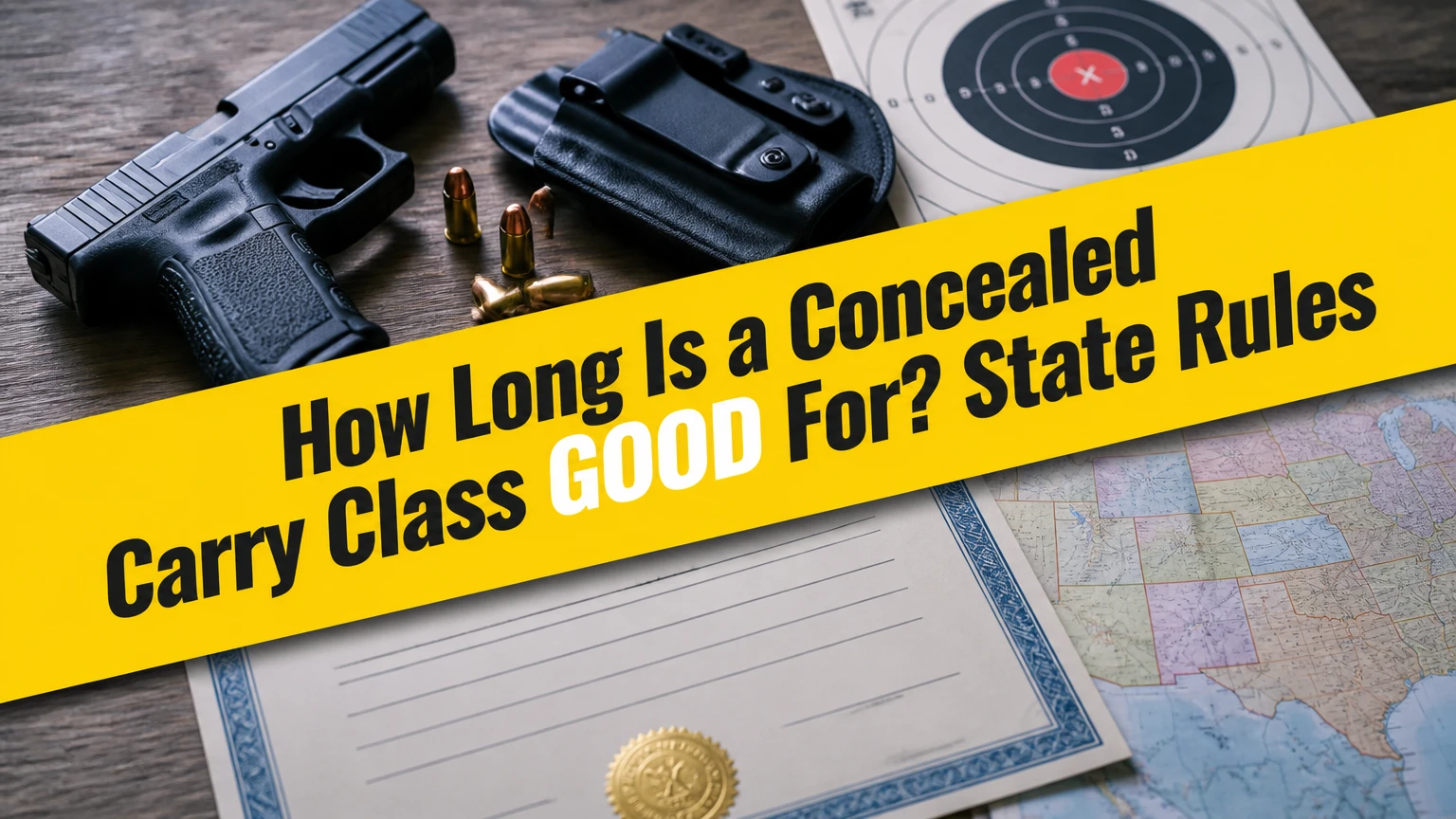
A concealed carry class certificate is usually valid for the period set by the state where you apply, often 6 months to 3 years, although some states accept older or indefinitely valid training proof. The certificate is not a concealed carry permit, and its deadline can differ from the permit’s expiration date or renewal-training requirement.
Key Facts at a Glance
A concealed carry class certificate proves training; it does not authorize concealed carry.
State law or the issuing agency determines whether training proof expires.
Common certificate windows range from 6 months to 3 years, but some states have no stated expiration for initial training proof.
The permit itself commonly lasts 2-5 years after approval.
A permitless-carry state may not require a class, but training can still matter for safety, reciprocity, or an optional permit.
Applicants should verify the current rule with the state police, sheriff, or licensing agency before booking a course.
What Does “Good For” Mean?
“How long is a concealed carry class good for” can refer to two different documents: the course-completion certificate and the concealed handgun permit. The certificate supports an application, while the permit is the government-issued authorization that may allow concealed carry under applicable law.
A training certificate normally records the instructor, completion date, curriculum, qualification result, and applicant identity. The licensing agency uses that record to determine whether the applicant met the initial training requirement. A certificate can therefore become unusable before an application is filed, even though the student completed the class successfully.
The permit has a separate issue date, expiration date, renewal procedure, and sometimes a continuing-education requirement. A five-year permit does not mean the underlying class certificate remains valid for five years. Conversely, a state may accept old training proof while requiring a new application, background check, or updated legal acknowledgment.
The safest interpretation is practical: ask, “How long may I use this certificate to support an initial application in my state?” Then separately ask, “How long will the issued permit last, and what is required to renew it?”
How Long Is a Concealed Carry Certificate Valid?
A concealed carry certificate may be usable for roughly 6 months, 1 year, 2-3 years, 5 years, or indefinitely, depending on state law and the type of application. No national expiration period applies, and an instructor’s statement cannot override a shorter statutory deadline.
Some jurisdictions define validity by the time between course completion and application submission. California, for example, generally requires the firearms training course to be completed within six months before the application under California Penal Code requirements. North Carolina applicants should confirm the current rule with the county sheriff because application procedures and acceptable training documentation are administered locally within the state framework.
Other states use a longer window or accept a certificate without a separate stated expiration for an initial permit. Florida and Virginia are commonly cited examples, but acceptance still depends on whether the course meets the state’s statutory training category and whether the applicant satisfies all current requirements.
| Certificate rule pattern | Typical usable period | What starts the clock | Applicant risk |
|---|---|---|---|
| Short application window | 6 months | Course completion or certificate date | Filing after the cutoff |
| Annual application window | 12 months | Instructor signature or class date | Assuming the permit term controls |
| Moderate application window | 2-3 years | Course completion date | Using an old form or obsolete curriculum |
| Long application window | Up to 5 years | Course date or documented qualification | Missing a changed agency requirement |
| No stated expiration | Indefinite in some cases | No published certificate cutoff | Assuming every old course remains acceptable |
The table gives planning ranges, not a substitute for the current statute. States sometimes change training standards, forms, approved providers, or the agency responsible for applications.
Why Does the Certificate Date Matter?
The certificate date matters because licensing agencies often evaluate eligibility when they receive the application, not when the student paid for the class. A certificate that was acceptable on Monday can be outside a six-month window when an application arrives on Tuesday.
Practitioners should photograph the signed certificate, preserve the original, and submit the application well before the deadline. A 30-day buffer is a sensible administrative rule when the state does not clearly define whether mailing, online submission, appointment date, or receipt date controls.
Which States Illustrate the Main Rules?
State examples show the range, but they do not create a reliable nationwide rule. California is associated with a six-month training recency requirement, Colorado commonly uses a one-year training-document window for an initial application, and Ohio law has historically used a three-year period for certain competency certificates.
Connecticut, Michigan, Florida, and Virginia illustrate different structures. Connecticut applicants should verify the current two-year rule and approved documentation. Michigan’s CPL process has used a five-year relationship between the training certificate and application eligibility. Florida and Virginia may accept older initial training evidence when it fits an authorized training category, but agency review and statutory changes still matter.
| State example | Training-document pattern | Permit or license term example | Verification point |
|---|---|---|---|
| California | Course generally within 6 months before application | Varies by issuing authority and license type | County sheriff or California DOJ |
| Colorado | Commonly up to 1 year for application evidence | 5 years | County sheriff or Denver Police Department |
| North Carolina | Commonly treated as a 1-year certificate window | 5 years | County sheriff |
| Ohio | Commonly cited 3-year competency-document period | 5 years | Ohio Attorney General and sheriff |
| Michigan | Training certificate may support an application for up to 5 years | 5 years | Michigan State Police |
| Wisconsin | Approved training documentation supports application | 5 years | Wisconsin Department of Justice |
| Maryland | State-approved firearms training applies to Wear and Carry applications | 2 years for the permit in many cases | Maryland State Police |
| Florida | No commonly stated short certificate cutoff for qualifying initial proof | 7 years | Florida Department of Agriculture and Consumer Services |
| Virginia | Qualifying proof may remain acceptable without a short general expiration | Up to 5 years, depending on locality | Circuit court or Virginia State Police |
These examples require current confirmation. Florida’s permit term, Maryland’s application rules, and local Virginia procedures demonstrate why a national summary can become misleading when it compresses distinct statutes into one expiration number.
When Should You Submit the Permit Application?
Submit the concealed carry permit application immediately after receiving the certificate, preferably within days rather than weeks. Early submission reduces the chance that a short certificate window expires while the applicant is waiting for fingerprints, an appointment, a missing document, or a background-check response.
The usual application sequence is:
- Confirm eligibility. Check age, residency, prohibited-person rules, domestic-violence restrictions, pending charges, and any state-specific disqualifier.
- Verify the course. Confirm that the instructor and curriculum are accepted by the issuing agency, not merely recognized by a national training organization.
- Complete the class. Attend the required classroom instruction and complete any written test, demonstration, or live-fire qualification.
- Collect the certificate. Inspect the name, date, instructor credentials, signature, qualification result, and identifying information before leaving.
- Prepare fingerprints. Use the required Live Scan, law-enforcement, or approved fingerprinting process.
- File the application. Upload or submit the certificate, identification, photographs if required, fingerprints, and fee.
- Track the deadline. Keep the receipt, confirmation number, and submission timestamp.
The certificate must satisfy the rule on the date and through the method the agency recognizes. A mailed application can create a dispute if the deadline is based on agency receipt rather than the postmark.
What Documents Usually Accompany the Certificate?
A typical initial application includes government identification, proof of residency, the original or certified training certificate, fingerprints, an application form, and a nonrefundable fee. Some jurisdictions request photographs, proof of address, court records, military documentation, or explanations for prior arrests and protective orders.
| Application item | Typical quantity or cost | Common problem | Corrective action |
|---|---|---|---|
| Training certificate | 1 original or accepted digital copy | Missing signature or expired date | Request correction before filing |
| Fingerprints | 1 submission | Wrong vendor or poor-quality prints | Use the agency’s listed provider |
| Application fee | Typically $20-$150 | Nonrefundable payment error | Confirm payment method first |
| Identification | 1 government-issued document | Name or address mismatch | Bring supporting legal documents |
| Photograph | 1-2 images where required | Incorrect dimensions | Follow agency specifications |
| Background records | Case-specific | Omitted arrest or disposition | Obtain certified court records |
What Does Concealed Carry Training Usually Include?
A state-approved concealed carry course commonly lasts 4-16 hours and combines firearms safety, storage, handling, legal limits, defensive decision-making, and a live-fire qualification when the jurisdiction requires shooting proficiency. The legal minimum is a compliance threshold, not a reliable measure of defensive skill.
Classroom subjects often include the four basic safety rules, loading and unloading, malfunction awareness, secure storage, child access prevention, conflict avoidance, and state use-of-force law. Live-fire requirements vary considerably. A typical qualification may involve approximately 50-100 rounds at multiple distances, but the exact round count, target, time limit, and passing score belong to the state or issuing agency.
Online-only instruction is a frequent source of rejection. A digital class may provide useful legal education, yet it may not satisfy a state requirement for in-person instruction, instructor verification, or live-fire qualification. Written approval from the issuing agency is safer than relying on a course advertisement.
How Do Minimum and Advanced Classes Compare?
A minimum permit course usually costs less and takes one day, while a comprehensive defensive-pistol course costs more and may occupy a full weekend. The longer class is valuable for handling and decision-making practice, but it does not automatically make a student competent under stress.
| Course type | Typical duration | Typical price | Live-fire content | Best use |
|---|---|---|---|---|
| State-minimum class | 4-8 hours | $75-$150 | 0-100 rounds, state dependent | Meeting an application requirement |
| Standard initial CCW course | 8-16 hours | $125-$250 | 50-100 rounds, often required | First permit and basic handling |
| Advanced defensive pistol | 8-16 hours | $200-$400 | 200-500 rounds, instructor dependent | Holster use and performance practice |
| Refresher or legal update | 2-6 hours | $40-$125 | None to 100 rounds | Renewal preparation and law updates |
| Beginner fundamentals class | 4-8 hours | $75-$200 | Usually 50-150 rounds | Building safe basic skills before carry |
A true beginner should not use a permit class as a substitute for foundational instruction. A certificate proves completion of a curriculum; it does not prove that the student can safely draw, diagnose a malfunction, or make a sound decision during a rapidly changing encounter.
What Does the Process Cost?
A typical initial concealed carry process costs about $150-$550 before the price of a firearm, holster, secure storage, or defensive ammunition. The final amount depends on the course, ammunition, range access, fingerprinting, photographs, and state application fee.
Typical component costs are:
- Initial class: $75-$250
- Ammunition: $20-$40 for a basic qualification, depending on caliber and local prices
- Range or lane fee: $15-$50
- Fingerprints and background processing: $40-$150
- Application fee: $20-$150
- Renewal or refresher course: $40-$125
| Expense scenario | Course | Ancillary costs | Typical total | Time implication |
|---|---|---|---|---|
| Low-cost minimum | $75 | $75 | $150 | One half-day plus filing |
| Typical initial applicant | $150 | $150 | $300 | One day plus fingerprint appointment |
| High-cost urban applicant | $250 | $300 | $550 | One weekend plus agency appointment |
| Renewal with refresher | $75 | $75 | $150 | 2-6 hours plus renewal filing |
Course price does not prove legal acceptability. A $40 online certificate can be more expensive than a $200 approved course if the licensing agency rejects it and the applicant must repeat the process.
How Long Does the Actual Permit Last?
The actual concealed carry permit commonly lasts 2-5 years, although some states issue longer terms. Permit duration begins when the licensing authority issues the credential, not when the applicant takes the class.
Wisconsin’s Department of Justice describes its concealed carry license as valid for five years from issuance. Colorado commonly issues a five-year permit, while Maryland Wear and Carry permits are generally issued for a limited term that applicants must verify under current state rules. California license periods can vary by statutory category and issuing authority.
| Permit example | Common validity period | Renewal issue | Responsible authority |
|---|---|---|---|
| Wisconsin CCW | 5 years | Renewal application and fee | Wisconsin DOJ |
| Colorado CHP | 5 years | County renewal procedure | County sheriff |
| North Carolina concealed handgun permit | 5 years | Renewal or late-renewal rules | County sheriff |
| Maryland Wear and Carry | Commonly 2 years | Current application and training rules | Maryland State Police |
| California CCW | Often 2 years | Local issuing-authority procedure | County sheriff or city police |
A permit expiration is not the same event as a certificate expiration. Some states require a renewal class, some require continuing education, and some require no formal refresher course while still imposing an obligation to obey changed laws.
Is a Class Required in a Permitless-Carry State?
A class may not be legally required to carry without a permit in a permitless-carry state, but optional training can still be necessary for an enhanced permit, reciprocity, employer policy, or personal competence. Permitless carry does not eliminate age, location, prohibited-person, vehicle, or use-of-force restrictions.
Texas, Georgia, and Tennessee are examples of states with broad permitless-carry frameworks, but each retains separate rules for optional licenses and recognized out-of-state permits. A resident seeking interstate reciprocity may need a permit even when state law allows unlicensed carry at home.
The practical question is therefore two-part:
- Is a permit legally required for the intended conduct in the resident’s state?
- Would obtaining a permit provide a benefit, such as reciprocity or a different purchase procedure?
A person should not assume that a class certificate creates reciprocity. Reciprocity belongs to the permit and the destination state’s recognition rules, which can change independently.
How Often Should You Take Refresher Training?
Refresher training is legally required only when the applicable state renewal rule says so, but a practical 2-3-year retraining cycle is reasonable for an active carrier. The cycle should be shorter after a long gap in shooting, a change in firearm platform, or a move to a state with different defensive-force laws.
A useful refresher combines legal updates with supervised handling. Review prohibited locations, transportation, storage, reporting duties, defensive-force standards, and the mechanics of the specific firearm and holster combination.
The National Rifle Association’s basic safety guidance begins with the rule, “Always keep the gun pointed in a safe direction,” a principle that remains relevant regardless of whether a state requires recurrent instruction. Safe carry also requires a suitable holster, trigger-guard coverage, retention, and a method that prevents access by unauthorized people.
Training should address limitations honestly. A short renewal class is not good for repairing poor trigger control, unsafe muzzle direction, or unfamiliarity with clearing malfunctions. Those problems require a fundamentals course and supervised practice.
What Problems Can Make a Certificate Unusable?
The most common certificate failures are an expired application window, an unapproved instructor, incomplete identifying information, a missing live-fire qualification, and a course format the agency does not recognize. Administrative defects can invalidate otherwise legitimate training.
Use this troubleshooting sequence:
- Expired certificate: Ask the issuing agency whether a statutory exception or updated documentation is available; otherwise, retake the approved course.
- Lost certificate: Contact the instructor first, then ask the agency whether it can verify the class through an instructor roster or electronic record.
- Incorrect name or date: Obtain a corrected certificate before submitting the application.
- Unapproved online course: Do not assume a national credential cures a state-specific defect; request written confirmation or select an approved provider.
- Changed law or curriculum: Ask whether the course date remains acceptable under the current statute.
- Late permit renewal: Determine whether the agency permits late renewal or requires a new-applicant course, fingerprints, and background check.
An instructor’s claim that “the certificate never expires” is insufficient when the agency applies a recency requirement. The licensing authority, statute, or official application instructions control.
What Is the Most Common Timing Mistake?
The most common timing mistake is waiting until the end of the certificate period to start fingerprints and paperwork. Fingerprint appointments, incomplete records, agency closures, and background-check questions can consume several weeks, so applicants should treat the published deadline as a filing limit rather than a planning target.
A second mistake is confusing the course date with the permit issue date. The course may be six months old when the permit is approved, but the permit’s term normally starts at issuance. Those dates belong to separate legal events.
How Should You Verify the Current Rule?
Verify the rule through the agency that accepts the application, then compare it with the controlling statute or official regulations. Use the state police, attorney general, Department of Justice, county sheriff, circuit court, or designated licensing division, depending on the jurisdiction.
Before paying for a course, confirm:
- The instructor’s current state approval or accepted credential.
- The exact course name and curriculum accepted for an initial permit.
- Whether online attendance is allowed.
- Whether live-fire qualification is mandatory.
- How long the certificate remains acceptable.
- Whether the deadline is based on completion, signature, submission, postmark, or agency receipt.
- Which fingerprints, photographs, fees, and identification documents are required.
- Whether the application is filed with a state agency or local issuing authority.
Save a PDF or screenshot of the official instructions and record the date checked. Agency webpages can change without preserving the older wording that appeared when the class was taken.
Frequently Asked Questions
Can I use a certificate from another state?
Sometimes, but out-of-state training is accepted only when it matches the resident state’s statutory requirements or the issuing agency expressly recognizes it. National credentials such as NRA or USCCA training do not automatically satisfy every state. Confirm instructor approval, in-person hours, live-fire content, and certificate language before relying on another state’s course.
Does a concealed carry class let me carry immediately?
No. A concealed carry class certificate normally proves training only. Carry authority begins only when state law independently permits the conduct or the issuing agency approves and issues the required permit. Carrying after class completion but before authorization can create a serious criminal or licensing problem.
Can I apply before receiving the physical certificate?
Only if the issuing agency accepts an electronic certificate, instructor submission, or another official training record. Some agencies require an original signed document, while others accept uploads. Ask the agency before filing because an application missing required proof can be rejected even when the class was completed.
What if the law changes after I take the class?
A law change can affect whether an older certificate, curriculum, or qualification remains acceptable. The agency may grandfather existing training, require an updated legal course, or apply the new rule to applications received after the effective date. Check the effective date and written transition instructions before submitting.
Does renewing the permit require repeating the initial class?
Not always. Some states require a renewal course or continuing education, some accept the original training record, and others use a shortened renewal process. A late renewal can be treated differently from an on-time renewal, so verify the renewal category before allowing the permit to lapse.
How long is a concealed carry class good for in my state?
The answer depends on the state and sometimes the issuing county or city. Treat six months to three years as a common planning range, not a universal rule, and check the official application instructions for the certificate deadline, approved course type, and filing-date standard.
The Bottom Line
A concealed carry class is “good for” only as long as the applicable state and issuing agency accept its certificate for the intended application. The practical range is often 6 months to 3 years, but some jurisdictions accept qualifying proof for 5 years or without a short stated expiration. The permit itself is a separate document, commonly valid for 2-5 years.
Take an approved course, preserve the certificate, verify the deadline directly with the licensing agency, and submit the application early. Even when the certificate never expires and the state requires no refresher, updated legal and defensive training remains separate from the minimum paperwork requirement.