Gun safety classes usually last 40 minutes to 5 hours for foundational instruction and 4-16 hours for carry-permit, qualification, or advanced training. The exact duration depends on course purpose, live-fire requirements, class size, instructor schedule, and state or national law. Some courses meet across multiple days.
Key Facts at a Glance
Online introductory firearm-safety modules typically take 40-90 minutes.
Classroom-only home-safety courses commonly take 3-5 hours.
Beginner handgun, rifle, or shotgun courses commonly take 7-14 hours.
Concealed-carry training can require 4-16 hours, depending on jurisdiction.
Live-fire, written testing, range delays, and remediation can extend the scheduled time.
An online certificate rarely substitutes for hands-on training when a licensing authority requires practical qualification.
How Long Are Gun Safety Classes?
A basic gun safety class most often takes 3-5 hours when it focuses on safe storage, firearm identification, ammunition awareness, loading and unloading procedures, and accident prevention. A broader beginner course with supervised range work usually takes 7-14 hours because students need time for classroom instruction, dry handling, live-fire exercises, and feedback.
A 40-90-minute online course is the shortest common format, but it generally provides orientation rather than verified physical competence. A permit-specific class may take 4-16 hours, and some programs divide the instruction into a classroom day and a range day.
The scheduled duration is not always the time spent sitting in a classroom. Check-in, equipment inspection, safety demonstrations, breaks, range movement, written tests, and certificate processing can add 30-90 minutes. A class advertised as four hours may occupy most of a morning or afternoon.
Typical Course Durations
| Course type | Typical instruction time | Live-fire requirement | Common purpose |
|---|---|---|---|
| Online introduction | 40-90 minutes | No | Basic terminology and safety awareness |
| Home firearm safety | 3-5 hours | Usually no | Storage, handling, and accident prevention |
| Beginner firearm course | 7-14 hours | Usually yes | First-time operation and range fundamentals |
| Carry-permit course | 4-16 hours | Often yes | State licensing or permit application |
| Advanced defensive or competition course | 8-24 hours | Yes | Skill development after basic training |
These figures are planning ranges, not universal legal standards. A provider may compress instruction into a shorter session, while a smaller class with more individual coaching may take longer.
What Happens During a Gun Safety Class?
A standard in-person gun safety class moves from rules and terminology to supervised handling, and then to live-fire or qualification when the course requires it. Students generally complete registration, classroom instruction, dry-handling exercises, range work, and an assessment in that order, although providers may combine or rearrange stages.
The first stage usually covers the four core safety principles, muzzle direction, trigger-finger discipline, firearm status checks, ammunition identification, and procedures for responding to an unsafe condition. Instructors also discuss storage, transport, access control, and applicable state law.
The practical section uses an unloaded firearm, inert training gun, or dummy ammunition. Students may practice identifying whether a firearm is loaded, opening the action, unloading, applying a safety mechanism where applicable, and responding to a stoppage under instructor direction. Live-fire is conducted only when the course includes it and the range considers the student ready.
A Typical Class Timeline
| Stage | Approximate time | Main activity | Possible delay |
|---|---|---|---|
| Check-in and briefing | 15-30 minutes | ID check, rules, equipment review | Late arrivals or missing documents |
| Classroom lesson | 90-180 minutes | Safety, mechanics, law, storage | Questions and discussion |
| Dry-handling practice | 30-90 minutes | Unloaded manipulation and drills | Individual corrections |
| Live-fire session | 60-180 minutes | Supervised shooting and qualification | Lane assignment or range wait |
| Test and certification | 20-60 minutes | Written exam and paperwork | Retesting or incomplete forms |
A certified instructor or range safety officer should control transitions between classroom and range areas. Students should follow the provider’s rule about whether personal firearms may enter the classroom, whether they must remain cased, and who verifies that they are unloaded.
How Long Does a Basic Home-Safety Course Take?
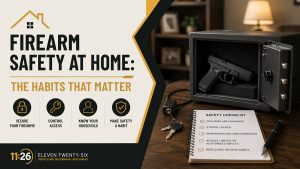
A basic home-safety course typically takes 3-5 hours and often excludes live ammunition. The curriculum concentrates on safe storage, unauthorized-access prevention, firearm recognition, basic operation, safe loading and unloading concepts, and household procedures for reducing accidents.
This format suits people who own no firearm yet, family members who need safe-access knowledge, and households that want a common storage plan without beginning range practice. It can be particularly appropriate for a person who wants safety education before deciding whether to purchase a firearm.
Home-safety instruction is not a substitute for a full beginner shooting course. A student may understand storage rules and still need supervised instruction on grip, stance, sight alignment, loading, unloading, and range commands. Project ChildSafe summarizes the storage principle directly: “There is no such thing as a childproof gun. There are only childproof behaviors.” The organization recommends locked storage that prevents unauthorized access.
Does Every Safety Class Include Live-Fire Shooting?
No. Online courses and many home-firearm-safety classes do not include live-fire practice, while beginner shooting, qualification, and many carry-permit courses do. The course description should state whether the range session is mandatory, optional, included in the price, or scheduled separately.
Live-fire adds more than shooting time. Students must receive a range briefing, put on eye and hearing protection, move safely to firing positions, respond to commands, and wait while instructors supervise each participant. Small classes can provide more feedback, but they may use a longer schedule because each student receives more individual attention.
A classroom-only certificate can document education without proving physical handling ability. Conversely, a live-fire qualification may establish that a student completed a required exercise without demonstrating broad judgment in stressful or changing situations. Training scope matters more than the certificate label.
How Long Does a Carry-Permit Class Take?
A concealed-carry or firearm-permit class commonly takes 4-16 hours, but the legally valid duration is determined by the relevant state, territory, province, or issuing authority. Some jurisdictions require classroom hours plus a shooting qualification, while others accept approved training alternatives or impose no fixed training hour requirement.
Carry courses usually add legal subjects that a basic safety class may cover only briefly. Those subjects can include lawful possession, prohibited locations, storage in vehicles, interaction with law enforcement, use-of-force law, defensive avoidance, and the consequences of displaying or discharging a firearm.
State rules change. A provider’s advertisement is not proof that its certificate satisfies the issuing authority. Before paying, confirm the required hours on the official state police, licensing agency, attorney general, or sheriff website, then verify that the instructor and course appear in the accepted category.
Carry-Training Examples
| Requirement pattern | Classroom time | Practical component | Verification needed |
|---|---|---|---|
| Short state-approved course | 4-6 hours | Qualification may be included | State agency and instructor approval |
| Full-day permit course | 6-8 hours | Range session often included | Certificate wording and score rules |
| Extended state curriculum | 12-16 hours | Classroom plus live-fire | Attendance, test, and qualification |
| Split-session program | 4-8 hours per day | Range on a second date | Both dates and completion records |
The 4-16-hour range describes common course structures, not a national standard. In the United States, firearm licensing is primarily governed by state law, so two neighboring states may impose different training requirements.
Can an Online Class Satisfy a Legal Requirement?
An online gun safety class satisfies a legal requirement only when the issuing authority explicitly accepts that format for the specific permit or license. Online training can establish knowledge through videos, text, and quizzes, but it cannot independently verify physical manipulation, muzzle control, loading and unloading, or live-fire performance.
Online instruction remains useful for preparation. A student can learn terminology, review legal definitions, study storage principles, and arrive at an in-person course with fewer basic questions. The format is also useful for household members who need safety awareness but do not plan to shoot.
Do not rely on a provider’s claim that a certificate is “nationally recognized.” Ask the licensing authority three questions: whether online completion is accepted, whether the provider is approved, and whether a practical test is separately required. Save the agency’s written guidance and the course certificate.
What Does a Gun Safety Class Cost?
A gun safety class typically costs $20-$350 before optional ammunition, equipment rental, range fees, and travel. Online modules commonly cost $20-$100, classroom safety courses $25-$125, beginner live-fire courses $100-$200, and permit-specific training $80-$250.
Prices vary because providers bundle different items. One course may include a firearm, ammunition, targets, eye protection, hearing protection, range fees, and certification. Another may charge separately for each item. A low advertised price can therefore produce a higher final cost.
Typical Price Breakdown
| Expense | Typical range | When charged | Cost-control question |
|---|---|---|---|
| Online course | $20-$100 | Before access | Is the certificate legally accepted? |
| Classroom course | $25-$125 | Registration | Are materials and testing included? |
| Live-fire course | $100-$200 | Registration or class day | Are firearm and lane fees included? |
| Ammunition | $25-$100 | Range day | What caliber and quantity are required? |
| Equipment rental | $10-$60 | Range day | Are eye and hearing protectors included? |
| Private instruction | $60-$150 per hour | Appointment | Is a minimum lesson length required? |
Typical ammunition costs depend on caliber, quantity, and local inventory. Never substitute ammunition based only on appearance. Use the firearm manufacturer’s marking and the instructor’s written course instructions, and ask the range before purchasing.
What Should You Bring to Class?
Bring government-issued photo identification, registration documents, eye and hearing protection if required, water, a notebook, and only the firearm and ammunition specified by the instructor. Most ranges require a personal firearm to arrive unloaded, secured in a case, and separate from ammunition, although local range rules control.
Call the provider 24-48 hours before class. Confirm the start and end time, parking, clothing rules, rental equipment, ammunition type and quantity, cancellation policy, and whether a firearm is supplied. Ask whether students may bring a personal firearm at all.
A student should not bring a loaded firearm into a classroom unless the facility has given explicit instructions and a controlled procedure. Treat every firearm as loaded until the instructor or range officer directs otherwise. If you are uncertain about the firearm’s condition, do not manipulate it in the parking lot or classroom. Notify staff and follow their procedure.
What Can Make a Class Take Longer?
Range capacity, class size, late arrivals, safety corrections, equipment problems, weather, written-test retakes, and incomplete paperwork can extend a gun safety class by 30 minutes or more. Live-fire sessions are especially sensitive to lane availability and the instructor-to-student ratio.
A course with 20 students cannot provide the same individual coaching speed as a private lesson. A novice who needs repeated demonstrations may appropriately take longer, because rushing a safety correction creates a greater risk than extending the schedule.
Common Scheduling Problems
- The advertised time excludes check-in. Arrive 15-30 minutes early and treat the published start time as the beginning of instruction.
- The range session is separate. Read the registration email for a second date, location, or qualification appointment.
- A student brings the wrong ammunition. Stop before opening the box and ask range staff to identify the correct specification.
- The student misses a required segment. Ask whether make-up instruction is allowed; many providers cannot issue a complete certificate for partial attendance.
- The class exceeds the planned end time. Avoid booking a flight, work shift, or other fixed appointment immediately afterward.
A practical rule is to reserve one extra hour beyond the advertised duration when travel and range work are involved. That buffer covers ordinary administrative and equipment delays without assuming that the class will run inefficiently.
Which Class Length Fits Your Situation?
The best course length depends on the learner’s goal, prior experience, need for a legal certificate, and willingness to practice under supervision. A 3-5-hour home-safety class fits household education, while a 7-14-hour beginner course is a stronger choice for a first-time shooter who needs verified handling and range instruction.
| Situation | Recommended format | Planned time | Why it fits |
|---|---|---|---|
| Family member needs storage knowledge | Classroom home safety | 3-5 hours | No shooting required in many programs |
| First-time firearm owner | Beginner in-person course | 7-14 hours | Combines handling and supervised range work |
| Permit applicant | State-approved carry course | 4-16 hours | Matches local legal and testing requirements |
| Experienced shooter changing platforms | Platform-specific lesson | 2-4 hours | Focuses on unfamiliar controls and operation |
| Person uncomfortable with firearms | Private or classroom-only lesson | 2-5 hours | Slower pace and controlled exposure |
| Canadian firearms licence applicant | CFSC, plus CRFSC if needed | Commonly 8-16 hours total | Follows the applicable federal course pathway |
The Canada comparison requires special care. The Royal Canadian Mounted Police identifies the Canadian Firearms Safety Course, or CFSC, as the course associated with non-restricted firearms, while the Canadian Restricted Firearms Safety Course, or CRFSC, applies to restricted firearms. Provider schedules vary, so applicants should confirm current requirements with the RCMP Canadian Firearms Program.
How Should You Verify a Course Before Registering?
Verify the issuing authority, instructor credential, required hours, practical component, certificate wording, expiration rules, and total price before registering. The official licensing agency, rather than a course advertisement, determines whether training is valid for a permit or application.
Use this verification sequence:
- Identify the exact license or permit you want.
- Find the issuing authority’s current training page.
- Record the required classroom, practical, and testing elements.
- Match the instructor’s credential to the approved category.
- Ask whether online, out-of-state, military, hunter-education, or prior-service training qualifies.
- Confirm the certificate’s name, date, issuing organization, and expiration requirements.
- Obtain the complete cost in writing.
This step prevents a common failure: completing a legitimate safety course that is unsuitable for the legal purpose. A course can be professionally taught and still fail to satisfy a particular jurisdiction’s application rules.
What Should You Do After Class?
After class, store firearms and ammunition according to the instructor’s guidance, review the written material, and schedule supervised practice if you intend to shoot. A completion certificate records attendance or qualification; it does not guarantee safe judgment, consistent manipulation, or legal knowledge in every situation.
A sensible follow-up plan includes a short review within one week, a supervised range session within one month, and periodic practice that follows range rules. Keep the certificate, course receipt, instructor contact details, and any qualification score with other important records.
New owners should ask an instructor to check their specific firearm before independent practice. Controls, loading procedures, sights, safeties, and disassembly methods vary by model. General familiarity with one handgun does not automatically transfer to a different handgun, rifle, or shotgun.
What If You Need More Time or a Different Format?
Ask for a private lesson, smaller class, classroom-only option, or accessibility accommodation before enrolling. A competent provider should be able to explain whether the course can be slowed down, whether a non-shooting observer may attend, and how the facility handles hearing, mobility, language, or anxiety-related needs.
A private lesson commonly takes 2-4 hours for an introductory session, while a group beginner course may take 7-14 hours. Private instruction costs more per hour, but the student may need fewer total sessions because feedback is immediate and the lesson can focus on the specific firearm and learning pace.
A student should postpone live-fire participation if they cannot reliably follow range commands or maintain safe firearm direction. The correct response is additional instruction, not pressure to finish on schedule.
Frequently Asked Questions
Is a four-hour gun safety class enough for a beginner?
A four-hour class can be enough for basic safety awareness, storage instruction, and introductory handling when the curriculum is classroom-focused. It is usually insufficient for broad beginner competence if the student also needs firearm operation, malfunction response, live-fire practice, and individual coaching. A 7-14-hour course provides more complete initial coverage.
Do gun safety classes expire?
A general safety certificate may not expire, but a permit-training certificate can have jurisdiction-specific age, validity, or application deadlines. Some agencies accept certificates indefinitely, while others require recent instruction or impose rules tied to the application date. Check the issuing authority before assuming an old certificate remains valid.
Can I take a gun safety class without owning a firearm?
Yes. Many instructors provide training firearms, inert replicas, or classroom demonstrations, and home-safety courses often require no firearm ownership. Tell the provider that you are a non-owner before registering, because some live-fire classes require a particular platform, ammunition type, or rental reservation.
Are gun safety classes difficult?
Basic safety classes are usually manageable for beginners because instructors introduce terminology and handling progressively. The assessment may test rules, storage, identification, and local law, while a practical qualification may add handling or accuracy standards. Difficulty increases when the course compresses many subjects into one day or requires live-fire performance.
Should family members take the same class?
Family members who share a home should receive consistent storage and access-control instruction, even if only one person owns the firearm. They do not necessarily need the same permit or live-fire course. A household safety class can establish common procedures, while the owner may separately complete platform-specific and legal training.
How often should someone repeat firearm safety training?
Repeat training after acquiring a different firearm, moving to a new jurisdiction, experiencing a long break from shooting, or noticing uncertainty about safe handling. A formal refresher every one to three years is a reasonable planning interval, but the appropriate schedule depends on use, confidence, legal changes, and instructor advice.
The Bottom Line
For the question “how long are gun safety classes,” plan on 40-90 minutes for online orientation, 3-5 hours for classroom home safety, 7-14 hours for a complete beginner course, and 4-16 hours for carry-permit training. Confirm the local legal requirement, practical component, instructor approval, included equipment, and full schedule before booking.