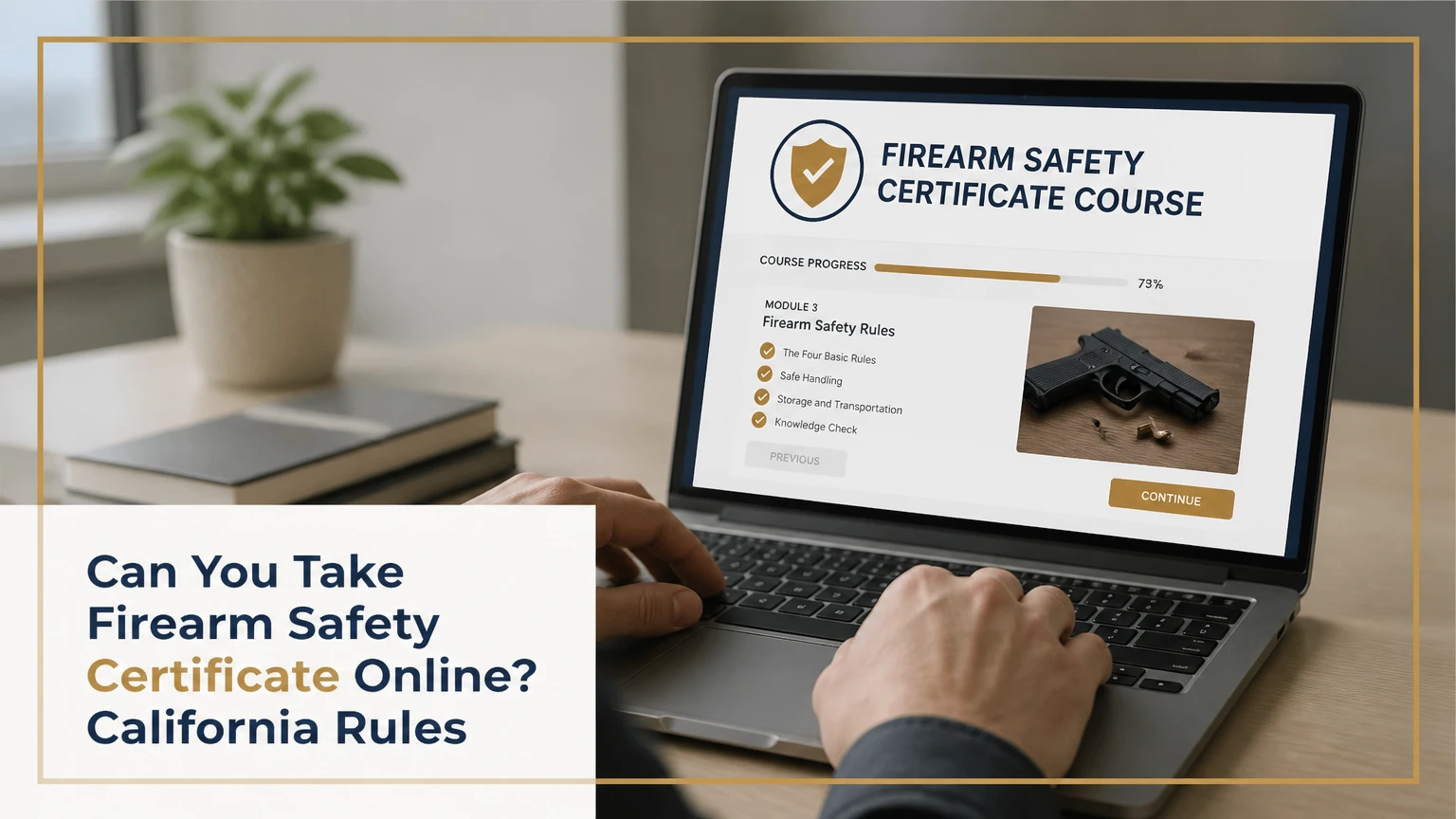
No, you generally cannot take the official California Firearm Safety Certificate exam entirely online. California requires the FSC test to be administered in person by a California Department of Justice-certified instructor, usually at a licensed firearms dealer, and the purchase process may also require a firearm-specific safe-handling demonstration.
Key Facts at a Glance
- The California FSC examination is an in-person, 30-question written test.
- A passing score is 75%, which means at least 23 correct answers out of 30.
- The statutory FSC fee is $25, although a dealer or instructor may charge separately for related services.
- A California FSC normally remains valid for five years from its issuance date.
- Online practice tests and general safety classes can prepare you, but they do not replace the official FSC.
- A safe-handling demonstration is separate from online study and must be completed physically when the transaction requires it.
Can You Take a Firearm Safety Certificate Online?
You cannot complete the official California FSC examination online because California requires an in-person test administered by a DOJ-certified instructor. An online certificate from a private website is not the state credential used to satisfy the FSC requirement for an ordinary California firearm purchase or transfer.
The distinction matters because “firearm safety certificate” describes several unrelated products. A private online course may provide education, a court may accept a digital completion record, and a hunting platform may issue a hunter education credential. None of those documents automatically becomes a California FSC.
The California Department of Justice identifies the FSC as a written examination covering firearm safety and California firearm laws. The official DOJ study guide is useful for preparation, but reading the guide online does not issue a certificate. The test itself remains tied to an authorized examiner and an identifiable applicant.
A dealer may administer the exam during a purchase appointment, or a certified instructor may offer testing separately. Policies differ on appointments, payment methods, and whether the dealer charges beyond the statutory state fee, so confirm those details before traveling.
Why online completion does not satisfy the requirement
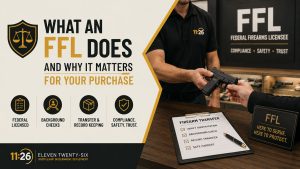
The in-person requirement verifies the applicant’s identity and creates a controlled setting for the examination. It also allows the dealer or instructor to address the safe-handling requirement when a specific firearm transaction calls for a demonstration.
An online quiz cannot establish that the person who took it is the purchaser. It also cannot show whether the applicant can safely handle the firearm involved in the transaction. That physical verification is the main reason an online completion badge cannot substitute for the official process.
What Is a California Firearm Safety Certificate?
A California Firearm Safety Certificate is a state-recognized credential issued after an applicant passes the FSC examination through a DOJ-certified instructor. The credential generally supports the purchase or transfer of a firearm in California, subject to separate eligibility, background-check, waiting-period, and transaction rules.
The certificate is not a license to carry a firearm. It does not authorize concealed carry, replace a carry permit, or prove that a person is legally eligible to possess a firearm. The dealer still completes the required Dealer Record of Sale process and other legal checks.
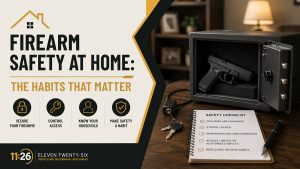
The FSC also does not replace safe storage obligations. California law imposes storage duties in circumstances involving children and unauthorized access, and the firearm purchaser remains responsible for following current law. The DOJ study guide covers these subjects, including basic handling, storage, transportation, and prohibited-person rules.
California’s official safety guidance begins with the rule: “Always keep the gun pointed in a safe direction.” That rule is a handling principle, not an online-course credential. A person should learn and practice safe handling before attempting the examination or visiting a dealer.
How Do You Get an FSC?
You obtain a California FSC by studying the DOJ materials, locating a DOJ-certified testing provider, presenting acceptable identification, passing the in-person exam, and completing any required safe-handling demonstration connected with the firearm transaction. The written test commonly takes about 15-30 minutes, excluding waiting time.
Step 1: Study the official material
Start with the California DOJ FSC Study Guide rather than relying on a national course that may teach different laws. Review safe direction, trigger discipline, loading and unloading, storage, transportation, ammunition, child access prevention, and California restrictions.
Practice quizzes can identify weak areas, but practice questions are not guaranteed to match the live examination. Treat third-party quizzes as revision tools, not legal authorities. California firearm rules change, and an old quiz can preserve an obsolete age rule, transfer exception, or storage statement.
Success checkpoint: You can explain each safety rule without memorizing only an answer pattern.
Common mistake: Studying a course from another state and assuming its terminology matches California law.
Step 2: Locate an authorized examiner
Ask a licensed California firearms dealer whether the location administers FSC examinations, or find a DOJ-certified instructor through a reputable local provider. Confirm that the examiner is currently authorized before paying for a course or traveling.
Ask four practical questions:
- Is the FSC test offered to non-purchasers?
- Is an appointment required?
- What is the total price, including any service charge?
- Will the location handle the safe-handling demonstration for the firearm being transferred?
Success checkpoint: You have the provider’s address, appointment requirement, fee, identification policy, and test availability in writing.
Common mistake: Assuming every gun store offers testing at all times.
Step 3: Bring acceptable identification
Bring current government-issued identification that satisfies the dealer’s identity and residency requirements. A California driver’s license or California identification card is commonly used, but a dealer may need additional documents for a transaction involving a recent move, an address mismatch, or a federal identification requirement.
The FSC exam and the firearm purchase are related but distinct. Passing the exam does not cure an invalid identification document, a prohibited-person issue, an unsafe handgun restriction, or a residency documentation problem.
Success checkpoint: The name and address on your documents are consistent with the transaction records, or you have asked the dealer what supplemental documents are required.
Common mistake: Arriving with an expired license, temporary paper document, or an address that does not satisfy the dealer’s transaction requirements.
Step 4: Take the written test in person
The FSC test contains 30 questions in true-false and multiple-choice formats. The passing threshold is 75%, so you need at least 23 correct responses.
Read each question literally. California firearm questions often turn on a defined condition, an exception, or the difference between safe handling and legal eligibility. Do not infer that a familiar rule from another state applies in California.
Success checkpoint: The instructor records a passing result and begins the certificate issuance process.
Common mistake: Rushing through questions because the material appears familiar.
Step 5: Complete the safe-handling demonstration
The safe-handling demonstration is a physical evaluation connected with the firearm type involved in the transaction. The instructor may require you to demonstrate safe steps such as receiving the firearm, keeping the muzzle controlled, keeping your finger outside the trigger guard, checking its condition, and following directions for unloading or clearing it.
The exact demonstration can depend on the firearm and California requirements in effect at the time. Ask the dealer what firearm will be used and what procedure the instructor expects. Never manipulate a firearm without the instructor’s direction.
Success checkpoint: The instructor confirms that your handling is safe and documents completion if required.
Common mistake: Treating the written FSC pass as permission to handle the firearm independently.
Step 6: Receive and retain the certificate
After a passing result, the authorized provider records and issues the FSC. Keep the certificate information with your important firearm records, because the credential normally lasts five years and may be needed for a later transaction.
The dealer still must complete the purchase or transfer process. An FSC does not guarantee approval, shorten the statutory waiting period, or override a background-check delay.
What Is on the FSC Exam?
The California FSC exam tests basic firearm safety, safe storage, transportation, firearm operation, and California legal requirements. The exam has 30 questions, and a 75% score requires 23 correct answers rather than 22.
| Exam attribute | California FSC detail | Practical implication |
|---|---|---|
| Administering authority | DOJ-certified instructor | Online-only providers cannot issue the official FSC |
| Question count | 30 questions | Review every subject in the study guide |
| Passing threshold | 75% | At least 23 correct answers |
| Typical completion time | 15-30 minutes | Allow additional dealer waiting time |
| Retake timing | At least 24 hours after failure | Do not plan a same-day second attempt |
| Subject areas | Safety, storage, law, operation | National courses may omit California rules |
California DOJ materials should control when a commercial practice quiz conflicts with a current legal source. The test is not a substitute for legal advice, and passing it does not establish that every firearm or transaction is lawful.
How Much Does the FSC Cost and How Long Does It Last?
The California FSC statutory fee is $25, and the certificate normally remains valid for five years from the date of issuance. The actual amount paid at a dealer can be higher if the business adds a lawful service charge, combines testing with instruction, or charges separately for transaction services.
| Cost or time item | Typical California figure | What can change it |
|---|---|---|
| Statutory FSC fee | $25 | Provider billing and current state rules |
| Written examination | 15-30 minutes | Queue length and test administration |
| Certificate validity | 5 years | Statutory changes or transaction-specific rules |
| Retake delay | 24 hours minimum | Provider schedule after the waiting period |
| Dealer transaction time | Often 30 minutes or more | Background check, paperwork, and store workload |
| Online preparation | $0 to course price | Free DOJ materials versus private instruction |
The $25 amount is not necessarily the complete cost of buying a firearm. A dealer can have separate prices for the firearm, transfer, DROS-related services, storage, locks, ammunition, or optional instruction. Request an itemized quote.
Which Online Courses Are Useful?
Online firearm-safety courses are useful for education, review, and some court or employer requirements, but they cannot replace the California FSC examination unless the specific authority expressly accepts that course for a different purpose. Verify acceptance with the court, employer, probation office, or licensing agency before enrolling.
| Online option | Completion format | Replaces California FSC? | Appropriate use |
|---|---|---|---|
| California DOJ FSC Study Guide | Digital or printed reading | No | Primary exam preparation |
| FSC practice quiz | Online questions | No | Recall practice and weak-area review |
| General firearm safety class | Usually self-paced | No | Introductory education |
| Hunter education course | Often online plus field component | No | Hunting-license education |
| CCW training course | Online or hybrid, depending on provider | No | Carry-license training where accepted |
| Court-ordered safety course | Court-approved format | Not automatically | Compliance with a specific order |
A digital course can teach principles that improve handling, but a completion certificate is not proof of passing the state FSC. The course provider’s marketing language is less important than the agency that must accept the document.
How should you evaluate an online class?
Check the issuing organization, California law update date, instructor qualifications, refund policy, and exact purpose of the credential. A course that says “California compliant” may mean only that it discusses California topics, not that the state accepts it as an FSC.
An online class is a poor choice when the buyer’s only goal is to obtain the purchase credential. The official DOJ study guide plus an in-person FSC test is usually the shorter and less expensive route.
Does Hunter Education or a CCW Course Replace an FSC?
A hunter education card or concealed-carry training certificate does not automatically replace a California FSC. These credentials address different legal purposes, and an agency may accept one only for the narrow program that issued or approved it.
Hunter education generally focuses on hunting ethics, wildlife rules, field safety, and firearm or bow handling. A CCW course addresses carry law, qualification, and permit requirements. The FSC focuses on California’s firearm safety and purchase-related requirements.
Some California statutes create exemptions or alternative qualifications for particular applicants or transactions. Because the exemption depends on exact facts, ask the dealer to verify the applicable current California DOJ rule rather than relying on a course provider’s promise.
Who May Be Exempt From the FSC Requirement?
Certain people and transactions may qualify for statutory exemptions, but exemption status is fact-specific and must be documented. Examples can include particular active or retired law-enforcement personnel, military personnel, certified instructors, and transactions covered by a specific legal exception.
Military status alone should not be assumed to create an exemption. Orders, identification, duty status, firearm type, and transaction facts can matter. A person stationed in California should ask the dealer what documentation the dealer requires before beginning the purchase.
| Situation | Automatic exemption assumption | Safer action |
|---|---|---|
| Active law enforcement | Do not assume every credential qualifies | Present agency identification and ask the dealer |
| Military service | Orders and status may matter | Bring military documents and verify current rule |
| Retired law enforcement | Qualification varies | Ask whether retirement credentials satisfy the exemption |
| Certified instructor | Certification type matters | Provide current certification documentation |
| Private-party transfer | FSC may still apply | Have the dealer review the transfer facts |
| Prior FSC expiration | Old certificate may not qualify | Confirm issuance date and obtain a new FSC if needed |
An exemption from the FSC does not remove background-check, possession, storage, waiting-period, or other firearm-law requirements. It only addresses the specific requirement covered by the exemption.
How Do Private-Party and Out-of-State Transfers Work?
Private-party and interstate transfers do not become exempt merely because the seller is an individual or the firearm came from another state. California generally requires transfers to proceed through a licensed dealer, and the dealer determines which FSC, identification, background-check, and documentation rules apply.
An out-of-state seller cannot normally ship a firearm directly to a California buyer for an ordinary private transaction. Federal and California requirements may require a California dealer and an appropriately licensed shipping or receiving dealer. The FSC is only one part of that process.
For a private-party transfer, contact the receiving dealer before meeting the seller. Ask whether both parties must appear, which identification is accepted, whether the dealer handles the firearm type, and whether the buyer needs a current FSC or can document an exemption.
What Mistakes Cause Problems?
The most expensive FSC mistakes occur when buyers confuse an educational certificate with a state credential, fail to verify the provider, or arrive without transaction-ready identification. Fixing the problem usually requires another visit, a new fee, or a delayed transfer.
Mistake 1: Buying an “online FSC”
A website promising an “official online California FSC” should be treated as unverified. Search the California DOJ instructions, call the dealer, and ask whether the provider is authorized to administer the exam.
Mistake 2: Using an outdated practice test
A quiz can contain old law or another state’s rules. Compare disputed answers with the current California DOJ study guide and ask the instructor about unresolved conflicts.
Mistake 3: Assuming a passing score completes the purchase
The FSC is not a background-check approval. The dealer still processes the transfer, verifies eligibility, observes required handling, and follows waiting-period and firearm-specific rules.
Mistake 4: Returning immediately after failing
California requires a waiting period before a retake, commonly at least 24 hours. Use the interval to review the missed subject rather than memorizing the previous question order.
Mistake 5: Handling the firearm without instructions
Do not pick up, open, load, unload, or clear a firearm until the instructor gives a direction. Safe handling includes following the facility’s commands, not merely knowing general rules.
Mistake 6: Treating the FSC as a carry permit
The FSC does not authorize concealed or open carry. Carry authority requires separate legal analysis and, where applicable, a permit issued by the appropriate California licensing authority.
What Should a First-Time Buyer Do Before Visiting?
A first-time buyer should download the current California DOJ FSC Study Guide, study for one evening or several short sessions, call a DOJ-certified provider, and confirm the total fee and identification requirements. Plan at least 45-90 minutes at the location if testing and transaction paperwork occur together.
Use this preparation checklist:
- Read the current DOJ study guide.
- Review California storage, transportation, and prohibited-person rules.
- Complete one or two practice quizzes.
- Schedule the test if the provider requires an appointment.
- Bring current identification and any address documents.
- Ask whether the provider performs the firearm-specific demonstration.
- Budget for the $25 statutory FSC fee plus separate dealer charges.
- Keep the certificate date for the five-year expiration calculation.
A practice quiz should reveal uncertainty, not replace study. The highest-value preparation is understanding why an answer is correct, especially where California law differs from general firearm instruction.
What Is the Best Choice for Different Situations?
The best route depends on whether the goal is a California purchase, general education, court compliance, hunting, or carry licensing. For a purchase, use official California materials and an in-person certified examiner; for another purpose, follow the authority’s written acceptance rules.
| User situation | Best first action | Online component | Required caution |
|---|---|---|---|
| First California firearm purchase | Contact a licensed dealer or certified instructor | DOJ guide and practice | Confirm total price and handling procedure |
| Wants general safety education | Choose a reputable basic course | May be fully online | Course does not create an FSC |
| Court-ordered class | Read the court order | May be online if approved | Obtain written acceptance first |
| Hunter licensing | Use the state-approved hunter program | Often partly online | Hunter card is not an FSC |
| CCW applicant | Contact the issuing licensing authority | Course format varies | CCW training is a separate requirement |
| Out-of-state transferee | Contact a California receiving dealer | Research can occur online | Federal transfer rules still apply |
This distinction prevents the common false economy of paying for a course that the intended authority will not accept. The provider should identify the credential’s legal purpose in writing.
Can You Retake the FSC if You Fail?
You can retake the California FSC examination after the required waiting period, which is generally at least 24 hours after a failed attempt. The provider may require a new appointment or charge according to its posted policy, so ask about retesting before beginning the first exam.
Review the study guide section connected with the missed questions. If the problem involved California law, use DOJ material rather than a generic firearm course. If the problem involved terminology, ask the instructor to explain the distinction before attempting the retake.
A failed exam does not permanently bar a buyer from obtaining an FSC. It does delay the related transaction and may require another visit.
FAQ
Is the California FSC test open book?
The California FSC test should be treated as a supervised examination, not an open-book online quiz. Follow the testing provider’s instructions and do not use notes, a phone, or reference material unless the instructor expressly permits it. The official DOJ study guide is intended for preparation before the test.
Do you need an FSC to buy ammunition?
The FSC is primarily associated with firearm purchase and transfer requirements, not a universal ammunition-purchase certificate. Ammunition sales involve separate California eligibility and background-check rules. Ask the ammunition vendor about current requirements because an FSC does not substitute for the documentation or approval required for ammunition transactions.
Can a nonresident take a California FSC test?
A nonresident should ask a California dealer or DOJ-certified instructor whether the person’s intended transaction and identification documents qualify. Passing an FSC does not make a nonresident eligible for a California purchase, and federal interstate-transfer rules can independently control the transaction.
Does an FSC prove that a firearm is registered?
An FSC does not prove firearm registration, ownership, or transfer approval. The dealer submits transaction records through the required process, while the certificate only addresses the safety-examination requirement unless a specific exemption applies.
Do you need a new FSC every time you buy a firearm?
A new FSC is generally not required for every purchase while a valid certificate remains available, because the certificate normally lasts five years. A dealer may still require additional documentation, and a transaction may involve an exemption or firearm-specific requirement that should be verified before purchase.
Can an online course prepare someone for safe handling?
An online course can explain safe direction, trigger discipline, storage, and basic operating concepts, but it cannot evaluate physical handling reliably. Use online instruction as preparation, then follow the certified instructor’s directions during the in-person demonstration and never handle a firearm without supervision when learning.
The Bottom Line
You cannot take the official California Firearm Safety Certificate exam entirely online. Use the California DOJ study guide and reputable practice quizzes for preparation, then complete the 30-question, in-person examination with a DOJ-certified instructor, achieve at least 23 correct answers, and follow the dealer’s requirements for identification and safe handling.
Online firearm-safety classes remain useful for education or an expressly approved court, employer, hunting, or licensing requirement. They do not replace the FSC unless a current California rule specifically provides an exemption or alternative. Before paying any provider, confirm the credential’s purpose with the dealer or government agency that must accept it.