No. You cannot use a purely online concealed carry class to satisfy Virginia’s current handgun competency requirement for a Concealed Handgun Permit (CHP). A Virginia resident or nonresident may complete theory online when a provider includes a required in-person component, but the final training evidence must meet Virginia law and the issuing authority’s requirements.
Key Facts at a Glance
- Virginia law removed online-only, electronic, and video-only training as a standalone competency route effective January 1, 2021.
- A hybrid course is acceptable only when its in-person component produces compliant proof of handgun competency.
- Virginia residents generally apply through the clerk of the circuit court for their city or county.
- Nonresidents apply through the Virginia State Police using the nonresident application process.
- A course completion voucher, online quiz result, or payment receipt is not automatically a valid competency certificate.
- Virginia State Police guidance and the relevant circuit court should control when a provider’s advertising makes a broader claim.
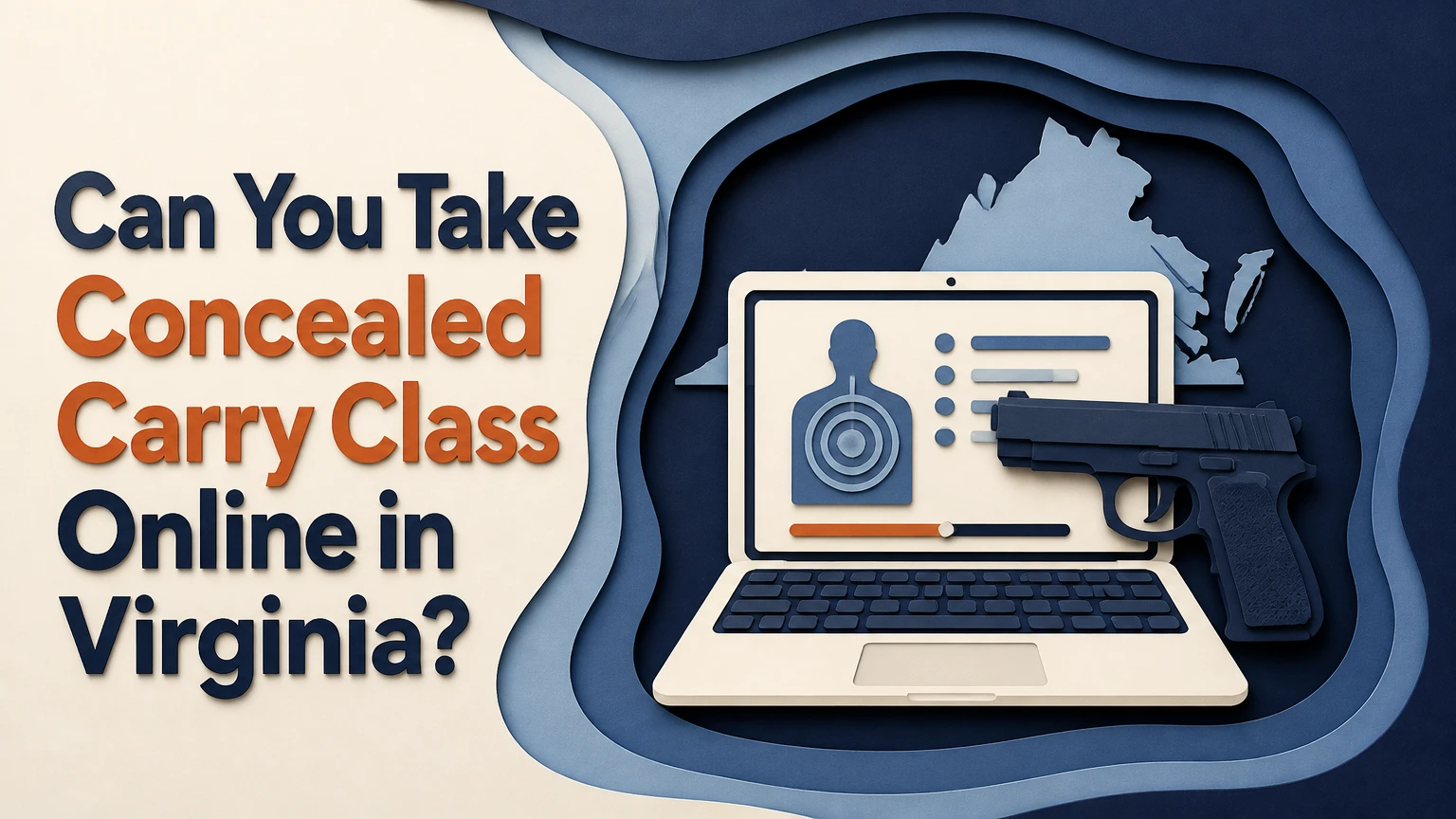
Can You Take Concealed Carry Class Online in Virginia?
Virginia does not accept a 100% online class by itself for a concealed handgun permit application. The controlling issue is not whether a website calls its product a Virginia CCW course; the issue is whether the applicant can submit legally recognized proof of handgun competency under Virginia Code § 18.2-308.02.
Virginia’s rule changed on January 1, 2021. Older articles, videos, certificates, and provider pages may still describe online-only training as sufficient, but a certificate issued under an outdated process can produce a rejected or delayed application.
The phrase “online Virginia concealed carry class” therefore has two meanings. Some providers use it for online lessons followed by an instructor meeting, skills demonstration, classroom verification, or range session. Other websites sell an online-only certificate that may be useful for another state but does not establish Virginia eligibility.
The distinction matters before payment. Virginia State Police publishes application requirements, but a resident application is processed through the local circuit court clerk. Clerks can inspect submitted documents, so applicants should confirm that a proposed hybrid certificate will be accepted before booking travel or paying a nonrefundable fee.
What Does Virginia Law Require?
Virginia requires proof of handgun competency through a qualifying course, credential, or experience category listed in Virginia Code § 18.2-308.02. The statute addresses competency, not merely exposure to online information, which is why a video presentation and multiple-choice quiz may be insufficient on their own.
The statutory framework can include qualifying firearms courses offered to the public, courses conducted by recognized organizations, hunter education in appropriate circumstances, military or law-enforcement firearms training, and other specifically described evidence. The exact document must establish the applicant’s completion of a recognized competency pathway.
The key legal change is the removal of electronic, video, or online-only instruction as a standalone option. A provider cannot cure that problem by printing a certificate after an applicant watches videos. The certificate must correspond to a training route Virginia recognizes.
What changed on January 1, 2021?
Virginia removed the prior online-only avenue for demonstrating handgun competency on January 1, 2021. A pre-2021 webpage can therefore give a technically outdated answer even when its course remains available for applicants in another state.
The safest rule is simple: treat online coursework as preparation, not final proof, unless the provider identifies the required in-person component and the receiving authority confirms acceptance. The Virginia State Police is the appropriate source for current statewide guidance, while the local circuit court clerk handles resident filing questions.
The statute does not mean every applicant must complete a particular commercial range qualification. It means the applicant must submit acceptable evidence from a qualifying category. Some providers require live-fire practice; others structure the in-person element differently. Applicants should not assume that one provider’s format applies to every course.
How Does a Hybrid Virginia CHP Course Work?
A compliant hybrid course normally divides instruction into online theory and an in-person verification or training appointment. The online portion may cover safe handling, storage, Virginia carry restrictions, defensive-force concepts, transportation, and the application process, but the provider must explain exactly what happens face to face.
A typical process takes 2-3 hours online and 1-4 hours in person, with total pricing commonly ranging from $60-$150 before optional ammunition, range, fingerprinting, or equipment charges. Those are typical market ranges, not state-set prices.
Step 1: Confirm the course before paying
Ask the provider five precise questions:
- What in-person activity is mandatory?
- Who is the instructor, and what certification or authority does that person hold?
- Does the final certificate identify the applicant, course, date, instructor, and competency basis?
- Are range, ammunition, firearm rental, and administrative fees included?
- Will the provider support the certificate if a circuit court asks for verification?
A provider that answers only “Virginia accepts our online certificate” has not answered the important question. The applicant needs the structure and documentation of the in-person element.
Step 2: Complete the online theory
Online lessons can be useful for learning terminology and legal concepts at a convenient pace. They do not prove that an applicant can safely load, unload, handle, store, or operate a handgun.
Keep the completion email, quiz result, receipt, and course terms. These documents may help resolve a provider dispute, but they do not replace the final competency evidence.
Step 3: Attend the in-person component
The in-person meeting may involve supervised handling, a live-fire session, an instructor-led competency assessment, or a required classroom verification. The provider’s written terms should state the activity, duration, location, equipment rules, and rescheduling policy.
Beginners should choose supervised live-fire training when possible. A short verification appointment can confirm paperwork, but it may not correct unsafe grip, trigger-finger placement, muzzle direction, loading, unloading, or storage habits.
Step 4: Obtain the final certificate
The final document should match the applicant’s government identification exactly. Check the legal name, date of birth if shown, course date, instructor information, organization name, signature, and competency description before leaving the appointment.
A temporary voucher is not necessarily the final certificate. Some providers issue a pre-certification document after the online quiz and issue the formal signed record only after the in-person requirement is complete.
Step 5: File the permit application
Virginia residents generally submit the application to the clerk of the circuit court for the city or county where they reside. The clerk’s website should identify the accepted application form, fee, payment method, office hours, identification requirements, and any appointment or fingerprinting procedure.
Nonresidents follow the Virginia State Police nonresident process rather than a local Virginia resident filing route. Nonresident applicants should use the current State Police form and instructions because mailing details, fees, and document rules can change.
Which Training Format Should You Choose?
The best format depends on prior firearm experience, schedule, location, and the provider’s documentation. Hybrid training saves classroom time, but a traditional in-person class gives a beginner more opportunity to ask questions and receive immediate safety corrections.
| Training format | Online time | In-person time | Typical total cost |
|---|---|---|---|
| Online-only certificate | 2-6 hours | 0 hours | $30-$100, not a reliable Virginia route |
| Hybrid classroom verification | 2-4 hours | 1-2 hours | $60-$120 |
| Hybrid with range session | 2-4 hours | 2-4 hours | $100-$200 |
| Full in-person class | 0 hours | 4-8 hours | $75-$200 |
Is live fire required for every Virginia permit class?
Virginia’s competency requirement does not necessarily mean that every qualifying pathway uses the same live-fire test. A specific provider or organization may require live fire, while another accepted course may document competency through a different in-person structure.
Live fire remains the stronger practical choice for a new shooter because it combines legal instruction with direct firearm supervision. Applicants should ask the provider and clerk whether the exact certificate format is accepted rather than generalizing from a friend’s course or a different county.
Hybrid versus full classroom training
| Decision factor | Hybrid course | Full in-person course |
|---|---|---|
| Online study | 2-4 hours at home | 0 hours |
| Facility visit | 1-4 hours | 4-8 hours |
| Beginner feedback | Limited to scheduled session | Available throughout class |
| Range availability | Often separate or optional | Usually stated in enrollment terms |
| Scheduling risk | Two appointments or stages | One block of time |
| Common hidden cost | Range, ammunition, rental fees | Parking, range, ammunition fees |
Hybrid training is efficient for an experienced owner who understands basic handling and can attend the required appointment. It is a poor substitute for fundamentals training when the applicant has never handled a handgun.
How Much Does a Virginia Concealed Handgun Course Cost?
A Virginia permit-training course commonly costs $60-$200, depending on whether the price includes an instructor meeting, range time, firearm rental, ammunition, certificate production, and administrative support. The permit application fee is separate from training and varies by filing authority and current fee schedule.
| Expense | Typical amount | Usually paid to | Confirm before payment |
|---|---|---|---|
| Online theory | $30-$90 | Training provider | Whether it includes the in-person step |
| Instructor verification | $30-$100 | Training provider | Duration and certificate issuance |
| Range lane or access | $20-$50 | Commercial range | Whether lane time is reserved |
| Ammunition | $20-$60 | Range or retailer | Caliber and round quantity |
| Firearm rental | $15-$40 | Commercial range | Identification and rental rules |
| CHP application fee | Varies | Circuit court or Virginia State Police | Current official fee schedule |
A low advertised price can exclude the very component that makes the course useful. Ask for the total out-the-door price, including the certificate, range, ammunition, firearm rental, rescheduling, and tax.
The application fee should come from the current court or Virginia State Police instructions, not from a third-party training page. Fees and payment methods can change independently of the course price.
What Documents Do You Need to Apply?
Most applicants should prepare a completed CHP application, government-issued photo identification, acceptable handgun competency evidence, and the required fee. The issuing authority may request additional documentation based on residency, name changes, criminal history, or the specific application circumstances.
| Document or condition | Resident applicant | Nonresident applicant |
|---|---|---|
| Application destination | Local circuit court clerk | Virginia State Police process |
| Government identification | Virginia identification commonly used | Government photo identification |
| Competency evidence | Qualifying course or statutory category | Qualifying course or statutory category |
| Address documentation | Current Virginia residence | Current nonresident address |
| Fee | Current local court schedule | Current State Police schedule |
| Fingerprints | Follow local instructions | Follow State Police instructions |
A name mismatch is a preventable problem. If the certificate says “Jonathan Smith” and the identification says “Jon Smith,” ask the provider to correct the document before filing.
Do not staple unrelated receipts to the application and assume they prove competency. The clerk needs the document that identifies the qualifying course or experience, not merely evidence that an online product was purchased.
Where Do Virginia Residents File the Application?
Virginia residents generally file with the circuit court clerk in the city or county where they reside. The Virginia State Police resident guidance explains the overall process, but local clerks may differ in appointment scheduling, payment methods, copies, and document presentation.
Before visiting, check the clerk’s official website or telephone office. Confirm whether the office accepts walk-ins, whether applications are filed in person or by mail, whether copies are required, and whether the clerk wants an original signed certificate.
Virginia law provides a processing framework that commonly includes a 45-day period for approval or denial. If the court cannot complete the decision within the statutory period, the applicable law may require a temporary permit under specified conditions. A temporary permit is not automatic permission to ignore application defects.
How Do Nonresidents Apply?
Nonresidents apply through the Virginia State Police nonresident concealed handgun permit process rather than filing with a Virginia county court as a resident would. The applicant should use the current State Police application, follow mailing instructions, provide the required identification and competency documents, and pay the current fee.
A nonresident can often complete qualifying firearms training outside Virginia when the course satisfies Virginia’s competency rules. That does not make an online-only course acceptable. The relevant question is whether the training includes the required recognized instruction and evidence, including any mandatory in-person element.
Nonresidents who frequently travel to Virginia should also examine where concealed carry is prohibited and whether another state’s permit affects travel through intervening jurisdictions. Permit reciprocity is a separate issue from Virginia’s training requirement.
Can an Out-of-State Online Permit Solve the Problem?
An out-of-state online certificate does not automatically satisfy Virginia’s training requirement, and an out-of-state permit does not convert a Virginia resident’s online-only course into Virginia competency evidence. Reciprocity concerns recognition of a permit, while training compliance concerns how that permit or a Virginia application was obtained.
Virginia residents should not purchase an Arizona, Florida, or Oregon online course solely because an advertisement claims broad reciprocity. The issuing state may accept that course under its own law, while Virginia may reject the certificate as evidence for a Virginia CHP.
A nonresident permit can be useful for travel only where the destination recognizes it and the carrier understands the destination’s restrictions. Carrying in Virginia still requires compliance with Virginia law, including prohibited locations, vehicle rules, school restrictions, and other applicable limitations.
What Are the Most Common Application Problems?
Most avoidable problems involve an outdated online-only certificate, an incomplete hybrid requirement, a mismatched name, an expired or altered document, or filing with the wrong authority. The remedy depends on whether the defect is in the training evidence, the application, or the filing route.
| Problem | Likely cause | Corrective action |
|---|---|---|
| Certificate rejected | Online-only course | Complete a qualifying course with the required in-person element |
| Clerk requests more proof | Vague competency description | Obtain provider documentation identifying course and instructor |
| Name mismatch | Nickname, marriage, or typographical error | Request a corrected certificate |
| Wrong filing location | Resident filed as nonresident or vice versa | Follow local clerk or State Police instructions |
| Unexpected extra charge | Range, ammunition, or certificate fee excluded | Request an itemized price before enrollment |
| Course page conflicts with law | Outdated marketing copy | Rely on current statute, State Police, and clerk guidance |
Do not argue from a provider’s advertisement when a clerk questions the certificate. Request the clerk’s specific deficiency, then ask the provider for written documentation that addresses that deficiency. If the certificate cannot establish a qualifying pathway, taking a compliant course is usually faster than trying to defend an ambiguous document.
Which Option Fits Your Situation?
Absolute beginner
Choose a full in-person class with supervised firearm handling and, where offered, live-fire practice. Online law lessons can reduce classroom time, but they cannot show an instructor whether you control the muzzle, keep your finger off the trigger, or safely unload the firearm.
Experienced handgun owner
Choose a hybrid course only after confirming the exact in-person requirement, final certificate format, total cost, and acceptance route. Experienced shooters may benefit from self-paced legal instruction, but familiarity with a firearm does not eliminate Virginia’s documentation rules.
Busy professional
Compare total appointment time rather than online seat time. A hybrid course requiring a 90-minute verification appointment may be more convenient than an eight-hour class, but a provider with limited appointment dates can create a longer calendar delay.
Virginia resident near a state border
Use the Virginia resident filing route if Virginia is your residence. An out-of-state training location may be acceptable when the course meets Virginia’s competency standard, but the issuing authority should confirm the document before enrollment.
Frequent visitor who lives elsewhere
Review the Virginia nonresident process and the laws of every state where you plan to carry. A Virginia nonresident permit does not override location-specific restrictions, transportation rules, or another state’s recognition limits.
What Should You Verify Before Enrolling?
Use this checklist before entering payment details:
- Confirm that the course is not online-only.
- Identify the date, location, duration, and instructor for the in-person component.
- Ask whether live fire, supervised handling, or classroom verification is required.
- Request a sample certificate with personal information removed.
- Confirm the instructor’s qualifying certification or organizational status.
- Obtain the full price, including range, ammunition, rental, and certificate fees.
- Check the provider’s cancellation and rescheduling policy.
- Confirm the appropriate resident or nonresident filing authority.
- Compare the course information with current Virginia State Police guidance.
- Contact the circuit court clerk before filing if the certificate uses unusual wording.
The most useful provider is not necessarily the cheapest. Documentation quality determines whether the training can support the application.
What Does a Virginia CHP Allow and Not Allow?
A Virginia Concealed Handgun Permit authorizes concealed handgun carry only within the scope of Virginia law. It does not authorize prohibited conduct, eliminate location restrictions, permit unlawful use of force, or guarantee that another state will recognize the permit.
Permit holders must still understand restricted places, posted or statutory prohibitions, school-related rules, alcohol-related provisions, transportation requirements, and interactions with law enforcement. Those rules can change through legislation or court decisions, so a class taken months earlier is not a permanent substitute for current legal review.
A permit also does not replace safety training. Legal eligibility and practical competence are separate responsibilities. An applicant can receive a permit while still needing instruction in storage, holster selection, safe handling, defensive decision-making, and emergency procedures.
FAQ
Does Virginia require a shooting test for a concealed handgun permit?
Virginia requires proof of handgun competency, but the exact accepted pathway does not always use the same shooting-test format. Some providers include live fire, while others use another qualifying in-person structure. Confirm the specific course certificate with the provider and receiving authority before enrollment.
Can I take the online portion from another state?
You may be able to complete theory online or attend qualifying training outside Virginia, especially as a nonresident, but an online-only certificate remains problematic. The course must produce evidence that fits Virginia’s statutory competency requirements, and the in-person portion should be documented clearly.
Do I need fingerprints for a Virginia CHP?
Fingerprint requirements can differ by application route and current instructions. Follow the current resident circuit court or Virginia State Police nonresident directions instead of relying on a training provider’s general checklist. The provider does not control the issuing authority’s application procedure.
How long is a Virginia concealed handgun permit valid?
A Virginia concealed handgun permit is generally issued for five years. Check the expiration date printed on the permit and begin renewal planning early because a renewal application, fee, identification, and any required documentation must follow current instructions.
Can I carry while my application is pending?
A pending application is not the same as an issued permit. Do not treat a receipt, course certificate, temporary voucher, or filing confirmation as a concealed handgun permit unless the issuing authority has issued a document that legally authorizes carry.
What if my local clerk rejects a hybrid certificate?
Ask the clerk to identify the exact deficiency and obtain the provider’s written explanation of the in-person training, instructor qualification, and certificate basis. If the document cannot establish compliance, request a corrected certificate or complete a different qualifying course before refiling.
The Bottom Line
You cannot take a purely online concealed carry class in Virginia and rely on its certificate alone for a Virginia Concealed Handgun Permit. A hybrid course may work when it includes and documents a required in-person competency component, while a full in-person class remains the clearest choice for beginners. Verify the provider, certificate, filing route, current fee, and local acceptance before paying.