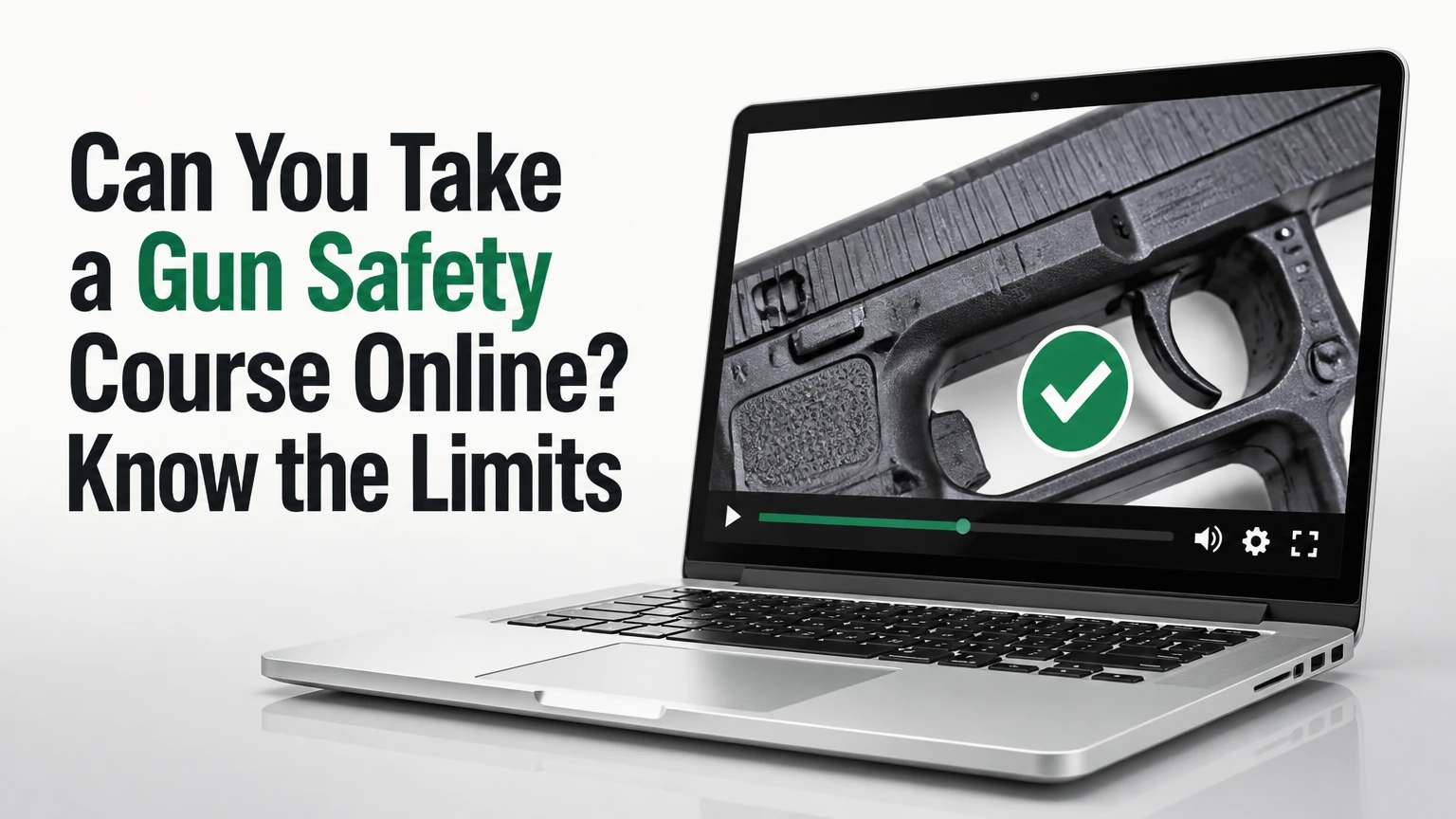
Yes, you can take a gun safety course online, but an online certificate does not automatically satisfy a state permit, purchase, or training requirement. Online instruction works well for firearm terminology, safe-storage principles, legal concepts, and preparation. Hands-on handling, live-fire qualification, and official acceptance depend on your state and your specific purpose.
Key Facts at a Glance
A general online gun safety course usually proves course completion, not physical firearm proficiency.
No universal federal online certificate authorizes a person to carry a concealed firearm.
State-issued permits may require an approved instructor, in-person attendance, live fire, or all three.
Typical online education costs $0-$100 and takes about 90 minutes to 4 hours.
Hybrid courses combine online classroom material with an in-person skills or live-fire session.
A state police, attorney general, Department of Justice, or issuing agency is the final authority on acceptance.
What Is an Online Gun Safety Course?
An online gun safety course is a web-based educational program that teaches firearm rules, basic terminology, storage, transportation principles, and applicable legal concepts without requiring the student to sit in a classroom. Most programs use videos, reading modules, quizzes, and a final assessment.
A typical course explains the four foundational rules, ammunition identification, firearm components, accidental-discharge prevention, child-access prevention, cleaning precautions, and what to do when a person encounters an unknown firearm. Some programs also discuss defensive-force law, de-escalation, concealed-carry responsibilities, and interstate transportation.
The format is usually asynchronous. A student creates an account, completes modules in sequence, answers knowledge checks, and downloads a certificate after passing the final test. Course controls vary: some providers use timed lessons and unlimited retakes, while others require a minimum score, identity verification, or instructor review.
An online course is useful before a first range visit because the student can learn vocabulary and procedures without the noise, pressure, and distractions of a firing line. The limitation is equally important: a screen cannot confirm whether a student controls a muzzle, manipulates a specific firearm safely, responds correctly to a malfunction, or maintains safe behavior under recoil and stress.
What Does an Online Course Actually Prove?
An online certificate generally proves that a named student completed educational content and passed a knowledge assessment. It does not necessarily prove that the student handled a firearm, fired a qualifying group, demonstrated loading and unloading skills, or received instruction from a state-approved instructor.
The National Shooting Sports Foundation publishes the rule, “Always keep the gun pointed in a safe direction,” among its core firearm-safety guidance. Memorizing that rule matters, but practical instruction tests whether a student follows it while picking up, setting down, transporting, holstering, or clearing a firearm.
Read the certificate language carefully. “Certificate of completion,” “online safety training,” “state-approved training,” and “live-fire qualification” describe different outcomes. A provider may use persuasive wording on a sales page while the issuing authority requires a particular instructor number, course code, attendance record, or range qualification.
Can You Take a Gun Safety Course Online for a Permit?
You can take a gun safety course online for permit preparation, but you can use the certificate for a state-issued permit only when the issuing authority expressly accepts that course and format. Many jurisdictions require in-person instruction, live-fire practice, a practical demonstration, or a state-approved instructor, so a 100% online certificate may be educational but legally insufficient.
State rules change and often differ by permit type. A concealed-carry license, firearm-safety certificate for a purchase, hunting credential, and court-ordered education requirement can each use different definitions of approved training. A course accepted for one purpose may be rejected for another.
For example, California’s Firearm Safety Certificate process involves a DOJ-certified instructor and a safe-handling demonstration; an ordinary online quiz certificate is not a substitute for that process. New York’s concealed-carry licensing framework includes prescribed classroom and live-fire training for many applicants. Other states may accept online classroom work but still require an in-person range qualification.
Verify acceptance before paying by checking:
- The state police, attorney general, Department of Justice, or licensing agency website.
- The exact permit or certificate name, not merely the word “firearms.”
- Whether the provider, instructor, course number, and delivery method appear on an approved list.
- Whether live fire, a shooting qualification, or a safe-handling demonstration remains mandatory.
- Whether the certificate has an expiration period or must be issued within a specified number of months.
- Whether your county or issuing sheriff applies an additional local requirement.
A provider’s claim that a course is “valid nationwide” does not override the agency that processes your application. Reciprocity websites can help with travel research, but the issuing state controls the requirements for obtaining its own credential.
Does an Online Certificate Let You Carry a Firearm?
An online certificate alone does not create a right to carry a firearm. Carry authority comes from applicable law, a permit issued by the relevant jurisdiction, or a specific legal exemption, and those rules can depend on location, firearm type, prohibited places, age, criminal history, and other conditions.
Permitless-carry laws also do not eliminate the value of training or guarantee that an online certificate has legal significance. A person can be legally allowed to carry and still face separate storage, vehicle, school-zone, courthouse, workplace, or private-property restrictions.
Treat legal modules as orientation rather than legal advice. State statutes, administrative rules, court decisions, and agency guidance can change, and an online provider may not update every lesson immediately.
Which Course Format Fits Your Purpose?
General online education fits knowledge-building, while a hybrid or in-person class fits people who need physical coaching or an official qualification. The correct format depends on the outcome you need, not on whether a provider issues a downloadable certificate.
| Course format | Typical time and cost | Practical component | Best-supported use |
|---|---|---|---|
| Free informational course | 45-120 minutes, $0 | None | Safety vocabulary, storage review, family orientation |
| Paid online fundamentals | 90 minutes-4 hours, $20-$100 | Usually none | General education and pre-range preparation |
| State-specific online classroom | 2-8 hours, $40-$150 | Varies by state | Permit theory only when the agency accepts online delivery |
| Hybrid firearms course | 4-16 total hours, $75-$250 | Scheduled instructor or range session | Permit applicants needing classroom and practical work |
| In-person basic handgun class | 4-12 hours, $100-$300 | Handling and often live fire | Beginners needing direct coaching |
| Formal state qualification | 8-16 hours or state-defined duration, $150-$400+ | Required live fire or demonstration | Applications with a statutory training standard |
Prices are typical consumer ranges, not legal fees or guaranteed quotations. Ammunition, range rental, eye and ear protection, fingerprinting, application fees, and instructor travel may be charged separately.
How Does Online Training Compare With In-Person Instruction?
Online training offers lower cost and scheduling flexibility, while in-person instruction provides immediate correction of physical behavior. Online education is strongest for concepts that can be read or viewed; in-person training is stronger for tactile decisions involving a loaded or unloaded firearm under controlled supervision.
| Decision factor | Online course | In-person course | Hybrid course |
|---|---|---|---|
| Student time | 90 minutes-4 hours, self-paced | 4-12 scheduled hours | 2-8 online hours plus 2-8 onsite hours |
| Typical tuition | $0-$100 | $100-$300 | $75-$250 |
| Firearm handling | Video or inert demonstration only | Instructor-supervised handling | Onsite session |
| Live-fire qualification | Not included | Sometimes included | Often included when required |
| Immediate correction | No, or limited messaging | Yes, during each drill | Yes, during onsite portion |
| Permit acceptance | Must be verified individually | More commonly accepted | Depends on course approval |
| Beginner suitability | Preparation and theory | Strongest for physical skills | Strong when scheduling permits |
The practical winner for a new owner is usually in-person or hybrid training. The online winner for a knowledgeable owner is a short refresher that addresses storage, transport, and current legal topics without pretending to replace supervised practice.
What Does a Quality Online Firearms Course Include?
A quality online firearms course identifies its instructor or organization, states its jurisdictional limits, explains its assessment rules, and separates educational completion from legal qualification. A polished video library is not enough if the provider cannot explain who accepts the certificate.
Look for these content areas:
- The four universal safety rules and examples of safe direction.
- Differences among loaded, unloaded, chambered, and magazine-inserted conditions.
- Ammunition caliber or cartridge compatibility, with a warning to follow the firearm manual.
- Safe storage using locked containers, locking devices, and access control.
- Child-access prevention and household risk management.
- Transport rules, including the distinction between state law and federal protections.
- Basic cleaning safety, including unloading and checking the chamber before maintenance.
- Defensive-force concepts presented as jurisdiction-specific legal information.
- Range etiquette, eye and ear protection, cease-fire commands, and emergency procedures.
- A clear final score, retake policy, certificate name, date, and provider contact information.
The course should identify whether examples apply to handguns, rifles, shotguns, or all three. A pistol-oriented lesson may not address long-gun storage, detachable magazines, ammunition segregation, or transport cases in the same way.
What Should You Check Before Enrolling?
Check the issuing agency first, then compare the provider’s credential, curriculum, assessment, and refund terms. That order prevents the most expensive mistake: purchasing a certificate that cannot be used for the application you intend to submit.
Use this screening list:
- Confirm the jurisdiction. A course for Arizona, California, Texas, or New York may have different legal content and approval status.
- Confirm the purpose. Ask whether you need general safety education, a purchase certificate, a concealed-carry class, a hunting credential, or court-required instruction.
- Confirm delivery rules. “Online classroom” may be allowed, while “online only” may not be.
- Identify the instructor. Look for a verifiable name, credential, issuing organization, and contact method.
- Read the syllabus. It should state lesson topics, estimated time, passing score, retake rules, and practical requirements.
- Inspect the certificate sample. It should show the student’s legal name, course title, completion date, instructor or provider information, and any approval number.
- Check record retention. Keep the certificate, receipts, emails, and screenshots of the approval claim.
- Avoid absolute promises. “Accepted in every state” is a warning sign because state requirements are not uniform.
An online course should also use accessible captions, readable transcripts, secure payment handling, and a privacy policy. Students should not need to upload unnecessary identity documents to take general safety education.
How Do You Complete an Online Gun Safety Course?
Most online gun safety courses take six practical stages: verify the purpose, select an appropriate provider, complete the lessons, pass knowledge checks, take the final assessment, and preserve the completion record. The total time is typically 90 minutes to 4 hours for general education, excluding any separately scheduled practical session.
Step 1: Define the Required Outcome
Write down the exact action you plan to take after training. “I want to understand safe storage” requires a different course from “I need training for a concealed-carry application in a named state.”
Do not start with a search result that promises a certificate. Start with the agency, permit form, or court order that specifies the requirement.
Step 2: Verify State and Local Acceptance
Search the official agency website and compare its language with the provider’s course description. Record whether the rule requires a live instructor, attendance hours, a practical test, a live-fire score, or a certificate issued within a particular period.
If the official page is unclear, contact the licensing office in writing. Save the response with your application records.
Step 3: Complete the Educational Modules
Study the lessons in sequence and use the firearm’s manufacturer manual for model-specific information. A general course cannot safely substitute for the manual covering your particular controls, loading indicators, takedown procedure, or approved ammunition.
Do not handle a firearm during a first viewing unless the firearm is unloaded, ammunition is absent from the area, and a qualified instructor has given you a safe supervised process. Watching a demonstration is not a reason to imitate it casually at home.
Step 4: Pass the Quizzes and Final Exam
Treat quizzes as knowledge checks rather than obstacles. Typical providers set a passing score around 70%-80%, but the threshold, retake limit, timer, and question pool vary.
Record the final score if the platform displays it. A certificate with no assessment information may still be valid for general education, but it provides less evidence of what the student actually completed.
Step 5: Download and Inspect the Certificate
Check the spelling of your legal name, course title, provider, instructor, date, jurisdiction, and approval number. Correct errors before closing the account because an issuing office may reject a certificate that does not match the application.
Store a PDF in two secure locations. Do not assume the provider will retain access indefinitely.
Step 6: Complete Required Practical Training
Schedule the instructor or range session if the law or your safety needs require one. Bring the requested identification, eye and ear protection, unloaded firearm if permitted, compatible ammunition if instructed, and any course completion record.
The successful checkpoint is not merely hitting a target. It includes following range commands, maintaining muzzle awareness, controlling the trigger finger, safely handling the firearm between exercises, and responding correctly when directed to stop.
How Long and How Much Does an Online Course Cost?
A general online gun safety course typically costs $0-$100 and takes 90 minutes to 4 hours. A state-regulated or hybrid program commonly costs $75-$250 and takes 4-16 total hours because classroom material, instructor time, range use, and live-fire requirements add expense.
| Training need | Typical duration | Typical course price | Additional likely cost |
|---|---|---|---|
| Family safety orientation | 45-90 minutes | $0-$30 | $0-$50 for storage materials |
| General online fundamentals | 90 minutes-4 hours | $20-$100 | $0-$40 for optional instructor help |
| Online permit classroom | 2-8 hours | $40-$150 | $25-$100 for application or fingerprints |
| Hybrid permit training | 4-16 hours | $75-$250 | $30-$150 for range, ammunition, or equipment |
| In-person beginner class | 4-12 hours | $100-$300 | $25-$100 for firearm rental and ammunition |
| State application package | Agency-defined | Not included | $20-$200+ depending on jurisdiction |
A free course may be adequate for orientation but may lack instructor feedback, state-specific updates, accessibility support, or a certificate recognized by an agency. A higher price does not prove approval; verify the legal requirement separately.
What Are the Main Safety Limits and Edge Cases?
The main safety limit is that online instruction cannot observe real-time firearm handling. The limitation matters most when a student is learning muzzle direction, trigger-finger discipline, loading and unloading, holster use, malfunction response, or behavior during a live-fire exercise.
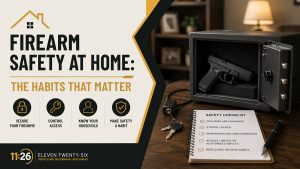
Storage deserves special attention. A safety lesson should address who can access the firearm, where ammunition is kept, whether a lock prevents unauthorized use, how keys or codes are controlled, and how the plan changes when children, visitors, or prohibited persons enter the home.
Transport rules are also easy to oversimplify. Federal law, state law, destination rules, vehicle restrictions, and local location rules can interact; a general course should direct students to current official sources rather than promise that one container or one method works everywhere.
What Online Courses Are Not Good For
Online courses are not a reliable substitute for:
- Diagnosing unsafe handling in real time.
- Teaching recoil management through physical coaching.
- Confirming that a specific firearm fits the student’s hands or needs.
- Establishing a live-fire qualification when a state requires one.
- Providing individualized legal advice after a defensive incident.
- Replacing the owner’s manual or a manufacturer safety notice.
- Making a person competent with every firearm category.
That limitation is not a defect in every course. It is a scope boundary. The safest progression for a first-time owner is online theory, a qualified instructor, supervised handling, and gradual range practice.
Which Mistakes Cause the Most Problems?
Mistake 1: Buying before checking the agency. The recovery is to stop the application process, contact the issuing office, and obtain written confirmation of an accepted alternative.
Mistake 2: Confusing a certificate with a license. The recovery is to identify the actual permit, registration, or carry authority and follow its application process separately.
Mistake 3: Practicing from a video without supervision. The recovery is to store the firearm safely and schedule an instructor-led session rather than reinforce an unsafe habit.
Mistake 4: Ignoring the exact firearm manual. The recovery is to use the manufacturer’s current manual and ask an instructor about model-specific controls before handling the firearm.
Mistake 5: Assuming reciprocity equals local approval. The recovery is to check the destination jurisdiction’s current official rules before traveling.
Mistake 6: Losing the certificate. The recovery is to request a replacement promptly, then retain digital and printed copies for future applications.
A technical problem such as a locked quiz or failed video usually requires contacting the provider, using a supported browser, disabling conflicting extensions, or requesting an accessibility alternative. Technical troubleshooting cannot cure a course that lacks legal approval.
Which Course Should a Beginner, Permit Applicant, or Owner Choose?
A first-time owner should choose supervised in-person or hybrid training after completing basic online education. A permit applicant should choose only a course confirmed by the issuing authority. An experienced owner seeking a refresher can use a general online program, provided the owner separately reviews current law and storage obligations.
| User situation | Recommended first choice | Why it fits | What to add |
|---|---|---|---|
| No firearm experience | Hybrid or in-person basic class | Corrects physical habits | Supervised range practice |
| New firearm owner | Online fundamentals plus instructor visit | Builds vocabulary before handling | Exact manufacturer manual |
| Concealed-carry applicant | State-approved course | Matches application rules | Required live fire and application |
| Experienced owner | Short online refresher | Efficient review of rules | Current state transport and carry law |
| Household member or caregiver | Free or low-cost safety course | Focuses on access and storage | Written household storage plan |
| Interstate traveler | State-specific legal review | Laws vary by route and destination | Official agency confirmation |
An expert rule of thumb is to spend the first training dollar on feedback rather than production quality. A cinematic online demonstration can explain a concept clearly, but a competent instructor can identify the unsafe movement that a camera angle conceals.
Is Online or In-Person Training Better?
Neither format is universally better. Online instruction is better for low-cost theory and preparation, while in-person training is better for physical competence, live-fire judgment, and any requirement involving an instructor or range.
Choose online training when the goal is to understand terminology, storage, legal vocabulary, or basic safety before meeting an instructor. Choose in-person training when the student has never handled a firearm, feels uncertain about basic controls, intends to carry, or must satisfy a practical qualification.
Choose hybrid training when the provider and issuing agency clearly define the online and onsite portions. Confirm that the practical session is included, scheduled by the provider, and documented on the certificate or separate qualification form.
The most useful combined plan is usually short online preparation followed by an instructor-led session. That sequence reduces classroom confusion without treating theoretical knowledge as physical proficiency.
What Should You Do After Finishing the Course?
After completing an online course, save the certificate, verify whether it satisfies your specific purpose, read the firearm manual, establish secure storage, and arrange supervised practice if you will handle or fire a firearm. The certificate should become one part of a safety plan, not the plan itself.
Use this post-course checklist:
- Confirm the certificate matches the required jurisdiction and course type.
- Submit it only through the official application process.
- Keep ammunition and firearms secured from unauthorized access.
- Review the manual for the exact model.
- Obtain properly fitted eye and ear protection before range use.
- Learn the range’s commands and cease-fire procedure.
- Schedule an instructor session if any physical skill remains uncertain.
- Recheck laws before carrying, transporting, or traveling.
- Record storage changes when children, guests, or household circumstances change.
Legal knowledge also needs maintenance. A course completed two years ago may not explain a later statute, court ruling, agency policy, or local restriction.
Frequently Asked Questions
Can I take a free gun safety course online?
Yes, free online gun safety courses are available and can teach universal safety rules, storage concepts, terminology, and basic legal awareness. Free content usually does not include individualized coaching or a certificate accepted for a permit. Confirm the provider’s curriculum, update date, assessment method, and agency acceptance before relying on it.
Do online courses teach you how to shoot?
Online courses can explain aiming concepts, range etiquette, and basic shooting terminology, but they cannot teach live-fire competence by themselves. A qualified instructor must observe grip, stance, trigger control, muzzle direction, and responses to range commands. Students should not treat video demonstrations as a substitute for supervised practice.
Can an online course satisfy a firearm purchase requirement?
Sometimes, but the answer depends on the jurisdiction and the exact purchase requirement. Some states use a safety certificate or permit process with defined testing conditions, while others do not require a training certificate for an ordinary purchase. Check the state agency or licensed dealer instructions before enrolling.
Are online concealed-carry classes legitimate?
Some online concealed-carry classes are legitimate educational programs, but legitimacy and permit acceptance are separate questions. A provider may lawfully sell training that a state refuses to recognize for licensing. Confirm the instructor, approval number, delivery method, live-fire requirement, and certificate expiration with the issuing authority.
Should I take a course before buying a firearm?
Taking a safety course before buying can help a new owner understand storage, ammunition, access control, and training needs. The course cannot determine which firearm is appropriate for every person, and it should not replace supervised handling or the manufacturer’s manual. Ask a qualified instructor for model-neutral guidance.
How often should firearm safety training be refreshed?
There is no single national refresh interval for general safety education. A practical schedule is to review core rules annually and seek formal instruction whenever you acquire a different firearm type, move to another state, begin carrying, or experience uncertainty. Permit renewal rules may impose a separate legally defined interval.
The Bottom Line
You can take a gun safety course online, and online education is valuable for rules, storage, terminology, and legal orientation. The certificate is not automatically a permit, purchase credential, or proof of shooting skill. Verify acceptance with the relevant state agency, choose hybrid or in-person instruction when practical training is required, and use the exact firearm manual before handling a firearm.