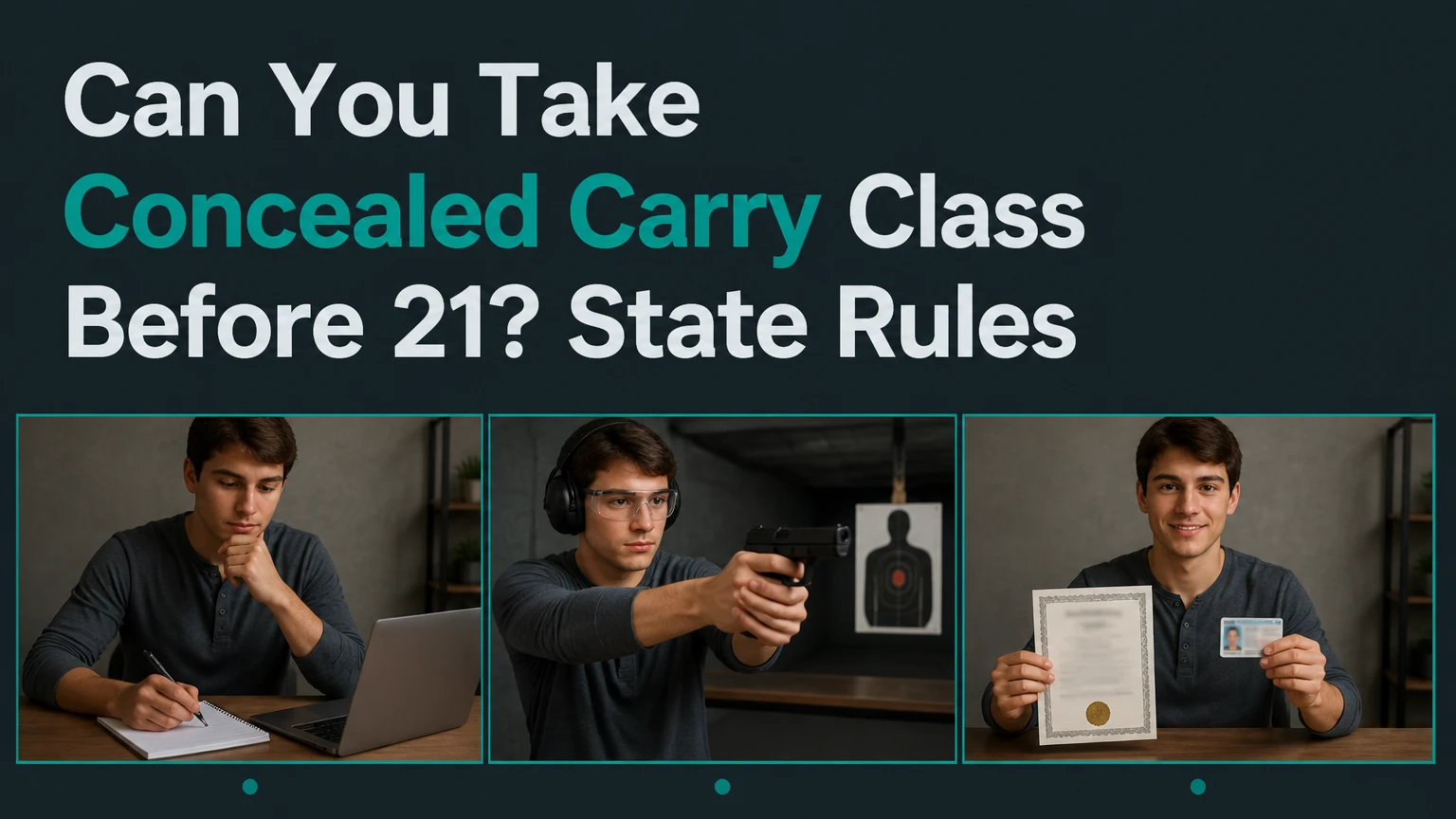
Yes, you can take a concealed-carry class before turning 21 in many U.S. states, but class admission does not guarantee a concealed-carry permit or lawful public carry. State law, instructor policy, certificate expiration, firearm-access rules, residency, and military exceptions determine what an 18-to-20-year-old may do.
Key facts
A concealed-carry class and a concealed-carry permit are separate legal matters.
Many instructors accept students at 18, while some states or ranges impose different minimum ages.
A training certificate may expire before the student reaches 21, so timing matters.
Federal firearms dealers generally cannot sell a handgun to anyone under 21.
An 18-to-20-year-old may have different possession, purchase, open-carry, permitless-carry, and concealed-carry rights under state law.
A permit from one state does not automatically authorize concealed carry in another state.
What Does “Concealed Carry Class” Mean?
A concealed-carry class is a state-approved or instructor-designed course covering safe firearm handling, use-of-force law, public-carry restrictions, and sometimes live-fire qualification. A completion certificate documents training; it does not itself authorize a person to carry a concealed handgun.
The required course varies considerably. One state may require a classroom curriculum and shooting qualification, while another may accept military training, a recognized firearms course, or no training for permitless carry. Private instructors can also impose stricter enrollment rules than state law.
The four questions that must be kept separate are:
- Can the person enroll?
- Can the person handle or possess the handgun used in training?
- Can the person apply for a license?
- Can the person lawfully carry in the intended location?
A “yes” to the first question does not answer the other three. That distinction is the most common source of incorrect under-21 advice.
Can You Take Concealed Carry Class Before 21?
In many states, an 18-to-20-year-old can enroll in a concealed-carry course, complete the required instruction, and receive a certificate. The deciding authority is the state’s licensing statute and the instructor or range’s enrollment policy, not the federal age for buying a handgun from a licensed dealer.
Before paying for a course, ask the instructor for four written details:
- The minimum student age for classroom attendance.
- The minimum age for live-fire participation.
- Whether the certificate can be submitted before age 21.
- The certificate’s validity period and accepted course credentials.
Some instructors will teach an under-21 student but will not issue a certificate intended for a permit application unless the student satisfies the state’s licensing age. Other instructors may allow a student to complete training early but recommend taking the formal course closer to the application date.
State terminology also matters. “Concealed weapon license,” “concealed handgun permit,” and “license to carry” can describe different documents with different eligibility rules.
How Do Class Eligibility and Permit Eligibility Differ?
Class eligibility concerns access to education; permit eligibility concerns a government-issued authorization to carry. A training certificate is evidence that a requirement was completed, whereas a permit application also involves age, identity, residency, fingerprints, criminal-history checks, disqualifying conditions, fees, and prohibited locations.
The distinction can be summarized as follows:
| Question | Typical decision-maker | Possible under-21 result |
|---|---|---|
| May I attend class? | Instructor, range, state course rule | Often yes at 18, but policy varies |
| May I use a loaner handgun? | Range, instructor, state law | Possible with supervision and required documentation |
| May I submit a permit application? | State police, sheriff, licensing agency | State-specific, often 18, 19, or 21 |
| May I carry concealed? | State carry law and permit terms | Depends on age, permit status, location, and firearm |
| May I carry in another state? | Destination state | Reciprocity may impose a different minimum age |
The Federal Bureau of Investigation’s National Instant Criminal Background Check System does not create a national concealed-carry permit. Similarly, the Bureau of Alcohol, Tobacco, Firearms and Explosives age rule for dealer transfers does not establish the minimum age for every state carry license.
What Does a Concealed-Carry Class Cover?
A typical course lasts 4-16 hours and combines safety instruction, legal topics, written testing, and a live-fire qualification when state rules require shooting. The exact round count, target distance, passing score, and curriculum come from the state or approving agency.
Common subjects include:
- The four core firearm-safety rules.
- Loading, unloading, storage, and transport.
- Muzzle direction, trigger-finger discipline, and safe holster use.
- State definitions of justified force and deadly force.
- Defense of self or others.
- Duty-to-retreat rules, where applicable.
- Restricted places such as schools, courthouses, secured government buildings, and posted private property.
- Interaction with law enforcement after a defensive incident.
- Safe storage around children and prohibited persons.
- Basic cleaning and malfunction prevention.
A live-fire qualification usually measures safe handling and accuracy against a paper target. It is not a complete defensive-skills assessment. A passing score does not prove that a student can make sound decisions under stress, identify a threat correctly, or understand every carry restriction.
How Do You Take the Class Before 21?
An under-21 applicant should complete six checks before attending a course. The most important checkpoint is confirming that the certificate will still be valid when the licensing agency accepts the application.
Step 1: Identify the licensing authority
Find the official state agency that issues the permit. It may be a state police department, attorney general’s office, department of public safety, or county sheriff. Use the agency’s current application page rather than a course advertisement or reciprocity map.
Step 2: Confirm the minimum age
Read the statute or official eligibility page for the exact license type. Check whether the rule applies to residents, nonresidents, active-duty military personnel, veterans, or only permitless carry.
Step 3: Ask the instructor about under-21 enrollment
Confirm classroom and range ages separately. A range may permit an 18-year-old in the classroom but set a higher age for handgun rental, lane access, or unsupervised handling.
Step 4: Verify the certificate requirements
Ask whether the course is approved, whether the instructor’s credentials are recognized, and how long the certificate remains valid. Obtain the answer in writing because a general “CCW certificate” may not satisfy a specific state agency.
Step 5: Complete training safely
Bring identification, hearing and eye protection if required, and any documents requested by the instructor. Follow the range’s handling commands exactly. Students should not bring a personally owned handgun unless the instructor expressly permits it and state law allows possession.
Step 6: Apply at the legally permitted time
Submit the application only when the official agency says the applicant qualifies. If the state requires age 21, schedule the course within the certificate’s validity window rather than assuming an early certificate will remain usable.
How Long and How Much Does Training Cost?
A typical concealed-carry class costs $75-$250 and takes one or two days, while a basic pistol course commonly costs $50-$150 for 4-6 hours. A student may also pay for ammunition, range fees, fingerprints, photographs, equipment rental, and the government application fee.
| Training option | Typical duration | Typical price | Usually provides |
|---|---|---|---|
| State-approved carry class | 4-16 hours | $75-$250 | Legal instruction, test, possible qualification |
| Basic pistol course | 4-6 hours | $50-$150 | Handling, loading, storage, cleaning, fundamentals |
| Private defensive handgun course | 8-16 hours | $150-$400 | Supervised practice and decision-making exercises |
| Simulator or laser course | 2-4 hours | $60-$120 | Dry practice and scenario discussion |
Typical additional expenses include $15-$50 for ammunition, $10-$30 for range use, $10-$30 for fingerprints, and $20-$60 for passport photographs. Government application fees vary widely and may range from approximately $40 to more than $100.
The least expensive course is not necessarily the least expensive path. If a certificate expires before the applicant can apply, paying for training twice costs more than taking the approved course at the correct time.
Can an 18-to-20-Year-Old Carry a Handgun?
An 18-to-20-year-old may be allowed to carry a handgun in some states, but the answer depends on the type of carry and the state’s current law. Permitless carry, open carry, concealed carry with a license, and possession in a vehicle can have separate age thresholds.
The Supreme Court’s 2022 decision in New York State Rifle & Pistol Association v. Bruen changed the constitutional analysis of public-carry licensing, but it did not create one nationwide age rule. Courts and legislatures continue to shape state-specific eligibility, and online summaries can become obsolete quickly.
Do not rely on a broad list claiming that every person aged 18-20 may carry in Florida, Texas, Tennessee, Indiana, New Hampshire, West Virginia, Wyoming, or another named state. Verify the current statute and official licensing page for the exact date and circumstances. Legislative changes, injunctions, appeals, and agency implementation can alter the result.
| Legal situation | Why the answer differs | Verification needed |
|---|---|---|
| Concealed carry with a permit | License age and application rules control | State licensing agency |
| Permitless concealed carry | Statutory age and restrictions control | Current carry statute |
| Open carry | Separate state rule may apply | State police or attorney general |
| Vehicle transport | Location, loaded status, and accessibility may matter | State transport law |
| Carry on private property | Owner restrictions may control | Posted policy and state law |
A permitless-carry state may still require a person to meet age, residency, prohibited-person, location, and firearm-possession conditions. “No permit required” does not mean “no restrictions apply.”
Can You Buy or Borrow a Handgun Before 21?
A federally licensed firearms dealer generally may not sell or deliver a handgun to a person under 21, although federal law treats long guns differently. That dealer rule does not answer every question about private transfers, gifts, possession, or supervised range use.
The ATF states that a person under 21 may acquire a handgun from an unlicensed person who resides in the same state, provided the transaction complies with federal and state law. The same ATF guidance also warns that state and local rules may impose additional restrictions, and a person prohibited from possessing firearms cannot lawfully receive one.
For a training class, the practical options may include an instructor-owned handgun, a range rental, or a firearm lawfully provided by an eligible family member. The range can impose stricter requirements, such as requiring a qualifying adult, a specific rental arrangement, or proof of prior experience.
Do not treat a private transfer as automatically lawful. Check residency, transfer method, prohibited-person rules, waiting periods, registration requirements, storage obligations, and any state minimum age before receiving or transporting a handgun.
Do Military Members Receive an Exception?
Some states reduce the minimum licensing age for active-duty service members, reserve members, or honorably discharged veterans, but military status does not create a universal federal concealed-carry exception. The exact qualifying documents and age reduction are state-specific.
A licensing agency may require a military identification card, orders, discharge papers, a DD-214, or proof of firearms training. A state may recognize military training for the course requirement while still retaining a separate minimum age for the license.
Ask the agency three separate questions:
- Does military status change the minimum permit age?
- Does it waive or replace the civilian training course?
- Does it change firearm-purchase or carry rules in the intended location?
A military exception can also be narrower than it appears. For example, an exception may apply to active-duty residents but not to a civilian spouse, former service member without qualifying discharge documentation, or nonresident applicant.
How Long Does the Certificate Last?
Certificate validity commonly ranges from a fixed period such as 12 months to a period determined by the state’s application rules, while some credentials may remain usable longer. The instructor’s statement is not enough if the licensing agency publishes a different submission deadline.
Use this timing formula:
Latest safe course date = intended application date minus the certificate-validity period.
For example, if an applicant turns 21 on October 15 and the state accepts a certificate for 12 months, taking the course any time after October 15 of the prior year may fit the certificate window. If the agency requires a certificate issued after the applicant reaches the licensing age, early training may not help at all.
| Certificate rule | Example timing | Practical result |
|---|---|---|
| Valid for 12 months | Course at 20, application at 21 | May expire before application |
| Valid for 24 months | Course 18 months before application | Often remains usable, subject to agency rules |
| No stated expiration | Course several years early | Confirm acceptance in writing |
| Age-linked acceptance | Course before licensing age | Agency may require a new certificate |
Keep the original certificate, instructor approval number, course date, and any range qualification record. A licensing agency may reject an incomplete, unsigned, altered, or non-approved document.
Which Course Is Best Before 21?
A state-approved concealed-carry course is best when the student is already eligible for the permit or can use the certificate before it expires. A basic pistol or firearm-safety course is usually better for a complete beginner who is several years away from permit eligibility.
| Student situation | Best first course | Reason | Main limitation |
|---|---|---|---|
| Turns 21 within 3-6 months | Approved carry course | Certificate can support a near-term application | Legal content may be dense |
| Age 18 with no handling experience | Basic pistol course | Builds supervised safety fundamentals | Usually does not satisfy permit training |
| Lives in an 18+ licensing state | Approved carry course | May support immediate eligibility | Carry restrictions still apply |
| Cannot use a handgun at the range | Classroom plus approved simulator | Provides legal preparation | May not satisfy live-fire rules |
| Active-duty or veteran applicant | Agency-approved military documentation review | May replace civilian training | Documentation requirements vary |
The course should match the legal objective. A simulator can improve judgment discussion and dry-handling concepts, but it cannot replace a required live-fire qualification unless the state expressly accepts it.
An honest limitation matters here: a carry class is a legal minimum in many jurisdictions, not a complete defensive education. Students who plan to carry should consider later instruction in safe holster use, storage, medical response, conflict avoidance, and post-incident procedures.
What Mistakes Cause Under-21 Applications to Fail?
The most frequent failures involve using an expired certificate, confusing permitless carry with unrestricted carry, and relying on a private website’s age chart instead of the licensing agency. These mistakes are preventable because each can be checked before enrollment.
Taking the wrong course
A generic online course may not satisfy a state’s classroom or live-fire requirement. Confirm the instructor’s approval number and the exact credential accepted by the licensing authority.
Applying before the eligible date
A certificate does not override a statutory minimum age. If the agency requires 21, wait until the permitted filing date unless an official exception applies.
Assuming a neighboring state’s rule applies
Carry rights follow the law of the state where the person is physically present. A home-state permit may not be recognized, and the destination may impose a 21-or-older recognition rule.
Ignoring prohibited locations
A valid permit does not authorize carry in every public building, school zone, courthouse, airport area, posted business, or private residence. Read the current prohibited-place statute before carrying.
Bringing an unapproved firearm to class
Ranges may restrict ammunition, loaded firearms, holster use, or personally owned weapons. Follow the instructor’s written equipment policy and use a range firearm when required.
Failing the background or eligibility review
Training cannot cure a felony conviction, qualifying domestic-violence prohibition, unlawful drug-user status, certain court orders, or another disqualifier. Review the official application criteria before paying a nonrefundable fee.
Will Another State Honor the Permit?
Another state may honor a concealed-carry permit only under its current reciprocity law, and recognition can depend on the permit holder’s age, permit type, residency, and conduct. A state that recognizes an out-of-state license may still refuse recognition to an 18-to-20-year-old permit holder.
Before crossing a state line, check:
- Whether the destination recognizes the issuing state’s license.
- Whether recognition applies to nonresident permits.
- Whether the destination requires the permit holder to be 21.
- Whether vehicle transport rules differ.
- Which locations prohibit carry.
- Whether notification, signage, or storage rules apply.
Reciprocity maps are useful starting points, but the destination state’s official statute or attorney general guidance is the controlling source. Save a current copy of the rules and confirm the date accessed because reciprocity agreements can change.
How Do You Verify the Rule in Your State?
Use a primary-source verification process rather than a national age chart. The state licensing agency should answer permit age and training questions, while the state legislature or attorney general should clarify public-carry and prohibited-location rules.
Verification checklist
- Search the official state website for “concealed handgun license eligibility.”
- Identify the minimum age for the exact license.
- Check resident and nonresident rules separately.
- Read the approved-training and certificate-validity section.
- Search for military, veteran, or law-enforcement exceptions.
- Check permitless and open-carry rules separately.
- Confirm handgun possession and transfer rules.
- Call the agency if the statute and application page conflict.
- Ask the instructor to confirm course approval in writing.
- Recheck the rules before carrying, especially after a legislative change or court order.
For Florida, for example, the Florida Department of Agriculture and Consumer Services publishes concealed-weapon-license eligibility information. That page is more reliable for current licensing requirements than a commercial blog that lists national age categories without a date or statutory citation.
The Bottom Line
Can you take concealed carry class before 21? Often yes, especially at age 18, but the class certificate is only one part of the legal process. Confirm the state’s class-age rule, permit-age rule, firearm-access rule, certificate-validity period, and carry restrictions before registering.
If the state allows licensing at 18, an approved class may support an immediate application. If the state requires 21, a basic pistol course may be the better early option unless the official agency confirms that an early certificate will remain valid and acceptable.
Frequently Asked Questions
Can a 19-year-old take a CCW class with no firearm?
Often, yes, if the instructor and range permit enrollment and provide a lawful supervised firearm. A student should not assume that lack of personal ownership prevents training, because many courses use range-owned handguns. Confirm rental age, ammunition rules, identification requirements, and whether the class includes a qualifying live-fire test.
Can a parent give a handgun to an 18-year-old?
A parent may be able to transfer a handgun to an 18-year-old under federal law if the transfer is otherwise lawful, but state law can impose stricter requirements. The recipient must not be prohibited from possessing firearms, and the transfer must comply with residency, background-check, waiting-period, and storage rules where applicable.
Does an online concealed-carry class count?
An online course counts only if the relevant state expressly accepts it for the specific permit. Many states require instructor interaction, an examination, live-fire qualification, or an approved curriculum. A course certificate labeled “nationally accepted” has no independent legal force unless the licensing agency recognizes that credential.
Can an 18-year-old carry a concealed handgun without a permit?
The answer varies by state and may depend on residency, firearm possession, location, and age-specific restrictions. Permitless carry does not eliminate prohibited places or other eligibility conditions. Verify the current statute in the state where the person will carry, not only the law of the person’s home state.
Should someone take the formal class years before turning 21?
Usually, a person should take the formal permit course close enough to the application date that the certificate remains valid. A basic safety course is often more useful several years early. The exception is a state that confirms long certificate validity and allows the certificate to be submitted after the student reaches the licensing age.