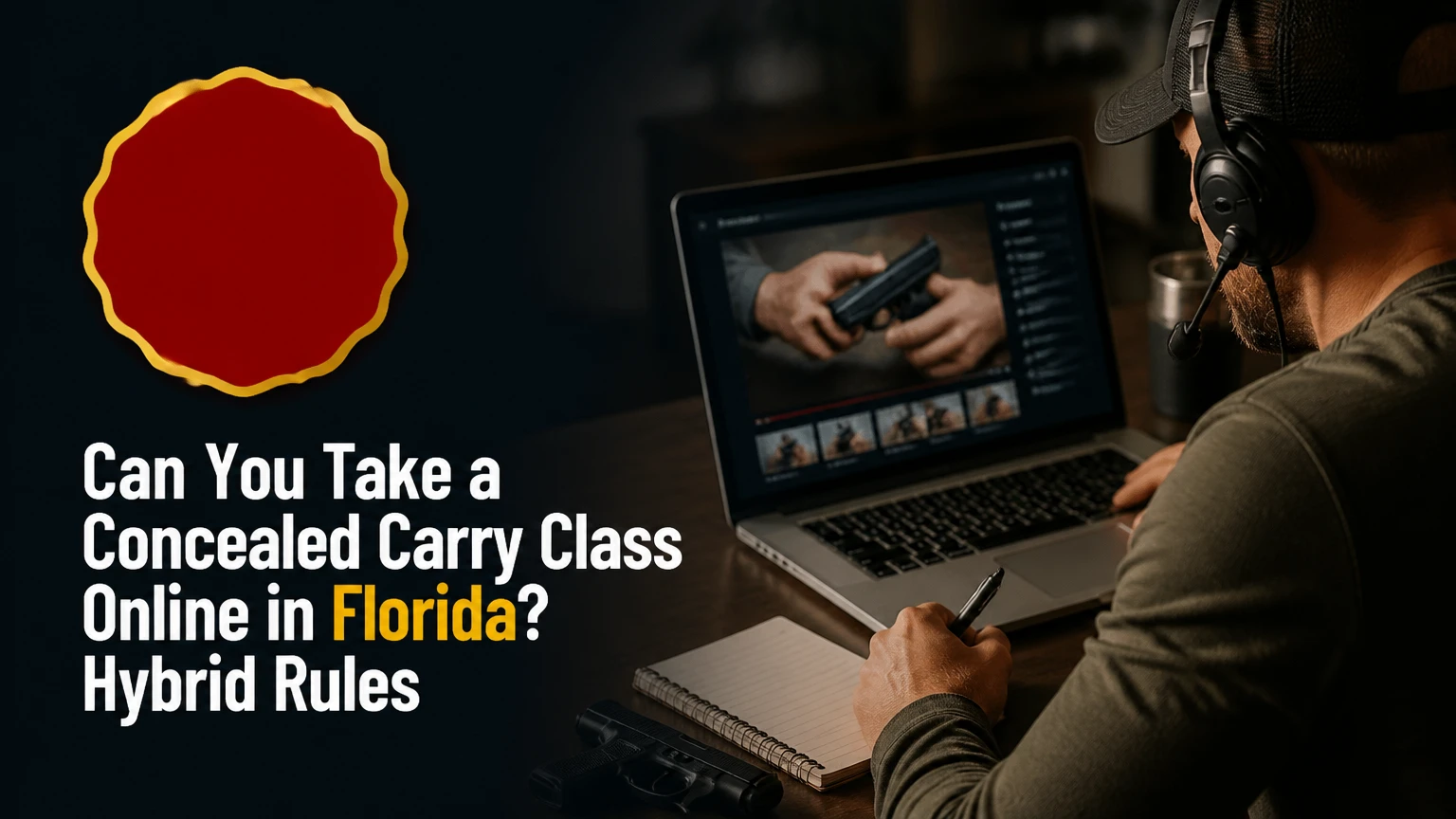
Yes, you can complete the classroom portion of a Florida concealed weapon license course online, but an online certificate is not automatically valid. Florida law requires applicants to document “demonstrated competence with a firearm,” and the Florida Department of Agriculture and Consumer Services, or FDACS, decides whether submitted training documentation meets the application standard.
Can You Take a Concealed Carry Class Online in Florida?
A Florida concealed carry class can be partly online when the provider connects the academic course to acceptable proof of firearm competency. Some providers use an in-person range appointment, while others rely on a qualifying instructor certificate or another method recognized under Florida Statute 790.06 and FDACS guidance. Florida does not issue a license merely because someone watched videos or passed an internet quiz.
The legal answer therefore has two parts. Online instruction can cover firearm law, safe handling, storage, self-defense concepts, and license procedures. The applicant must still submit documentation that satisfies the state’s competency requirement, and a provider’s claim that a certificate is “Florida approved” does not replace FDACS review.
What does Florida law actually require?
Florida Statute 790.06(2)(h) lists evidence an applicant may use to show competence with a firearm. Examples include completion of a hunter education or safety course approved by the Florida Fish and Wildlife Conservation Commission, a National Rifle Association firearms safety or training course, a firearms safety course offered by a law enforcement agency, or other documentation accepted by the department.
The statute also addresses experience, including certain military, law enforcement, and firearms-instruction backgrounds. The important phrase is “demonstrated competence with a firearm.” The statute does not establish one universal online curriculum, one required number of rounds, or one statewide class length.
FDACS maintains the current application instructions and acceptable firearms-training documentation. Because providers can change their course format, applicants should check the current FDACS page before paying.
Key Facts at a Glance
Florida allows online academic instruction, but online video completion alone does not guarantee license eligibility.
The application requires acceptable evidence of firearm competence under Florida Statute 790.06.
Many hybrid providers add an in-person instructor-observed handling or range session.
Florida has allowed permitless concealed carry for eligible people since July 1, 2023, subject to statutory restrictions.
A Florida license can remain useful for interstate travel, purchase-related benefits, and clearer documentation of eligibility.
Active-duty service members and qualifying veterans may use military documentation instead of a civilian training course.
How Does an Online Florida Carry Course Work?
A typical online Florida license course has four stages: academic instruction, competency verification, document issuance, and state application. The provider controls the first three stages, while FDACS controls the licensing decision.
Step 1: Complete the online academic portion
Online modules commonly take 1.5-3 hours, although course length varies by provider. Subject matter may include:
- Florida firearm definitions and prohibited locations
- Safe storage and transportation
- Basic handgun operation
- Use-of-force concepts
- Self-defense and criminal-law risks
- Situational awareness
- Reciprocity limitations
- Application documents and renewal information
A quiz may follow each module or appear at the end. Treat the quiz as a knowledge check, not as proof that you can safely load, unload, grip, aim, or fire a handgun.
Step 2: Complete the provider’s competency procedure
Many online providers schedule a 15-45-minute appointment at a Florida range or training site. An instructor may have you identify safety rules, handle an unloaded firearm, load and unload under supervision, and fire at a target.
That format is common, but the exact procedure is not uniform statewide. A course may instead provide documentation based on an approved training program, prior experience, or another statutory pathway. Ask the provider exactly what document you will receive and which subsection of Florida Statute 790.06 supports it.
Step 3: Receive and inspect your certificate
Before applying, inspect the certificate for your legal name, course or instructor identification, completion date, and competency language. A receipt, webinar attendance email, or generic “concealed carry completion” badge may not be enough.
Save a paper copy and a digital copy. FDACS may request clarification if the documentation does not clearly establish the applicant’s firearm competency.
Step 4: Submit the license application
Applicants can apply through the FDACS Division of Licensing process or at a participating Florida tax collector or regional office. The application generally involves identity documentation, fingerprints, a photograph, fees, and competency evidence.
The state’s published processing period can extend up to 90 days after receipt of a complete application. Missing fingerprints or unclear training records can delay resolution.
Which Online Course Formats Are Available?
Florida applicants usually choose among asynchronous hybrid courses, live online classes, traditional in-person instruction, and military-documentation pathways. The best choice depends on whether the applicant needs scheduling flexibility or hands-on instruction.
| Course pathway | Academic format | Competency evidence | Typical applicant |
|---|---|---|---|
| Asynchronous hybrid | 1.5-3 hours of recorded modules | 15-45-minute instructor or range appointment | Experienced owner with limited scheduling flexibility |
| Live webinar hybrid | 2-4 hours on Zoom or another platform | Scheduled Florida instructor session | Student who wants real-time questions |
| Traditional classroom | 3-8 hours at a training facility | Same-day instructor documentation or range work | Beginner needing direct guidance |
| Military documentation | No civilian class in qualifying cases | DD-214, active orders, or accepted service record | Qualifying veteran or active-duty applicant |
An online class is most useful when the provider clearly separates legal education from competency verification. Providers that use identical certificates for every state deserve additional scrutiny because state standards differ.
How Much Does a Florida Online Carry Class Cost?
A Florida online course commonly costs $40-$75 for academic access alone and approximately $80-$150 when range time, firearm rental, ammunition, and instructor verification are bundled. The state license fee is separate from the provider’s price.
| Expense | Typical amount | When paid | What changes the amount |
|---|---|---|---|
| Online academic course | $40-$75 | Enrollment | Live instruction and lifetime access |
| Range or instructor session | $25-$75 | Appointment | Location, rental, supervision time |
| Firearm rental | $15-$35 | Range visit | Range policy and handgun model |
| Ammunition | $15-$40 | Range visit | Caliber and required quantity |
| Initial license fee | $55 | State application | Florida statutory fee |
| Fingerprint processing | $42 | Fingerprint appointment | Vendor and location |
| Tax collector service fee | Often $12-$22 | In-person application | Local processing policy |
Prices change frequently, especially when providers advertise a low course price and add range or certificate fees at checkout. Confirm the full amount before enrollment, including cancellation fees and whether the provider supplies a firearm for students who do not own one.
What Documents and Equipment Do You Need?
Most applicants need government identification, a compliant photograph, fingerprints, training evidence, and payment. A range appointment may also require eye and ear protection, closed-toe shoes, ammunition, and a firearm, although many facilities rent equipment.
| Requirement | Common specification | Where obtained | Frequent problem |
|---|---|---|---|
| Identification | Florida driver license, state ID, or accepted identity document | DMV or issuing agency | Name mismatch |
| Photograph | Recent passport-style image | Provider, office, or photo service | Wrong dimensions or poor quality |
| Fingerprints | Electronic or properly prepared fingerprints | Law-enforcement agency, tax collector, or authorized vendor | Unreadable prints |
| Competency proof | Certificate or statutory evidence | Course instructor or military records | Certificate lacks competency language |
| Payment | State fee plus local or provider charges | FDACS or application office | Assuming course price includes licensing |
A person who has never handled a handgun should not treat eye protection, ammunition, and a rental firearm as administrative details. The safe solution is to arrange instruction before the qualification appointment, because a brief verification session may not provide enough time for basic shooting education.
Is a Florida License Still Worth Getting After Permitless Carry?
A Florida Concealed Weapon or Firearm License can remain useful even though eligible adults may carry concealed without a license under Florida’s permitless-carry law. The license may support reciprocity, reduce certain purchase waiting-period issues, and provide a portable record of eligibility, but it does not override another state’s restrictions.
Florida’s permitless-carry law took effect July 1, 2023. Eligibility still matters, and prohibited places, prohibited persons, vehicle rules, use-of-force law, and other restrictions continue to apply.
Reciprocity is conditional. A state may recognize a Florida license only for a specific age group, may impose location restrictions, or may require compliance with its own carry rules. Check the destination state’s official authority before crossing the state line.
Florida law also contains a purchase waiting-period exception for concealed weapon license holders under specified conditions. Because local implementation and statutory exceptions can change, confirm the current rule with the Florida Department of Agriculture and Consumer Services or a qualified Florida attorney.
What about the age requirement?
Do not rely on a course website’s age statement without checking current FDACS instructions. Florida statutes, litigation, injunctions, and administrative guidance can affect whether a person under 21 may receive a license, while permitless carry has its own age and eligibility rules.
The AI Overview’s claim about a 2026 appellate ruling changing the license age should be independently verified against current official sources before publication or enrollment. A court case mentioned by a provider is not itself proof that FDACS will accept every application from a younger applicant.
Online Versus In-Person: Which Route Fits You?
Online hybrid training saves classroom time, while in-person instruction provides more opportunities to correct unsafe handling and poor shooting mechanics. Neither format automatically makes someone proficient with a defensive handgun.
| Decision factor | Online hybrid | Fully in-person course | Military documentation |
|---|---|---|---|
| Academic scheduling | 1.5-3 hours at home | Fixed 3-8-hour appointment | No civilian class |
| Hands-on correction | Usually 15-45 minutes | Several hours available | Depends on current skill |
| Typical direct cost | $80-$150 bundled | $75-$250 | Record-retrieval cost may be $0 |
| Best use case | Experienced, schedule-limited applicant | New or uncertain shooter | Qualifying service member |
| Main limitation | Minimal practice time | Longer fixed commitment | Documentation may need review |
Choose an in-person class if you cannot safely demonstrate loading, unloading, muzzle awareness, trigger-finger discipline, and basic sight alignment. Choose a hybrid course if you already possess those skills and the provider’s competency documentation is clear.
Is an online certificate enough for a beginner?
An online certificate is not a substitute for beginner firearms training. A new shooter may complete the legal modules successfully yet remain unable to safely operate the firearm used during the qualification appointment.
A practical training sequence for a beginner is a basic handgun safety class, supervised dry practice with an unloaded firearm, and a coached range session before the license qualification. The license course answers a legal documentation need; it may not teach defensive marksmanship, malfunction clearance, holster selection, or judgment under stress.
How Do You Choose a Legitimate Provider?
Verify the provider before paying by asking for the legal basis of the certificate, the identity and credentials of the instructor, and the location of any physical competency session. A legitimate provider should answer those questions in writing.
Use this checklist:
- Ask whether the course is academic-only or hybrid. The checkout page should identify every required step.
- Request the competency procedure. Confirm whether an instructor observes handling, firing, or another qualifying activity.
- Confirm the physical location. A Florida applicant should know the range or instructor location before enrollment.
- Inspect a sample certificate. Look for student identity, instructor details, date, and competency wording.
- Check refund terms. A provider should explain what happens if the range appointment is unavailable.
- Compare the certificate with FDACS guidance. The state, not the vendor, determines whether evidence is acceptable.
- Avoid universal promises. “All states,” “no range needed,” and “guaranteed approval” are warning signs.
An out-of-state online permit course may satisfy another jurisdiction while failing to document Florida’s requirement. A multistate certificate is not automatically a Florida certificate.
What Problems Can Delay or Defeat the Application?
The most common problems are incomplete competency evidence, fingerprint errors, identity mismatches, and confusion between permitless carry and licensed carry. Each problem is easier to prevent before submission than to correct afterward.
| Failure mode | Likely consequence | Preventive action | Recovery |
|---|---|---|---|
| Video-only certificate | FDACS requests more evidence or rejects it | Confirm competency documentation first | Ask provider for qualifying records |
| Name mismatch | Application delay | Use the same legal name everywhere | Provide legal-name documentation |
| Poor fingerprints | Reprocessing delay | Use an authorized, experienced vendor | Follow FDACS resubmission instructions |
| Missing photograph | Incomplete application | Prepare a compliant recent photo | Submit the requested replacement |
| Expired or unclear record | Review delay | Use current, legible documents | Obtain a corrected certificate |
| Assuming permitless carry equals licensing | Wrong application decision | Identify the benefit needed | Apply only if reciprocity or documentation matters |
A provider cannot guarantee state approval because FDACS evaluates the complete application and eligibility record. Keep every email, receipt, certificate, and appointment confirmation until the license decision is final.
Do Veterans and Active-Duty Members Need the Class?
Qualifying active-duty military personnel and honorably discharged veterans may document firearm competence through military records instead of taking a civilian concealed-carry class. Acceptable proof depends on the applicant’s service status and the records submitted.
Common documents include a DD-214 showing an appropriate discharge, active-duty orders, or other service documentation identified by FDACS. Military service alone does not erase the other license requirements, such as identity, background eligibility, fingerprints, and fees.
Contact FDACS or the application office before relying on an old record. The safest approach is to submit a legible copy that identifies the applicant and supports the relevant firearms training or service history.
What Should You Do After Completing the Course?
After completing the course, verify the certificate, arrange fingerprints, prepare the photograph, and submit the application through FDACS or an authorized office. The application clock begins when the state receives a complete submission, not when an applicant purchases an online course.
Use this sequence:
- Download and print the final certificate.
- Check the name, date, instructor, and competency language.
- Obtain fingerprints through an accepted channel.
- Prepare the required photograph and identification.
- Pay the state and local processing charges.
- Submit the application and retain the confirmation number.
- Monitor requests for additional information.
- Review the license and expiration date when issued.
Do not carry in a restricted location merely because an application is pending. A pending application is not a license, and permitless-carry eligibility must be evaluated separately under current Florida law.
Frequently Asked Questions
Can I complete a Florida concealed carry course entirely from home?
Usually, a home-based video course alone is not enough to establish Florida firearm competency. Florida Statute 790.06 requires acceptable evidence of demonstrated competence, and many providers satisfy that condition through an instructor-observed handling or live-fire appointment. Confirm the exact documentation with FDACS before enrolling.
How long does a Florida online carry class take?
The online academic portion commonly takes 1.5-3 hours, while a hybrid competency appointment often takes 15-45 minutes. Application preparation adds fingerprinting, photography, document review, and submission time. FDACS can take up to 90 days to process a complete application under its published guidance.
Can a nonresident apply for a Florida concealed weapon license?
Florida generally accepts applications from eligible nonresidents, subject to the same statutory eligibility and documentation requirements. A nonresident should verify current FDACS instructions, provide acceptable identification and fingerprints, and confirm whether the license provides the intended reciprocity benefit in the person’s home or travel states.
Does Florida require a shooting test with a specific number of rounds?
Florida law focuses on demonstrated firearm competence rather than a universally stated round count in the statute. Providers may impose their own supervised shooting procedure, including a particular firearm or ammunition requirement. Ask the provider for its written qualification procedure and compare the resulting documentation with FDACS requirements.
Can I carry while waiting for my Florida license?
A pending license application does not itself authorize licensed carry. An eligible person may have separate permitless-carry rights under Florida law, but age, prohibited-person, location, weapon, and conduct restrictions still apply. Do not assume that filing an application changes those rules.
Does a Florida license let me carry everywhere in the state?
No. A Florida license does not remove statutory restricted-location rules or federal restrictions. Schools, courthouses, government facilities, private property, establishments serving alcohol, and other locations may involve fact-specific limits. Review current Florida law and posted property rules before carrying.
The Bottom Line
You can take a concealed carry class online in Florida, but the safe legal interpretation is “online classroom plus acceptable firearm-competency documentation,” not “watch videos and receive an automatically valid license.” Confirm the provider’s certificate, any in-person instructor requirement, FDACS application documents, current fees, and your independent eligibility before paying. A hybrid course fits an experienced shooter with a tight schedule; a full in-person course is the better starting point for a beginner.