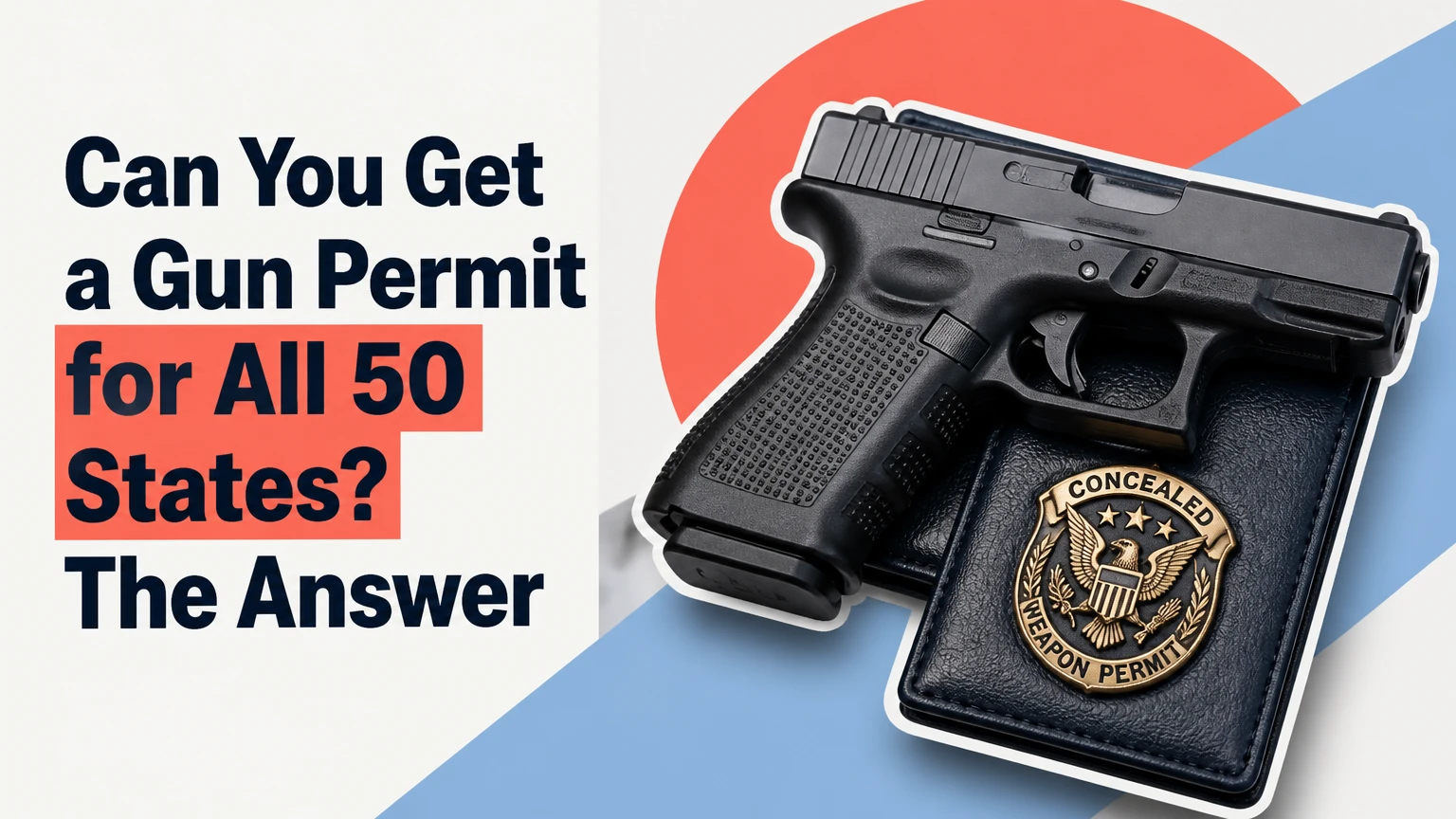
No, you cannot get one gun permit that authorizes concealed carry in all 50 states. The United States has no federal concealed-carry license, so each state decides whether it recognizes another state’s permit, allows permitless carry, or requires its own license. A carefully chosen resident and nonresident permit combination can expand coverage, but it cannot create universal authority.
Key Facts at a Glance
- No federal agency issues a concealed-carry permit valid in all 50 states.
- A concealed-carry permit is usually valid only under the issuing state’s law and the destination state’s recognition rules.
- Utah, Florida, and Arizona issue widely useful nonresident permits, but none covers every state.
- Permitless carry does not necessarily apply to visitors, every firearm, every location, or every age group.
- A recognized permit does not override magazine limits, prohibited-location rules, duty-to-inform laws, or possession restrictions.
- Reciprocity changes require a fresh review before each interstate trip.
Can You Get a Gun Permit for All 50 States?
No single nationwide gun permit exists because concealed carry is primarily regulated by state law rather than by one national licensing system. The federal government regulates subjects such as prohibited persons, interstate transportation, and school-zone restrictions, but federal law does not issue a civilian license that controls every state’s public-carry rules.
The Congressional Research Service described concealed-carry reciprocity as a matter shaped by state laws and agreements rather than a single national permit. The Supreme Court’s 2022 decision in New York State Rifle & Pistol Association v. Bruen also held that the Second Amendment protects carrying handguns publicly for self-defense, but the decision did not establish a 50-state permit or eliminate location-specific restrictions.
The practical answer is a coverage strategy, not a universal credential. A traveler normally begins with a home-state license, then evaluates one or more nonresident permits against the states actually visited.
What Does Reciprocity Mean?
Reciprocity means that one state recognizes a carry permit issued by another state under specified conditions. Recognition may depend on the permit holder’s age, resident status, permit type, firearm type, or whether the destination state recognizes only licenses from the permit holder’s home state.
Reciprocity is not mutual in every case. State A may recognize State B’s permit while State B does not recognize State A’s permit. A recognition map also cannot answer every practical question because prohibited places, transportation, ammunition, magazine capacity, and notification rules remain separate issues.
How Do Multi-State Gun Permits Work?
Multi-state carry works by stacking legal authorities that each cover different states. The home-state permit supplies the foundation, while a nonresident Utah, Florida, or Arizona permit may add recognition in jurisdictions that do not recognize the home permit.
The number of states covered is not fixed. Reciprocity agreements, permit classes, age limits, and statutory interpretations change, so published estimates such as 37-41 states describe a possible range for certain permit combinations, not a guaranteed national result.
Resident and Nonresident Permits Compared
| Permit category | Typical applicant | Typical validity | Main strategic value |
|---|---|---|---|
| Home-state permit | Resident of issuing state | 4-8 years | Establishes local authority and may unlock nonresident applications |
| Utah CFP | Resident or eligible nonresident | 5 years | Broad recognition and nationwide course availability |
| Florida CWFL | Resident or eligible nonresident | 7 years | Strong recognition in many states and multiple training pathways |
| Arizona CCW | Resident or eligible nonresident | 5 years | Mail-based option with broad documentation choices |
A nonresident license does not turn a visitor into a resident. Some destination states recognize an out-of-state permit only for a nonresident who meets that permit’s original requirements, while others impose separate age or permit-class conditions.
Which Nonresident Permits Are Most Useful?
Utah, Florida, and Arizona are common choices because they offer nonresident application pathways and can add states to a traveler’s recognition map. The best combination depends on the home state, destination states, age, training records, and whether the traveler needs coverage for a particular route.
| Permit | Typical state fee | Typical extra cost | Typical processing time |
|---|---|---|---|
| Utah CFP | About $63.25 | $50-$150 for course and materials | 30-90 days |
| Florida CWFL | About $97 | $40-$150 for training and fingerprints | 30-90 days |
| Arizona CCW | About $60 | $20-$100 for fingerprints and training records | 45-90 days |
| Home-state license | About $40-$250 | $25-$200 for course, fingerprints, and photos | 2-16 weeks |
Fees and processing times are typical planning figures, not permanent prices. Applicants should confirm the current amount with the Utah Bureau of Criminal Identification, Florida Department of Agriculture and Consumer Services, Arizona Department of Public Safety, and their home-state licensing authority.
Utah Nonresident CFP
The Utah Concealed Firearm Permit is useful when an applicant wants a relatively standardized nonresident process. Utah generally requires an approved course, fingerprints, a photograph, and an application fee; course availability is a practical advantage because certified instructors operate outside Utah.
Utah is not a universal solution. A state may recognize Utah’s permit for residents but not nonresidents, or may apply a different minimum age to an out-of-state license. The Utah permit also does not authorize carry in places where the destination state prohibits firearms.
Florida Nonresident CWFL
The Florida Concealed Weapon or Firearm License is useful for applicants who can document qualifying firearm competency. Florida lists several acceptable training or experience routes, which can include approved courses, hunter education, military documentation, or other qualifying records, subject to the state’s current requirements.
Florida’s permit has a longer typical validity period than Utah’s, but the application still involves fingerprints, photographs, eligibility screening, and a state fee. A Florida permit can add recognition in some states that do not recognize another nonresident license.
Arizona Nonresident CCW
The Arizona concealed weapons permit can be useful for applicants who prefer a nonresident application that accepts several forms of training documentation. Applicants generally submit proof of eligibility, fingerprints, a photograph, and the required fee.
Arizona’s permit should be treated as a supplement rather than a replacement for the home-state permit. Its value is highest when the destination states recognize Arizona’s nonresident license and the applicant’s age and permit category satisfy those states’ conditions.
How Do You Build the Broadest Legal Coverage?
Build the broadest lawful coverage by obtaining the home-state license first, identifying the states on the actual travel route, and adding only the nonresident permits that close specific recognition gaps. The correct sequence reduces wasted fees and prevents an applicant from buying a permit that a destination state will not honor.
Step 1: Confirm Home-State Eligibility
Check whether the home state issues a resident concealed-carry license, what training it requires, and whether a current license is needed before applying for a nonresident permit. Some issuing authorities require a resident license when the applicant’s home state offers one.
Step 2: List Actual Destinations
Create a route list that includes overnight stops, airport destinations, work sites, hotels, and border crossings. A permit combination chosen for a trip from Ohio to Texas may be useless for a trip involving New York City, New Jersey, or Illinois.
Step 3: Compare Official Recognition Rules
Use the destination state’s official police, attorney general, or licensing website first. Independent references such as Handgunlaw.us and USCCA can help identify issues, but a map cannot replace the destination statute, administrative rule, or licensing authority’s current guidance.
Step 4: Complete Training and Fingerprints
Use an instructor whose certificate meets the issuing state’s exact standard. Obtain fingerprints on the required card or through the required electronic process, and verify photograph dimensions, signature rules, notarization, and payment method before mailing the packet.
Step 5: Audit the Entire Trip
Check carry method, loaded or unloaded transport, vehicle storage, prohibited locations, magazine capacity, ammunition restrictions, duty to inform, and alcohol-related rules. The permit is only one part of the trip’s legal analysis.
Step 6: Track Renewals and Law Changes
Record each permit’s expiration date and begin renewal research several months early. Recheck reciprocity before every interstate journey because a legislature, attorney general, or court can change the practical result after a map was published.
Which States Create the Biggest Coverage Gaps?
California, New York, New Jersey, Hawaii, Maryland, Massachusetts, Connecticut, Illinois, and Oregon commonly create serious gaps for nonresident travelers, although the exact barrier differs by state. Some do not generally recognize ordinary out-of-state permits, some restrict nonresident applications, and some impose demanding application or destination rules.
Illinois illustrates why a simple “recognized or not recognized” label is inadequate. Illinois has a nonresident concealed-carry license process for qualifying applicants from certain states, but the process can involve substantial fees, training, fingerprinting, and eligibility conditions.
Oregon also requires careful distinction between possession, open carry, concealed carry, local ordinances, and nonresident licensing. A traveler should not assume that a neighboring state’s permit creates a convenient Oregon exception.
| State or jurisdiction | Typical visitor problem | Verification priority |
|---|---|---|
| New York | Permit recognition and sensitive-location rules | State permit law and location list |
| New Jersey | Nonresident carry licensing and restricted places | Attorney general and police guidance |
| California | Out-of-state permit generally does not authorize concealed carry | California carry and transport statutes |
| Hawaii | Separate licensing structure and restrictive application practice | County police licensing authority |
| Illinois | Nonresident license eligibility and training requirements | Illinois State Police |
| Oregon | Nonresident licensing and local carry restrictions | Oregon statutes and local rules |
“May-issue” is no longer a complete description of these states after Bruen. The relevant question is whether a visitor can lawfully carry under the current statute, permit process, and recognized historical restrictions.
Does Constitutional Carry Solve the 50-State Problem?
No. Constitutional carry, more precisely permitless carry, removes a permit requirement under a particular state’s conditions; it does not create a national right to carry under one uniform standard.
A permitless-carry state may limit the rule by age, residency, firearm type, location, or prohibited-person status. Some states extend the rule to lawful visitors, while others use language or related restrictions that require closer analysis.
A permit can also provide benefits that permitless carry does not. Those benefits may include reciprocity in other states, eligibility for a state-specific exception under federal law, streamlined purchase procedures in some jurisdictions, or clearer proof of training and licensing status.
Permitless Carry and Nonresidents
Visitors should verify four points before relying on permitless carry:
- Whether the state expressly allows nonresidents to carry without a permit.
- Whether the traveler meets the state’s minimum age and eligibility rules.
- Whether the rule covers concealed carry, open carry, or both.
- Whether local ordinances or sensitive-place laws limit the authority.
The National Conference of State Legislatures tracks state firearm legislation, but its summaries should be checked against current state statutes before a trip.
What Does a Permit Not Allow?
A recognized carry permit does not authorize possession by a prohibited person, entry into every public building, possession of every firearm or magazine, or conduct that violates the destination state’s criminal law. Recognition answers one question, namely whether the license can qualify as carry authority; it does not answer all other questions.
Common independent restrictions include:
- Schools, courthouses, polling places, government offices, and secured airport areas.
- Private property where the owner gives legally effective notice.
- Bars, restaurants, and venues subject to alcohol or posted-premises rules.
- Magazine-capacity limits, ammunition restrictions, and assault-weapons statutes.
- Carry in vehicles, roadside stops, rest areas, and state parks.
- Mandatory disclosure to an officer during an official encounter.
Federal School-Zone Rules
The federal Gun-Free School Zones Act, 18 U.S.C. § 922(q), generally restricts possession of a firearm within 1,000 feet of a school zone, subject to statutory exceptions. One exception involves a license issued by the state in which the school zone is located, so an out-of-state permit or permitless-carry authority should not automatically be treated as sufficient.
The statute also contains exceptions involving private property, school programs, and unloaded firearms in locked containers or locked firearm racks. Because the federal rule and state school laws operate together, a traveler should analyze both systems rather than rely on a reciprocity map.
How Much Does Broad Multi-State Coverage Cost?
A realistic starting budget is about $200-$600 for a home-state license plus one or two nonresident permits, depending on training, fingerprint, photograph, travel, and renewal expenses. A three-license strategy can cost more when the home-state course is mandatory or when an applicant needs separate fingerprint appointments.
| Expense | Typical one-time range | Common driver |
|---|---|---|
| State application fees | $100-$350 | Number of permits and resident status |
| Training | $50-$250 | Course length and state certification |
| Fingerprints | $15-$75 per submission | Police, sheriff, or private vendor |
| Passport photographs | $10-$30 | Self-service or commercial service |
| Certified mail and copies | $10-$40 | Application delivery and records |
The cheapest permit combination is not always the most useful. A $60 permit that adds no destination state has less practical value than a $100 permit that closes a route-specific gap.
Can You Travel by Car or Plane With a Firearm?
Yes, interstate travel can be lawful, but the traveler must satisfy the origin, destination, and transportation rules rather than relying only on a carry permit. Driving and flying involve different procedures, and a permit that authorizes public carry may not authorize loaded transport through every jurisdiction.
For air travel, the Transportation Security Administration requires firearms to be unloaded, locked in a hard-sided container, and declared to the airline at the ticket counter. Firearms and ammunition must travel in checked baggage under applicable airline and TSA rules; a firearm may not be carried through the passenger screening checkpoint.
For road travel, check whether the firearm must be unloaded, locked, separated from ammunition, inaccessible from the passenger compartment, or transported under a state-specific procedure. The federal Firearm Owners’ Protection Act, 18 U.S.C. § 926A, may protect certain interstate transportation between places where possession is lawful, but its conditions are narrow and do not replace destination-state compliance.
What Are the Most Common Permit Mistakes?
The most costly mistakes occur when travelers treat reciprocity as a complete legal answer. A permit map may show recognition while omitting school zones, prohibited magazines, local restrictions, permit-class conditions, and the difference between carrying and merely transporting a firearm.
Mistake 1: Trusting an Old Reciprocity Map
Fix: Check the destination state’s official source immediately before departure and save the relevant page or statute date. Reciprocity can change during a legislative session or after an attorney general issues updated guidance.
Mistake 2: Assuming Permitless Carry Covers Visitors
Fix: Confirm nonresident eligibility, age, carry method, and location rules. “Constitutional carry” is a state-law label, not a uniform national standard.
Mistake 3: Carrying Into a Prohibited Location
Fix: Build a location checklist for schools, courthouses, posted private property, government buildings, stadiums, airports, and public transit. A recognized permit does not erase sensitive-place restrictions.
Mistake 4: Submitting Defective Fingerprints
Fix: Use the issuing authority’s required card and a trained technician, keep hands clean and dry, and inspect every rolled impression before leaving. Rejection can add weeks to processing.
Mistake 5: Carrying the Wrong Magazine or Firearm
Fix: Verify firearm configuration, magazine capacity, ammunition type, and transport condition for every destination. Recognition of a permit does not legalize equipment prohibited by local law.
Mistake 6: Forgetting Duty to Inform
Fix: Before driving, learn whether the state requires immediate disclosure, disclosure upon questioning, or no disclosure. Keep hands visible, follow instructions, and avoid reaching toward the firearm or permit without direction.
Which Strategy Fits Different Travelers?
A home-state permit plus carefully selected nonresident permits is usually the strongest strategy for frequent interstate travelers, but the right combination depends on the route rather than the theoretical maximum number of states.
- Frequent road traveler: Start with the home-state permit, then evaluate Utah, Florida, and Arizona against actual destinations. Carry printed copies of permits and current state guidance.
- Airline traveler: Prioritize lawful possession and transport at the destination. A broad reciprocity combination will not solve airport, city, hotel, or destination-possession problems.
- Budget-conscious owner: Use the home-state permit and verify visitor eligibility in permitless-carry states. Avoid paying for a nonresident permit that adds no relevant destination.
- Professional driver: Analyze company policies, commercial-vehicle rules, overnight parking, rest areas, and every state along the route. A personal permit does not override an employer’s restriction.
- Traveler visiting restrictive states: Do not assume a nonresident permit solves the problem. Research the state’s own license process, transport law, and sensitive-location rules before carrying.
An experienced compliance rule is simple: map the route, not the country. The most useful permit is the one that covers the next trip without creating a false sense of security.
FAQ
Is There a Federal Concealed-Carry License?
No. The federal government does not issue a general civilian concealed-carry license recognized across the United States. Federal law affects possession, transportation, and special zones, while each state controls its own licensing, permitless-carry, reciprocity, and prohibited-location rules.
Can a Nonresident Apply for a Concealed-Carry Permit?
Often, yes, but eligibility varies by issuing state. Utah, Florida, and Arizona provide established nonresident application pathways, while other states restrict nonresident permits or require a substantial connection to the state. Applicants must satisfy training, fingerprints, photographs, fees, age, and background-check requirements.
Does a Concealed-Carry Permit Let Me Carry Openly?
Not automatically. Open carry and concealed carry may have different statutory rules, age requirements, location restrictions, and vehicle provisions. A permit issued for concealed carry should not be treated as universal open-carry authority without checking the destination state’s law.
Can I Carry in My Vehicle Across State Lines?
Sometimes, but vehicle transport rules differ sharply. Some states require an unloaded firearm in a locked container, while others permit loaded carry with a recognized license. Review every state crossed, including rest areas and overnight stops, and distinguish transport from public carry.
How Long Do Nonresident Permits Usually Last?
Common validity periods range from four to seven years. Utah and Arizona permits commonly use five-year periods, while Florida commonly uses a seven-year period. The issuing authority controls the actual expiration date, and renewal processing can require updated fingerprints, fees, or forms.
What Should I Do Before a Road Trip?
Verify the destination state’s current reciprocity rule, permit class, age requirement, carry method, prohibited places, magazine limits, vehicle rules, duty-to-inform law, and transportation requirements. Check official state sources immediately before departure because third-party maps can become outdated.
The Bottom Line
Can you get a gun permit for all 50 states? No. You can combine a valid home-state license with carefully selected nonresident permits, such as Utah, Florida, or Arizona, to expand lawful coverage across many states, but no combination guarantees universal carry authority. Before every trip, verify reciprocity, visitor eligibility, sensitive locations, equipment restrictions, transportation rules, and federal limitations with current official sources.