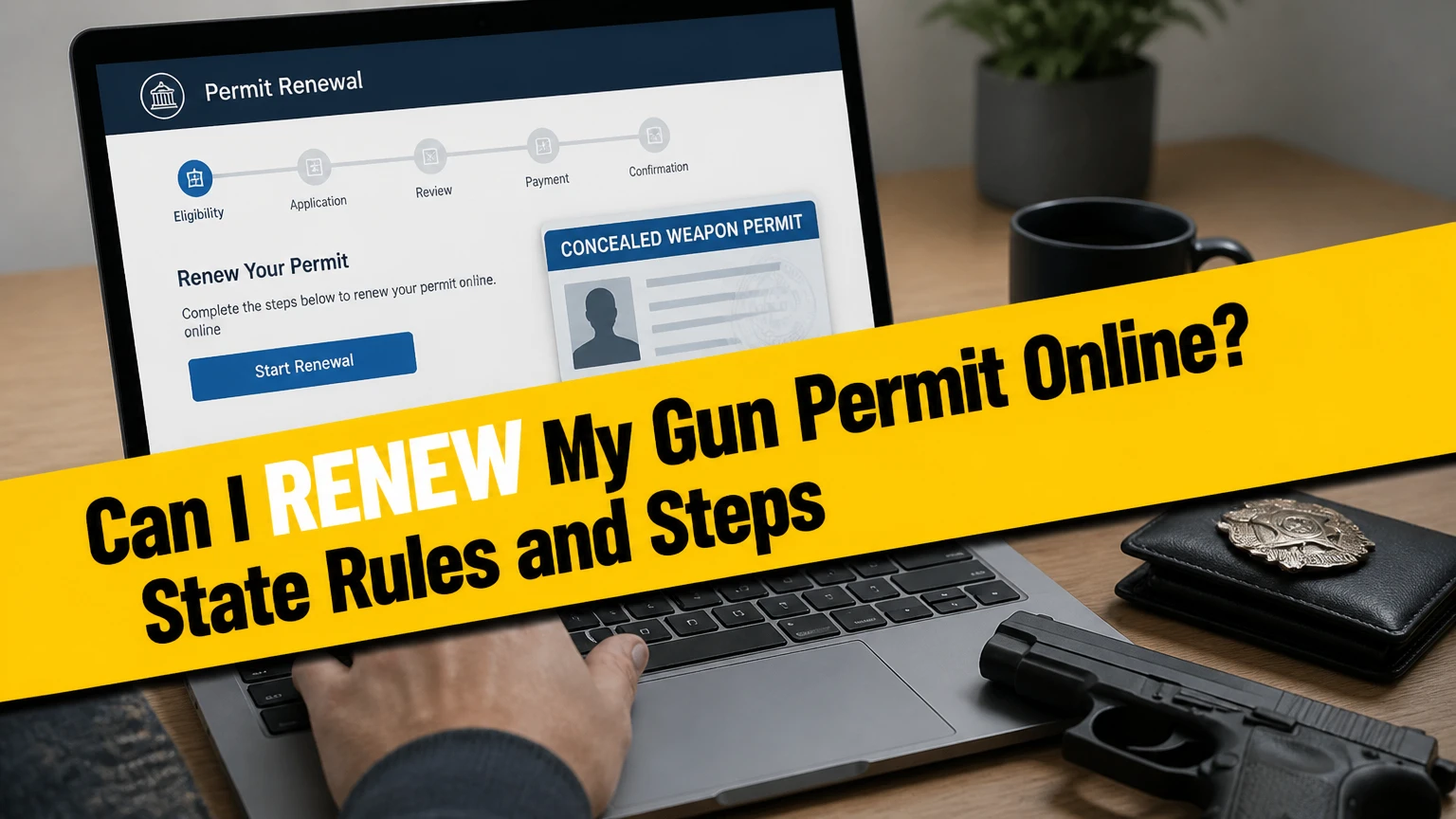
You may be able to renew your gun permit online, but the answer depends on the issuing state, county, permit type, and expiration status. A concealed carry license, firearm-owner card, pistol permit, and purchase permit can follow different renewal rules, so verify the official issuing agency before submitting payment or carrying during processing.
Key Facts at a Glance
- Online renewal is available only when the issuing authority provides a renewal portal for that specific permit.
- A concealed carry license renewal is legally different from renewing a firearm purchase permit or ownership card.
- A pending online application usually does not extend the authority to carry concealed.
- Renewal fees, eligibility windows, fingerprints, photographs, and training requirements vary by jurisdiction.
- A recently expired permit may qualify for late renewal in one jurisdiction but require a new application in another.
- The official state police, department of public safety, sheriff, or licensing agency is the controlling source.
Can I Renew My Gun Permit Online?
You can renew a gun permit online when the issuing jurisdiction has enabled digital renewal and your permit remains eligible for that process. Texas, Florida, Michigan, Indiana, and some county-administered systems provide online options for certain license types, while other jurisdictions require mail or an in-person appointment.
“Gun permit” is not one uniform legal category in the United States. The relevant document might be a concealed handgun license, concealed weapon license, License to Carry, pistol permit, firearm identification card, or permit to purchase. The issuing authority may also differ: Texas uses the Department of Public Safety for its License to Carry program, Florida uses the Department of Agriculture and Consumer Services, and many North Carolina counties use the sheriff’s office.
Do not use a commercial directory as the final authority. Start with the agency printed on your current card, then confirm the renewal page, eligibility dates, required documents, fee, and expiration consequences.
What Kind of Permit Are You Renewing?
The permit category determines whether online renewal is available, what background checks apply, and whether the document authorizes carrying a firearm. A concealed carry license generally concerns carrying authority, while a firearm identification or purchase permit may concern possession or acquisition under state law.
| Permit category | Typical issuing authority | Common renewal question |
|---|---|---|
| Concealed handgun license | State public-safety agency or state police | Does the existing license remain eligible for digital renewal? |
| Concealed weapon license | State licensing department | Are address, fingerprints, and background checks current? |
| Pistol or firearm permit | Local police or sheriff’s office | Does the local agency accept online renewals? |
| Firearm identification card | State police or local law enforcement | Is a new photograph, fingerprint, or suitability review required? |
| Permit to purchase | Local law enforcement or state agency | Is the document renewable, or must the applicant request a new permit? |
A purchase permit is especially easy to confuse with a carry license. Renewing one does not automatically renew the other, and an online carry-license portal may not accept a firearm-owner card number.
What information identifies the correct process?
Use the exact permit name, issuing agency, permit number, expiration date, and state or county printed on the card. A driver’s license number alone is not enough because several firearm-related documents can exist within the same state.
Which Permits Commonly Renew Online?
Statewide concealed carry systems are the most likely to support online renewal, but digital availability still depends on the license type and the record held by the agency. County-administered permits are less predictable because neighboring counties can use different vendors, appointment systems, or paper forms.
| Jurisdiction example | Permit or license | Renewal channel commonly identified by the agency | Important condition |
|---|---|---|---|
| Texas | License to Carry a Handgun | Texas Department of Public Safety online service | Confirm the renewal record and current personal information |
| Florida | Concealed Weapon or Firearm License | Florida Department of Agriculture and Consumer Services portal or renewal process | Follow the agency’s current eligibility and identification rules |
| Michigan | Concealed Pistol License | Michigan State Police CPL online renewal system | Online access depends on the existing CPL record and notice details |
| Indiana | License to Carry a Handgun | Indiana State Police online licensing system | Check whether the license type and record qualify for online service |
| North Carolina | Concealed handgun permit | County sheriff’s office | Availability and appointment requirements vary by county |
| California | Local concealed weapons license | County sheriff or police department | Renewal method, training, and timing vary substantially by issuing agency |
The examples above show system patterns, not a guarantee for every applicant. Florida’s official renewal information is published by the Florida Department of Agriculture and Consumer Services. Michigan provides a dedicated Michigan State Police CPL renewal system. Texas directs applicants to the Texas Department of Public Safety Handgun Licensing Service.
New York illustrates a different model. New York pistol permit recertification is a separate state process from ordinary concealed-carry renewal, and the New York State Police provides the relevant recertification information. The document name matters.
What Should I Prepare Before Starting?
Prepare the current permit, government identification, renewal notice, payment method, address history, and any training or identity documents listed by the issuing agency. Set aside about 20-40 minutes for the application, although agency processing can take several weeks.
Before-you-start checklist
| Item | Typical requirement | What to verify |
|---|---|---|
| Current permit | Permit number and expiration date | Whether the card is active, expired, suspended, or lost |
| Government ID | Driver license or state identification | Whether the name and address match the agency record |
| Renewal notice | PIN, application number, or barcode | Whether the notice came from the official agency |
| Payment | Debit or credit card, sometimes money order | Total fee, convenience charge, and refund policy |
| Photograph | Digital or physical image in some jurisdictions | File dimensions, background, age, and format |
| Training record | Certificate or course information when required | Whether a prior certificate remains valid for renewal |
| Fingerprints | Existing record or new submission | Whether the agency requires fresh biometrics |
A renewal notice is useful but not always required. Some portals authenticate with a permit number, date of birth, driver-license number, or account login. Never send a Social Security number, payment details, or identity documents through a link received in an unsolicited message.
How Do You Renew a Gun Permit Online?
The general process has seven stages: open the official portal, identify the existing record, confirm eligibility, update information, answer statutory questions, upload required documents, and pay the fee. The exact screen sequence differs, but the legal checkpoint is the same: submit only when the agency confirms that the application is a renewal rather than a new application.
Step 1: Open the official issuing-agency portal
Find the agency through a verified government website, such as a state police, department of public safety, sheriff, or licensing department domain. Type the agency’s address directly when possible instead of relying on a paid advertisement or social-media link.
Success checkpoint: The page names your exact permit or license type and identifies renewal, not initial application.
Common mistake: Starting with a generic “gun permit renewal” website that adds a service charge without submitting the application.
Step 2: Match the existing permit record
Enter the permit number, renewal PIN, application number, date of birth, or driver-license details requested by the portal. Use the information exactly as the agency recorded it, including legal name formatting.
Success checkpoint: The portal displays the correct permit type, issue date, and expiration date.
Common mistake: Selecting a new application because the renewal record is difficult to locate. Contact the agency before paying for the wrong filing.
Step 3: Confirm eligibility and expiration status
Read the portal’s eligibility statement before proceeding. Some systems allow renewal before expiration, some permit late renewal, and some require a new application after a defined deadline.
Success checkpoint: The portal states that your record qualifies for renewal and identifies any late-renewal condition.
Common mistake: Assuming that a grace period preserves concealed-carry authority. A grace period may permit late filing without preserving every privilege attached to an unexpired license.
Step 4: Update name, address, and contact information
Enter the current residential address and legal name, then follow separate instructions for address changes, name changes, or moves between counties. A driver-license update may be required before the firearm licensing database can verify the new information.
Success checkpoint: The application preview shows your current identity details without spelling errors.
Common mistake: Using a mailing address where the law requires a residential address, or assuming a DMV update automatically changes the firearm permit record.
Step 5: Answer the statutory questions accurately
Renewal forms commonly ask about disqualifying convictions, pending charges, protective orders, mental-health adjudications or commitments, substance-related restrictions, and other statutory eligibility factors. The wording and legal significance vary by jurisdiction.
Success checkpoint: Every answer is complete, truthful, and supported by records when the agency requests clarification.
Common mistake: Treating a renewal as a routine payment because a changed legal circumstance can affect eligibility. If a question is unclear, obtain legal advice or ask the licensing agency for procedural clarification.
Step 6: Upload documents or schedule verification
Upload only the file types, sizes, photographs, certificates, and identification documents specified by the portal. Some agencies reuse existing fingerprints and photographs; others require new prints, photographs, training, or an appointment.
Success checkpoint: Each upload displays as accepted, not merely selected from your device.
Common mistake: Submitting a blurry certificate, cropped identification card, unsupported file type, or photograph that fails the agency’s specifications.
Step 7: Pay, save the receipt, and track the application
Pay the published renewal fee and save the confirmation number, receipt, submitted form, and agency contact information. A payment receipt proves submission, not approval and not necessarily continuing carry authority.
Success checkpoint: The portal provides a confirmation page or email with a tracking or transaction number.
Common mistake: Closing the browser after payment without recording the confirmation number.
How Much Does Renewal Cost?
A typical renewal fee is approximately $25-$115, but the exact amount depends on the jurisdiction, permit type, late status, payment method, and required services. Fingerprints, photographs, training, replacement cards, expedited handling, and online convenience fees can increase the total.
| Cost component | Typical amount or treatment | When it applies |
|---|---|---|
| Base renewal fee | $25-$115 | Most ordinary renewals, subject to local law |
| Online convenience fee | $2-$5 typical | Portal payments handled by a third-party processor |
| Late-renewal charge | $15-$35 typical | Only where the jurisdiction permits late renewal |
| Fingerprint service | $20-$60 typical | When new biometric capture is required |
| Training course | $50-$150 typical | When renewal education is mandated or the permit lapsed |
| Replacement card | $5-$25 typical | Lost, damaged, or corrected card |
Published fees change. Nebraska State Patrol, Florida FDACS, Michigan State Police, and local sheriff offices publish different schedules and payment instructions, so a fee from one state cannot be used to predict another state’s total.
How Long Does Online Renewal Take?
Portal submission often takes 20-40 minutes, while agency processing commonly takes 14-45 business days when the record is complete. A fingerprint appointment, manual review, unresolved address mismatch, background-check delay, or mailing period can extend the total beyond that typical range.
| Processing stage | Typical duration | Main cause of delay |
|---|---|---|
| Applicant completes portal | 20-40 minutes | Missing documents or account-access problems |
| Automated submission check | Immediate to 2 business days | Data mismatch or payment verification |
| Agency review and background check | 14-45 business days typical | Record volume and manual review |
| Card production | 3-10 business days typical | Printing queue and agency workflow |
| Postal delivery | 3-10 business days typical | Address accuracy and mail service |
| In-person or paper route | 30-90 days typical | Appointment, manual entry, and mailing |
Do not plan travel or concealed carry around the optimistic end of a processing estimate. The operative date is the date the issuing authority confirms the renewed license is valid, not the date the applicant paid online.
Can I Carry While Renewal Is Pending?
Usually, no. Submitting an online renewal application generally does not extend an expired concealed-carry license, and the applicant must follow the jurisdiction’s specific rule about continued carry during an approved but unissued renewal.
Wisconsin’s official concealed-carry renewal system, for example, provides a state-specific renewal process, but applicants still must follow Wisconsin law concerning license status and eligibility. Other states may issue a receipt, temporary authorization, or statutory extension, while some provide no temporary authority at all.
| Status | Carry assumption | Required action |
|---|---|---|
| Permit unexpired | Existing authority may continue | Follow location, firearm, and conduct restrictions |
| Renewal submitted, permit unexpired | Existing card may remain valid until expiration | Confirm the printed expiration date |
| Permit expired, renewal pending | Do not assume carry authority | Check the statute or issuing agency before carrying |
| Late renewal approved | Authority depends on jurisdiction | Read the approval notice and effective date |
| New card issued | Carry under the new license terms | Check expiration and reciprocity separately |
A renewal receipt is not automatically a carry license. Keep the receipt for administrative records, but do not treat it as legal authorization unless the issuing authority expressly says so.
What Happens If the Permit Expired?
An expired permit may qualify for late renewal, reinstatement, or a completely new application, depending on the jurisdiction and length of the lapse. Once the permitted late-renewal period ends, the agency may require new training, fingerprints, photographs, background checks, and application fees.
| Expiration situation | Possible agency treatment | Likely consequence |
|---|---|---|
| Expires in the future | Standard renewal | Ordinary fee and existing-record verification |
| Expired recently | Late renewal | Late fee and restricted eligibility window |
| Expired beyond late period | New application | New applicant requirements may apply |
| Lost card but active record | Replacement or renewal | Identity verification and replacement fee |
| Record suspended or denied | Administrative review | Renewal payment does not remove the restriction |
The word “grace period” requires care. Some laws extend the filing deadline but do not make the expired card valid for carrying. Ask the issuing agency two separate questions: whether it will accept the renewal, and whether the applicant may lawfully carry during the lapse.
How Should a Recent Mover Renew?
A recent mover should update the address in the order required by the issuing jurisdiction, which may involve the DMV, state licensing agency, local sheriff, or all three. An address change can trigger a separate amendment process rather than a routine online renewal.
Use the current residential address, not the address on an old renewal notice. If the portal cannot match the new address, stop before payment and ask whether the agency requires a new driver license, proof of residence, a county transfer, or an in-person identity check.
A practical sequence is:
- Confirm the new address with the DMV if state rules require it.
- Check whether the permit agency requires an address amendment.
- Wait only when the agency instructs applicants to allow database synchronization.
- Begin renewal through the official portal.
- Save proof of the address update and renewal submission.
Do not assume a 48-72-hour synchronization period applies nationally. That timeframe is a possible agency instruction, not a universal legal rule.
Which Renewal Method Is Safer?
Online renewal is usually the fastest and easiest option when the record is active, the address is unchanged, fingerprints are already on file, and the portal confirms eligibility. In-person or mail renewal is safer when the permit is expired, the applicant moved, the name changed, the record cannot be found, or new fingerprints are required.
| Renewal method | Typical time to submit | Best use case | Main limitation |
|---|---|---|---|
| Online portal | 20-40 minutes | Clean, active record with matching identity data | Cannot resolve every record problem |
| In-person appointment | 30-120 minutes onsite | Biometrics, identity changes, or staff assistance | Limited hours and appointment availability |
| Mail application | 1-3 days to prepare | Jurisdictions without digital service | Postal delay and weaker status visibility |
| Sheriff or police counter | 30-120 minutes onsite | County-controlled permits | Rules differ between neighboring counties |
Online systems are not automatically better. A portal can accept payment while leaving an address, eligibility, or biometric issue unresolved. In-person staff may identify the problem earlier, but the appointment itself can add weeks.
What Are the Alternatives to Online Renewal?
The main alternatives are an in-person appointment, a mailed application, a local sheriff or police submission, or a new application when renewal eligibility has ended. The correct alternative is the one listed by the issuing agency for the same permit category.
Use mail when the agency expressly accepts a current form and payment method. Use an in-person appointment when the agency requires fresh fingerprints, a photograph, identity verification, or an explanation of a record mismatch. Use a new application only when the agency says the renewal window has closed or the permit type requires a new filing.
Do not pay a private “expediting” service until the government agency confirms that the service is recognized. A private company cannot create legal carry authority or shorten a mandatory background-check period.
How Do I Fix Common Portal Failures?
Most renewal failures come from an incorrect permit type, stale identity data, expired eligibility, unsupported documents, or a payment mismatch. The recovery action depends on the error, so repeated submissions can create duplicate fees or conflicting records.
| Portal problem | Likely cause | Recommended recovery |
|---|---|---|
| Invalid PIN or record not found | Wrong number, expired record, or database mismatch | Compare the notice and card, then call the issuing agency |
| Driver-license mismatch | Name, address, or date-of-birth difference | Correct the underlying record before resubmitting |
| Payment rejected | Billing ZIP, card restriction, or processor issue | Use an accepted payment method and retain the error code |
| Upload rejected | File size, format, resolution, or page issue | Follow the portal’s exact PDF, JPG, or PNG specifications |
| Renewal option unavailable | Ineligible permit status or closed renewal window | Ask whether late renewal or a new application applies |
| No confirmation received | Browser, email, or submission interruption | Check the account and contact the agency with transaction details |
Never create multiple accounts to bypass a missing record. The agency may need to merge records or manually release an application.
What Are the Most Common Renewal Mistakes?
The most consequential mistakes are confusing permit types, assuming submission extends carry authority, ignoring address changes, and waiting until the final days before expiration. Each mistake can produce a legal lapse even when the online form itself appears complete.
Mistake 1: Using the wrong government portal
State police, public-safety departments, agriculture departments, and local sheriffs can administer different firearm documents. Verify the agency printed on the card.
Mistake 2: Treating a late-renewal window as continuous validity
A filing deadline and a carry-authority period are separate legal questions. Obtain the effective-status rule in writing or from the agency’s official instructions.
Mistake 3: Failing to check reciprocity
A renewed home-state license does not guarantee recognition in another state. The U.S. Concealed Carry Association publishes state information, but travelers should confirm the destination state’s current official law because reciprocity agreements can change.
Mistake 4: Uploading a document that was never accepted
A file selected for upload is not necessarily attached to the application. Confirm that the portal marks each document accepted before submission.
Mistake 5: Assuming a background-check delay means denial
A delayed review can result from a name match, incomplete record, or agency workload. Contact the licensing bureau through its published channel rather than submitting a second application.
How Do You Verify the Rule for Your State?
Verify the rule by matching four facts: issuing jurisdiction, exact permit name, expiration date, and current address. Then use the agency’s official renewal page, application instructions, fee schedule, and contact number.
Official examples include:
- Texas Department of Public Safety, Handgun Licensing Service:
txapps.texas.gov/txapp/txdps/ltc/ - Florida Department of Agriculture and Consumer Services, Concealed Weapon or Firearm License renewal information:
fdacs.gov - Michigan State Police, CPL Online Renewal System:
cplrenewal.msp.state.mi.us - New York State Police, pistol permit recertification:
gunsafety.ny.gov - Wisconsin Department of Justice, concealed-carry renewal system:
concealedcarry.doj.wi.gov - Nebraska State Patrol, concealed handgun permit renewal information:
statepatrol.nebraska.gov
An official page should identify the agency, application type, fee, payment method, and contact route. A page that promises guaranteed approval or asks for unnecessary personal data is not a substitute for the government portal.
Frequently Asked Questions
Can I renew a gun permit online if I lost the card?
Possibly, if the issuing agency can verify an active record and offers replacement or renewal through its portal. A lost card does not automatically mean the permit expired, but the agency may require identity verification, a replacement fee, or an in-person appointment before issuing a new card.
Do I need fingerprints again for an online renewal?
Not always. Some jurisdictions reuse fingerprints already associated with an active permit, while others require new electronic or ink prints after a lapse, record change, or defined period. The renewal portal or agency instructions should state whether existing biometric data satisfies the current requirement.
Can I renew online if my name changed?
A name change may require a separate amendment, certified court order, marriage certificate, updated driver license, or in-person verification before renewal. Enter the legal name shown on the agency’s record only when instructed, and do not submit a mismatch without confirming the required sequence.
Will a renewal application affect my right to own firearms?
A routine renewal application generally concerns the specific license or permit being renewed, but statutory answers about convictions, orders, adjudications, or other disqualifying events can affect eligibility. Ownership, possession, purchase, and concealed carry are separate legal questions under many state systems.
Can I renew online from another state?
You may be able to submit a renewal while temporarily away from home, but residency, mailing address, identity verification, and biometric requirements still apply. An out-of-state location does not change the issuing state’s deadline or guarantee that a renewed license will be recognized where you are traveling.
What should I do if the agency denies renewal?
Read the denial notice for the stated reason, deadline, hearing procedure, and appeal address. Do not carry on the assumption that an appeal preserves the old license. If the reason involves criminal history, mental-health records, protective orders, or an identity error, consult a qualified attorney and follow the agency’s formal review process.
The Bottom Line
You can renew your gun permit online only when the issuing jurisdiction authorizes online renewal for your exact permit type and status. Confirm the official portal, expiration rule, fee, address requirements, documents, and carry authority while processing. If the record is expired, mismatched, relocated, or unavailable, contact the issuing agency before submitting a new payment.
The answer to “can i renew my gun permit online” is therefore jurisdiction-specific, not universal. The safest next step is to identify the agency printed on your card and verify its current renewal instructions directly.