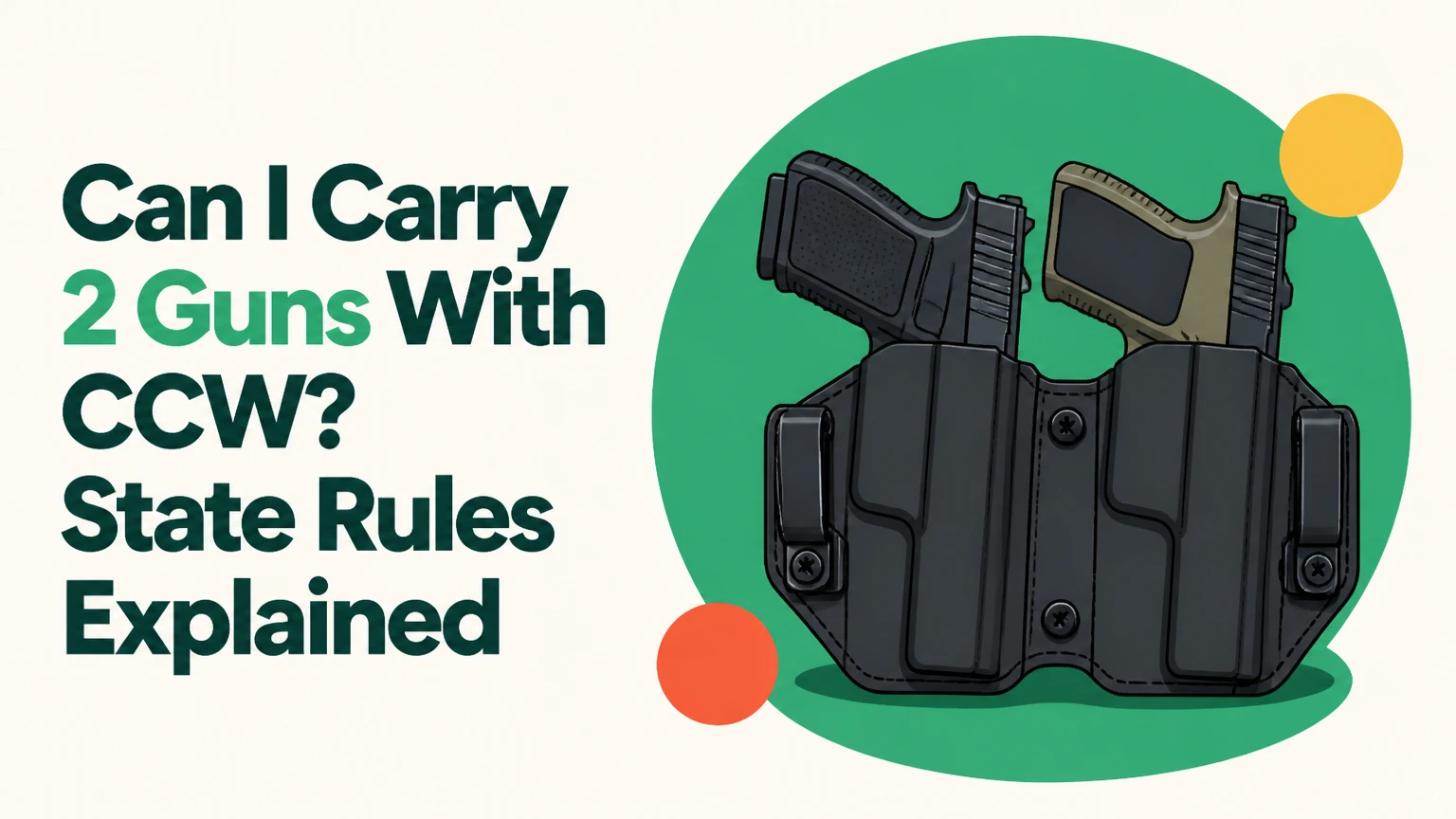
Yes, you can carry two concealed handguns with a CCW, CHL, LTC, or similar permit in many U.S. jurisdictions, but no nationwide rule guarantees that result. The controlling law may depend on the issuing state, the permit’s wording, whether each firearm must be listed, prohibited locations, vehicle rules, and the law of any state you visit.
Key Facts at a Glance
A concealed-carry permit usually authorizes a method of carrying, not automatically every firearm or every location.
Some states and issuing authorities require each carried handgun to appear on the permit or qualification record.
Texas and Florida generally do not impose a simple statewide two-handgun limit on ordinary licensed carry, but location and conduct restrictions still apply.
New Mexico has treated its concealed-handgun license as authorizing one concealed handgun at a time, so current New Mexico Department of Public Safety rules require verification.
California permits commonly identify approved firearms, and local issuing authorities can impose additional conditions or limits.
A second handgun creates separate safety, retention, training, storage, and legal-compliance problems that an extra magazine may avoid.
Can I Carry 2 Guns With CCW?
A CCW permit can allow two guns only when the applicable law and permit conditions allow two guns. The phrase “CCW permit” is not a national license: states use names such as Concealed Handgun License, License to Carry, and Concealed Pistol License, with different statutory requirements.
The decisive question is not whether the firearms are both legally owned. Ownership, possession, transportation, and concealed carry are separate legal issues. A permit holder must also comply with prohibited-place rules, firearm-specific conditions, ammunition restrictions, vehicle requirements, and instructions from the issuing authority.
A permit that lists one handgun may not authorize a second handgun, even if the same permit would authorize a different carry method. Conversely, a state may allow multiple handguns without listing each firearm, while still banning carry in courthouses, schools, government buildings, private premises that provide legally effective notice, or other restricted places.
What Does CCW Mean?
CCW commonly means “carrying a concealed weapon,” “concealed carry weapon,” or a concealed-carry permit. The legal document may instead be called a CHL, LTC, CPL, or permit to carry a concealed handgun.
Read the statute, administrative rules, permit card, training certificate, and issuing-agency guidance together. A gun shop, online map, or older reciprocity chart cannot replace current official law.
What Determines Whether Two Guns Are Legal?
State law, permit conditions, firearm listings, location rules, and travel status determine whether two-gun carry is lawful. The number of firearms is only one variable, and it is often less important than whether the specific carry method and location are permitted.
Permit Language and Firearm Listings
Some jurisdictions issue a permit tied broadly to the licensee. Others connect the license or qualification record to specific firearms. A listed-firearm system may record a handgun’s manufacturer, model, caliber, and serial number, although the exact fields and amendment process vary.
A license condition can be narrower than the statute. For example, an issuing authority may approve only firearms demonstrated during qualification, impose a number limit, or require an updated card before a newly acquired handgun can be carried.
Do not infer permission from the fact that a second handgun fits in a holster. Check whether the permit card says “approved firearms,” includes identifying data, or refers to an attached schedule.
Prohibited Places and Carry Methods
A permit usually does not override location restrictions. Two otherwise lawful handguns can create two violations if carried into a prohibited location, and a permit may not protect against federal restrictions.
Check these categories before carrying:
- State and local government buildings, courthouses, and law-enforcement facilities.
- Schools, colleges, childcare locations, and posted private property.
- Airports beyond screening checkpoints, secure facilities, and federal buildings.
- Places where alcohol, firearms, or weapons are regulated by special statutes.
- Vehicles, parking areas, and employer premises with separate rules.
Open carry, concealed carry, pocket carry, and storage in a vehicle can have different legal treatment. A permit authorizing concealed carry does not necessarily authorize open carry or possession in every vehicle compartment.
Which States Treat Multiple-Gun Carry Differently?
States differ most in permit wording and administration, not through a single nationwide “one gun versus two guns” rule. Texas, Florida, California, and New Mexico illustrate four different compliance questions, but these examples are not substitutes for checking current official rules.
| Jurisdiction | Key question | Practical compliance point | Official source to check |
|---|---|---|---|
| Texas | Does the license impose a firearm-number limit? | Review Texas License to Carry rules and restricted locations; ordinary licensed carry is not generally framed as a simple two-gun limit | Texas Department of Public Safety |
| Florida | Does the license identify a particular handgun? | Florida’s concealed weapon or firearm license is broader than a single listed pistol, but location and weapon-class rules still apply | Florida Department of Agriculture and Consumer Services |
| California | Must each firearm be approved or listed? | Many permits identify approved firearms, and the issuing county or city may impose conditions and limits | Local California issuing authority and California DOJ |
| New Mexico | How many concealed handguns does the license authorize? | Verify the current one-handgun rule, permit wording, and firearm qualification requirements before carrying a second gun | New Mexico Department of Public Safety |
| Other states | Is the permit licensee-based or firearm-specific? | Confirm statutory limits, agency rules, sensitive places, vehicle provisions, and reciprocity | State police, public safety, or attorney general |
What About Texas and Florida?
Texas and Florida generally allow a licensed person to carry more than one handgun unless another rule limits the conduct, location, or weapon. That conclusion does not eliminate restrictions involving schools, courts, secure facilities, private-property notice, intoxication, or restricted firearms.
Texas uses a License to Carry framework administered by the Texas Department of Public Safety. Florida uses a concealed weapon or concealed firearm license administered by the Florida Department of Agriculture and Consumer Services. Each state can change statutes, administrative guidance, and prohibited-place interpretations, so confirm the current text before relying on a general summary.
What About California?
California requires especially careful permit review because local issuing authorities commonly specify approved firearms and may impose conditions on the license. A California permit holder should verify every handgun’s make, model, caliber, and serial number against the current permit or official agency record before carrying it.
County practices can differ, and local numerical limits or amendment procedures may change. A California resident should ask the issuing sheriff or police department whether a second firearm must be qualified, listed, added by amendment, or carried only under a particular condition. Online claims that cite a fixed county limit without a current agency document are unreliable.
What About New Mexico?
New Mexico requires a current check of its concealed-handgun license rules before carrying two concealed handguns. New Mexico has been associated with a one-concealed-handgun limitation, which means a permit holder should not assume that a generally permissive state rule applies there.
The New Mexico Department of Public Safety is the controlling starting point. Confirm the number limit, whether a backup handgun is treated differently, qualification requirements, and whether the rule applies to both resident and recognized nonresident permits.
Does a CCW Permit List Every Firearm?
A CCW permit lists every firearm only when the issuing jurisdiction uses a firearm-specific permit or requires listed-firearm approval. A licensee-based permit may authorize multiple lawfully possessed handguns without recording each serial number, but the permit card and agency rules control.
| Permit model | Typical record | Can a second handgun be carried? | Main verification |
|---|---|---|---|
| Licensee-based | Permit holder’s identity and license class | Often possible, subject to state law and location rules | State statute and prohibited-place list |
| Firearm-specific | Make, model, caliber, and serial number | Only if the second firearm is listed or approved | Permit card and issuing agency |
| Qualification-based | Firearm or class used during training | Depends on agency rules and approved substitutions | Training certificate and agency policy |
| Conditional local permit | Listed firearms plus special conditions | Only within the written conditions | Issuing sheriff or police department |
A permit amendment may require a new qualification session, fingerprints, paperwork, fee, and replacement card. Processing time is agency-specific. Do not carry the second firearm while an amendment is pending unless the current permit and law clearly authorize it.
What Makes a Two-Firearm Setup Safe?
A safe two-firearm setup requires complete trigger protection, secure retention, consistent handling procedures, and training for each firearm. Concealment alone is insufficient because a loose pocket gun, shifting holster, or exposed trigger can create a negligent-discharge hazard.
Use a purpose-built holster that fully covers the trigger guard and keeps the firearm positioned consistently. A pocket-carried handgun needs a dedicated pocket holster that remains in the pocket during the draw; carrying a loose handgun with keys or other objects is unsafe.
A second firearm also changes daily movement. Sitting, bending, climbing stairs, entering a vehicle, and removing a jacket can expose a grip or dislodge a holster. Examine concealment in a mirror and during ordinary movements, then verify retention under professional supervision.
Should Both Firearms Operate the Same Way?
Matching the manual of arms usually reduces cognitive load, but identical firearms do not remove the need for separate practice. A striker-fired pistol and a double-action revolver can have different trigger characteristics, reload procedures, safeties, sights, and malfunction responses.
| Pairing approach | Example | Benefit | Limitation |
|---|---|---|---|
| Same platform | Glock 19 and Glock 26 | Similar controls and trigger behavior | Different grip size and sight radius still require practice |
| Same brand, different system | SIG P365 and SIG P365-variant | Familiar controls may reduce transition time | Model-specific safeties and magazines can differ |
| Semi-auto plus revolver | Compact pistol and J-frame revolver | Backup is not dependent on a slide cycling | Trigger stroke, capacity, and reload methods differ |
| Different manufacturers | Smith & Wesson pistol and Ruger revolver | May fit separate concealment needs | Controls, holsters, ammunition, and training diverge |
A practitioner rule is simple: if the carrier cannot identify the loaded chamber condition, safety status, trigger behavior, and unloading procedure of both firearms without hesitation, the setup is not ready for daily carry.
Is a Second Gun Better Than a Spare Magazine?
A second gun is not automatically better than a spare magazine. For many civilian carriers, one reliable handgun, a secure holster, and a spare magazine provide a simpler system with fewer handling and concealment problems.
A backup handgun can remain available if the primary firearm is inaccessible, damaged, or separated from the carrier. It also introduces another loaded trigger, another retention problem, another set of ammunition requirements, and another firearm that must be stored safely around children or unauthorized users.
| Option | Typical added weight | Typical equipment cost | Main advantage | Main drawback |
|---|---|---|---|---|
| Spare magazine | 2-6 oz loaded | $15-$60 | Supports a magazine-related stoppage or ammunition shortage | Does not address a disabled or inaccessible handgun |
| Second micro-compact | 14-22 oz loaded | $300-$700 for firearm | Provides a separate firearm | Adds holster, retention, and training demands |
| Second revolver | 16-24 oz loaded | $300-$900 for firearm | No semiautomatic slide to cycle | Different trigger and reload technique |
| Medical kit and phone | 4-16 oz | $20-$150 | Supports injury response and emergency communication | Does not provide a second weapon |
The best choice depends on the actual failure being addressed. A spare magazine addresses ammunition and magazine problems, while a second firearm addresses access and catastrophic equipment failure. Neither choice compensates for poor judgment, unsafe storage, or inadequate training.
Where Can a Second Firearm Be Carried?
A second firearm may be carried at the waistband, in a dedicated pocket holster, or in another purpose-built method, but legality and safety vary by location. An ankle or pocket position can create access and retention trade-offs that are different from a belt holster.
| Carry method | Useful circumstance | Typical weakness | Safety checkpoint |
|---|---|---|---|
| Waistband holster | Standing and ordinary daily movement | Added bulk and printing | Rigid holster, full trigger coverage, stable belt |
| Support-side waistband | Separate access position | Cross-hand handling can be unfamiliar | Professional instruction and unloaded practice |
| Dedicated pocket holster | Concealment with lightweight handgun | Slow access during movement | Holster stays in pocket and covers trigger |
| Ankle holster | Some seated situations | Exposure to dirt and slower access while standing | Retention strap and clean, covered trigger guard |
| Locked vehicle container | Transport where carry is restricted | Not immediate access and theft risk | Anchored, concealed, locked container |
The safest location is the one that preserves trigger protection, retention, lawful concealment, and consistent access without requiring unsafe handling. A vehicle should not become an improvised holster, and a firearm left inside a car may create theft, storage, and reporting consequences.
What Does Two-Gun Carry Cost?
Typical equipment costs range from approximately $100 to $300 before purchasing a second handgun, while a complete setup can exceed $500 when the firearm, holster, belt, training, and secure storage are included. Permit amendment fees and processing times vary by issuing authority.
| Cost item | Typical range | Recurring cost | What changes the price |
|---|---|---|---|
| Purpose-built holster | $40-$180 | Replacement after wear | Material, retention, and carry position |
| Reinforced carry belt | $60-$150 | Replacement after wear | Construction and buckle design |
| Second handgun | $250-$1,200+ | Maintenance and ammunition | New, used, optic-ready, or premium model |
| Training session | $75-$250 | Additional ammunition | Instructor, range, and course length |
| Lockbox or vehicle container | $25-$250 | Battery or hardware replacement | Size, anchoring, and security rating |
| Permit amendment | $0-$150 typical | Agency-specific | Qualification, card replacement, and local fees |
A claimed national processing time is not reliable. Some agencies process changes in days, while others require a scheduled qualification appointment and issue a replacement card later. Ask the issuing authority for the exact documents, fee, appointment requirement, and temporary-carry rule.
Can You Travel Across State Lines With Two Guns?
Traveling across state lines with two guns requires checking both the destination state’s carry-recognition rules and federal transportation protections. Recognition of a permit does not guarantee permission to carry multiple firearms, carry in every location, or use the same vehicle-storage method.
Before travel, verify:
- Whether the destination recognizes the specific permit, including resident or nonresident status.
- Whether the destination limits listed firearms, firearm types, magazine capacity, or number carried.
- Whether the route crosses additional states with different rules.
- Whether schools, government facilities, posted businesses, public transportation, or airports restrict possession.
- Whether firearms must be unloaded, locked, or inaccessible during vehicle transport.
The federal Firearm Owners Protection Act, 18 U.S.C. § 926A, addresses certain interstate transportation conditions, but it is not a universal concealed-carry authorization. It generally concerns lawful possession at the origin and destination and secure, unloaded transportation inaccessible from the passenger compartment. A traveler should obtain current state guidance before departure.
What Problems Do Two-Firearm Carriers Encounter?
The most common problems are legal overconfidence, shifting equipment, incompatible handling procedures, unsafe reholstering, and storage failures. These problems arise because the second firearm changes the entire carry system rather than merely adding another tool.
| Failure mode | Immediate consequence | Corrective action | Verification |
|---|---|---|---|
| Second gun is not listed | Possible permit violation | Stop carrying it and contact the issuing agency | Written agency confirmation or updated permit |
| Holster shifts or prints | Loss of concealment and retention | Replace the holster or belt; reassess clothing and position | Movement and retention check with unloaded firearms |
| Manual safety is forgotten | Unsafe or failed presentation | Use one system consistently or obtain qualified instruction | Instructor-observed handling drill |
| Trigger guard is exposed | Negligent-discharge risk | Remove the firearm from carry until a proper holster is obtained | Full trigger coverage confirmed visually |
| Gun is left in a vehicle | Theft and legal exposure | Use lawful, locked storage and take the firearm with you when required | Check state and employer storage rules |
| Reholstering is rushed | Clothing can enter trigger guard | Slow down, clear clothing, and visually inspect | Controlled unloaded practice |
One counterintuitive truth matters: a smaller backup gun can be harder to handle safely than a larger primary because its abbreviated grip, shorter sight radius, and heavier trigger often reduce control. Small dimensions improve concealment, not necessarily shootability.
Another practitioner rule is to test the complete clothing system. A setup that works with a loose T-shirt may fail with a tucked shirt, winter coat, seatbelt, or work uniform. Carryers should assess those conditions with unloaded firearms and an instructor rather than experimenting during an emergency.
When Is One Firearm the Better Choice?
One firearm is usually the better choice when the carrier is new, the second gun cannot be securely holstered, the permit status is unclear, or the additional weight causes inconsistent daily carry. A single system that is carried lawfully and safely is more useful than a complicated system left at home.
Choose one firearm plus a spare magazine when:
- The primary handgun has a secure, full-trigger-covering holster.
- The carrier has limited training time or frequently changes clothing.
- The second firearm uses a different manual of arms.
- A local permit lists only one approved firearm.
- The carrier needs to prioritize medical equipment, identification, communication, or mobility.
Consider a second firearm only after the legal conditions are documented and the carrier can safely manage both firearms, their ammunition, their storage, and their distinct maintenance schedules. A professional firearms instructor can evaluate the arrangement without assuming that more equipment improves defensive outcomes.
What Should You Verify Before Carrying Two Guns?
Verify the law in writing before carrying two guns, because a general online answer cannot establish permission for a specific permit holder in a specific location. The following sequence reduces avoidable errors:
- Read the permit card for firearm-specific language, conditions, and expiration date.
- Locate the current state statute and administrative rule governing the permit.
- Ask the issuing agency whether the second handgun must be listed, qualified, or amended.
- Check prohibited places, private-property notice, vehicle storage, and employer policies.
- Check every state on the travel route if crossing state lines.
- Confirm that each firearm has a dedicated holster with complete trigger coverage.
- Obtain instruction for the exact firearms and carry methods.
- Document serial numbers, purchase records, and secure-storage arrangements.
- Recheck the rules after legislative or agency changes.
The issuing authority’s written answer is more valuable than an informal statement from a retailer, social-media group, or reciprocity website. Keep the date and source of the verification because carry rules change.
Frequently Asked Questions
Can I carry two different types of handguns?
You may be able to carry two different handguns if your state law, permit conditions, and location rules allow it. The legal issue is separate from the training issue: a striker-fired pistol, double-action revolver, and manual-safety pistol require different handling procedures, trigger management, loading, unloading, and malfunction responses.
Does carrying two guns increase criminal penalties?
Carrying two guns does not automatically create a criminal offense in every state, but an unlisted firearm, prohibited location, unlawful magazine, or permit violation can create legal exposure. Penalties depend on the specific statute and facts. A local firearms attorney is the appropriate source after an alleged violation or arrest.
Can I carry two guns under constitutional carry?
Constitutional carry does not create identical rules across states. A state may remove the permit requirement for some eligible adults while retaining restrictions on locations, prohibited persons, firearm types, vehicle transport, and the number or manner of concealed firearms. Verify the current statute rather than assuming a permit rule applies.
Is a backup gun required for concealed carry?
A backup gun is not generally required for concealed carry. Most licensing systems focus on eligibility, training, lawful possession, and the permitted method of carry. The decision to carry one firearm or two is usually a personal risk and training decision, subject to state and local restrictions.
Can I carry two guns if only one appears on my California permit?
Do not carry the unlisted gun until the California issuing authority confirms that the permit allows it. Many California permits identify approved firearms, and local agencies can require qualification or an amendment. Check the current permit card and written county or city instructions before carrying any firearm not listed.
The Bottom Line
Whether you can carry 2 guns with CCW depends on the exact permit, state law, firearm-listing rules, location, and travel route. Many states permit multiple concealed handguns, while jurisdictions such as New Mexico or California may impose more specific limits or approval requirements. Confirm the rule with the issuing authority, use secure trigger-covering holsters, and choose one firearm instead when a second gun adds more legal or safety risk than practical value.