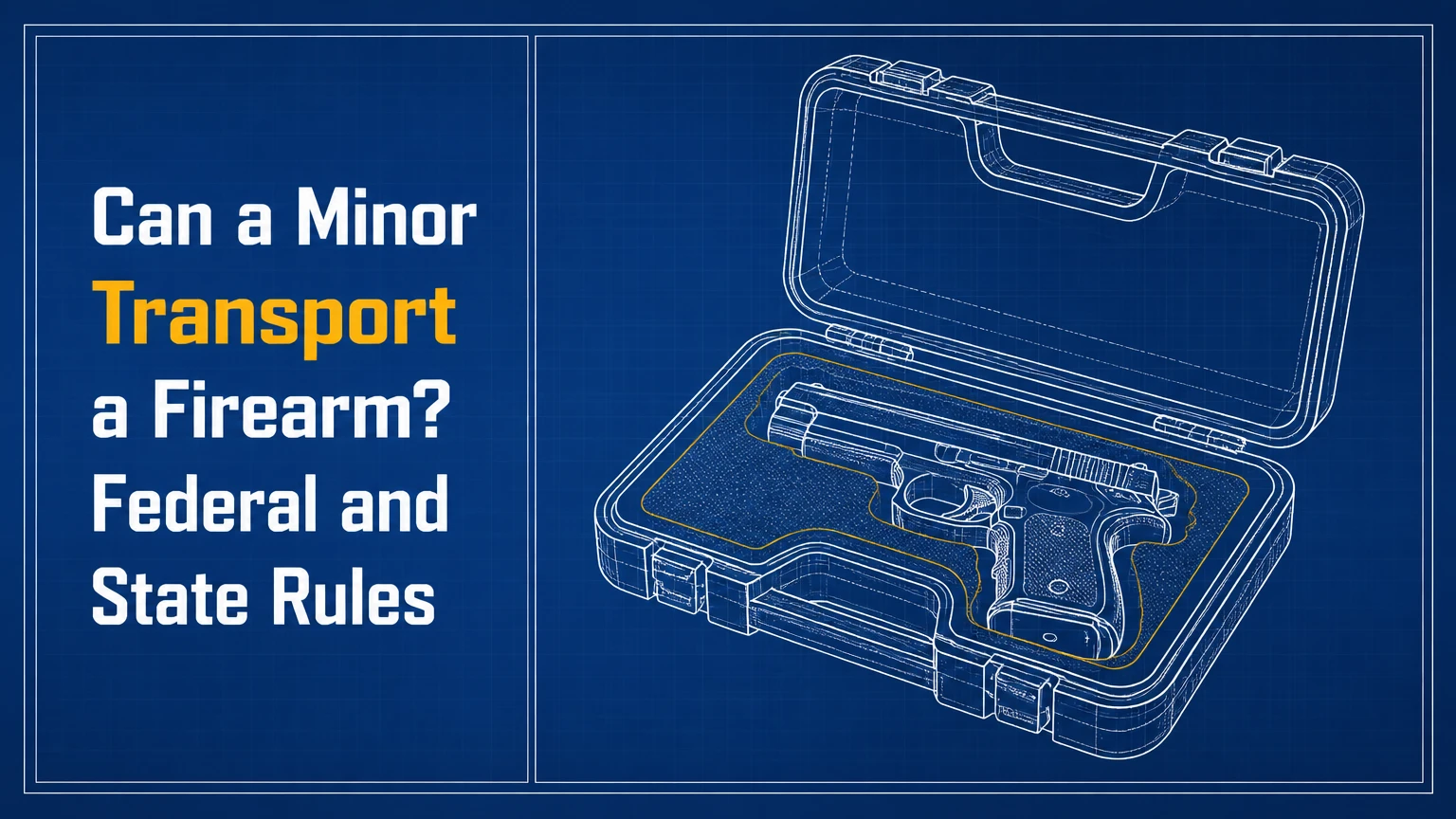
A minor may be able to transport a firearm, but legality depends on the firearm type, the minor’s age, the purpose of travel, supervision, and every applicable state and local law. Federal law sharply restricts handgun possession by people under 18, while long-gun transport is governed mainly by state law, location-specific rules, and safe-storage requirements.
Key Facts at a Glance
- Federal law generally prohibits a person under 18 from knowingly possessing a handgun, subject to limited exceptions in 18 U.S.C. § 922(x).
- Federal law does not create one universal minimum possession age for rifles and shotguns, but state juvenile, hunting, vehicle, and storage laws may prohibit a minor’s unsupervised transport.
- A parent’s written permission may help satisfy a federal handgun exception, but parental permission cannot override a state prohibition.
- The federal interstate-transport statute, 18 U.S.C. § 926A, requires the firearm to be legal at the origin and destination and transported unloaded and inaccessible.
- A locked case in a trunk is the most conservative vehicle method, but state law may require additional separation of ammunition or impose different rules.
- A minor can violate a possession law without holding the firearm if the minor knowingly has practical access or control over it.
What Does “Transport” Mean Under Firearm Law?
Firearm transport means moving a firearm from one location to another, such as traveling from a residence to a shooting range, hunting property, gunsmith, or competition. Transport normally concerns a firearm that is not immediately available for use, while carrying often describes possession on the person or within immediate reach.
The distinction matters, but labels do not decide legality. A handgun under a driver’s seat may be described as “transport,” yet its accessibility can make the situation look like carrying or unlawful possession. A rifle in a locked case in a separate trunk compartment presents a different factual pattern.
Federal law also uses the concept of possession. Actual possession means the minor physically holds or controls the firearm. Constructive possession can arise when a person knows the firearm is present and has the power and intent to control it, although the precise standard depends on the statute and jurisdiction.
Is a Minor the Same as a Person Under 18?
For the federal Youth Handgun Safety Act, the key threshold is generally under 18. State law may use different categories, including under 16, under 18, under 21, “juvenile,” or “minor in possession.”
A person aged 18 to 20 is no longer under 18 for the federal youth handgun possession prohibition, but that person may still face state restrictions, permit limitations, dealer-purchase restrictions, or rules governing concealed carry. Age must therefore be checked against the specific law, not treated as a single national category.
Can a Minor Transport a Firearm Under Federal Law?
A minor may transport a firearm under federal law only when the firearm, age, purpose, route, and exception all fit the applicable statute. The clearest federal restriction concerns handguns: 18 U.S.C. § 922(x) generally prohibits a juvenile under 18 from knowingly possessing a handgun or handgun ammunition, with narrow exceptions for activities such as ranching, farming, target practice, hunting, and firearms instruction.
The federal statute does not create a blanket prohibition on every rifle or shotgun carried by every minor. That does not make a long gun automatically lawful. Federal school-zone rules, prohibited-person rules, federal-property restrictions, and state law can still apply.
The statutory exceptions are narrower than a general statement such as “a parent said it was okay.” For example, the exception may depend on the firearm being used for a lawful purpose, the activity being supervised or controlled by an eligible adult, and the minor having prior written consent from a parent or guardian where the statute requires it.
Does Written Parental Permission Make Transport Legal?
Written parental permission may satisfy one federal condition for a qualifying handgun exception, but it is not a universal permit. A permission letter does not legalize a handgun in a state that bars juvenile possession, does not authorize possession in a school zone, and does not replace a hunting license or range rule.
A practical letter should identify the minor, parent or guardian, firearm description, lawful purpose, travel dates, route or destination, and emergency contact information. The parent should sign and date it. Keep the original with the minor and a copy with the supervising adult.
A permission note is evidence of consent, not proof that every legal element has been met. The most reliable approach is adult supervision whenever a handgun is involved.
How Do Handgun and Long-Gun Rules Compare?
Handguns create the highest federal risk for minors because 18 U.S.C. § 922(x) directly addresses juvenile possession. Rifles and shotguns avoid that particular federal age prohibition, but state law can still make unsupervised transport unlawful.
| Issue | Handgun | Rifle | Shotgun |
|---|---|---|---|
| Federal youth rule | Under-18 possession generally prohibited, subject to exceptions | No matching federal under-18 possession ban | No matching federal under-18 possession ban |
| Typical transport concern | Immediate access, concealed carry, juvenile possession | State vehicle-storage and hunting rules | State vehicle-storage and hunting rules |
| Conservative vehicle method | Unloaded, locked case, trunk or inaccessible rear area | Unloaded, locked case, trunk or inaccessible rear area | Unloaded, locked case, trunk or inaccessible rear area |
| Common lawful purpose | Target practice, hunting, instruction under statutory conditions | Hunting, competition, range travel | Hunting, competition, range travel |
| Parent’s note | May be relevant to a federal exception | Usually not a substitute for state compliance | Usually not a substitute for state compliance |
| Main additional check | State handgun possession and carry law | Hunting and juvenile possession law | Hunting and juvenile possession law |
A semiautomatic rifle is still a long gun for this federal age distinction, but its configuration may trigger separate state restrictions. A short-barreled rifle, machine gun, or other regulated firearm can create additional federal and state requirements unrelated to the minor’s age.
What Laws Must Be Checked Before a Minor Drives?
A minor’s transport plan must pass four legal checks: federal law, the law where the trip begins, the law where the firearm will be used or stored, and the law of every jurisdiction where the vehicle stops. A route that is lawful at home can become unlawful after crossing a state line or entering a restricted property.
| Legal layer | Question to verify | Typical authority |
|---|---|---|
| Federal age rule | Is the firearm a handgun, and is the person under 18? | 18 U.S.C. § 922(x) |
| Origin state | May this age group possess and transport this firearm? | State criminal and firearm statutes |
| Destination state | May the minor possess it at the range, hunt, or residence? | State firearm and wildlife agencies |
| Route and stops | Do temporary stops create local possession or storage issues? | State, municipal, and property rules |
| Restricted location | Is the vehicle entering a school, courthouse, federal building, or posted property? | 18 U.S.C. § 922(q), state and local law |
School zones deserve separate attention. Federal law generally restricts possession of a firearm in a school zone, subject to listed exceptions, and state law may be stricter. A student driving past a school is not automatically violating the federal statute, but taking a firearm onto school property, parking in a school-controlled lot, or relying on an exception without checking its conditions creates substantial risk.
Vehicle ownership also matters factually. A firearm owned by a parent can still be knowingly possessed by a minor if the minor controls the vehicle, has the only keys, or can access an unsecured firearm.
Does FOPA Protect a Minor Crossing State Lines?
The Firearm Owners’ Protection Act, 18 U.S.C. § 926A, can protect some interstate travelers who move between places where they may lawfully possess the firearm. FOPA generally requires the firearm to be unloaded and not readily accessible, and if the vehicle lacks a separate trunk, the firearm must be in a locked container other than the glove compartment or console.
FOPA is not a nationwide juvenile transport license. It does not authorize possession at the origin or destination, and it does not erase the federal under-18 handgun rule. A minor who cannot lawfully possess a handgun at the destination cannot use FOPA to manufacture that legality.
The statute also describes transportation between lawful locations. Extended sightseeing, an overnight hotel stay, or an unnecessary detour can create an argument that the trip is no longer protected transport. Courts have differed in how they apply FOPA to stops and state prosecutions, so a direct route with no unnecessary stops is the prudent practice.
What Storage Does FOPA Require?
The conservative FOPA arrangement is an unloaded firearm inside a locked hard-sided case, placed in a vehicle trunk, with ammunition separately contained and inaccessible. In a pickup truck or vehicle without a trunk, place the locked case behind the rearmost seat or in another area not readily reachable from the passenger compartment.
| Vehicle type | Firearm location | Ammunition location | Conservative practice |
|---|---|---|---|
| Sedan with trunk | Locked case in trunk | Separate container in trunk | Keep both inaccessible from passenger seats |
| SUV with open cargo area | Locked case behind rearmost seat | Separate container beside or behind case | Use a hard-sided case and cover it from view |
| Pickup truck | Locked case inside cab only if inaccessible, or secured cargo container | Separate locked container | Avoid an exposed truck-bed case |
| Motorcycle | Locked case in secured luggage | Separate secured container | Verify state law before attempting interstate travel |
A glove box and center console are poor universal choices because they remain readily accessible to occupants and may fail state-specific requirements. FOPA also does not prevent an officer from investigating a different offense or a separate violation.
How Should a Minor Transport a Firearm in a Vehicle?
The safest general procedure is to unload the firearm, verify the chamber and magazine well, lock it in a case, separate or securely contain ammunition, place the case outside passenger reach, and carry the documents required by the route and destination. State law controls whether these precautions are legally sufficient.
Before Leaving
Confirm the exact firearm classification, the minor’s age, the origin and destination, the purpose of travel, and whether an adult will accompany the minor. Check the current statutes and official guidance from the state police, attorney general, wildlife agency, and destination facility.
Use a checklist:
- Firearm unloaded, with chamber visually and physically checked.
- Magazine removed and ammunition removed from the firearm.
- Locked case sized to prevent the action from being manipulated.
- Ammunition in a separate container where state law requires it.
- Hunting license, competition documentation, or range reservation available.
- Parent or guardian consent document available when relevant.
- No school, courthouse, federal building, or posted private-property stop planned.
During the Trip
Keep the firearm cased and inaccessible for the entire journey. Do not open the case at a fuel station, hotel, restaurant, roadside location, or friend’s house unless the law and purpose clearly authorize possession there.
A firearm should not be placed under a seat, in a door pocket, in an unlocked backpack, or in a center console. A locked case can reduce access, but locking alone does not solve an illegal possession problem.
At the Destination
Transport directly to the authorized range, hunting location, residence, or gunsmith. Confirm that the destination accepts minors and that its range or event rules do not require an adult member, instructor, or guardian.
The destination’s rules can be stricter than state law. A competition organizer may require an adult transport the firearm even when state law permits a licensed young hunter to carry an unloaded rifle.
What Are the Costs and Time Requirements?
A basic compliant setup typically costs $30-$150, excluding the firearm, ammunition, licenses, and professional legal advice. A locked pistol case may cost $20-$60, while a larger hard-sided rifle case commonly costs $60-$180; prices vary by lock quality, size, and airline-rating features.
| Item or requirement | Typical amount | Typical time | Why it matters |
|---|---|---|---|
| Lockable handgun case | $20-$60 | 5-10 minutes to secure | Prevents casual access |
| Lockable rifle case | $60-$180 | 10-15 minutes to secure | Accommodates longer firearm dimensions |
| Cable or padlock | $8-$30 | 2-5 minutes | Adds case or vehicle security |
| Hunting license | $15-$100, state dependent | 15-45 minutes online | May be required for the lawful-purpose exception |
| Route and statute check | $0-$300 | 30-90 minutes | Official sources or attorney review |
| Range or competition documentation | $0-$100 | 5-30 minutes | Confirms destination eligibility |
Typical preparation takes 20-45 minutes when the case and documents are already available. Legal research can take longer because age, firearm type, county, city, school zones, and wildlife rules may appear in separate sources.
What Are the Most Common Legal Mistakes?
The most common error is treating “unloaded” as equivalent to “lawful.” An unloaded handgun can still be unlawfully possessed by a minor, and an unloaded rifle can still violate a state’s juvenile or vehicle-storage rule.
Mistake 1: Treating a Parent’s Permission as a Universal Exception
A signed note cannot override a statute. The note should supplement a qualifying lawful activity and supervision plan, not replace them.
Mistake 2: Leaving the Firearm Within Reach
Under-seat storage and an unlocked rear seat may expose the minor to both possession and vehicle-access allegations. Use the trunk or a locked container in an inaccessible cargo area.
Mistake 3: Assuming a Detached Loaded Magazine Is Always Safe
States define “loaded firearm” differently. Some focus on ammunition in the firearm, while others consider a loaded magazine or ammunition immediately available. Separate the ammunition from the firearm and follow the stricter interpretation when the statute is unclear.
Mistake 4: Relying on FOPA for a Hotel or Sightseeing Stop
FOPA is designed for travel between lawful endpoints, not a general right to possess a firearm during an extended visit. A direct trip with minimal necessary stops is easier to defend than a trip involving overnight stays.
Mistake 5: Ignoring Local and Property Rules
A state may allow transport while a city, school district, courthouse, transit system, or private property prohibits possession. “Legal in the state” does not mean “legal everywhere in the state.”
Mistake 6: Giving Inaccurate Information During a Traffic Stop
The minor should keep hands visible, follow commands, avoid touching the case, and answer truthfully. Disclosure duties vary by state, so the driver should not assume that immediate voluntary disclosure is required or prohibited everywhere.
The Transportation Security Administration states that “firearms must be unloaded and locked in a hard-sided container and transported as checked baggage only” for airline travel. That rule concerns air travel, not ordinary driving, and airline procedures add separate requirements.
Which Situations Change the Answer?
The purpose and supervision arrangement can change the legal analysis, but neither factor guarantees legality. The following situations require separate checks.
Youth Hunter
A minor hunting with a rifle or shotgun may qualify under state wildlife rules, but the minor may need a hunting license, hunter-education certificate, permission to hunt the land, and an adult supervisor. Some states impose age-specific firearm or ammunition restrictions even during hunting season.
Youth Competition Shooter
A range or competition may permit junior participants while requiring an adult coach or parent to transport the firearm. Handgun events require particular caution because federal and state juvenile-possession rules can apply even when the event is sanctioned.
Minor Driving a Parent’s Vehicle
The parent’s ownership of the vehicle does not automatically transfer lawful possession to the minor. An unsecured firearm in a vehicle accessible to the driver can create a possession issue, especially if the minor knows about it and controls the vehicle.
Interstate Family Trip
A family traveling together may reduce practical uncertainty because an adult can retain possession and control, but the adult’s presence does not cure a destination-state prohibition. Keep the firearm secured, transport it directly, and verify both endpoints.
Minor Traveling by Air
Air transport follows TSA and airline rules rather than ordinary vehicle rules. A firearm must be unloaded, declared to the airline, locked in a hard-sided container, and transported in checked baggage; minors may also face airline policies requiring an adult passenger.
What Should You Do When the Law Is Unclear?
Do not transport the firearm until the unresolved question is answered by an authoritative source. Start with the current text of the relevant state statute, then verify official state-police, attorney-general, wildlife-agency, and destination-range guidance.
Use this decision sequence:
- Identify the firearm precisely, including handgun, rifle, shotgun, short-barreled firearm, or other regulated configuration.
- Identify the minor’s exact age on the travel date.
- List every state, municipality, school property, federal property, and private facility involved.
- Determine whether the minor will possess the firearm or whether an adult will retain control.
- Confirm the lawful purpose, supervision, license, and written-consent requirements.
- Apply the strictest storage rule among the jurisdictions involved.
- Ask a licensed attorney for advice when the firearm is a handgun, the route crosses restrictive states, or the minor may face criminal exposure.
An online summary, forum response, or generic gun-store recommendation cannot resolve a state-specific criminal-law question. The exact statutory wording and current enforcement guidance matter more than a broad statement that a firearm is “unloaded” or “locked.”
Frequently Asked Questions
Can a 16-Year-Old Transport a Rifle to a Shooting Range?
A 16-year-old may be able to transport an unloaded rifle to a range, but the answer depends on state law, vehicle-storage rules, range policies, and whether the minor has lawful possession. The conservative arrangement is adult supervision, a locked case, inaccessible placement, separate ammunition, and direct travel to the authorized range.
Can an 18-Year-Old Transport a Handgun?
Federal law’s under-18 handgun possession restriction generally no longer applies at age 18, but state law may impose higher age limits, permit requirements, or restrictions on possession and carry. An 18-year-old also may not purchase a handgun from a federally licensed dealer, even though possession may be lawful under other circumstances.
Can a Minor Transport Ammunition Without a Firearm?
A minor may be allowed to transport ammunition, but state law, local rules, hunting regulations, and the ammunition type can change the answer. Keep ammunition in its original packaging or a closed container, separate it from the firearm, and check whether the jurisdiction treats a loaded magazine as ammunition immediately accessible to the firearm.
Can a Minor Keep a Firearm in a Vehicle Overnight?
A minor should not leave a firearm in a vehicle overnight unless the law clearly permits it and the firearm is secured in a locked container that cannot be readily accessed or seen. Theft risk, hotel rules, municipal restrictions, and state safe-storage statutes can create separate violations even when transport began lawfully.
Does a Locked Gun Case Prove Legal Possession?
A locked gun case proves only that a storage precaution was used. A locked case does not establish that the minor may possess the firearm, that a federal exception applies, or that the destination and route are lawful. Age, firearm type, purpose, supervision, and jurisdiction remain separate requirements.
Should a Minor Transport a Firearm Alone?
A minor should avoid transporting a handgun alone because federal and state possession rules create substantial legal uncertainty. A minor transporting a long gun alone may still violate state law, so adult transport is the lower-risk option whenever supervision is available, particularly for interstate travel or travel through restrictive jurisdictions.
The Bottom Line
Can a minor transport a firearm? Sometimes, but no single federal rule answers every situation. A minor under 18 faces a specific federal handgun restriction under 18 U.S.C. § 922(x), while rifle and shotgun transport depends heavily on state law, lawful purpose, supervision, location, and storage.
For the lowest-risk arrangement, have an adult transport the firearm, keep it unloaded and locked in a case, place it outside passenger reach, separate the ammunition, travel directly, and verify the current laws at every relevant location. Do not rely on a parental note, FOPA, or an unloaded condition as a substitute for confirming that possession itself is lawful.